
 100% FREE ACCESS
10th Standard CBSE Syllabus & Materials
10th Standard CBSE
CBSE 10th Social Science ECO - Globalisation and the Indian Economy - New Model Questions Papers Study Material - QB365 Set A
NEW10th Standard CBSE
CBSE 10th Social Science ECO - Money and Credit - New Model Questions Papers Study Material - QB365 Set A
NEW10th Standard CBSE
CBSE 10th Social Science ECO - Sectors of the Indian Economy - New Model Questions Papers Study Material - QB365 Set A
NEW10th Standard CBSE
CBSE 10th Social Science ECO - Development - New Model Questions Papers Study Material - QB365 Set A
NEW10th Standard CBSE
CBSE 10th Social Science PS - Outcomes of Democracy - New Model Questions Papers Study Material - QB365 Set A
NEW10th Standard CBSE
CBSE 10th Social Science PS - Gender, Religion and Caste - New Model Questions Papers Study Material - QB365 Set A

Published on: 13/02/2020
10th standard CBSE Mathematics Board Exam Model Question Paper II 2019-2020
Download CBSE Class 10th Standard CBSE Maths question papers, sample papers, important questions, and previous year solved papers in PDF format. Get free study materials, NCERT solutions, and exam preparation resources for Class 10th Standard CBSE Maths
Questions + Answers key
Take MCQ Maths Test
1.
In figure ABCD is a trapezium of area 24.5 sq. cm. In it, AD II BC, \(\angle\)DAB = 90°,AD = 10 cm and BC = 4 cm. If ABE is a quadrant of a circle, find the area of the shaded region. [Take \(\pi\) = \(\\ \frac { 22 }{ 7 } \)]
2.
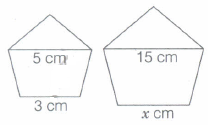
The given shapes are mathematically similar. Calculate the unknown side.
3.
Find a point on X-axis, which is equidistant from the point (7,6) and (-3,4).
4.
Write an AP having 4 as the first term and -3 as the common difference.
5.
Two dice are thrown simultaneously. Find the probability that the sum of the two numbers appearing on the top is less than or equal to 10.
6.
A man standing on the deck of a ship, which is 10 m above water level, observes the angle of elevation of the top of a hill as 60o and angle of depression of the base of the hill as 30o. Find the distance of the hill from the ship and height of the hill.
7.
In the figure, a circle is inscribed in a quadrilateral ABCD in which\(\angle 90^0\).If AD = 23 cm, AB = 29 cm and DS = 5 cm, find the radius(r) of the circle.
8.
If 4 cos \(\theta\) = 11 sin \(\theta\), find the value of \(\frac { 11\cos { \theta } -7\sin { \theta } }{ 11\cos { \theta } +7\sin { \theta } } \)
9.
In the figure, QR is a common tangent to given circle which meet at T. Tangent at T meets QR at P. If QP = 3.8 cm, then find length of QR.
10.
Find all the zeroes of f(x) = x2 - 2x
11.
The following table gives the number of pages written by Sarika for completing her own book for 30 days:
| Number of pages written per day | 16-18 | 19-21 | 22-24 | 25-27 | 28-30 |
|---|---|---|---|---|---|
| Number of days | 1 | 3 | 4 | 9 | 13 |
Find the number of pages written per day.
12.
Sheena went to a bank to withdraw Rs.1000 and asked the cashier to give her Rs.100 and Rs.50 notes only. She got 14 notes in all. Find how many notes of Rs.100 and Rs. 50 she received?
13.
In a flight of 600km, an aircraft was slowed down due to bad weather. Its average speed for the trip was reduced by 200 km/h and the time of flight increased by 30 min. Find the duration of the flight.
14.
Find the perpendicular distance of A(5, 12) from the Y-axis.
15.
A car wiper has two blades each of length 56 cm. How much area will they both sweep if each makes an angle of 135° while it moves. \([Use \ \ \pi = \frac{22}{7}]\)
16.
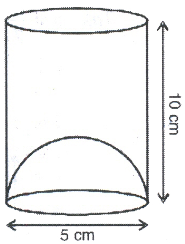
A milkman while supplying milk to their customer measures milk with a measuring cane which is cylindrical in shape with hemispherical raised bottom. The diameter of the measuring cylinder is 5 cm and height of the cylinder is 10 cm.
(i) Find the volume of measuring cane.
(ii) Which mathematical concept is used in given problem?
17.
Name the famous mathematician associated with finding the sum of the first 100 natural numbers.
18.
If the probability of winning a game is 0.3, what is the probability of losing it?
19.
Find the roots of the quadratic equation \(\sqrt{3}x^{2}-2x-\sqrt{3}=0\) .
20.
Find the perimeter of the triangle with vertices (0,4),(0,0) and (3,0).
21.
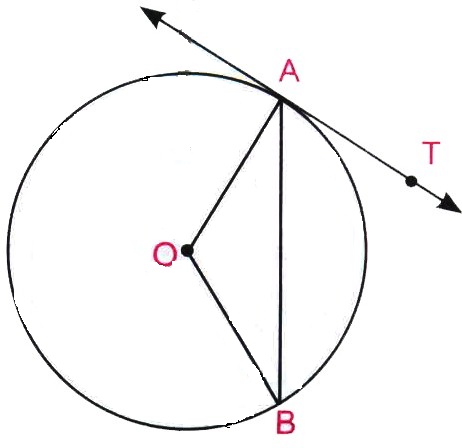
In given figure, O is the centre of the circle, AB is a chord and AT is the tangent at If \(\angle AOB=100^0\) then find \(\angle BAT\)
22.
The 19th term of an AP is equal to three times its sixth term. If its 9th term is 19, find the AP?
23.
To construct a triangle similar to a given triangle as per given scale factor which may be __________ than or may be __________ than 1.
24.
The point of intersection of the medians of a triangle is called the .................. of the triangle.
25.
The constant difference between the consecutive terms of an A.P. is called.......
26.
Mode and mean of a data are 12 k and 15 k respectively. Find the median of the data.
27.
If the polynomial 6x4+8x3-5x2+ax+b is exactly divisible by the polynomial 2x2-5, then find the values of a and b.
28.
Show that any positive odd integer is of the form 6q + 1 or 6q + 3 or 6q + 5, where q is some integer.
29.
A frustum of a cone height 7 cm. The radius of its two circular ends are 6 cm and 3 cm. Find the volume of frustum.
30.
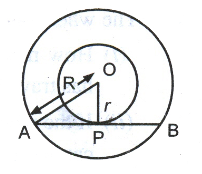
In the given figure, find the area of the region between two concentric circles, if the length of the chord of the outer circle touching the inner circle is 14 cm.
31.
A coin is tossed. If it results in a head a coin is tossed, otherwise a die is thrown. Describe the following events:
(i) A = getting atleast one head
(ii) B = getting an even number
(iii) C = getting a tail
(iv) D = getting a tail and an odd number
32.
A rational number can be expressed as a terminating decimal if its denominator has factors
2, 3 and 5
3 and 5
2 and 3
2 and 5
33.
A golf ball has diameter equal to 4.2 cm. Its surface has 200 dimples each of radius 2 mm. Assuming that the dimples are hemispherical, total surface area which is exposed to the surroundings is
85.82 cm2
100 cm2
90 cm2
80.58 cm2
34.
Consider a constellation of 3 stars A, B and C forming a right triangle with angle ABC = 90° and angle BAC = 30° . If the distance between star A and B is 3√3 x 10¹³ km, then how much time does light take to travel from star C to B with a speed of 3 x 10⁸ m/s?
√3 x 10⁵ sec
104 sec
√3 x 10⁴ sec
105 sec
35.
In the triangles PQR and NLM, angle M will be
70°
40°
60°
50°
1.
Area of trapeziums = 24.5 cm2
\(\frac { \lambda (a+b) }{ 2 } =24.5 \ wherea=AD, \ b \ = \ BC\)
\(\frac { \lambda (10+4) }{ 2 } =24.5\)
\(\lambda \times 7=24.5\)
\(\lambda =\frac { 24.5 }{ 7 } =3.5\quad cm\)
AB \(\bot \) AD |Given|
AB is the bigist of the trapeziums \(\lambda =AB=3.5\ cm\)
But AB s the radius of the quadrant
Area of the shaded region = Area of trapeziums Area of quadratus
\(\\ \Rightarrow \ 24.5-\frac { 1 }{ 2 } \times \frac { 11 }{ 7 } \times 0.5\times 3.5\)
\(\Rightarrow \ 24.5-\frac { 19.25 }{ 2 } \)
\(\Rightarrow \frac { 49-19.25 }{ 2 } \)
\(\Rightarrow \frac { 19.75 }{ 2 } { cm }^{ 2 }\)
2.
Given, both figures are similar.
So, the ratio of corresponding sides will be equal.
\(\therefore \frac { 3 }{ x } =\frac { 5 }{ 15 } =\frac { 3\times 15 }{ 5 } =9\quad cm\)
3.
Let A(x,0) be any point on the X-axis, which is equidistant from B(7,6) and C(-3, 4).
\(\therefore\) AB = AC
\(\Rightarrow\) AB2 = AC2 [on squiring both sides]
\(\Rightarrow\) (7-x)2 + (6-0)2 = (-3-x)2 + (4-0)2
\(\left[ \because \quad distance=\sqrt { { \left( { x }_{ 2 }-{ x }_{ 1 } \right) }^{ 2 }+{ ({ y }_{ 2 }-{ y }_{ 1 }) }^{ 2 } } \right] \)
\(\Rightarrow\) 49+x2 - 14x + 36 = 9+ x2 + 6x + 16
\(\Rightarrow\) 20x = 60
\(\Rightarrow\) x=3
Hence the required value is (3,0).
4.
Given, first term (a) = 4 and common difference (d) = -3
On putting the values of a and d in general form
a,a + d, a + 2d, a + 3d,..., we get
4, 4- 3, 4 + 2 (-3), 4 + 3(-3),...
4, 1 ,4- 6 ,4 -9,...
or 4 ,1 , -2, -5,...
which is the required AP.
5.
\(\frac { 11 }{ 2 } \)
6.
Let a man is standing on the deck of a ship at point A such that AB = 10 m and let CD be the hill.
Then, ∠EAD = 60° and ∠CAE = ∠BCA = 30° [alternate angles]
Let BC = x m = AE and DE = h m
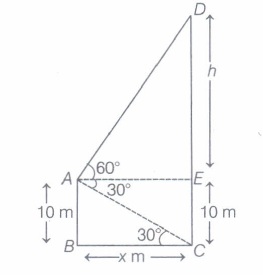
In right angled ΔAED,
\(\tan 60^{\circ}=\frac{P}{B}=\frac{D E}{E A}=\frac{h}{x}\)
In right angled ΔABC,
\(\tan 30^{\circ}=\frac{A B}{B C} \Rightarrow \frac{1}{\sqrt{3}}=\frac{10}{x}\left[\because \tan 30^{\circ}=\frac{1}{\sqrt{3}}\right]\)
distance of the hill from the ship is 10\(\sqrt3\) m and height of the hill is 40 m.
7.
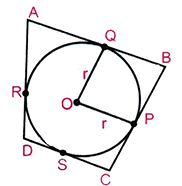
OQ 1 AB l [Radius is perpendicular to the tangent) OP 1 BC 1
ஃ OPBQ is a square.
⇒ BQ = BP = OP = r.
Now RD = DS ⇒ RD = 5 cm
ஃ AR = AD - RD = 23 - 5 = 18 cm
Also, AR = AQ ⇒ AQ = 18 cm
Now, AB = AQ + BQ ⇒ 29 = 18 + r ⇒ r = 11 cm.
8.
Given : 4 cos \(\theta\) = 11 sin \(\theta\)
\(\Rightarrow \quad \cos { \theta } =\frac { 11 }{ 4 } \sin { \theta } \)
Now \(\frac { 11\cos { \theta } -7\sin { \theta } }{ 11\cos { \theta } +7\sin { \theta } } =\frac { 11\times \frac { 11 }{ 4 } \sin { \theta } -7\sin { \theta } }{ 11\times \frac { 11 }{ 4 } \sin { \theta } +7\sin { \theta } } \)
\(=\frac { \sin { \theta } \left( \frac { 121 }{ 4 } -7 \right) }{ \sin { \theta } \left( \frac { 121 }{ 4 } +7 \right) } \)
\(=\frac { 121-28 }{ 121+28 } =\frac { 93 }{ 149 } \)
9.
QP = 3.8
QP = PT
(Length of tangents from external points are equal)
\(\Rightarrow\) PT = 3.8 cm
PR = PT = 3.8 cm
\(\Rightarrow\) QR = 7.6 cm
10.
f(x) = x2 - 2x
= x(x - 2)
i.e. f(x) = 0 \(\Rightarrow \) x = 0 or x = 2
Hence zeroes are 0 & 2.
11.
Table for given data is
| Number of pages written per day | Class marks (xi) | Number of days (fi) | fixi |
|---|---|---|---|
| 16-18 | 17 | 1 | 17 |
| 19-21 | 20 | 3 | 60 |
| 22-24 | 23 | 4 | 92 |
| 25-27 | 26 | 9 | 234 |
| 28-30 | 29 | 13 | 377 |
| Total | \(\sum { f_{ i }=30 } \) | \(\sum { f_{ i }x_{ i } } =780\) |
Here, \(\sum { f_{ i }=30 } \) and \(\sum { f_{ i }x_{ i } } =780\)
Mean \(\overline { x } =\frac { \sum { f_{ i }x_{ i } } }{ \sum { f_{ i } } } =\frac { 780 }{ 30 } =26\)
Hence, the mean number of pages written per day is 26.
12.
Let the number of Rs.100 and Rs.50 notes be x and y, respectively. Then, according to the question, x+y=14100x+50y=1000
Rs.100 notes=6, Rs.50 notes=8
13.
\(\frac { 600 }{ x } -\frac { 600 }{ x+1/2 } =200\Rightarrow \) 2x2 + x - 3 = 0
= 1 h
14.
It is clear from the figure, perpendicular distance of A from the Y-axis is 5 units.

15.
7392 cm2
16.
Radius of cylinder and hemisphere (r)=\(\frac{5}{2}\)cm
Height of cylinder (h)=10 cm
(i) Volume of the measuring cane=πr2h-\(\frac{2}{3}\)πr3
=\(\frac{22}{7}\times{\frac{5}{2}}\times{\frac{5}{2}}\times{10}-\frac{2}{3}\times{\frac{22}{7}}\times{\frac{5}{2}}\times{\frac{5}{2}}\times{\frac{5}{2}}\)
=196.43-32.74=163.69 cm3
(ii) Volumes of solid figures (mensuration)
17.
Gauss
18.
Probability of winning a game = 0.3
\(\therefore\) Probability of losing the game = 1 - Probability of winning the game = 1 - 0.3 = 0.7
19.
\(\sqrt{3},-{1\over\sqrt{3}}\)
20.
Let A(0,4), B(0,0) and C(3,0) are the vertices of △ABC
\(AB=\sqrt { ({ 0-0) }^{ 2 }+({ 0-4) }^{ 2 } } =4\)
\(BC=\sqrt { { (0-3) }^{ 2 }+({ 0-0) }^{ 2 } } =3\)
\(AC=\sqrt { { (3-0) }^{ 2 }+({ 0-4) }^{ 2 } } =5\)
Perimeter of △ABC = AB+BC+CA = 4+3+5 = 12 units.
21.
\(\angle \)AOB = 100°
\(\angle \)AOB + \(\angle \)OAB + \(\angle \)OBA = 180°
⇒ 100° + x + x = 180° [Let \(\angle \)OAB = x = \(\angle \)OBA]
angle opp. to equal side
⇒ 2x = 180° - 100°
⇒ 2x = 80° ⇒ x = 40°
\(\angle \)OAB + \(\angle \)BAT = 90°
⇒ \({ 40 }^{ \underset { \_ }{ O } }\) + BAT = 90°
⇒ \(\angle \)BAT = 50 °
22.
Let Ist term of the AP=a and common difference = d
A.T.Q., a19 = 3 x a6
\(\Rightarrow \) a+18d = 3(a+5d)
\(\Rightarrow a=\frac { 3 }{ 2 } d\) ........ (i)
Also, a9 = 19 \(\Rightarrow \) a+8d = 19
\(\Rightarrow \) \(\frac { 3 }{ 2 } d\) + 8d = 19 [using eq.(i)]
\(\Rightarrow \) 19d=38 \(\Rightarrow \) d=2
When d=2, equation (i) becomes
\(a=\frac { 3 }{ 2 } \times 2=3\)
AP is 3,5,7,9,.....
23.
()
Less, greater
24.
()
centroid
25.
()
common difference
26.
Median\(=\frac { Mode+2(Mean) }{ 3 } \)
\(=\frac { 12k+2\times 15k }{ 3 } \\ =\frac { 42k }{ 3 } =14k\)
27.
a=-20, b=25
28.
Consider a positive odd integer as a.
On dividing a by b, let q be the quotient and r be the remainder.
Then, a = bq + r,
[by Euclid's division lemma]
On putting b= 6 in Eq.(i) we get
a = 6q + r, \(0\le r<6\) .... (ii)
So, possible values of r = 0, 1, 2, 3, 4, 5
If r = 0, then from Eq.(ii), a = 6q
Here, 6q is divisible by 2, so 6q is even.
If r = 1, then from Eq.(ii), a = 6q + 1
Here, 6q + 1 is not divisible by 2, so 6q + 1 is odd.
If r = 2, then from Eq.(ii), a = 6q + 2
Here, 6q + 2 is divisible by 2, so 6q+ 2 is even.
If r = 3, then from Eq.(ii), a = 6q + 3
Here, 6q + 3 is not divisible by 2, so 6q+ 3 is odd.
If r = 4, then from Eq.(ii), a = 6q + 4
Here, 6q+ 4 is divisible by 2, so 6q + 4 is even.
If r = 5, then from Eq.(ii), a = 6q + 5
Here, 6q + 5 is not divisible by 2, so 6q + 5 is odd.
Since, a is odd, so a cannot be 6q, 6q + 2, 6q + 4
Hence, any positive odd integer is of the form 6q + 1, 6q + 3 and 6q + 5.
29.
Volume of frustum\(=\frac { 1 }{ 3 } \pi h(r^{ 2 }_{ 1 }+r^{ 2 }_{ 2 }+r_{ 1 }r_{ 2 })\)
462 cm3
30.
154 cm2
31.
Total outcomes
(H, H), (H, T), (T, 1), (T, 3), (T, 4), (T, 5), (T, 6)
A=(H, H), (H, T)
B=(T, 2), (T, 4), (T, 6)
C=(H, T), (T, 1), (T, 2), (T, 3), (T, 4), (T, 5), (T, 6)
D=(T, 1), (T, 3), (T, 5)
32.
(d)
2 and 5
33.
(d)
80.58 cm2
34.
(b)
104 sec
35.
(d)
50°

10th Standard CBSE Syllabus & Materials
10th Standard CBSE
CBSE 10th Social Science PS - Federalism - New Model Questions Papers Study Material - QB365 Set A
NEW10th Standard CBSE
CBSE 10th Social Science PS - Power Sharing - New Model Questions Papers Study Material - QB365 Set A
NEW10th Standard CBSE
CBSE 10th Social Science GEO - Manufacturing Industries - New Model Questions Papers Study Material - QB365 Set A
NEW10th Standard CBSE
CBSE 10th Social Science GEO - Minerals and Energy Resources - New Model Questions Papers Study Material - QB365 Set A



CBSE 10th Standard CBSE Subjects
CBSE Standards





