
 100% FREE ACCESS
10th Standard CBSE Syllabus & Materials
10th Standard CBSE
CBSE 10th Social Science ECO - Globalisation and the Indian Economy - New Model Questions Papers Study Material - QB365 Set A
NEW10th Standard CBSE
CBSE 10th Social Science ECO - Money and Credit - New Model Questions Papers Study Material - QB365 Set A
NEW10th Standard CBSE
CBSE 10th Social Science ECO - Sectors of the Indian Economy - New Model Questions Papers Study Material - QB365 Set A
NEW10th Standard CBSE
CBSE 10th Social Science ECO - Development - New Model Questions Papers Study Material - QB365 Set A
NEW10th Standard CBSE
CBSE 10th Social Science PS - Outcomes of Democracy - New Model Questions Papers Study Material - QB365 Set A
NEW10th Standard CBSE
CBSE 10th Social Science PS - Gender, Religion and Caste - New Model Questions Papers Study Material - QB365 Set A

Published on: 13/02/2020
10th standard CBSE Mathematics Board Exam Model Question Paper II 2020
Download CBSE Class 10th Standard CBSE Maths question papers, sample papers, important questions, and previous year solved papers in PDF format. Get free study materials, NCERT solutions, and exam preparation resources for Class 10th Standard CBSE Maths
Questions + Answers key
Take MCQ Maths Test
1.
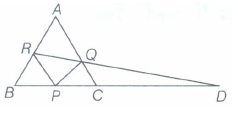
In the given figure, \(PQ\parallel BA\) and \(PR\parallel CA\) . If PD = 12 cm, then find BD x CD.
2.
An Aeroplane at an altitude of 200 m observes the angle of depression of opposite points on the two banks of a river to be \({ 45 }^{ \circ }\) and \({ 60 }^{ \circ }\) .Find width of the river.
3.
Find the coordinates of the point P which divides the line joining A(-3,3) and B(2,-7), internally in the ratio 2:3
4.
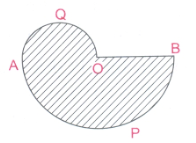
In fig., APB and AQO are semicircle, and AO = OB. If the perimeter of the figure is 40 cm, find the area of the shaded region. [ Use \(\pi\) = 22 / 7]
5.
If m times the mth term of an AP is equal to n times its nth term, find the (m + n)th term of the AP.
6.
A player sitting on the top ofa tower of height 20m observes the angle of depression of a ball lying on the ground as 60°. Find the distance between the foot of the tower and the ball.
7.
A metallic sphere of total volume \(\pi\) is melted and recast into the shape of a right circular cylinder of radius 0·5 cm. What is the height of cylinder?
8.
For what value of k; k + 2, 4k - 6, 3k - 2 are three consecutive terms of an A.P.
9.
If the zeroes of the polynomial x2+px+q are double in value to the zeroes of 2x2-5x-3, then find the values of p and q.
10.
If k - 1, k + 3 and 3k - 1 are in AP, then find the value of k.
11.
If in a lottery, there are 5 Prizes and 20 blanks, then find the probability of getting a prize.
12.
The wheel of a motorcycle is of radius 35cm.How many revolution per minute must the wheel make o as to keep a speed of 66 km/h?
13.
Construct a tangent to a circle of radius 3 cm from a point on the concentric circle of radius 5 cm and measure its length. Also, verify the measurement by actual calculation.
14.
The angles of depression of top and bottom of tower as seen from the top of a 100m high cliff are 300 and 600 respectively.Find the height of the tower.
15.
At one end P of a diameter PQ of a circle of radius 5 cm, tangent XPY is drawn. Find the length of the chord RS parallel to XY and at a distance of 8 cm from P.
16.
If A(-3,0), B(1,-3) and C(4,1) are the vertices of a triangle, then write the shape of the triangle.
17.
Find the sum of all 2-digit odd positive numbers
18.
One pipe can fill a tank in (x-2)hours and the other pipe can empty the full tank in (x+2)hours. If the tank is empty and both the pipes are opened together, the tank is filled completely in 24 hours. Find how much time will the second pipe take to empty the tank?
19.
The following distribution gives the state-wise teacher-student ratio in higher secondary schools of India. Find the mode and mean of this data. Interpret the two measures.
| Number of students per teacher | Number of states/UT |
|---|---|
| 15-20 | 3 |
| 20-25 | 8 |
| 25-30 | 9 |
| 30-35 | 10 |
| 35-40 | 3 |
| 40-45 | 0 |
| 45-50 | 0 |
| 50-55 | 2 |
20.
Prove that \(\frac { \sec ^{ 2 }{ \theta } -\sin ^{ 2 }{ \theta } }{ \tan ^{ 2 }{ \theta } } =1+\cot ^{ 2 }{ \theta } -\cos ^{ 2 }{ \theta } \)
21.
Draw the graphs of the equations x - y +1= 0 and 3x + 2y - 12 = 0. Determine the coordinates of the vertices of the triangle formed by these lines and the X-axis and shade the triangular region.
22.
If the polynomial x4+2x3+8x2+12x+18 is divided by another polynomial x2+5, the remainder comes out to be px+q, then find the values of p and q.
23.
Prove that, if a, b, c and d are positive rationals such that \(a+\sqrt { b } =c+\sqrt { d } \), then either a = c and b = d or b and d are squares of rationals.
24.
Find the area of the segment of a circle of radius 12 cm, whose corresponding sector has a central angle of 60o . [Take, \(\pi =3.14\)].
25.
There are 40 students in Class X of a school of whom 25 are girls and 15 are boys. The class teacher has to select one student as a class representative. She writes the name of each student on a separate card, the cards being identical. Then she puts cards in a bag and stirs them thoroughly. She then draws one card from the bag. What is the probability that the name written on the card is the name of (i) a girl? (ii) a boy?
26.
A bucket has top and bottom diameter of 40 cm and 20 cm respectively. Find the volume of the bucket if its depth is 12 cm. Also find the cost of tin sheet for making the bucket at the rate of Rs.1.20 per dm2.
27.
If the angle of elevation of a cloud from a point h metres above a lake is \(\alpha\) and the angle of depression of its reflection in the lake is \(\beta\). Prove that the distance of the cloud from the point of observation is \(\frac { 2hsec\alpha }{ tan\beta -tan\alpha } \).
28.
Find the coordinates of the points of trisection of the line segment joining (4,-1) and (-2,-3)
29.
A tangent is always ____________ to the radius at the point of contact.
30.
The sum of any two sides of a triangle is always _____________ than the third side.
31.
Three points A, B and C are collinear, if any one of the following takes place:
AC + ............ = AB
32.
A school has three sections of Class 10. They need to have enough books in the class library so that they can be distributed equally in the three sections . What is the minimum number of books required if the number of students in section A , B and C are 30, 32 and 36 respectively?
36
30
288
1440
33.
What is \(1-\sqrt { 3 } \)?
Non terminating repeating
Non terminating non repeating
Terminating
None of the above
34.
If sun’s elevation is 60° then a pole of height 6 m will cast a shadow of length
3√2 m
2√3 m
6√3 m
√3 m
35.
Given a triangle with side AB = 8 cm. To get a line segment AB’ = 3/4 of AB, it is required to divide the line segment AB in the ratio:
1 : 3
4 :3
3 :1
3 : 4
1.
144
2.
Let P be the position of the aeroplane. Then, PM=200m and let A and B be two points on the two banks of a river such that the angles of depression at A and B are \({ 60 }^{ \circ }\)and \({ 45 }^{ \circ }\) , respectively.
Let Am=x m and BM= y m.
Then, \(\angle XPB=\angle MBP={ 45 }^{ \circ }\) [altenatives angles]
and \(\angle XPB=\angle MBP={ 60 }^{ \circ }\) [altenatives angles]
In right angled \(\Delta AMP,\) \(\tan { { 60 }^{ \circ } } =\frac { PM }{ AM } \)
\(\Rightarrow \sqrt { 3 } =\frac { 200 }{ x } \Rightarrow 200=\sqrt { 3x } \)
\(\Rightarrow x=\frac { 200 }{ \sqrt { 3 } } m \)
In right angled \(\Delta BMP,\)
\(\tan { { 45 }^{ \circ } } =\frac { PM }{ BM } \Rightarrow 1=\frac { 200 }{ y }\)
\(\Rightarrow y=200m \)
Now, width of the river, AB=BM+MA
\(\Rightarrow AB=x+y=\frac { 200 }{ \sqrt { 3 } } +200\)
\( =200\left( \frac { 1 }{ \sqrt { 3 } } +1 \right)\)
\(=200(1.5773)=315.46m. [\because \sqrt { 3 } =1.732]\)
Hence, the width of the river is 315.46m.
3.
P(-1,-1)
4.
Let AO = OB = r
Then perimeter of semicircle APB
= \(2\pi r \over 2\) = \(\pi\)r
Perimeter of semicircle AQO
= \(\frac { 2\pi \frac { r }{ 2 } }{ 2 } =\frac { \pi r }{ 2 } \)
(∵ radius of semicircle AQO = \(r\over2\))
∴ Perimeter of shaded region
\(=\ \pi r+\frac { \pi r }{ 2 } +r=\frac { 2\pi r+\pi r+2r }{ 2 } \)
But perimeter of shaded region
ஃ \(\frac { 2\pi r+\pi r+2r }{ 2 } =40\)
⇒ r(2\(\pi\) + \(\pi\) + 2) = 80
⇒ r(3\(\pi\) + 2) = 80
⇒ \(r\left( 3\times \frac { 22 }{ 7 } +2 \right) =80\)
⇒ \(r\left( \frac { 66 }{ 7 } +2 \right) =80\)
⇒ \(r\left( \frac { 80 }{ 7 } \right) =80\)
ஃ \(r=\frac { 80\times 7 }{ 80 } =7cm\)
Now, Area of APB = \(\frac { \pi { r }^{ 2 } }{ 2 } =\frac { 22\times 7\times 7 }{ 7\times 2 } \)
= 77 cm2
Area of AQO = \(\frac { \pi { r }^{ 2 } }{ 2 } \)
\(=\frac { 22 }{ 7 } \times \frac { 7 }{ 2 } \times \frac { 7 }{ 2 } \times \frac { 1 }{ 2 } \)
= \(77\over4\) cm2
ஃ Area of shaded region
= 77 + \(\frac { 77 }{ 4 } =\frac { 308+77 }{ 4 } \)
= \(\frac { 385 }{ 4 } \) = 96.25 cm2
5.
Let Ist term = a, common difference = d.
\(\therefore\) am = a + ( m - 1 )d and an = a + ( n - 1 )d
A.T.Q.,
m.am = n.an \(\Rightarrow\) m { a + ( m - 1 )d} = n{ a + ( n - 1 )d }
\(\Rightarrow\) ma - na = n( n -1 )d - m ( m - 1)d - m( m - 1 )d \(\Rightarrow\) ( m - n ) a = ( n2 - n - m2 + m )d
\(\Rightarrow\) ( m - n ) a = ( n - m ) ( m + n - 1 )d \(\Rightarrow\) a = - ( m + n - 1 )d
Now am + n = a + ( m + n - 1)d = - ( m + n - 1 )d + ( m + n - 1 )d = 0
6.
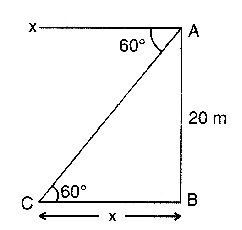
Let C be the point where the ball is
ㄥC = 60° (alternate angles)
In ΔABC, \(tan\ 60^0={AB\over BC}\)
⇒ \(\sqrt3={20\over x}\)
⇒ \(x={20\over \sqrt3}\)
\(=20\left(\sqrt3\over3 \right)\)
Hence, required distance is
1 = 11.53m
7.
Volume of cylinder = Volume of sphere,
\(\pi\)r2h =\(\pi\)
where r and h are radius of base and height of cylinder
(0.5)2h=1
\({ \left( \frac { 1 }{ 2 } \right) }^{ 2 }h=1\)
h=4 cm.
8.
Three consecutive terms k + 2, 4k - 6 and 3k - 2 are in A.P.
\(\therefore\) (4k-6)-(k+2) = (3k-2)-(4k-6)
\(\Rightarrow\) 4k - 6 - k - 2 = 3k - 2 - 4k + 6
\(\Rightarrow\) 3k - 8 = - k + 4
\(\Rightarrow\) 4k=4+8
\(\Rightarrow\) k = 12/4 =3
9.
p=-5, q=-6
10.
Given, k -1, k + 3 and 3k - 1 are in AP.
\(\therefore\) Second term - First term = Third term - Second term
\(\Rightarrow (k+3)-(k-1)=(3k-1)-(k+3)\)
\(\Rightarrow\) 4 = 2k - 4
\(\Rightarrow\) k = 4
11.
\(\frac { 1 }{ 5 } \)
12.
Here, speed of the motor cycle = 66km/h
\(={66000\over60}m/min\)
=1100 m/min
Radius of the wheel \((r)=35cm={35\over 100}m\)
circumference of the wheel=\(2\times{22\over 7}\times{35\over 100}m\)
=2.2m
Number of revolutions per minute=\({1100\over 2.2}\)
=500.
13.
4 cm
14.
66.67m
15.
8 cm
16.
Here, \(|AB|=\sqrt { \left( 1+3 \right) ^{ 2 }+\left( -3-0 \right) ^{ 2 } } \)
\(=\sqrt { { 4 }^{ 2 }+(-3)^{ 2 } } =\sqrt { 16+9 } \)
\(=\sqrt { 25 } =5\quad units\)
\(|BC|=\sqrt { \left( 4-1 \right) ^{ 2 }+\left( 1+3 \right) ^{ 2 } } =\sqrt { { 3 }^{ 2 }+{ 4 }^{ 2 } } \)
\(=\sqrt { 9+16 } =\sqrt { 25 } =5\quad units\)
\(|CA|=\sqrt { \left( -3-4 \right) ^{ 2 }+\left( 0-1 \right) ^{ 2 } } \)
\(=\sqrt { \left( -7 \right) ^{ 2 }+\left( -1 \right) ^{ 2 } } \)
\(=\sqrt { 49+1 } =\sqrt { 50 } =5\sqrt { 2 } units\)
Now, AB = BC and AB2 + BC2 CA2
Thus, ΔABC is an isosceles right triangle.
17.
Two-digit odd positive numbers are 11,
13, 15, ... 99.
These numbers are in AP.
Here a = 11 and d = 2
an = 99
\(\Rightarrow\) a + ( n - 1 )d = 99
\(\Rightarrow\) 11 + ( n - 1 ) x 2 = 99
\(\Rightarrow\) ( n - 1 ) x 2 = 88
\(\Rightarrow\) n - 1 = 44 \(\Rightarrow\) n = 45
Since, Sn = \(\frac{n}{2}(a+l)\)
\(\Rightarrow\) S45 = \(\frac{45}{2}(11+99)=2475\)
18.
Part of tank fillled by one pipe in 1 hour - PArt of tank emptied by IInd pipe in 1 hour = part of tank filled by both the pipes in 1 hour
\(\Rightarrow \frac { 1 }{ x-2 } -\frac { 1 }{ x+2 } =\frac { 1 }{ 24 } \)
\(\Rightarrow \frac { x+2-x+2 }{ (x-2)(x+2) } =\frac { 1 }{ 24 } \)
\(\Rightarrow x^{ 2 }-4=96\)
\(\Rightarrow x^{ 2 }=100\)
\(\Rightarrow \) x=10, -10 [Rejected x=-10]
\(\therefore \) Time taken by the pipe to empty the tank = 10+2=12 hours
19.
It can be observed from the given data that the maximum class frequency is 10 belonging to class interval 30 − 35.
Therefore, modal class = 30 − 35
Class size (h) = 5
Lower limit (l) of modal class = 30
Frequency (f1) of modal class = 10
Frequency (f0) of class preceding modal class = 9
Frequency (f2) of class succeeding modal class = 3
\(\text { Mode }=l+\left(\frac{f_{1}-f_{0}}{2 f_{1}-f_{0}-f_{2}} \times h\right) \)
\(=30+\left(\frac{10-9}{2}(10)-9-3\right) \times(5) \)
\(=30+\left(\frac{1}{20-12}\right) 5\)
= 30 + 5/8 = 30.625
Mode = 30.6
It represents that most of the states/U.T have a teacher-student ratio as 30.6.
To find the class marks, the following relation is used.
\(x = {-b \pm \sqrt{b^2-4ac} \over 2a}\)
Taking 32.5 as assumed mean (a), di, ui, and fiui are calculated as follows.
| Number of students per teacher |
Number of states/U.T (fi) |
xi | di = xi − 32. | ui=di/5 | fiui |
| 15 − 20 | 3 | 17.5 | − 15 | − 3 | − 9 |
| 20 − 25 | 8 | 22.5 | − 10 | − 2 | − 16 |
| 25 − 30 | 9 | 27.5 | − 5 | − 1 | − 9 |
| 30 − 35 | 10 | 32.5 | 0 | 0 | 0 |
| 35 − 40 | 3 | 37.5 | 5 | 1 | 3 |
| 40 − 45 | 0 | 42.5 | 10 | 2 | 0 |
| 45 − 50 | 0 | 47.5 | 15 | 3 | 0 |
| 50 − 55 | 2 | 52.5 | 20 | 4 | 8 |
| Total | 35 | -23 |
\(\text { Mean, } \bar{x}=a+\left(\frac{\sum f_{i} u_{i}}{\sum f_{i}}\right) \times h \)
\(=32.5+\left(\frac{-23}{35}\right) \times 5\)
= 32.5 - 23/7 = 32.5 - 3.28
= 29.22
Therefore, mean of the data is 29.2.
It represents that on an average, teacher−student ratio was 29.2
20.
LHS = \(\frac { \frac { 1 }{ \cos ^{ 2 }{ \theta } } -\sin ^{ 2 }{ \theta } }{ \frac { \sin ^{ 2 }{ \theta } }{ \cos ^{ 2 }{ \theta } } } =\frac { 1-\sin ^{ 2 }{ \theta } .\cos ^{ 2 }{ \theta } }{ \sin ^{ 2 }{ \theta } } ={ cosec }^{ 2 }\theta -\cos ^{ 2 }{ \theta } \)
\(=1+\cot ^{ 2 }{ \theta } -\cos ^{ 2 }{ \theta } \)
21.
Given, pair of linear equations is x - y + 1 = 0 and 3x + 2y -12 = O. Table for x r- y+l = 0 or y = x + 1 is
| x | 0 | 4 | -1 |
| y=x+1 | 1 | 5 | 0 |
| Points | A(0,1) | B(4,5) | C(-1,0) |
Table for 3x+2y-12=0 or \(y=\frac {12-3x}{2}\) is
| x | 0 | 2 | 4 |
| \(y=\frac {12-3x}{2}\) | 6 | 3 | 0 |
| Points | D(0,6) | E(2,3) | F(4,0) |
Now, plot the points A (0,1), B(4, 5), C (-1,0) and join them to get a line CB. Similarly, plot the points D(0, 6), E(2,3), F (4,0) and join them to get a line DF.
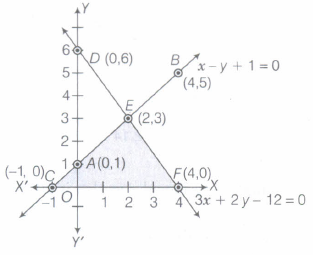
Clearly, the two lines intersect each other at the point E (2, 3). Hence, x = 2 and y = 3 is the solution of the given pair of equations. The line DE cuts X-axis at the point F (4, 0) and the line AB cuts X-axis at the point C (-1, 0).
Hence, the coordinates of the vertices of the triangle, so formed are E(2, 3), F( 4,0) and C (-1,0).
22.
p=2, q=3
23.
Given, \(a+\sqrt { b } =c+\sqrt { d } \)
If a = c, then \(\sqrt { b } =\sqrt { d } \)
\(\Rightarrow \) b = d [squaring both sides]
If \(a\neq c\), then there exists a positive rational number x such that a = c + x.
Now, \(a+\sqrt { b } =c+\sqrt { d } \)
\(\Rightarrow \quad c+x+\sqrt { b } =c+\sqrt { d } \quad \quad \left[ \because \quad a=c+x \right] \)
\(\Rightarrow \quad x+\sqrt { b } =\sqrt { d } \)
\(\Rightarrow \quad \left( x+\sqrt { b } \right) ^{ 2 }=\left( \sqrt { d } \right) ^{ 2 }\) [squaring both sides]
\(\Rightarrow \quad { x }^{ 2 }+b+2x\sqrt { b } =d\quad \Rightarrow { x }^{ 2 }+2x\sqrt { b } +b-d=0\)
\(\Rightarrow \quad 2x\sqrt { b } =d-b-{ x }^{ 2 }\Rightarrow \sqrt { b } =\frac { d-b-{ x }^{ 2 } }{ 2x } \)
Since, d, x and b are rational numbers and x > 0.
So, \(\frac { d-b-{ x }^{ 2 } }{ 2x } \) is a rational number.
\(\Rightarrow \) \(\sqrt { b } \) is a ratonal number.
\(\Rightarrow \) b is the square of a rational number.
from Eq.(i)
\(\sqrt { d } =x+\sqrt { b } \quad \Rightarrow \quad \sqrt { d } \) is a rational number.
\(\Rightarrow \) d is the square of a rational number.
Hence, either a = c and b = d or b and d are the squares of rationals.
24.
(75.36 - \(36\sqrt { 3 } \)) cm2
25.
There are 40 students, and only one name card has to be chosen.
(i) The number of all possible outcomes is 40
The number of outcomes favourable for a card with the name of a girl = 25
Therefore, P (card with name of a girl) = P(Girl) = \(\frac{25}{40}=\frac{5}{8}\)
(ii) The number of outcomes favourable for a card with the name of a boy = 15
Therefore, P(card with name of a boy) = P(Boy) \(=\frac{15}{40}=\frac{3}{8}\)
Note : We can also determine P(Boy), by taking
P(Boy) = 1 – P(not Boy) = 1 – P(Girl) \(=1-\frac{5}{8}=\frac{3}{8}\)
26.
R1 = \(\frac { 40 }{ 2 } \) cm , R2 = \(\frac { 20 }{ 2 } \)= 10 cm,height = 12cm
Volume = \(\frac { 1 }{ 3 } \) \(\pi h\) (R21 + R22 +R1R2)
\(\frac { 1 }{ 3 } \times 12\left( 20^{ 2 }+10^{ 2 }+20\times 10 \right) \)
= \(\frac { 1 }{ 3 } \times \frac { 22 }{ 7 } \times 12\times 700=8800cm^{ 3 }\)
Slant height t = \(\sqrt { h^{ 2 }+(R_{ 1 }-R_{ 2 })^{ 2 } } \)
\(\sqrt { (12)^{ 2 }+(20-10)^{ 2 } } =\sqrt { 244\quad } cm=15.62cm\)
Area of tin sheet used = \(\pi R^{ 2 }_{ 2 }+\pi l(R_{ 1 }+R_{ 2 })\)
= \(\pi \left[ R^{ 1 }_{ 2 }+l(R_{ 1 }+R_{ 2 }) \right] =\frac { 22 }{ 7 } \left( 10 \right) ^{ 2 }+15.62\times 30=1787.02cm^{ 3 }\)
Cost of 1 dm2 of sheet used = Rs 1.20
\(\Rightarrow \) cost 100 cm2 of sheet = Rs 1.20
\(\Rightarrow \) Cost of 1787.02 cm2 sheet = Rs \(\frac { 1.20 }{ 100 } \times 1787.02=\) Rs 21.44
27.
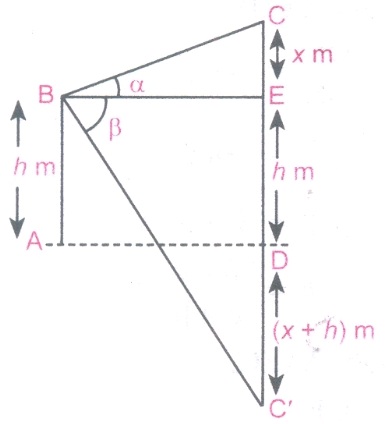
Let cloud is at C and its reflection is C'. B is a point h m , above lake such that ㄥCBE=α and ㄥEBC'=β
In right ∆BEC', \(\frac { EC }{ BE } \)=tanβ
In right ΔCEB. \(\frac { CE }{ BE } =tan\alpha ,\frac { BC }{ BE } =sec\alpha \)
Now \(\frac { 2h\quad sec\alpha }{ tan\beta -tan\alpha } =\frac { 2h\times \frac { BC }{ BE } }{ \frac { EC' }{ BE } -\frac { CE }{ BE } } \)
=\(\frac { 2h\times BC }{ EC'-CE } =\frac { 2h\times BC }{ (h+x+h)-x } =\frac { 2h\times BC }{ 2h } \)=BC
BC=distance of the cloud from the point of observation. Hence proved.
28.
Let points P and Q trisect the line joining the points.

∴ AP=PQ=QB
P divides AB in the ration 1:2 and Q divides AB in the ration 2:1
P (coordinate x) = \(\frac { 1\times \left( -2 \right) +2\times 4 }{ 1+2 } =\frac { 6 }{ 3 } \)=2; P (coordinate y) = \(\frac { 1\times \left( -3 \right) +2\times \left( -1 \right) }{ 1+2 } =-\frac { 5 }{ 3 } \)
The coordinates of P are \(\left( 2,\frac { 5 }{ 3 } \right) \)
Q(x-coordinate) = \(\frac { 2\times \left( -2 \right) +1\times \left( 4 \right) }{ 2+1 } =-\frac { -4+4 }{ 3 } =0\) Q(y-coordinates) = \(\frac { 2\times \left( -3 \right) +1\times \left( -1 \right) }{ 2+1 } =-\frac { -7 }{ 3 } \)
The coordinates of Q are \(\left( 0,-\frac { 7 }{ 3 } \right) \).
29.
()
perpendicular
30.
()
greater
31.
()
CB
32.
(d)
1440
33.
(b)
Non terminating non repeating
34.
(b)
2√3 m
35.
(c)
3 :1

10th Standard CBSE Syllabus & Materials
10th Standard CBSE
CBSE 10th Social Science PS - Federalism - New Model Questions Papers Study Material - QB365 Set A
NEW10th Standard CBSE
CBSE 10th Social Science PS - Power Sharing - New Model Questions Papers Study Material - QB365 Set A
NEW10th Standard CBSE
CBSE 10th Social Science GEO - Manufacturing Industries - New Model Questions Papers Study Material - QB365 Set A
NEW10th Standard CBSE
CBSE 10th Social Science GEO - Minerals and Energy Resources - New Model Questions Papers Study Material - QB365 Set A



CBSE 10th Standard CBSE Subjects
CBSE Standards





