
 100% FREE ACCESS
10th Standard CBSE Syllabus & Materials
10th Standard CBSE
CBSE 10th Social Science ECO - Globalisation and the Indian Economy - New Model Questions Papers Study Material - QB365 Set A
NEW10th Standard CBSE
CBSE 10th Social Science ECO - Money and Credit - New Model Questions Papers Study Material - QB365 Set A
NEW10th Standard CBSE
CBSE 10th Social Science ECO - Sectors of the Indian Economy - New Model Questions Papers Study Material - QB365 Set A
NEW10th Standard CBSE
CBSE 10th Social Science ECO - Development - New Model Questions Papers Study Material - QB365 Set A
NEW10th Standard CBSE
CBSE 10th Social Science PS - Outcomes of Democracy - New Model Questions Papers Study Material - QB365 Set A
NEW10th Standard CBSE
CBSE 10th Social Science PS - Gender, Religion and Caste - New Model Questions Papers Study Material - QB365 Set A

Published on: 13/02/2020
10th standard CBSE Mathematics Board Exam Model Question Paper III 2019-2020
Download CBSE Class 10th Standard CBSE Maths question papers, sample papers, important questions, and previous year solved papers in PDF format. Get free study materials, NCERT solutions, and exam preparation resources for Class 10th Standard CBSE Maths
Questions + Answers key
Take MCQ Maths Test
1.
If \(\sqrt { 3 } \sin { \theta } -\cos { \theta } =0\) and \({ 0 }^{ ° }<\theta <{ 90 }^{ ° }\), find the value of \(\theta\)
2.
In fig., PA and PB are tangents to the circle with centre O such that \(\angle APB={ 50 }^{ ° }\) Write the measure of \(\angle OAB\) .
3.
Find the next term of the series \(\sqrt { 2 } ,\sqrt { 8 } ,\sqrt { 18 } ,\sqrt { 32 } ....\)
4.
Find a quadratic polynomial, the sum and product of whose zeroes are 6 and 6 respexctively. Hence find the zeroes.
5.
A solid ball is exactly fitted inside the cubical box of side a. What is the volume of remaining space inside the cubical box?
6.
Find the discriminant of quadratic equation \(x^{ 2 }+4x-1\)
7.
If A is a point on Y-axis, whose ordinate is 3 and B is a point (- 5, 2), then find the distance AB.
8.
A school has five houses A, B, C, D and E.A class has 23 students, 4 from house A, 8 from house B, 5 from house C, 2 from house D and rest from houseE.A single student is selected at random to be the class monitor.Find the probability that the selected student is not from A, B, and C.
9.
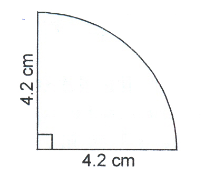
The figure shows the quadrant of a circle of radiius 4.2 cm. Find the perimeter of the quadrant.
10.
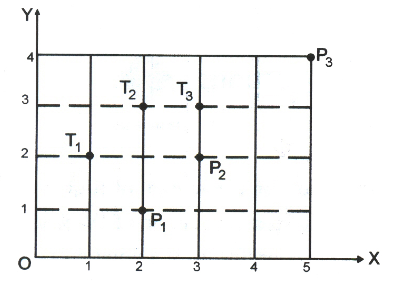
Prabhsimran and Tavleen planted some trees in her garden as shown in the figure and both arguing that they planted them in straight line. Find who is correct ? P stands for Prabhsimran and T for Tavleen. Which social value is depicted in the question?
11.
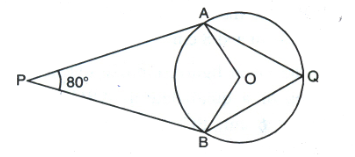
In the given figure, O is the centre of the circle. If PA and PB are tangents from an external point P to the circle, then find the measure of \(\angle AQB\) .
12.
A sector of a circle of radius 12cm has the angle 1200.It is rolled up so that two bounding radii are joined together to form a cone.Find the volume of the cone.
13.
Find the sum of first five multiples of 3.
14.
Draw a circle of radius 4cm. Take two points P and Q on one of its extended diameter each at a distance of 6 cm from its centre. Draw tangents to the circle from these two points P and Q.
15.
Write first four terms of the AP, when the first term a and the common difference d are given as follows: a = -2, d = 0
16.
Evaluate : sin2 30° cos2 45° + 4 tan2 30° + \(\frac{1}{2}\) sin2 90° - 2 cos2 90° + \(\frac{1}{24}\)
17.
Solve the following pair of linear equations by the substitution and cross-multiplication methods.
8x+5y=9, 3x+2y=4
18.
Write the missing numbers is the following factorisation.
(i) -q.png) (ii)
(ii) -q.png)
19.
A game of chance consists of spinning an arrow which is equally likely to come to rest pointing to one of the number 1,2,3,....15,16 as shown in the given figure.what is the probability that it will point to
(i)13
(ii)8
(iii)An odd number
(iv)A number which is multiple of 4"
(v)An even number
(vi)Multiple of 5
20.
Four cows are tethered at the four corner of a square plot of side 50 m, so that they just cannot reach one another. What area will be left ungrazed?
21.
The angle of elevation of the top of a building from the foot of a tower is 30o.The angle of elevation of the top of the tower from the foot of the building is 60o. If the tower is 60 m high, find the height of the building.
22.
If a boy's age and his father's age amount together to 24years. Fourth part of the product of their ages exceeds the boy's age by 9years. Find how old they are.
23.
A tree breaks due to storm and the broken part bends so that the top of the tree touches the ground making an angle 30o with it. The distance between the foot of the tree to the point where the top touches the ground is 8 m. Find the height of the tree.
24.
Find the ratio in which the line joining points (a + b, b + a) and (a - b, b - a) is divided by the point (a, b).
25.
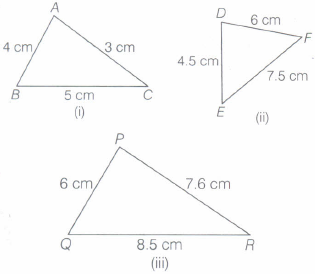
State which pairs of triangles in the given figure are similar? Also, state the similarity criterion used.
26.
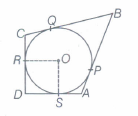
A circle is inscribed in a ΔBC having sides AB=8 cm, BC = 10 cm and CA = 12 cm as shown in figure. Find AD, BE and CF
27.
A card is drawn from a well shuffled deck of 52 cards.Find the probability of getting:
(i)A king of red colour
(ii)A face card
(iii)The queen of diamonds.
28.
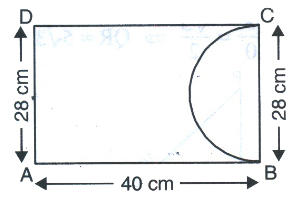
From a rectangular sheet of paper ABCD with AB=40cm and AD=28cm, a semicircular portion with BC as diameter is cut off.Find the area of the remaining paper.[Use \(\pi={22\over7}\)]
29.
Find the sum of all three-digit natural numbers, which are multiples of 11.
30.
A man standing on the deck of a ship, which is 10 m above water level, observes the angle of elevation of the top of a hill as 60o and angle of depression of the base of the hill as 30o. Find the distance of the hill from the ship and height of the hill.
31.
The centroid of triangle divides the median in the ratio ...........
32.
To divide the line segment AB in the ratio 2 : 3, a ray AX is drawn such that LBAX is acute, AX is then marked at equal intervals. Find minimum number of these marks
33.
Which of the following rational numbers has a denominator that can be expressed as a product of powers of 2 and 5?
0.143245
0.141414
1.34573457
0.23452345
34.
A bucket is in the form of a frustum of a cone ad holds 28.490 liters of water. The radii of the top and bottom are 28cm and 21cm respectively. Find the height of the bucket.
20 cm
15 cm
10 cm
None of the above
35.
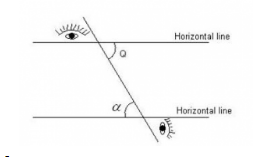
In the above fig Q and α respectively are
Angle of Depression and Angle of Depression
Angle of Elevation and Angle of depression
Angle of Elevation and Angle of Elevation
Angle of depression and Angle of Elevation
36.
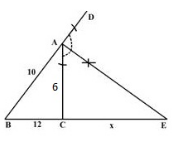
In the figure, AE is the bisector of exterior angle CAD meeting BC produced in E. If AB = 10 cm, AC = 6 cm and BC = 12 cm, then CE is equal to
8 cm
7.2 cm
18 cm
10 cm
1.
Here \(\sqrt { 3 } \sin { \theta } -\cos { \theta } =0\) and \({ 0 }^{ ° }<\theta <{ 90 }^{ ° }\)
\(\Rightarrow \quad \sqrt { 3 } \sin { \theta } =\cos { \theta } \)
\(\Rightarrow \quad \frac { \sin { \theta } }{ \cos { \theta } } =\frac { 1 }{ \sqrt { 3 } } \)
\(\Rightarrow \quad \tan { \theta } =\frac { 1 }{ \sqrt { 3 } } \)
\(=\tan { { 30 }^{ ° } } \left[ \because \quad \tan { \theta } =\frac { \sin { \theta } }{ \cos { \theta } } \right] \)
\(\therefore \quad \theta =\tan { { 30 }^{ ° } } \)
2.
Here, \(\angle APB={ 50 }^{ ° }\)
\(\angle PAB=\angle PBA=\frac { { 180 }^{ ° }-{ 50 }^{ ° } }{ 2 } ={ 65 }^{ ° }\)
\(\angle OAB={ 90 }^{ ° }-\angle PAB\)
\(={ 90 }^{ ° }-{ 65 }^{ ° }={ 25 }^{ ° }\)
3.
Here, \(a=\sqrt { 2 } ,a+d=\sqrt { 8 } =2\sqrt { 2 } \)
\(d=2\sqrt { 2 } -\sqrt { 2 } =\sqrt { 2 } \\ \therefore Next\quad term=\sqrt { 32 } +\sqrt { 2 } \\ =4\sqrt { 2 } +\sqrt { 2 } \\ =5\sqrt { 2 } \\ =\sqrt { 50 } \)
4.
Sum of zeroes = 6, Product of zeroes = 9
\(\therefore\) Quadratic polynomial is x2 - 6x + 9
Also x2 - 6x + 9 = 0
\(\Rightarrow\) (x - 3)(x - 3) = 0
\(\Rightarrow\) x = 3, 3
Hence zeroes are 3, 3
5.
Diameter of solid ball =Length of edge of cubical box = a
\(\therefore\) Volume of remaining space inside the box=Volume of cubical box-Volume of solid ball.
\(\sqrt { 3 } :\frac { a^{ 3 } }{ 6 } (6-\pi )\)
6.
12
7.
Here, point A lies on Y-axis, so its abscissa is zero and its ordinate is 3. So, the point A on Y: axis is A(0, 3).
Here, A=(x1,y1)=(0, 3) and B=(x2,y2)=(-5, 2)
\(\therefore \)AB =\(\sqrt { { \left( { x }_{ 2 }-{ x }_{ 1 } \right) }^{ 2 }-{ \left( { y }_{ 2 }-{ y }_{ 1 } \right) }^{ 2 } } \)
=\(\sqrt { { \left( -5-0 \right) }^{ 2 }+{ (2-3) }^{ 2 } } =\sqrt { { (-5) }^{ 2 }+{ (-1) }^{ 2 } } \)
=\(\sqrt { 25+1 } =\sqrt { 26 } \) units
Hence, the distance between A and B is \(\sqrt { 26 } \) units.
8.
Here, total number of students in the class=23
Number of students from three houses A, B and C
=4+8+5=147
Number of students not from houses A, Band C=23-17=6
Hence, the required probability=\({6\over23}\)
9.
15 cm
10.
Here, Prabhsimran planted the treat at P1(2,1), P2(3,2) and P3(5,4).
So, area of △ P1P2P3
=\(\frac {1}{2}\)|2(2-4)+3(4-1)+5(1-2)|
=\(\frac {1}{2}\)|-4+9-5|=0
Thus, given points P1P2P3 are collinear or they form a straight line.
Now, Tavleen planted the trees at T1(1,2), T2(2,3) and T3(3,3).
∴ Area of △ T1T2T3
=\(\frac{1}{2}\)|1(3-3)+2(3-2)+3(2-3)|
=\(\frac{1}{2}\)|0+2-3|-\(\frac{1}{2}\)sq units
Thus, given points are not collinear or they do not form a straight line. Hence, Prabhsimran planted the trees in straight line. Planting trees help in making environment clean and green. So the two girls by planting trees are giving healthy environment to the society.
11.
50∘
12.
Length of the arc=\(\frac{\theta\pi\times{r}}{180°}=\frac{120}{180}\times{\frac{22}{7}}\times{12}\)
=circumference of the base cone
Let radius of cone be r
⇒2xπxr=\(\frac{120}{180}\times{\frac{22}{7}}\times{12}\Rightarrow r=\frac{2}{3}\times{\frac{12}{2}}\)=4cm
r=4cm, l=12 cm
h2=128 ⇒ h=\(\sqrt{128}=8\sqrt{2}\)cm
Volume of the cone=\(\frac{1}{3}\times\pi\times r^{2}\times{h}=\frac{1}{3}\times{\frac{22}{7}}\times \left(4\right)^{2}\times{8}\times{\sqrt{2}}\)
=\(\frac{1}{3}\times{\frac{22}{7}}\times{16}\times{8}\times{1.414}\)cm3=189.61 cm3
13.
45
14.
BC'A' is the required triangle.
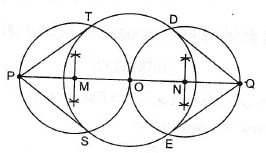
(i) Draw a circle of radius 4 cm with O as its centre
(ii) Draw AB as diameter of thc circle.
(iii) Take P and Q as twopointson extended diameter AB such that OP = 0Q = 6 cm.
(iv) Draw perpendicular bisector of OP and OQ intersecting Op and Oe at M and N respectively
(v) With M as centre and OM as radius draw a circle intersecting the 1st circle at T and S.
(vi) With N as centre and eN as radius intersecting the 1st circle at D and E
(vii) Join PT, PS, QD and QE
(viii) PT, PS, QD and QE are required tangents.
15.
Given, a = -2, d = 0
The first four terms of the AP are -2, -2, -2, and -2.
16.
sin2 30° cos2 45° + 4 tan2 30° + \(\frac{1}{2}\) sin2 90° - 2 cos2 90° + \(\frac{1}{24}\)
\(={ \left( \frac { 1 }{ 2 } \right) }^{ 2 }\times \left( \frac { 1 }{ \sqrt { 2 } } \right) ^{ 2 }+4\left( \frac { 1 }{ \sqrt { 3 } } \right) ^{ 2 }+\frac { 1 }{ 2 } { \left( 1 \right) }^{ 2 }-2\left( 0 \right) +\frac { 1 }{ 24 } \)
\(=\frac { 1 }{ 4 } \left( \frac { 1 }{ 2 } \right) +\frac { 4 }{ 3 } +\frac { 1 }{ 2 } +\frac { 1 }{ 24 } \)
\(=\frac { 1 }{ 8 } +\frac { 4 }{ 3 } +\frac { 1 }{ 24 } +\frac { 1 }{ 2 } \)
\(=\frac { 48 }{ 24 } =2\)
17.
By substitution method
Given, pair of linear equations is
8x+5y=9 ...(i)
and 3x+2y=4 ...(ii)
Solve similar to Q.1 part(i)
Hence, x=-2 and y=5
By cross-multiplication method
Given, pair of linear equations is
2x+5y=9
\(\Rightarrow\) 8x+5y-9=0 ...(i)
and 3x+2y=4
\(\Rightarrow\) 3x+2y-4=0
On comparing Eqs. (i) and (ii) with standard form of pair of linear equations, we get
a1=8, b1=5, c2=-9
and a2=3, b2=2, c2=-4
By using cross-multiplication method, we get
\(\frac { x }{ [(5)-4)-(2)(-9)] } =\frac { y }{ [(-9)(3)-9-4)(8)] } =\frac { 1 }{ [8\times 2-3\times 5] } \)
\(\left[ \because \quad \frac { x }{ { b }_{ 1 }{ c }_{ 2 }-{ b }_{ 2 }{ c }_{ 1 } } =\frac { y }{ { c }_{ 1 }{ a }_{ 2 }-{ c }_{ 2 }{ a }_{ 1 } } =\frac { 1 }{ { a }_{ 1 }{ b }_{ 2 }-{ a }_{ 2 }{ b }_{ 1 } } \right] \)
\(\Rightarrow \quad \frac { x }{ (-20+18) } =\frac { y }{ (-27+32) } =\frac { 1 }{ (16-15) } \)
\(\Rightarrow \quad \frac { x }{ -2 } =\frac { y }{ 5 } =\frac { 1 }{ 1 } \)
Now, take \(\frac { x }{ -2 } =\frac { 1 }{ 1 } \) and \(\frac { y }{ 5 } =\frac { 1 }{ 1 } \)
\(\Rightarrow\) x=-2 and y=5
18.
(i) 36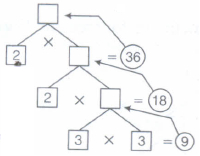
(ii) 42
19.
\((i){1\over16}(ii){1\over16}(iii){1\over2}(iv){1\over4}(v){1\over25}(vi){3\over16}\)
20.
535.71 m2
21.
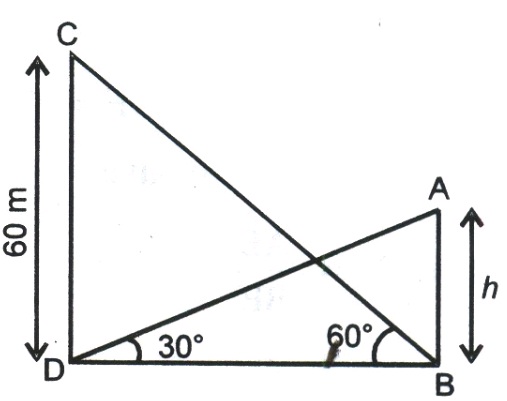
Let us assume that the height of the building be h m .
As CD=60 m
ㄥADB=30o
ㄥCBD=60o
Consider art . ΔBDC, we have
tan60o=\(\frac { CD }{ BD } \)
⇒ \(\sqrt { 3 } =\frac { 60 }{ BD } \) [cross-multiply]
⇒ BD=\(\frac { 60 }{ \sqrt { 3 } } \).......(i)
Again, consider art . ΔABD, we have
tan30o=\(\frac { AB }{ BD } \)
⇒ h=\(\frac { 1 }{ \sqrt { 3 } } =\frac { AB }{ BD } \)
⇒ h=\(\frac { 1 }{ \sqrt { 3 } } \times \frac { 60 }{ \sqrt { 3 } } \) [from (i)]
⇒ h=\(\frac { 60 }{ 3 } \)=20 m
Hence, the height of the building is 20 m.
22.
Let age of the boy be x years
\(\therefore \) Age of the father be (24 - x) years
ATQ \(\frac { 1 }{ 4 } x(24-x)=x+9\)
\(\Rightarrow 24x-x^{ 2 }=4x+36\)
\(\Rightarrow x^{ 2 }-20x+36=0\)
\(\Rightarrow (x-18)(x-2)=0\Rightarrow x=18,x=2\)
\(\Rightarrow \) Age of the boy =2 years
and Age of Father = 24-2=22 years
If x = 18 then age of father =24- 18 = 6 (Not Possible)
23.
Let DB is a tree and AD is the broken part of it which touches the ground at C.
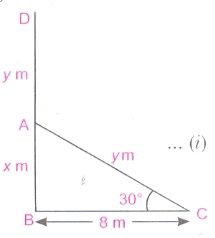
Given: ㄥACB = 30\(\unicode{xb0} \) and BC = 8m
Let AB = x m and AD = y m
∴ Now, length of the tree = (x + y)m
In ΔABC,
\(\frac { AB }{ BC } \) = tan 30\(\unicode{xb0} \) ⇒ \(\frac { x }{ 8 } =\frac { 1 }{ \sqrt { 3 } } \Rightarrow \frac { 8 }{ \sqrt { 3 } } \)
and \(\frac { AB }{ AC } \)-sin 30\(\unicode{xb0} \) ⇒ \(\frac { x }{ y } =\frac { 1 }{ 2 } \)
⇒ y = 2x ⇒ y = 2 x \(\frac { 8 }{ \sqrt { 3 } } =\frac { 16 }{ \sqrt { 3 } } \)
Hence, total height of the tree
x + y = \(\frac { 8 }{ \sqrt { 3 } } +\frac { 16 }{ \sqrt { 3 } } =\frac { 24 }{ \sqrt { 3 } } =\frac { 24 }{ \sqrt { 3 } } \times \frac { \sqrt { 3 } }{ \sqrt { 3 } } =\frac { 24\sqrt { 3 } }{ 3 } \)= 8 x 1.732 = 13.856 m
24.
Let A(a + b, b + a), B(a - b, b - a) and P(a, b) and P divides AB in k : 1, then :
\(a=\frac { k\left( a-b \right) +1\left( a+b \right) }{ k+1 } \)
\(\Rightarrow\) a(k + 1) = k(a - b) + a + b
\(\Rightarrow\) ak + a = ak - bk + a + b
\(\Rightarrow\) bk = b
\(\Rightarrow\) k = 1
\(\therefore\) (a, b) divides A(a + b, b + a), B(a - b, b - a) in 1 : 1 internally.
25.
Here, \(\frac { AB }{ DF } =\frac { 4 }{ 6 } =\frac { 2 }{ 3 } ,\frac { BC }{ EF } =\frac { 5 }{ 7.5 } =\frac { 2 }{ 3 } ,\frac { AC }{ DE } =\frac { 3 }{ 4.5 } =\frac { 2 }{ 3 } \)
As, \(\frac { AB }{ DF } =\frac { BC }{ EF } =\frac { AC }{ DE } \)
So, \(\triangle ABC\sim \triangle DFE\) [by SSS similarity criterion]
Hence, figures (i) and (ii) are similar triangles, but no other pairs of triangles in the given figure are similar.
26.
We know that, tangents drawn from an exterior point to a circle are equal in length.
AD = AF = x cm
BD = BE = y cm
CE = CF = z cm
Given, AB = 8 cm
⇒ AD + BD = 8cm
⇒ x + y = 8
BC = 10 cm ⇒ BE + CE = 10 cm
⇒ y + z = 10
and CA = 12 cm ⇒ CF + AF = 12 cm
⇒ z + x = 12
On adding Eqs. (i), (ii) and (iii), we get
2(x + y + z) =30
⇒ x + y + z = 15
On subtracting Eq. (ii) from Eq. (iv), we get
x =15 - 10 = 5
On subtracting Eq. (iii) from Eq. (iv), we get
y = 15-12 = 3
On subtracting Eq. (i) from Eq. (iv), we get
z=15-8=7
AD = xcm = 5 cm
BE= ycm = 3 cm
and CF = z cm = 7 cm
Hence, the length of AD, BE and CE are 5 cm, 3 cm and 7 cm, respectively.
27.
(i)Total number of cards=52
Number of red coloured kings=2
p(a king of red colour)=\({2\over52}={1\over26}\)
(ii)Number of face cards=12
p(a face card)\(={12\over52}={3\over13}\)
(iii)Number of queen of diamonds=1
p(the queen of diamonds)\(={1\over52}\)
28.
The area of rectangular sheet ABCD = 40 x 28
= 1120 cm2
The diameter of semicircle = 28 cm
ஃ Radius of semicircle = 14 cm
Area of semicircle = \(\frac { 1 }{ 2 } \times \frac { 22 }{ 7 } \times 14\times 14\quad { cm }^{ 2 }\)
= 308 cm2
Thus, area of remaining paper = Area of paper - Area of semicircle
= 1120 - 308 = 812
∴ Required area = 812 cm2
29.
We know that, in natural numbers, the smallest and the largest number of three-digits which are multiples of 11 are 110 and 900 respectively. Therefore, the sequence of three-digit numbers which are multiples of 11 are 110, 121, 132, ..., 990. Thus, it is an A.P. with first term a = 110, common difference d = 9 and last term (an) = l = 990.
Let there are n terms in this sequence.
\(\therefore\) an = 999
\(\Rightarrow\) a + ( n - 1 )d = 999
\(\Rightarrow\) 110 + ( n - 1)11 = 999
\(\Rightarrow\) 11n = 990 - 99
\(\Rightarrow\) 11n = 891 \(\Rightarrow\) n = 81
Hence, the equired sum = \({81 \over 2}(110+990)\)
\(={81\times1100 \over 2}\)
= 81 x 550 = 44550
30.
Let a man is standing on the deck of a ship at point A such that AB = 10 m and let CD be the hill.
Then, ∠EAD = 60° and ∠CAE = ∠BCA = 30° [alternate angles]
Let BC = x m = AE and DE = h m
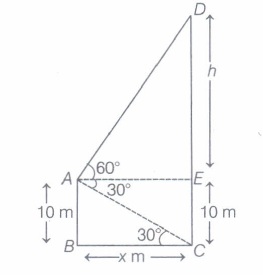
In right angled ΔAED,
\(\tan 60^{\circ}=\frac{P}{B}=\frac{D E}{E A}=\frac{h}{x}\)
In right angled ΔABC,
\(\tan 30^{\circ}=\frac{A B}{B C} \Rightarrow \frac{1}{\sqrt{3}}=\frac{10}{x}\left[\because \tan 30^{\circ}=\frac{1}{\sqrt{3}}\right]\)
distance of the hill from the ship is 10\(\sqrt3\) m and height of the hill is 40 m.
31.
()
2:1
32.
()
Minimum number of marks = 2 + 3 = 5
33.
(a)
0.143245
34.
(b)
15 cm
35.
(d)
Angle of depression and Angle of Elevation
36.
(c)
18 cm

10th Standard CBSE Syllabus & Materials
10th Standard CBSE
CBSE 10th Social Science PS - Federalism - New Model Questions Papers Study Material - QB365 Set A
NEW10th Standard CBSE
CBSE 10th Social Science PS - Power Sharing - New Model Questions Papers Study Material - QB365 Set A
NEW10th Standard CBSE
CBSE 10th Social Science GEO - Manufacturing Industries - New Model Questions Papers Study Material - QB365 Set A
NEW10th Standard CBSE
CBSE 10th Social Science GEO - Minerals and Energy Resources - New Model Questions Papers Study Material - QB365 Set A



CBSE 10th Standard CBSE Subjects
CBSE Standards





