
 100% FREE ACCESS
10th Standard CBSE Syllabus & Materials
10th Standard CBSE
CBSE 10th Social Science ECO - Globalisation and the Indian Economy - New Model Questions Papers Study Material - QB365 Set A
NEW10th Standard CBSE
CBSE 10th Social Science ECO - Money and Credit - New Model Questions Papers Study Material - QB365 Set A
NEW10th Standard CBSE
CBSE 10th Social Science ECO - Sectors of the Indian Economy - New Model Questions Papers Study Material - QB365 Set A
NEW10th Standard CBSE
CBSE 10th Social Science ECO - Development - New Model Questions Papers Study Material - QB365 Set A
NEW10th Standard CBSE
CBSE 10th Social Science PS - Outcomes of Democracy - New Model Questions Papers Study Material - QB365 Set A
NEW10th Standard CBSE
CBSE 10th Social Science PS - Gender, Religion and Caste - New Model Questions Papers Study Material - QB365 Set A

Published on: 13/02/2020
10th standard CBSE Mathematics Board Exam Model Question Paper III 2020
Download CBSE Class 10th Standard CBSE Maths question papers, sample papers, important questions, and previous year solved papers in PDF format. Get free study materials, NCERT solutions, and exam preparation resources for Class 10th Standard CBSE Maths
Questions + Answers key
Take MCQ Maths Test
1.
Given below is a cumulative frequency distribution showing the marks secured by 50 students of a class
| Marks | Number of students |
|---|---|
| Below 20 | 17 |
| Below 40 | 22 |
| Below 60 | 29 |
| Below 80 | 37 |
| Below 100 | 50 |
Form the frequency distribution table for the above data.
2.
If \(\sin { { \theta }_{ 1 } } +\sin { { \theta }_{ 2 } } +\sin { { \theta }_{ 3 } } =3,\)\({ 0 }^{ 0 }<{ \theta }_{ 1 },{ \theta }_{ 2 },{ \theta }_{ 3 }\le { 90 }^{ 0 },\) find the value of \(\cos { { \theta }_{ 1 } } +\cos { { \theta }_{ 2 } } +\cos { { \theta }_{ 3 } } .\)
3.
For a quadratic polynomial, whose one zero is 8 and the product of zeroes is -56.
4.
Express number as a product of its prime factor 140
5.
The probability of guessing the correct answer to a certain test is p/12. If the probability of not guessing the correct answer to this question is 3/4, then find the value of p?
6.
From a parachute vertically above a straight road, the angles of depression of two accidental vehicles, at an instant is found to be 450 and 600.If the vehicles are 100m apart, find the height of the parachute.
Which precautions one should take to avoid accidents on roads?
7.
For what value of p, are 2p - 1, 7 and 3p three consecutive terms of an A.P.?
8.
Find the ratio in which the line segment joining (2,-3) and (5,6) is divided by x-axis.
9.
Find the value of k, for which the quadratic equation \(4x^{2}+4\sqrt{3x} \ + \ k = 0\) has equal roots.
10.
A vessel is in the form of a hollow hemisphere mounted by a hollow cylinder. The diameter of the hemisphere is 14 cm and the total height of the vessel is 13 cm. Find the inner surface area of the vessel.
11.
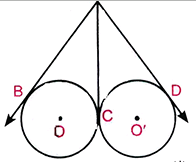
In the figure, AB, AC and AD are tangents. If AB - 5 cm, find AD.
12.
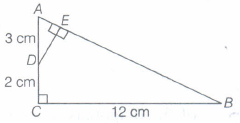
In the given figure, ABC is a right angled triangle, right angled at C and \(DE \bot AB\) .
(i) Prove that \(\triangle ABC\sim \triangle ADE\)
(ii) Find the lengths of AE and DE.
(iii) Find the area of ΔABC.
13.
The sum of the first term and the fifth term of an ascending AP is 26 and the product of the second term by the fourth term is 160. Find the sum of the first seven terms of this AP.
14.
An aeroplane is at an altitude of 1200 m. Find that two ships are sailing towards it in the same direction. The angles of depression of the ships as observed from the aeroplane are \(60°\) and \(30°\) , respectively. Find the distance between both ships.
15.
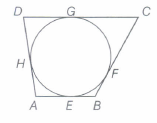
A village Panchayat constructed a circular tank to serve as a bird bath. A fencing was made in the shape of a quadrilateral. Sides of the quadrilateral touched the circle as shown in the figure. If AB = 5 m, CD = 6 m and BC = 7 m, then
(a) findAD.
(b) what values does village Panchayat depict through this action?
16.
Three coins are tossed simultaneously.Find the probability of getting:
(a)Three heads
(b)Exactly 2 heads
(c)At least 2 heads
17.
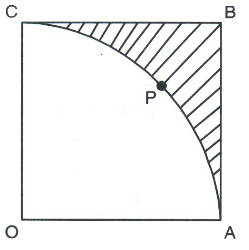
In fig., OABC is a square of side 7cm,.If OAPC is a quadrant of a circle with centre O, then find the area of the shaded region.
18.
If R(x,y) is a point on the line segment joining the points P(a,b) and Q(b,a) then prove that x+y=a+b
19.
The coordinates of one end point of a diameter of a circle are (4,-1) and the coordinates of the centre are (1,-3).
(i) Find the coordinates of the other end of the diameter.
(ii) Find the diameter of the circle.
(iii) Calculate the area of circle,
20.
Draw a line segment PQ of length 9cm. Taking P as centre, draw a circle of radius 4.5cm and taking Q as centre, draw circle of radius 3cm. Construct tangents to each circle from the centre of the other circle.
21.
A milk tanker cylindrical in shape having diameter 2 m and length 4·2 m supplies milk to the two booths in the ratio 3 : 2. One of the milk booths has cuboidal vessel having base area 3·96 sq. m. and the other has a cylindrical vessel
having radius 1 m. Find the level of milk in each of the vessels.\(\left[ Use\quad \pi =\frac { 22 }{ 7 } \right] \)
22.
In a painting competition of a school a child made Indian national flag whose perimeter was 50 cm. Its area will be decreased by 6 square cm, if length is decreased by 3 cm and breadth is increased by 2 cm then find the dimension of flag.What does the Saffron colour in flag signify?
23.
The following table gives the literacy rate (in percentage) of 35 cities. Find the mean literacy rate.
| Literacy rate (in %) | 45-55 | 55-65 | 65-75 | 75-85 | 85-95 |
|---|---|---|---|---|---|
| Number of cities | 3 | 10 | 11 | 8 | 3 |
24.
If cot \(\theta \) =\(\frac { 7 }{ 8 } \) , evaluate \(\frac { (1+sin\theta )(1-sin\theta ) }{ (1+cos\theta )((1-cos\theta ) } \)
25.
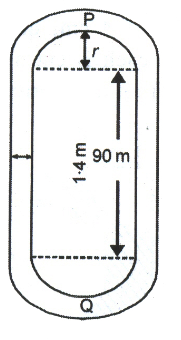
The inside perimeter of a running track is 400 m as shown in the figure. The length of each of the straight portion is 90 m and the ends are semicircles. If the track is everywhere 1.4 m wide, find the area of the track. Also, find the length of the outer running track.
26.
The angle of elevation of the top of a tower from two points at a distance of 4 m and 9 m from the base of the tower and in the same straight line with it are 60o and 30o respectively. Find the height of the tower.
27.
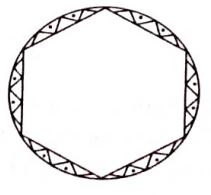
A round table cover has six equal designs as shown in the figure. If the radius of the cover is 28 cm, find the cost of making the designs at the rate of Rs. 0.35 per cm2 . [take, \(\sqrt3\) = 1.732]
28.
The time taken by a person to cover 150km was \(2{1\over2}\)jhrs. more than the time taken in the return journey. If he returned at a speed of 10km/h more than the speed of going, what was the speed per hour in each direction?
29.
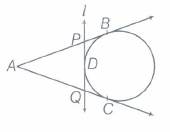
In the figure, if AB, AC and line I are tangents to the circle and semi-perimeter of \(\triangle APQ\)= 14 cm, then AC = ___________cm.
30.
A sequence a1, a2, a3,.......... an, an+1,..... is called an A.P. If there exists constant d such that
31.
When are the two triangles said to be similar?
32.
The decimal representation of 83/100 will be:
Non terminating
Non terminating repeating
Terminating
Non terminating non repeating
33.
Total surface area of a cylinder is equal to
πr + 2πrh
2πrh
πr2h
2πr(h + r)
34.
The horizontal distance between two towers is 140 m. The angle of elevation of the top of the first tower when seen from the top of the second tower is 30°. If the height of the second tower is 60 m then, the height of the first tower is
139.5 m
142 m
135 m
140.83 m
35.
In the triangles PQR and NLM, angle M will be
70°
40°
60°
50°
1.
| Classes | Frequency |
|---|---|
| 0-20 | 17 |
| 20-40 | 5 |
| 40-60 | 7 |
| 60-80 | 8 |
| 80-100 | 13 |
| Total | 50 |
2.
Given, \(\sin { { \theta }_{ 1 } } +\sin { { \theta }_{ 2 } } +\sin { { \theta }_{ 3 } } =3\)
and \({ 0 }^{ 0 }<{ \theta }_{ 1 },{ \theta }_{ 2 },{ \theta }_{ 3 }\le { 90 }^{ 0 }\)
We know that, the maximum value of \(\sin { \theta } \quad is\quad 1\)
\(\therefore \quad \sin { { \theta }_{ 1 } } +\sin { { \theta }_{ 2 } } +\sin { { \theta }_{ 3 } } =3\)
\( \Rightarrow \sin { { \theta }_{ 1 } } =\sin { { \theta }_{ 2 } } =\sin { { \theta }_{ 3 } } =1\)
\(\Rightarrow { \theta }_{ 1 }={ \theta }_{ 2 }={ \theta }_{ 3 }={ 90 }^{ 0 }\)
\(Now,\quad \cos { { \theta }_{ 1 } } +\cos { { \theta }_{ 2 } } +\cos { { \theta }_{ 3 } } \)
\(=\cos { { 90 }^{ 0 } } +\cos { { 90 }^{ 0 } } +\cos { { 90 }^{ 0 } } \)
\(=0+0+0=0\)
3.
x2-x-56
4.
We, have
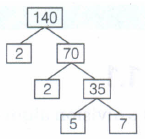
Product of prime factors of 140
= 2 x 2 x 5 x 7= 22 x 5 x 7
5.
Let E=Guessing the correct answer to a certain question
Probability (guessing the correct answer),
\(P(\overset { - }{ E } )=\frac { p }{ 12 } \) [given]
Probability (not guessing the correct answer),
\(P(\overset { - }{ E } )=\frac { 3 }{ 4} \) [given]
We know that, \(1-P(E)=P(\overset { - }{ E } )\)
\(\Rightarrow \ 1-\frac { p }{ 12 } =\frac { 3 }{ 4 } =\frac { p }{ 12 } \\ \Rightarrow \ p=3\)
Hence, the value of p is 3.
6.
\(50(3+\sqrt{3})m;\)To avoid accident everyone should follow road safety rules.
7.
p = 3
8.
Let the required ratio be k:1.
Then the coordinates of the point of division are \(\left( \frac { 2k+5 }{ k+1 } ,\frac { -3k+6 }{ k+1 } \right) \)
This point lies on the x-axis whose equation is y=0.
\(\therefore \ \frac { -3k+6 }{ k+1 } \ =\ 0\ \Rightarrow \ 3k=6,\ or\ k=2\)
Line segment joining the two points is divided in the ratio 2:1 internally by x-axis.
9.
k = 3
10.
Here, vessel is a combination of a hollow hemisphere and a hollow cylinder.
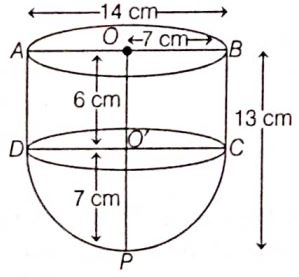
For cylindrical portion,
Diameter = AB = DC = 14 cm
\(\therefore\) Radius = OB = O'C = O' P
\(=\frac{A B}{2}=\frac{14}{2}=7 \mathrm{~cm}\)
Total length of vessel, PO = 13 cm
\(\therefore\) Length of cylinder, OO' = PO - O'P = 13 - 7 = 6 cm
For hemispherical portion,
Radius of hemisphere = Height of hemisphere = 7 cm
Now, the inner surface area of the vessel = Curved surface area of cylinder + Curved surface area of hemisphere
\(\begin{aligned} & =2 \pi r h+2 \pi r^2 \\ \end{aligned}\)
\(\begin{aligned} & =2 \times \frac{22}{7} \times 7 \times 6+2 \times \frac{22}{7} \times(7)^2 \\ \end{aligned}\)
\(\begin{aligned} & =2 \times 22 \times 6+2 \times 22 \times 7 \\ \end{aligned}\)
\(\begin{aligned} & =44(6+7)=44 \times 13=572 \mathrm{~cm}^2 \end{aligned}\)
11.
Given: AB, AC and AD are tangents. AB = 5 cm.
TO find: AD
Sol. AB and AC are tangents from the same point to the circle with centre O.
⇒ AB = AC .......(i)
(Length of the tangents from the same external point are equal).
AC and AD are tangents from the same point to the circle with centre O.
⇒ AC = AD .....(ii)
(Length of the tangents from the same external point are equal)
From (i) and (ii)
∵ AB = AD = 5 cm
12.
(i) Use AA criterion to prove \(\Delta A B C \sim \Delta A D E\)
(ii) AE = \(\frac{15}{13}\) cm, DE = \(\frac{36}{13}\) cm
(iii) 30 cm2
13.
Let a and d > 0 be the first term and common difference of an AP.
According to the given condition,
\({a}_{1} + { a } _{ 5 } { = } { 26 }\)
\(\Rightarrow\) a + a + (5 - 1)d = 26
\(\Rightarrow\) 2a + 4d = 26
\(\Rightarrow\) a + 2d = 13 [dividing by 2] ... (i)
Now, \({a}_{2}\times a_4=160\)
\(\Rightarrow\) \((a+d)\times(a+3d)=160\)
\(\Rightarrow\) (13 - 2d + d) (13 - 2d + 3d) = 160 [from Eq. (i)]
\(\Rightarrow\) (13 - d) (13 + d) = 160
\(\Rightarrow\) \((13)^2-(d)^2=160\)
\(\Rightarrow\) \({d}^{2}=169-160\)
\(\Rightarrow\) \({d}_{2}=9\)
\(\Rightarrow\) \(d = \pm 3\)
But d > 0
\(\therefore\) d = 3
On putting d = 3 in Eq. (i), we get
\(a + 2 \times 3 =13\)
\(\Rightarrow\) a = 13 - 6
\(\therefore\) a = 7
Now, the sum of first seven terms,
\({ S }_{ 7 }=\frac { 7 }{ 2 } \left[ 2\times a+\left( 7-1 \right) d \right] \)
\(=\frac { 7 }{ 2 } \left[ 2\times 7+6\times 3 \right] \)
\(=\frac { 7 }{ 2 } \left[ 14+18 \right] \)
\(=\frac { 7 }{ 2 } \left[ 14+18 \right] \)
14.
Let aeroplane be at B and let the two ships at C and D, such that their angles of depression from B are \(30°\)and\(60°\), respectively.Then, angles of elevation of D and C from B are \(30°\)and \(60°\)respectively.
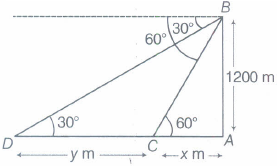
We have, AB=1200 m
Here, one side AB is common in both triangles.
Let AC=x m and CD= y m
In \(\Delta BAC\) , we have
\(tan\quad 60°=\frac { A }{ B } \Rightarrow \sqrt { 3 } =\frac { 1200 }{ x } \)
⇒ \(x=\frac { 1200 }{ \sqrt { 3 } } \times \frac { \sqrt { 3 } }{ \sqrt { 3 } } =\frac { 1200\sqrt { 3 } }{ 3 } =400\sqrt { 3 } \) ....(i)
In \(\Delta BAD\) , We have
\(tan\quad 30°=\frac { AB }{ AD }=\frac { AB }{ DC+CA }\) [∵ AD=DC+CA]
On putting the value of x from Eq.(i) in Eq. (ii) we get
\(y=1200\sqrt { 3 } -400\sqrt { 3 } \)
⇒ y = 1800\(\sqrt { 3 } \)
⇒ y = 800 x 1.732 \(\left[ \because \sqrt { 3 } =1.732 \right] \)
\(\Rightarrow y=1385.6m\)
Hence, the distance between both ships is 1385. 6m.
15.
(a) AD = 4 m
(b) Care towards nature and love for creature.
16.
(a) When three coins are tossed simultaneously, then the number of possible outcomes = 8,
(i.e. , HHH, HTH, THH, TTH, HHT, HTT, THT, TTT)
Number of favourable outcomes (three heads) = l, (i.e., HHH)
\(\therefore\)Required probability = \(\frac{1}{8}\)
(b) Number of favourable outcomes (exactly 2 3, (i.e., HTH, THH, HHT)
\(\therefore\)Required probability =\(\frac{3}{8}\)
(c) Number of favourable outcomes (at least two heads) = 4, (i.e., HTH, THH, HHT, HHH)
Required probability =\(\frac{4}{8}=\frac{1}{2}\)
17.
Here, OABC is a square of side 7 cm
⇒ OA = AB = BC CO = 7 cm
and OAPC is quadrant of a circle with centre O.
Now, radius of the circle = 7 cm
Hence, Area of shaded region
= Area of square OABC - Area of quadrant OAPC
= 7 x 7 - \(\frac { 1 }{ 4 } \times \frac { 22 }{ 7 } \) x 7 x 7 x = \(\left( 49-\frac { 77 }{ 2 } \right) \) cm2
= \({98-77\over2}={21\over2}\) = 10.5 cm2
18.
R(x,y) lies on the line segment joining the points P(a,b) and Q(b,a). Then P,Q and R lie on a line.
⇒ x(b-a)+a(a-y)+b(y-b)=0 ⇒ bx-ax+a2-ay+by-b2=0
⇒ b(x+y)-a(x+y)+(a2-b2) =0 ⇒ (b-a)(x+y)-(b-a)(b+a)=0
⇒ (b-a){(x+y)-(b+a)}=0 ⇒ (+y)=(b+a) [ Assuming a≠ b]
19.
Given that coordinates of one end point of the diameter is (4, -1) and centre of the circle is (1,- 3).
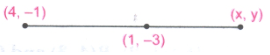
Let coordinates of the other end of the diameter be (x, y).
We know that the centre of the circle (1,-3) is the mid-point of diameter.
\(\Rightarrow \frac { 4+x }{ 2 } =1\) and \( \frac { (-1+y) }{ 2 } =-3\)
\(\Rightarrow 4+x=2\) and \( -1+y=-6\Rightarrow x=-2\) and \( y=-6+1=-5\)
Thus, coordinates of the other end of the diameter are (-2, -5).
20.
Steps of Construction:
(i) Draw a circle of radius 4 cm with O as its centre.
(ii) Draw AB as diameter of the circle.
(iii) Take P and Q as two points on extended diameter AB such that OP = OQ = 6 cm.
(iv) Draw perpendicular bisector of OP and OQ intersecting OP and OQ at M and N respectively.
(v) With M as centre and OM as radius draw a circle intersecting the 1st circle at T and S.
(vi) With N as centre and QN as radius intersecting the 1st circle at D and E.
(vii) Join PT, PS, QD and QE.
viii) PT, PS, QD and QE are required tangents.
21.
Volume of milk = \(\frac {22}{7}\) x 1x 1x 4·2 = 13·2 m3
To booth I= 13·2 x \(\frac {3}{5}\) = 264 x3
= 7.92 m3
To booth II = 13·2 x \(\frac {2}{5}\) = 264 X 2
= 5.28 m3
Height in 1st vessel = \(\frac {7.92}{3.96}\) = 2 m
Height in 2nd vessel \(=\frac { 5.28 }{ \frac { 22 }{ 7 } \times 1 } =\frac { 5.28\times 7 }{ 22 } \)
= 1.68 m.
22.
Let length of the flag = x cm and breadth of the flag = y cm .
2x + 2y = 50
\(\Rightarrow\) x + Y = 25 ....(i)
(x - 3) (y + 2) = xy - 6
\(\Rightarrow\) xy + 2x - 3yx - 6 = xy - 6
\(\Rightarrow\) 2x - 3y = 0 .... (ii)
On solving the eqns. (i) and (ii),
x = 15 cm and y = 10 cm
\(\therefore\) Length of the flag = 15 cm and Breadth of the flag = 10 cm
Significane: The saffron colour is symbol of courage and sacrifice
23.
To find the class marks, the following relation is used.
\(x_{i}=\frac{\text { Upper class limit + Lower class limit }}{2}\)
Class size (h) for this data = 10
Taking 70 as assumed mean (a), di, ui, and fiui are calculated as follows.
| Literacy rate (in %) |
Number of cities fi |
xi | di = xi − 70 | ui = di/10 | fiui |
| 45-55 | 3 | 50 | -20 | -2 | -6 |
| 55-65 | 10 | 60 | -10 | -1 | -10 |
| 65-75 | 11 | 70 | 0 | 0 | 0 |
| 75-85 | 8 | 80 | 10 | 1 | 8 |
| 85-95 | 3 | 90 | 20 | 2 | 6 |
| Total | 35 | -2 |
From the table, we obtain
\(\sum f_{i}=35 \)
\(\sum f_{i} u_{i}=-2 \)
\(\text { Mean } \bar{x}=a+\left(\frac{\sum f_{i} u_{i}}{\sum f_{i}}\right) \times h\)
\(=70+\left(-\frac{2}{35}\right) \times(10) \)
\(=70-\frac{20}{35} \)
\(=70-\frac{4}{7}\)
= 70 - 0.57
= 69.43
Therefore, mean literacy rate is 69.43%.
24.
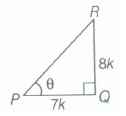
Given, cot \(\theta \) =\(\frac { 7 }{ 8 } \Rightarrow \frac { B }{ P } =\frac { 7 }{ 8 } \)
Let B = 7k and P = 8k
where, k is any positive integer.
Draw a right angled \(\Delta\)PQR, right angled at Q
In right angled \(\Delta\)PQR, H2 = B2 + P2
\(\Rightarrow\) H2 = (7k)2 + (8k)2 [ by using pythagoras theorem]
\(\Rightarrow\) H2 = 49 k2 + 64k2 = 113k2
\(\Rightarrow\) H = k\(\sqrt { 113 } \) [taking positive square root since, side cannot be negative]
\(\therefore \quad \sin \theta=\frac{P}{H}=\frac{8 k}{k \sqrt{113}}=\frac{8}{\sqrt{113}}\)
\(\text { and } \cos \theta=\frac{B}{H}=\frac{7 k}{k \sqrt{113}}=\frac{7}{\sqrt{113}}\)
\(\frac { (1+sin\theta )(1-sin\theta ) }{ (1+cos\theta )((1-cos\theta ) } \)=\(\frac { { 1 }^{ 2 }-{ sin }^{ 2 }\theta }{ { 1 }^{ 2 }-{ cos }^{ 2 }\theta } \)
\(\left[ \because (a+b)(a-b)={ a }^{ 2 }-{ b }^{ 2 } \right] \)
\(=\frac { 1-{ \left( \frac { 8 }{ \sqrt { 113 } } \right) }^{ 2 } }{ 1-{ \left( \frac { 7 }{ \sqrt { 113 } } \right) }^{ 2 } } =\frac { 1-\frac { 64 }{ 113 } }{ 1-\frac { 49 }{ 113 } } =\frac { \frac { 113-64 }{ 113 } }{ \frac { 113-49 }{ 113 } } \frac { 49 }{ 64 } \)
25.
566.16 cm2 , 408.8 m
26.
Let us assume that the height of the tower AC be h m and ∠ABC=60o , ∠ADC=30o
As BC=4m
DC=9m (given)
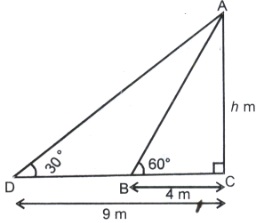
Consider a rt△ACB, we have
tan 60o = \(\frac{AC}{BC}\)
⇒ \(\sqrt{3} = \frac{h}{4}\) --- (i)
Again, consider a rt. △ACD, we have
tan 300 = \(\frac{AC}{DC}\)
⇒ \(\frac { 1 }{ \sqrt { 3 } } =\frac { h }{ 9 } \) --- (ii)
Now, multiply (i) and (ii), we have
\(1=\frac{h}{4}\times\frac{h}{9}\)
⇒ 1= \(\frac {h^{2}} {36}\)
⇒ h2=36
⇒ h=\(\sqrt{36}\)=6 m
⇒ h=6m
Hence, height of the tower is 6m.
27.
We know that the central angle of a circle is 360°.
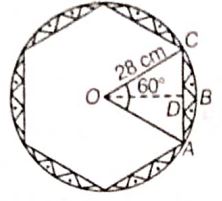
\(\therefore\) Angled of each sector \(=\frac{360^{\circ}}{6}=60^{\circ}\)
\(\therefore\) \(\angle\)AOC = 60° and OA = OC [radii of circle]
\(\therefore\) \(\angle\)OAC = \(\angle\)OCA = x (say)
[\(\because\) angles opposite to equal sides of a triangle are also equal]
In \(\Delta\)AOC, \(\angle\)AOC + \(\angle\)OAC + \(\angle\)OCA = 180°
[by angle sum property of triangle]
\(\Rightarrow\) 60° + x + x = 180° \(\Rightarrow\) 2x = 180° - 60°
\(\Rightarrow \quad x=\frac{120^{\circ}}{2} \Rightarrow x=60^{\circ}\)
\(\Rightarrow \quad \angle O A C=\angle O C A=60^{\circ}=\angle A O C\)
\(\therefore\) \(\Delta\)AOC is a equilateral triangle.
Area of \(\Delta\)AOC = \(=\frac{\sqrt{3}}{4} \times(28)^2=333.2 \mathrm{~cm}^2\)
[\(\because\)area of an equilateral triangle =\(\left.\frac{\sqrt{3}}{4}(\text { side })^2\right]\)
Now, area of sector OABCO \(=\frac{\theta}{360^{\circ}} \times \pi r^2\)
\(=\frac{60^{\circ}}{360^{\circ}} \times \frac{22 \times(28)^2}{7}=\frac{22 \times 4 \times 28}{6}=410.67 \mathrm{~cm}^2\)
\(\therefore\) Area of segment ABCA
= Area of sector OABCO - Area of \(\Delta\)AOC
= 410.67 - 333.2 = 77.47 cm2
Now, area of six segments = 6 \(\times\) 77.47 = 464.82 cm2
Since, the cost of making the design is Rs 0.35 per cm2.
\(\therefore\) Total cost = 464.82 \(\times\) 0.35 = Rs 162.69
28.
Let the speed while going be x km/h
Distance = 150 km
\(\therefore \) Time taken = \(\frac { 150 }{ x } \) hours
Now speed in return journey be (x + 10) km/h
\(\therefore \)Time taken in return journey
\(=\frac { 150 }{ x+10 } \)
ATQ \(=\frac { 150 }{ x } -\frac { 150 }{ x+10 } =2\frac { 1 }{ 2 } \)
\(\Rightarrow \frac { 150(x+10)-150x }{ x(x+10) } \frac { 5 }{ 2 } \)
\(\Rightarrow \frac { 1500 }{ x^{ 2 }+10x } =\frac { 5 }{ 2 } \)
\(\Rightarrow 2\times 1500=5(x^{ 2 }+10x)\)
\(\Rightarrow 600=x^{ 2 }+10x\)
\(\Rightarrow x^{ 2 }+10x-600=0\)
\(\Rightarrow (x+30)(x-20)=0\)
\(\Rightarrow x=-30\) (rejecting) x=20
Speed while going = 20 km/h speed in return journey and 20 + 10 = 30 km/h
29.
()
7 cm
30.
()
an+1 - an
31.
()
Two triangle are said to be similar when their corresponding sides are proportional and angles are equal
32.
(c)
Terminating
33.
(d)
2πr(h + r)
34.
(d)
140.83 m
35.
(d)
50°

10th Standard CBSE Syllabus & Materials
10th Standard CBSE
CBSE 10th Social Science PS - Federalism - New Model Questions Papers Study Material - QB365 Set A
NEW10th Standard CBSE
CBSE 10th Social Science PS - Power Sharing - New Model Questions Papers Study Material - QB365 Set A
NEW10th Standard CBSE
CBSE 10th Social Science GEO - Manufacturing Industries - New Model Questions Papers Study Material - QB365 Set A
NEW10th Standard CBSE
CBSE 10th Social Science GEO - Minerals and Energy Resources - New Model Questions Papers Study Material - QB365 Set A



CBSE 10th Standard CBSE Subjects
CBSE Standards





