
 100% FREE ACCESS
10th Standard CBSE Syllabus & Materials
10th Standard CBSE
CBSE 10th Social Science ECO - Globalisation and the Indian Economy - New Model Questions Papers Study Material - QB365 Set A
NEW10th Standard CBSE
CBSE 10th Social Science ECO - Money and Credit - New Model Questions Papers Study Material - QB365 Set A
NEW10th Standard CBSE
CBSE 10th Social Science ECO - Sectors of the Indian Economy - New Model Questions Papers Study Material - QB365 Set A
NEW10th Standard CBSE
CBSE 10th Social Science ECO - Development - New Model Questions Papers Study Material - QB365 Set A
NEW10th Standard CBSE
CBSE 10th Social Science PS - Outcomes of Democracy - New Model Questions Papers Study Material - QB365 Set A
NEW10th Standard CBSE
CBSE 10th Social Science PS - Gender, Religion and Caste - New Model Questions Papers Study Material - QB365 Set A

Published on: 13/02/2020
10th standard CBSE Mathematics Board Exam Model Question Paper IV 2019-2020
Download CBSE Class 10th Standard CBSE Maths question papers, sample papers, important questions, and previous year solved papers in PDF format. Get free study materials, NCERT solutions, and exam preparation resources for Class 10th Standard CBSE Maths
Questions + Answers key
Take MCQ Maths Test
1.
If PQ and PR are two tangents to a circle with centre O. If \(\angle QPR={ 46 }^{ ° }\) find \(\angle QOR\)
2.
If the centre and radius of circle is (3,4) and 7 units respectively, then what is the position of the point A(5,8) with respect to circle?
3.
If the common difference of an AP. is - 6, find a16 - a12
4.
Find the quadratic polynomial whose sum and product of the zeroes are \(\frac{21}{8}\) and \(\frac{5}{16}\) respectively.
5.
Using the formula, \(\cos { A } =\sqrt { \frac { 1+\cos { 2A } }{ 2 } } ,\) find the value of \(\cos { { 15 }^{ 0 } } \)
6.
Find the roots of the quadratic equation \(2x^{ 2 }-3x-10=0\) by using the quadratic equation.
7.
A number is chosen from 1 to 100. Find the probability that it is a prime number.
8.
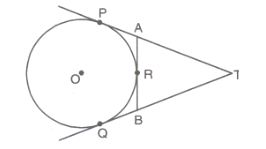
In the given figure, three tangents TP, TQ and AB are respectively drawn at the points P, Q and R to a circle. Find the semi-perimeter of,\(\triangle TAB\) if length of TP is 13 cm.
9.
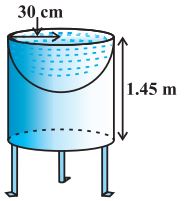
Mayank made a bird-bath for his garden in the shape of a cylinder with a hemispherical depression at one end (see fig.). The height of the cylinder is 1.45 m and its radius is 30 cm. Find the total surface area of the bird-bath.\(\left[ Take\quad \pi =\frac { 22 }{ 7 } \right] \)
10.
In a right triangle, what is the sum of two acute angles?
11.
At the foot of a mountain the elevation of its summit is 45o. After ascending 1.5km towards the top of the mountain up an inclination of 30o, the elevation changes to 60o. Find the height of the mountain.
12.
The students of a school decided to beautify the school on the annual day by fixing colourful flags on the straight passage of the school. They have 27 flags to be fixed at intervals of every 2m. The flags are stored at the position of the middle most flag. Ruchi was given the responsibility of placing the flags. Ruchi kept her books where the flags were stored. She could carry only one flag at a time.
(i) How much distance did she cover in completing this job and returning back to collect her books?
(ii) What is the maximum distance she travelled carrying a flag? On which day the armed forces flag day is celebrated?
13.
If two vertices of a triangle are at (-3,1), (0,-2) and centroid is at origin then find the coordinates of third vertex.
14.
Find the centroid of triangle whose vertices are (3,-4),(-4,2) and (4,8).
15.
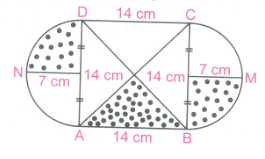
Find the area of the shaded region in the figure.
16.
Write the sequence with nth term: 9 - 5n
17.
Draw a triangle ABC with sides BC = 6 cm, AB = 5 cm and (Then construct a triangle whose sides are \({3\over 2}\) of the corresponding sides of the triangle ABC.
18.
a game consists of tossing a one-rupee coin three times and noting its outcome each time. Find the probability of getting:
(i) three heads,
(ii) at least two tails.
19.
In the given figure, find the value of x in terms of a, b and c.
20.
Determine an AP. whose third term is 9 and when fifth term is subtracted from 8th term, we get 6.
21.
A man who is \(1\frac { 3 }{ 4 } \)tall sees that angle of elevation
22.
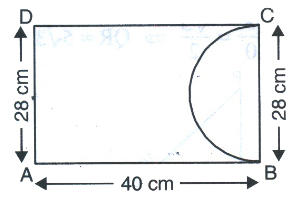
From a rectangular sheet of paper ABCD with AB=40cm and AD=28cm, a semicircular portion with BC as diameter is cut off.Find the area of the remaining paper.[Use \(\pi={22\over7}\)]
23.
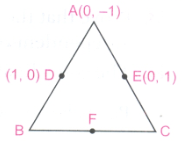
In the given figure, ABC is a triangle coordinate of whose vertex A are (0,-1). D and E respectively are the mid-points of the sides AB and AC and their coordinates are (1,0) and (0,1) respectively. If F is the mid-point of BC, find the areas of \(\Delta ABC\) and \(\Delta DEF\).
24.
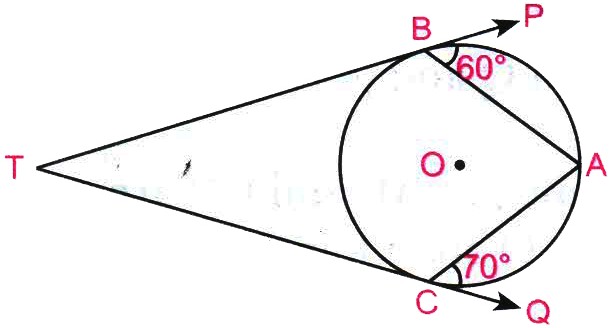
In the given figure, TBP and TCQ are tangents to the circle whose centre isO.Also \(\angle PBA=60^0\ and \ \angle ACQ=70^0.\)Determine \(\angle BAC\ and \ \angle BTC.\)
25.
Two poles of equal height are standing opposite to each other on either side of the road which is 80 m wide. From a point P between them on the road, the angle of elevation of the top of a pole is 60° and the angle of depression from the top of another pole at point P is 30°. Find the heights of the poles and the distances of the point P from the poles.
26.
If \(\alpha\) and \(\beta\) are the zeroes of the polynomial x2 +4x + 3, find the polynomial whose zeroes are \(1+\frac { \beta }{ \alpha } \) and \(1+\frac { \alpha }{ \beta} \)
27.
During Medical check up of 200 students of school, their weights were recorded as follows:
| Weight (in kg) | 30-39 | 40-49 | 50-59 | 60-69 | 70-79 | 80-89 |
|---|---|---|---|---|---|---|
| Number of students | 5 | 22 | 63 | 74 | 30 | 6 |
Find the median weight of students.
28.
Five years ago, Jacob's age was seven times that of his son. After five years, the age of Jacob will be three times that of his son. Represent this situation algebraically and graphically.
29.
There is a circular path around a sports field. Sonia takes 18 min to drive one round of the field, while Ravi takes 12 min for the same. Suppose they both start at the same point and at the same time and go in the same direction. After how many minutes will they meet again at the starting point?
30.
A group of students from a school decided to denote blood. The blood group of 16 students of Class X are recorded as follows
A, B, O, O, AB, O, A, O, B, A, O, B, A, O, O, AB
(i) Find the probability of blood group
(a) O (b) A
(ii) What value is depicted from this activity?
31.
In a flight of 1600 km, an aircraft was slowed down due to bad weather.Its average speed for the trip was reduced by 400 km/h and the time of flight increased by 40 min Then, find the actual time of flight.
32.
The angle of elevation of a jet plane from a point A on the ground is 600.After of 15 seconds, the angle of elevation changes to 300.If the jet plane is flying at a constant height of 1500\(\sqrt{3}\)m.Find the speed of the jet plane.
33.
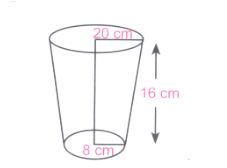
A bucket of height 16 cm is made up of metal sheet in the form of frustum of a right circular cone with radii of its lower and upper ends as 8 cm and 20 cm respectively. Find the volume of milk which can be filled in the bucket. Also find the cost of making the bucket when the metal sheet costs Rs. 15 per 100 cm2 .
34.
The diameters of the front and rear wheels of tractor are 80 cm and 2 m respectively. Find the number of revolutions that rear wheel will make to cover the distance which the front wheel covers in 1400 revolutions. [Use \(\pi={22\over 7}\)]
35.
The sum of all the angles of a triangle is________________
36.
The prime factorization of 184 is
23 × 3 ×. 23
8 × 23
23 × 23
46 ×. 4
37.
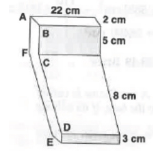
In the figure, the shape of a solid copper piece (made of two pieces) with dimensions as shown. The face ABCDEFA has uniform cross section. Assume that the angles at A, B, C, D, E and F are right angles. Calculate the volume of the piece.
840 cm
880 cm3
876 cm3
890 cm3
38.
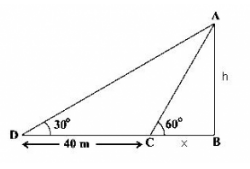
Find AB in the given figure
√3
30√3
20√3
10√3
39.
If four sides of a quadrilateral ABCD are tangential to a circle, then
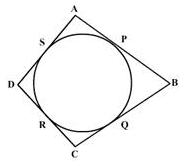
AC + AD = BD + CD
AB + CD = BC + AD
AB + CD = AC + BC
AC + AD = BC + DB
1.
\(\angle QOR+\angle QPR={ 180 }^{ ° }\)
(Supplementary angle)
\(\Rightarrow \quad \angle QOR+{ 46 }^{ ° }={ 180 }^{ ° }\)
\(\Rightarrow \quad \angle QOR={ 180 }^{ ° }-{ 46 }^{ ° }={ 134 }^{ ° }\)
2.
Distance of the point,
\(a=\sqrt { { \left( 5-3 \right) }^{ 2 }+{ \left( 8-4 \right) }^{ 2 } } \)
\(=\sqrt { 4+16 } =\sqrt { 20 } =2\sqrt { 5 } \)
\(\because 2\sqrt { 5 } \) is less than 7
\(\therefore\) The point lies inside the circle.
3.
Let the first term of an AP. be a, common difference,
d =-6
a16 = a + (16- 1)(- 6)
= a-90
a12 = a + (12-1)(-6)
= a-66
a16 - a12 = (a - 90) - (a - 66)
=a-90-a+66
=-24
4.
According to the question,
Sum of zeroes = \(\frac{21}{8}\)
and Product of zeroes = \(\frac{5}{16}\)
So, quadratic polynomial = x2 - (Sum of zeroes)x + Product of zeroes
= x2 - \(\left( \frac { 21 }{ 8 } \right) \)x + \(\left( \frac { 5 }{ 16 } \right) \)
= \(\frac { 1 }{ 16}\left( 16{ x }^{ 2 }-42x+5 \right) \)
= \(\left( 16{ x }^{ 2 }-42x+5 \right) \frac { 1 }{ 16}\)
5.
\(\frac { \sqrt { 2+\sqrt { 3 } } }{ 2 } \)
6.
\(\frac { \sqrt { 5 } +\sqrt { 21 } }{ 4 } \) and \(\frac { \sqrt { 5 } -\sqrt { 21 } }{ 4 } \)
7.
Total number of outcomes, n(S)=100
Let E=Event of getting a prime number
={2,3,5,7,11,13,17,19,23,29,31,37,41,43,47,53,59,61,71,73,79,83,89,97}
∴ n(E)=25
Hence, P (getting a prime number)
\(=\frac { n(E) }{ n(S) } =\frac { 25 }{ 100 } =\frac { 1 }{ 4 } \)
8.
We know that, tangents drawn from an external point to a circle are of equal length.
AR = AP
BR= BQ ....(I)
Now, perimeter of ATB = TA + AB - TB
= TA + AR + BR + TB
= TA + AP + BQ + TB [using (i)]
= TP + TQ = TP + TP
= 2TP [∵ TQ = TP]
Semi-perimeter \(\triangle\)TAB = \(1\over2\) x 2TP = TP
= 13 cm
9.
Let h be height of the cylinder, and r the common radius of the cylinder and hemisphere. Then, the total surface area of the bird-bath = CSA of cylinder + CSA of hemisphere
= 2\(\pi\)rh + 2\(\pi\)r2 = 2\(\pi\)r(h + r)
\(=2 \times \frac{22}{7} \times 30(145+30) \mathrm{cm}^2\)
= 33000 cm2 = 3.3 m2
10.
90o
11.
2.049km
12.
Since distance between the store and first flag towards right side in 2 m.
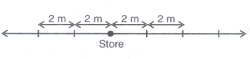
\(\therefore\) Distance covered by Ruchi to place the flag first towards right side of the store = 4 m
Distance covered by Ruchi to place the second flag towards right side of the store = 8 m
Distance covered by Ruchi to place the third flag towards right side of the store = 12 m
Similarly, distance covered by Ruchi to place the thirteenth flag towards right side of the store = a + 12d = 4 + 12 x 4 = 25 m
Now, total distance covered in completing the job = 2S13
\(=2\{ \frac{13}{2}(2\times4+12\times4) \}=13(8+48)\)
= 13 x 56 = 728 m
Maximum distance covered by Ruchi for carrying a flag is 52 m.
Armed forces flag day is celebrated on 7th December, every year.
13.
Let (x,y) be the coordinates of third vertex of the triangle.
\(\therefore \frac { x-3+0 }{ 3 } =0\) and \(\frac { y+1-2 }{ 3 } =0\)
\(\Rightarrow \ x=3\ \) and x=1
Hence, the coordinates of the third vertex is (3,1).
14.
Coordinates of the centroid of \(\Delta \) are
\(({3-4+4\over3},{-4+2+8\over3}) \) i.e., (1,2)
15.
126 cm2
16.
an=9-5n
a1=9-5x1=4
a2=9-5x2=2=-1
a3=9-5x3=-6
sequence is 4, -1, -6,....
17.
Steps of Construction:
1. Draw a line segment BC = 6 cm and at point B draw a ㄥABC = 60o.
2. Cut AB 5 cm. Join AC. We obtain ABC is triangle.
3. Draw a ray BX making an acute angle with BC on the side opposite to the vertex A.
4. Locate 4 points A1,A2,A3 and A4 on the ray BX so that BA1=A1A2=A2A3=A3A4.
5. Join A4 to C.
6. At A3 draw A3C' || A4C. Where C' is a point on the line segment BC.
7. At C' draw C'A' || CA, where A' is a point on the line segment BA.
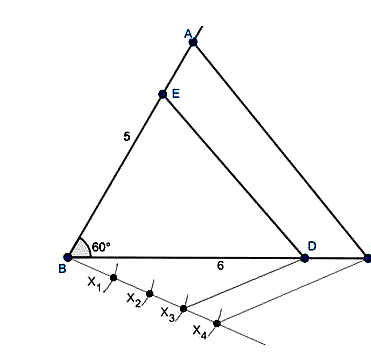
Δ A'BC' is the required triangle.
Justification:
In Δ A'BC' and ΔABC A'C' || AC
∴ By BPT \(\frac { A'B }{ AB } =\frac { BC' }{ BC } \) ...(i)
From (i) and (ii),
\(\frac { A'B' }{ AB } =\frac { 3 }{ 4 } \Rightarrow A'B=\frac { 3 }{ 4 } AB\)
In ΔBA3C' and ΔBA4C
\(\frac { BC' }{ BC } =\frac { { BA }_{ 3 } }{ { BA }_{ 4 } } =\frac { 3 }{ 4 } \) ...(ii)
∴ Sides of new triangle formed are \(\frac { 3 }{ 4 } \) times the corresponding sides of first triangle.
18.
Total number of outcomes = 23 = 8
(i) P(three heads) = \(\frac{1}{8}\)
(ii) P(atleast two tails) = \(\frac{4}{8}\)=\(\frac{1}{2}\)
19.
In triangles LMK and PNK,
\(\angle\)M = \(\angle\)N = 50° (Given)
\(\angle\)K =\(\angle\)K (Common)
\(\triangle\)LMK~\(\triangle\)PNK (AA similarity)
\(\Rightarrow \frac { LM }{ PN } =\frac { KM }{ KN } \)
\(\Rightarrow \frac { a }{ x } =\frac { b+c }{ c } \)
\(\therefore x=\frac { ac }{ b+c } \)
20.
Here given, a3 = 9 ⇒ a + 2d = 9 ....(i)
a8 - a5 = 6
⇒ (a + 7d) - (a + 4d) =6
⇒ 3d =6
⇒ d = 2 .......(ii)
Substituting (ii) in (i), we get
⇒ a + 2(2) = 9
⇒ a = 5
So, AP. is 5, 7, 9, 11, .....
21.
10.41 m
22.
The area of rectangular sheet ABCD = 40 x 28
= 1120 cm2
The diameter of semicircle = 28 cm
ஃ Radius of semicircle = 14 cm
Area of semicircle = \(\frac { 1 }{ 2 } \times \frac { 22 }{ 7 } \times 14\times 14\quad { cm }^{ 2 }\)
= 308 cm2
Thus, area of remaining paper = Area of paper - Area of semicircle
= 1120 - 308 = 812
∴ Required area = 812 cm2
23.
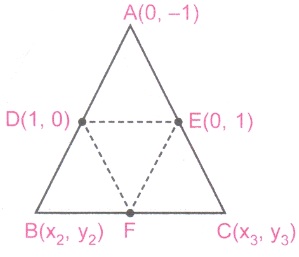
Let coordinates of B and C are (x2,y2) and (x3,y3) respectively.
D is mid-point of AB.
∴ 1= \(\frac { 0+{ x }_{ 2 } }{ 2 } \) ⇒ x2=2
and 0=\(\frac { -1+{ y }_{ 2 } }{ 2 } \)⇒ y2=1
∴ Coordinates of B are (2,1).
E is mid-point of AC
∴ 0=\(\frac { 0+{ x }_{ 2 } }{ 2 } \) ⇒ x3=0
and 1=\(\frac { -1+{ y }_{ 2 } }{ 2 } \)⇒ y3=3
∴ Coordinates of C are (0,3).
Area △ABC
= \(\frac{1}{2}\)|0(1-3)+2(3+1)+0(-1-1)|
=\(\frac{1}{2}\)x8 =4 sq.units
F is mid point of BC
∴ Coordinates F are \((\frac{2+0}{2},\frac{1+3}{2})\), i.e., (1,2).
Area △DEF ,
=\(\frac{1}{2}\)|1(2-1)+1(1-0)+0(0-2)|
=\(\frac{1}{2}\)|1+1|=1 sq.units.
24.
Given: T BP and TCQ are tangents to the circle whose centre is O.
Also, \(\angle \)PBA = 60°
\(\angle \)ACQ = 70°
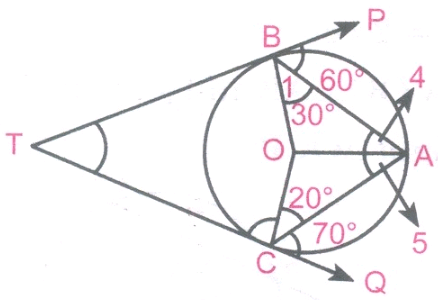
To determine: \(\angle \)BAC and \(\angle \)BTC
Sol. Join OB and OC
\(\angle \)OBP = 90°
[Tangent makes 90° angle with the radius at the point of contact]
⇒ \(\angle \)OBA + \(\angle \)ABP = 90°
⇒ \(\angle \)1 + 60° = 90° [Given ABP = 60°]
⇒ \(\angle \)1 = 30° ......(i)
Also \(\angle \)OCQ = 90°
⇒ OCA + 70° = 90° ......(i)
⇒ \(\angle \)OCA = 20° .....(ii)
In OBA , OB = OA = radii
⇒ \(\angle \)1 = \(\angle \)4 = \(\angle \)30° .....(iii)
[ Angles opposite to equal sides of a triangle are equal]
Similarly, In \(\triangle\)OCA
OC = OA
\(\angle \) 5 = 20° .....(iv)
From (iii) and (iv)
\(\angle \)BAC = 20° + 30° = 50°
⇒ \(\angle \)BOC = 2x50° = 100°
\(\angle \)BOC + BTC = 180°
100° + \(\angle \)BTC = 180°
⇒ \(\angle \)BTC = 80°
25.
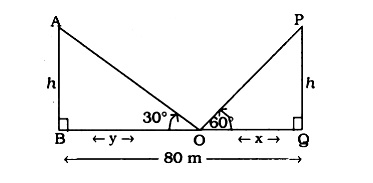
Let the distance of Pole PR = Y and PQ = 80 - Y
From \(\Delta BPR\),
tan 60°=\(\frac{x}{y}\)
x=y\(\sqrt{3}\) ...(i)
From \(\Delta APQ\),
tan 30° =\(\frac{x}{80-y}\)
\(\sqrt{3}\)x=80-y ...(ii)
Solving (i) and (ii),
y = 20,x = 20\(\sqrt{3}\)m
Height of pole = 20\(\sqrt{3}\)m
Distance of Pole, PR = 20 m.
QP = 80 - 20 = 60 m.
26.
Since \(\alpha\) and \(\beta\) are the zeroes of the cubic polynomial x2 +4x + 3
then, \(\alpha+\beta=-4 \)
and \(\alpha\beta=3\)
Sum of zeroes \(=1+\frac { \beta }{ \alpha } +1+\frac { \alpha }{ \beta } \)
\(=\frac { \alpha \beta +{ \beta }^{ 2 }+\alpha \beta +{ \alpha }^{ 2 } }{ \alpha \beta } \)
\(=\frac { { \alpha }^{ 2 }+{ \beta }^{ 2 }+2\alpha \beta }{ \alpha \beta } \)
\(=\frac { \left( \alpha +\beta \right) ^{ 2 } }{ \alpha \beta } =\frac { \left( -4 \right) ^{ 2 } }{ 3 } =\frac { 16 }{ 3 } \)
Product of zeroes = \(\left( 1+\frac { \beta }{ \alpha } \right) \left( 1+\frac { \alpha }{ \beta } \right) \)
\(=1+\frac { \alpha }{ \beta } +\frac { \beta }{ \alpha } +\frac { \alpha \beta }{ \alpha \beta } \)
\(\frac { { \alpha }^{ 2 }+{ \beta }^{ 2 }+2\alpha \beta }{ \alpha \beta } =\frac { \left( \alpha +\beta \right) ^{ 2 } }{ \alpha \beta } \)
\(=\frac { \left( -4 \right) ^{ 2 } }{ 3 } =\frac { 16 }{ 3 } \)
But required polynomial = x2 - (Sum of the zeroes) x + Product of the zeroes
\(={ x }^{ 2 }-\left( \frac { 16 }{ 3 } \right) x+\frac { 16 }{ 3 } \)
or \(=\left( { x }^{ 2 }-\frac { 16 }{ 3 } x+\frac { 16 }{ 3 } \right) \)
\(=\left( 3{ x }^{ 2 }-16x+16 \right) \frac { 1 }{ 3 } \)
27.
Convert the given distribution into continuous grouped frequency distribution and find the median.
60.85 kg
28.
Let present age of Jacob and his son be x and y, respectively.
According to the question,
Condition I. (x-5)=7(y-5) \(\Rightarrow\)x-7y+30=0 ...(i)
Condition II. (x+5)=3(y+5) \(\Rightarrow\)x-3y+10=0 ...(ii)
Hence, algebraic representation is
x-7y+30=0 \(\Rightarrow\)x-3y+10=0
For graphical representation, draw graphs Eq. (i) and Eq. (ii).
29.
Time taken by Sonia to drive one round of the field = 18 min
Time taken by Ravi to drive one round of the field = 12 min
The LCM of 18 and 12 gives the exact number of minutes after which they will meet at the starting point again.
Now, 18 = 2 x 3 x 3 = 2 x 32
and 12 = 2 x 2 x 3 = 22 x 3
\(\therefore \) LCM of 18 and 12 = 22 x 32 = 2 x 2 x 3 x 3 = 36
Hence, Sonia and Ravi will meet again at the starting point after 36 min.
30.
(i) Number of all possible outcomes = 16
(a) Let E1 be the event of getting blood group O.
Then, number of outcomes favourable to E1 = 7
\(\therefore \) Required probability = P (E1) = \(\frac{7}{16}\)
(b) 1/4
(ii) (a) Habit of donation (b) Social works
31.
\(\frac { 4 }{ 3 } h\)
32.
7200km/h
33.
Radii and height of the frustum i.e., bucket are
R= 20 cm ,r = 8cm , h= 16 cm
Volume of bucket = \(\frac { 1 }{ 3 } \pi h(R^{ 2 }+r^{ 2 }+Rr)\)
= \(\frac { 1 }{ 3 } \times 27\times 16(8^{ 2 }+20^{ 2 }+8\times 20)\)
\(\frac { 1 }{ 3 } \times \frac { 22 }{ 7 } \times 16(64+100+160)\)
\(\frac { 1 }{ 3 } \times \frac { 22 }{ 7 } \times 16\times 624cm^{ 3 }=10459.42cm^{ 3 }\)
Area of sheet required = area of the bucket
\(=\pi (R+r)+\pi r^{ 2 }\)
Where l = r\(\sqrt { h^{ 2 }+(R-r)^{ 2 } } \)
\(l=\sqrt { (16)^{ 2 }+(20-8)^{ 2 } } =\sqrt { 256+(12)^{ 2 } } =\sqrt { 256+144 } =\sqrt { 400 } =20\)
Area of sheet required = \(\pi (R+r)+\pi r^{ 2 }\)
= \(\frac { 22 }{ 7 } \left[ 20(20+8)+64 \right] =\frac { 22 }{ 7 } (20\times 28+64)\)
\(\frac { 22 }{ 7 } \left( 560+64 \right) =\frac { 22 }{ 7 } \times 624=1961.142cm^{ 2 }\)
Cost of 100 cm2 of metal sheet = Rs 15
Cost of 1 cm2 of metal sheet = Rs \(\frac { 15 }{ 100 } \)
Cost of 1961.142 cm2 = Rs \(\frac { 15 }{ 100 } \times 1961.142=Rs\quad 294.17\)
34.
Diameter of front wheel=80cm
∴ Radius=40cm
Distance covered in 1 revolution=\(2\pi r={2\times22\over 7}\times40={1760\over 7}cm\)
∴ Distance covered in 1400 revolution
\(={1400\times1760\over 7}=352000cm=3520m\)
Diameter of rear wheel=2m
∴ Radius of rear wheel=1m
Distance covered in 1 revolution=\(2\pi r={2\times\over 7}\times1m={44\over 7}m\)
∴ No. of revolutions to cover 3520m=\({3520\times7\over44}=560\)
35.
()
180o
36.
(c)
23 × 23
37.
(b)
880 cm3
38.
(c)
20√3
39.
(b)
AB + CD = BC + AD

10th Standard CBSE Syllabus & Materials
10th Standard CBSE
CBSE 10th Social Science PS - Federalism - New Model Questions Papers Study Material - QB365 Set A
NEW10th Standard CBSE
CBSE 10th Social Science PS - Power Sharing - New Model Questions Papers Study Material - QB365 Set A
NEW10th Standard CBSE
CBSE 10th Social Science GEO - Manufacturing Industries - New Model Questions Papers Study Material - QB365 Set A
NEW10th Standard CBSE
CBSE 10th Social Science GEO - Minerals and Energy Resources - New Model Questions Papers Study Material - QB365 Set A



CBSE 10th Standard CBSE Subjects
CBSE Standards





