
 100% FREE ACCESS
10th Standard CBSE Syllabus & Materials
10th Standard CBSE
CBSE 10th Social Science ECO - Globalisation and the Indian Economy - New Model Questions Papers Study Material - QB365 Set A
NEW10th Standard CBSE
CBSE 10th Social Science ECO - Money and Credit - New Model Questions Papers Study Material - QB365 Set A
NEW10th Standard CBSE
CBSE 10th Social Science ECO - Sectors of the Indian Economy - New Model Questions Papers Study Material - QB365 Set A
NEW10th Standard CBSE
CBSE 10th Social Science ECO - Development - New Model Questions Papers Study Material - QB365 Set A
NEW10th Standard CBSE
CBSE 10th Social Science PS - Outcomes of Democracy - New Model Questions Papers Study Material - QB365 Set A
NEW10th Standard CBSE
CBSE 10th Social Science PS - Gender, Religion and Caste - New Model Questions Papers Study Material - QB365 Set A

Published on: 13/02/2020
10th standard CBSE Mathematics Board Exam Model Question Paper IV 2020
Download CBSE Class 10th Standard CBSE Maths question papers, sample papers, important questions, and previous year solved papers in PDF format. Get free study materials, NCERT solutions, and exam preparation resources for Class 10th Standard CBSE Maths
Questions + Answers key
Take MCQ Maths Test
1.
Find the mean of the following frequency distribution:
| Class | 0-6 | 6-12 | 12-18 | 18-24 | 24-30 |
|---|---|---|---|---|---|
| Frequency | 7 | 5 | 10 | 12 | 6 |
2.
If the radius of the circle is 6 cm and the length of an arc is 12 cm. Find the area of the sector.
3.
If PQ and PR are two tangents to a circle with centre O. If \(\angle QPR={ 46 }^{ ° }\) find \(\angle QOR\)
4.
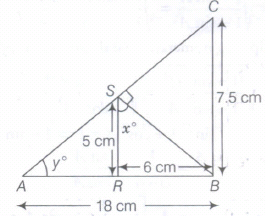
In the given figure, \(\triangle ABC,\) is the right angles at B. \(\triangle BSC\) is right angles at S and BC = 7.5 cm, RS = 5 cm, RB = 6 cm \(\angle BSR=x^0\) and \(\angle SAB=y^0.\) Find
(i) tan x0
(ii) sin y
(ii) cos y0
5.
If α and β are zeroes of the quadratic polynomial p(x)=x2-(k+6)x+2(2k-1), then find the value of k, if \(a+\beta =\frac { a\beta }{ 2 } \) .
6.
Find the sum of first 24 terms of the AP a1, a2, a3 ..., if its is known that a1 + a5 + a10 + a15 + a20 + a24 = 225
7.
Solve each of the following equation by factorisation.
t2+3t-10=0
8.
A child reshapes a cone of height 24 cm and base radius 6 cm, to the form of a sphere. Find the radius of the sphere.
9.
A box contains cards numbered 6 to 50.A card is down at random from the box.Find the probability that the drawn card has a number which is a perfect square.
10.
Given a rhombus PQRS in which PQ = 5.5 cm and angle PQR = 70o . Divide it into two triangles say PQR and PSR. Construct the triangle PQ'R' similar to triangle PQR with scale factor \(\frac { 3 }{ 2 } \). Draw a line segment R'S' parallel to RS, where R' lies on extended PR and S' lies on extended PS. Is PQ'R'S' a rhombus? Give reasons.
11.
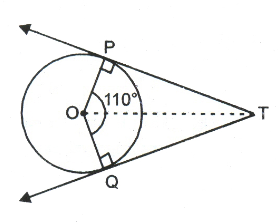
In the given figure, if TP and TQ are the two tangent to a circle with centre O, so that \(\angle POQ={ 110 }^{ \circ }\), then find \(\angle PTQ\).
12.
The angle of elevation of the top of the building of an organisation working for poor and needy children at a point on level ground is 45o. After moving 100m towards the building along the same horizontal line, the angle of elevation of the building is 600 .Find the height of the building.
(i)Which mathematical concept is being used here?
(ii)Which social act is being discussed here?
13.
If two vertices of a triangle are (6, 3) and (-1, 7) and centroid (1, 5), then find the third vertex.
14.
If the equation \(9x^{2} + 6kx+4 = 0\) has equal roots, then find the value of k.
15.
Find the 10th term of the AP : 2, 7, 12, . . .
16.
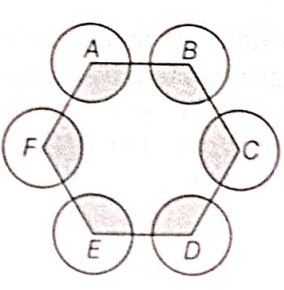
ABCDEF is a regular hexagon. With vertices A, B, C, D, E and F as the centres of circles with same radius r are drawn. Find the area of the shaded portion shown in the given figure.
17.
Draw a line segment AB of length 7 cm. Taking A as centre, draw a circle of radius 3 cm and taking B as centre, draw another circle of radius 2 cm. Construct tangents to each circle from the centre of the other circle
18.
In an isosceles right angled triangle, if the hypotenuse is \(5\sqrt{2}\) cm, then find the length of the sides of the triangle.
19.
Using section formula, show that the points A(-3, -1), B(1, 3) and C(-1, 1) are collinear.
20.
Three unbiased coins are tossed together. What is the probability of getting
(i) two heads?
(ii) atleast two heads?
(iii) atmost two heads?
21.
Divide 56 in four parts in AP, such that the ratio of the product of their extremes (1st and 4th) to the product of means (2nd and 4rd) is 5 : 6.
22.
A statue 1.46 m tall stand on the top of a pedestal. From a point on the ground, the angle of elevation of the top of the statue is 60o and from the same point, the angle of elevation of the top of the pedestal is 45o . Find the height of the pedestal. \((\sqrt { 3 } =1.73)\) .
23.
AB is a diameter of a circle. AH and BK are perpendicular from A and B respectively to the tangent at P.Prove that AH + BK = AB.
24.
The sum of all the angles of a triangle is________________
25.
Sum of 1st and 3rd term of an A.P. is equal to .......... the 2nd term.
26.
If \(15\tan ^{ 2 }{ \theta } +4\sec ^{ 2 }{ \theta } =23\), then find the value of \(\left( \sec { \theta } +cosec\theta \right) ^{ 2 }-\sin ^{ 2 }{ \theta } \)
27.
If α and β are the zeroes of the quadratic polynomial f(x)=x2-px+q, then prove that \(\frac { a^{ 2 } }{ \beta ^{ 2 } } +\frac { \beta ^{ 2 } }{ a^{ 2 } } =\frac { p^{ 4 } }{ q^{ 2 } } -\frac { 4p^{ 2 } }{ q } +2.\)
28.
Three horses are tethered at 3 corner of a triangular plot having sides 20 m, 30 m and 40 m with ropes of 7 m length each. Find the area of this plot which can be grazed by the horses.
29.
From the top of a hill the angles of depression of two consecutive kilometre stones east are found to be 30o and 60o . Find the height of the hill.
30.
The external length, breadth and height of a closed rectangular wooden box are 18 cm, 10 cm and 6 cm respectively and thickness of wood is 1/2 cm. When the box is empty it weighs 15 kg and when filled with sand it weighs 100 kg. Find the weight of the cubic cm of wood and cubic am of sand.
31.
‘a’ and ‘b’ are two prime numbers . What is their HCF
1
ab
a
b
32.
If H and h be the heights of two cylinders, then the ratio of curved surface areas of two cylinders with equal radii is
√H : 2√h
H : h
H2 : h2
2H : h
33.
An observer 1.5 m tall is 28.5 m away from a tower. The angle of elevation of the top of the tower from his eyes is 45°. The height of the tower is
30 m
20 m
40 m
10 m
34.
To divide a line segment AB in the ratio 4:7, a ray AX is drawn first such that ∠BAX is an acute angle and then points are located at equal distances on the ray AX and the point B is joined to
A12
A11
A10
A9
1.
| x | 3 | 9 | 15 | 21 | 27 | |
|---|---|---|---|---|---|---|
| f | 7 | 5 | 10 | 12 | 6 | \(\Sigma f=40\) |
| fx | 21 | 45 | 150 | 252 | 162 | \(\Sigma fx=630\) |
\(\Sigma fx=630\) , \(\Sigma f=40\)
Mean = \(\frac { 630 }{ 40 } =15.75\)
2.
Area of the sector =\(\frac{1}{2}\times\)(length of the corresponding are) \(\times\)radius
\(=\frac { 1 }{ 2 } \times l\times r\)
\(=\frac { 1 }{ 2 } \times 12\times 6\)
= 36 cm
3.
\(\angle QOR+\angle QPR={ 180 }^{ ° }\)
(Supplementary angle)
\(\Rightarrow \quad \angle QOR+{ 46 }^{ ° }={ 180 }^{ ° }\)
\(\Rightarrow \quad \angle QOR={ 180 }^{ ° }-{ 46 }^{ ° }={ 134 }^{ ° }\)
4.
Given, \(\angle CBA=90^0,\angle BRS=90^0,\angle BSC=90^0,\) BC = 7.5 cm, RS = 5 cm, BR = 6 cm and AB = 18 cm
Then, AR = AB - RB = 18 - 6 = 12 cm
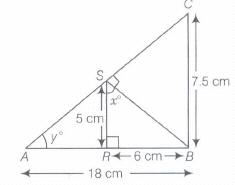
In \(\triangle ABC,\) by using Pythagoras theorem, we get
AS2 = AR2 + RS2 = (12)2 + (5)2
AS2 = 144 + 25 = 169
\(\Rightarrow\) AS = \(\sqrt 169\)
\(\therefore\) AS = 13 cm [since, side cannot be negative]
\((i)\quad In\quad \triangle BRS,\ tan{ x }^{ 0 }=\frac { P }{ B } =\frac { BR }{ RS } =\frac { 6 }{ 5 } \quad \)
\((ii)\quad In\quad \triangle ARS,\quad sin{ y }^{ 0 }=\frac { P }{ H } =\frac { SR }{ AS } =\frac { 5 }{ 13 } \)
\((iii)\quad In\quad \triangle ARS,\quad cos{ y }^{ 0 }=\frac { AR }{ AS } =\frac { 12 }{ 13 } \)
5.
k=7
6.
Let a be the first term and d be the common of given AP.
Then, a1 + a5 + a10 + a15 + a20 + a24 = 225
\(\Rightarrow \quad a+(a+4d)+(a+9d)+(a+14d)+(a+19d)+(a+23d)=225\)
\(\\ \Rightarrow \quad 6a+69d=225\ \)
\(\ \Rightarrow \quad 2a+23d=75\)
Now, \(S_{ 24 }=\frac { 24 }{ 2 } \left[ 2a+(24-1)d \right] \)
\(=12\left[ 2a+23d \right] =12\times 75\)
= 900
7.
As c is negative, find such factors of 10 whose difference is 3.(-5,2)
8.
6 cm
9.
Total number of cards = 1000
(i) Perfect square greater than 500 = 529, 576, 625,676,729,784,841,900,961
= 9 outcomes only
∴ Required Probability = \(\frac { 9 }{ 1000 } =0.009\)
(ii) After first player, who has won the prize the number of perfect squares greater than 500 will be 9 -1 i.e., 8
∴ Required probability = \(\frac{8}{999}\)
10.
Yes
11.
70∘
12.
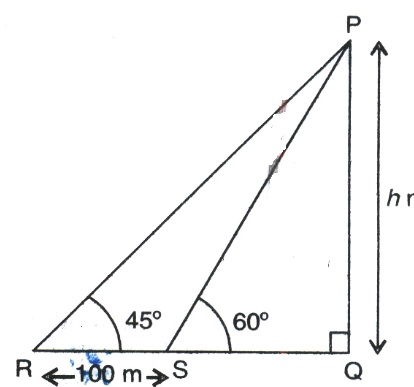
Let PQ be the building of height h m . Let R and S br the two positions on the ground such that
ㄥPRQ=45o, ㄥPSQ=60o
and RS=100 m
Now in rt ΔSQP, we obtain
\(\frac { PQ }{ SQ } \)=tan 60o
⇒ \(\frac { PQ }{ \sqrt { 3 } } =SQ\ or\ \frac { h }{ \sqrt { 3 } } =SQ\)
Also, in rt . ΔRQP, we obtain
\(\frac { PQ }{ RQ } \)=tan 450 ⇒ PQ=RQ
⇒ h=100+SQ
⇒ h=100+\(\frac { h }{ \sqrt { 3 } } \)
⇒ h\(\left( 1-\frac { 1 }{ \sqrt { 3 } } \right) \)=100
h=\(\frac { 100\sqrt { 3 } }{ \sqrt { 3 } -1 } \times \frac { \sqrt { 3 } +1 }{ \sqrt { 3 } +1 } \)
=50(3+\(\sqrt { 3 } \))m
Thus, height of the building is 50(3+ \(\sqrt { 3 } \))m
(i) Some applications of trigonometry
(ii) Kindness, charity and sacrifice.
13.
(-2, 5)
14.
\(k =\pm \ 2\)
15.
Here, a = 2, d = 7 – 2 = 5 and n = 10.
We have an = a + (n – 1) d
So, a10 = 2 + (10 – 1) × 5 = 2 + 45 = 47
Therefore, the 10th term of the given AP is 47.
16.
Each angle of regular hexagon \(=\frac{\text { Sum of all angles }}{\text { Number of sides }}\)
\(=\frac{(6-2) \times 180^{\circ}}{6}=120^{\circ}\)
\(\therefore \angle A=\angle B=\angle C=\angle D=\angle E=\angle \mathrm{F}=120^{\circ}\)
Area of shaded region = 6 \(\times\) Area of sector with \(\angle\)A.
Ans. 2\(\pi\)r2
17.
Steps of Construction:
1. Draw a line segment AB of 7 cm
2. Taking A and B as centre draw two circle of 3 cm and 2 cm radius
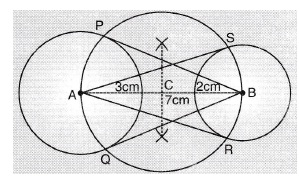
3. Bisect the line AB. Let mid-point of AB is C.
4. Taking C as centre draw a circle of radius AC which will intersect the circle at point P, Q, R and S.
5. Join BP, BQ, AS and AR. These are the required tangents.
18.
Since, ABC is an isosceles right angled triangle.
So, AB = BC ...(i)
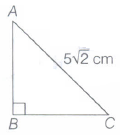
By Pythagoras theorem,
AC2 = AB2 + BC2
\(\Rightarrow \) AC2 = 2 AB2 [From Eq. (i)]
\(\Rightarrow \) \(\left( 5\sqrt { 2 } \right) ^{ 2 }\) = 2 AB2
\(\Rightarrow \) \(\frac{50}{2}\) = AB2
\(\Rightarrow \) AB2 = 25 \(\Rightarrow \) AB = 5
Hence, the length of the equal sides of a triangle is 5 cm.
19.
Let C(-1, 1) divides AB in the ratio k:1.
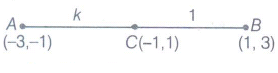
Then, by using section formula, we get
\(C(-1,1)=C\left( \frac { k-3 }{ k+1 } ,\frac { 3k-1 }{ k+1 } \right) \)
On equating x-coordinate from both sides, we get
\(-1=\frac { k-3 }{ k+1 } \\ \Rightarrow -k-1=k-3\\ \Rightarrow -2k=-3+1 \ \Rightarrow -2k=-2\\ \Rightarrow k=1\)
On equating y-coordinate from both sides, we get=
\(1=\frac { 3k-1 }{ k+1 } \\ \Rightarrow k+1=3k-1\\ \Rightarrow 2k=2 \ \\ \Rightarrow k=1\)
Since in both cases value of k is same. So, C divides AB in the ratio of 1:1. i.e. C is the mid-point of AB.
Hence, A, B and C are collinear.
20.
(i) \(\frac { 3 }{ 8 } \)
(ii) \(\frac { 1 }{ 2 } \)
(iii)\(\frac { 7 }{ 8 } \)
21.
Let four parts be a - 3d, a - d, a + d and a + 3d
a - 3d + a - d + a + d + a +3d = 56
4a = 56
a = 14
A.T.Q
\(\frac { \left( a-3d \right) \left( a+3d \right) }{ (a-d)(a+d) } =\frac { 5 }{ 6 } \)
\(\frac { { a }^{ 2 }-{ ad }^{ 2 } }{ { a }^{ 2 }-{ d }^{ 2 } } =\frac { 5 }{ -6 } \)
\(\Rightarrow \frac { { \left( 14 \right) }^{ 2 }-9{ d }^{ 2 } }{ { \left( 14 \right) }^{ 2 }-{ d }^{ 2 } } =\frac { 5 }{ 6 } \Rightarrow \frac { 196-9{ d }^{ 2 } }{ 196-{ d }^{ 2 } } =\frac { 5 }{ 6 } \)
\(\Rightarrow 1176-54{ d }^{ 2 }=980-5{ d }^{ 2 }\)
\(\Rightarrow 196=4{ d }^{ 2 }\)
\(\Rightarrow { d }^{ 2 }=4\Rightarrow d=\pm 2\)
when a = 14, d = 2
four parts are
14 - 3 x 2, 14 - 2, 14 + 2, 14 + 3 x 2,
i.e. 8,12,16,20
when a = 14, d = -2
four parts are 20,16,12 and 8
22.
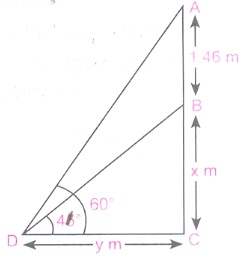
Let AB is statue, BC is pedestal and BC=x m, CD=y m.
In right ΔBCD, ΔBCD, \(\frac { BC }{ CD } \)=tan 45o
⇒, \(\frac { x }{ y } \)=1 ⇒ x=y .....(i)
In right ΔACD, \(\frac { AC }{ CD } \)=tan 600
⇒ \(\frac { x+1.46 }{ y } =\sqrt { 3 } \)
⇒ \(\frac { x+1.46 }{ x } \)=1.73 [Using (i)]
⇒ x+1.46=1.73x ⇒ 0.73x=1.46 ⇒ x=2
23.
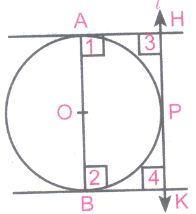
Given: A circle with centre O. AB is the diameter of this circle. I is tangent to the circle. AH and BK are perpendicular to I from A and B at H and K respectively.
To prove: AH + BK = AB
Proof: AH and HP are tangents from the external point H
ஃ AH = HP .....(i)
and BK, KP are tangent from the external point K
ஃ BK = KP ......(ii)
Adding (i) and (ii) we get
AH + BK = HP + PK = HK ......(iii)
AB ⊥ AH
AB ⊥ BK
[Tangent makes 90° angle with radius at the point of contact]
⇒ \(\angle \)1 = \(\angle \)2 = 90°
Given that AH ⊥ i ⇒ \(\angle \)3 = 90°
and BK ⊥ i ⇒ \(\angle \)4 = 90°
∵ \(\angle \)1 = \(\angle \)2 = \(\angle \)3 = \(\angle \)4 = 90°
⇒ AHKB is a rectangle
⇒ AB = HK ......(iv)
[Opposite sides of a rectangle are equal]
From (iii) and (iv) ⇒ PH + PK = AB
AH + BK = AB from (i) and (ii) Hence proved.
24.
()
180o
25.
()
Twice [\(\because\) Let a1, a2, a3 are first three terms of A.P.
a2 - a1 = a3 - a2
2a2 = a1 + a3 ]
26.
\(15\tan ^{ 2 }{ \theta } +4\sec ^{ 2 }{ \theta } =23\)
\(15\tan ^{ 2 }{ \theta } +4\left( \tan ^{ 2 }{ \theta } +1 \right) =23\)
\(\left( \because \sec ^{ 2 }{ \theta } =1+\tan ^{ 2 }{ \theta } \quad \right) \)
\(\Rightarrow \quad 15\tan ^{ 2 }{ \theta } +4\tan ^{ 2 }{ \theta } +4=23\)
\(\Rightarrow \quad 19\tan ^{ 2 }{ \theta } =19\)
\(\Rightarrow \quad \tan { \theta } =1=\tan { { 45 }^{ ° } } \)
\(\therefore \quad \theta ={ 45 }^{ ° }\)
Now, \(\left( \sec { \theta } +cosec\theta \right) ^{ 2 }-\sin ^{ 2 }{ \theta } \)
\(=\left( \sec { { 45 }^{ ° } } +cosec{ 45 }^{ ° } \right) ^{ 2 }-\sin ^{ 2 }{ { 45 }^{ ° } } \)
\(={ \left( \sqrt { 2 } +\sqrt { 2 } \right) }^{ 2 }-{ \left( \frac { 1 }{ \sqrt { 2 } } \right) }^{ 2 }\)
\(=\left( 2\sqrt { 2 } \right) ^{ 2 }-\frac { 1 }{ 2 } \)
\(=8-\frac{1}{2}=\frac{15}{2}\)
27.
We have to prove, \(\frac { a^{ 2 } }{ \beta ^{ 2 } } +\frac { \beta ^{ 2 } }{ a^{ 2 } } =\frac { p^{ 4 } }{ q^{ 2 } } -\frac { 4p^{ 2 } }{ q } +2\)
Given α and β are the zeroes of the quadratic polynomial f(x)=x2-px+q
∴ Sum of zeroes, α+β=\(\frac { -(-p) }{ 1 } =p\) and product of zeroes, \(a\beta =\frac { q }{ 1 } =q\)
Now, LHS\(=\frac { a^{ 2 } }{ \beta ^{ 2 } } +\frac { \beta ^{ 2 } }{ a^{ 2 } } \frac { a^{ 4 }+\beta ^{ 4 } }{ a^{ 2 }\beta ^{ 2 } } =\frac { (a^{ 2 })^{ 2 }(\beta ^{ 2 })^{ 2 } }{ a^{ 2 }\beta ^{ 2 } } \)
\(=\frac { (a^{ 2 }+\beta ^{ 2 })^{ 2 }-2a^{ 2 }\beta ^{ 2 } }{ a^{ 2 }\beta ^{ 2 } } \)
\(\left[ \because \quad a^{ 2 }+b^{ 2 }=(a+b)^{ 2 }-2ab \right] \)
\(=\frac { \left[ (a+\beta )^{ 2 }-2a\beta \right] ^{ 2 }-2\left( a\beta \right) ^{ 2 } }{ \left( a\beta \right) ^{ 2 } } \)
On substituting α+β=p and αβ=q, we get
\(LHS=\frac { \left[ p^{ 2 }-2q \right] ^{ 2 }-2q^{ 2 } }{ q^{ 2 } } \)
\(=\frac { (p^{ 2 })^{ 2 }+(2q)^{ 2 }-2\times p^{ 2 }\times 2q-2q^{ 2 } }{ q^{ 2 } } \)
\(\left[ \because \quad (a-b)^{ 2 }=a^{ 2 }+b^{ 2 }-2ab \right] \)
\(=\frac { p^{ 4 }+4q^{ 2 }-4p^{ 2 }q-2q^{ 2 } }{ q^{ 2 } } \)
\(=\frac { p^{ 4 }+2q^{ 2 }-4p^{ 2 }q }{ q^{ 2 } } =\frac { p^{ 4 } }{ q^{ 2 } } -\frac { 4p^{ 2 } }{ q } +2\)
=RHS
\(\therefore \) LHS=RHS
28.
77 m2
29.
Let AB= hm be height of the hill. BC = x km and BD = (x+1) km As ∠ACB = 600 and ∠ADB = 300 Consider rt. △ABC, we have
\(\frac{AB}{BC}\) =tan 60o
\(\frac{h}{x}=\sqrt{3}\)
⇒ h=\(\sqrt{3}x\) --- (i)
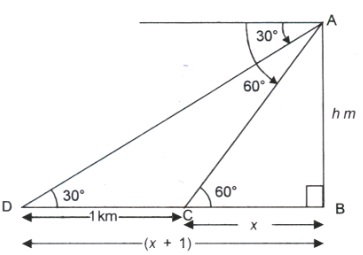
Consider rt. △ABD, we have
\(\frac{AB}{BD} \)=tan 30o
⇒ \(\sqrt{3}\)h=x+1
⇒ \(\sqrt{3}\)x\(\sqrt{3}\)x=x+1 [using(i)]
⇒ 3x=x+1
2x=1 ⇒ \(x=\frac{1}{2}\)
Putting the value of x in eq.(i), we have
h=\(\sqrt{3}\)x\(\frac{1}{2}\)=\(\frac{1.732}{2}\)
=0.866 km
=866 metre
∴ Height of the hill = 866 metre.
30.
Volume of the wood
= External volume - internal volume
= (18 x 10 x 6 -17 x 9 x 5 ) cm3
= 315 cm3
Weight of box = 15 kg
Weight of 1 cubic cm of wood
\(=\frac { 15 }{ 315 } =\frac { 1 }{ 21 } kg\)
Weight of box with sand = 100 kg
Weight of sand = 100 - 15 = 85 kg
Voluhle of sand = volume of the box
\(\Rightarrow \) Weight of 1 cu cm of stand
= \(\frac { 85 }{ 315 } =0.27\ kg\)
31.
(a)
1
32.
(b)
H : h
33.
(a)
30 m
34.
Since 4 + 7 = 11points are to be located on AX at equal distantes, so B is joined to last point, A11.

10th Standard CBSE Syllabus & Materials
10th Standard CBSE
CBSE 10th Social Science PS - Federalism - New Model Questions Papers Study Material - QB365 Set A
NEW10th Standard CBSE
CBSE 10th Social Science PS - Power Sharing - New Model Questions Papers Study Material - QB365 Set A
NEW10th Standard CBSE
CBSE 10th Social Science GEO - Manufacturing Industries - New Model Questions Papers Study Material - QB365 Set A
NEW10th Standard CBSE
CBSE 10th Social Science GEO - Minerals and Energy Resources - New Model Questions Papers Study Material - QB365 Set A



CBSE 10th Standard CBSE Subjects
CBSE Standards





