
 100% FREE ACCESS
10th Standard CBSE Syllabus & Materials
10th Standard CBSE
CBSE 10th Social Science ECO - Globalisation and the Indian Economy - New Model Questions Papers Study Material - QB365 Set A
NEW10th Standard CBSE
CBSE 10th Social Science ECO - Money and Credit - New Model Questions Papers Study Material - QB365 Set A
NEW10th Standard CBSE
CBSE 10th Social Science ECO - Sectors of the Indian Economy - New Model Questions Papers Study Material - QB365 Set A
NEW10th Standard CBSE
CBSE 10th Social Science ECO - Development - New Model Questions Papers Study Material - QB365 Set A
NEW10th Standard CBSE
CBSE 10th Social Science PS - Outcomes of Democracy - New Model Questions Papers Study Material - QB365 Set A
NEW10th Standard CBSE
CBSE 10th Social Science PS - Gender, Religion and Caste - New Model Questions Papers Study Material - QB365 Set A

Published on: 13/02/2020
10th standard CBSE Mathematics Board Exam Model Question Paper V 2019-2020
Download CBSE Class 10th Standard CBSE Maths question papers, sample papers, important questions, and previous year solved papers in PDF format. Get free study materials, NCERT solutions, and exam preparation resources for Class 10th Standard CBSE Maths
Questions + Answers key
Take MCQ Maths Test
1.
The frequency distribution of agricultural holdings in a village is given below:
| Area of land (in hectare) | 1-3 | 3-5 | 5-7 | 7-9 | 9-11 | 11-13 |
|---|---|---|---|---|---|---|
| Number of families | 20 | 45 | 80 | 55 | 40 | 12 |
Find the modal agricultural holdings of the village
2.
If the product of the zeroes of the polynomial (ax2-6x-6) is 4, then find the value of a.
3.
Find the centroid of a triangle whose vertices are (3, -7), (-8, 6) and (5, 10).
4.
If the probability of an event is p, then the probability of its complementary event
5.
Construct a tangent to a circle of radius 3 cm from a point on the concentric circle of radius 5 cm and measure its length. Also, verify the measurement by actual calculation.
6.
Draw a parallelogram LMNO with LM = 6.5 cm, MN = 4 cm and angle LMN = 45o , divide it into two triangles triangle LMN and triangle LNO by joining its diagonal LN. Construct triangle LM'N' similar to triangle LMN with scale factor \(\frac { 2 }{ 3 } \). Draw line O'N' \(\parallel \) ON. Is LM'N'O' a parallelogram?
7.
A tree is broken by the wind, the top struck the ground at an angle of 600 and at a distance of 20m from the root of the tree.Then find the whole height of the tree.
8.
PQ is tangent to circle with centre O. Find the radius of the circle, if PO = 5 cm and PQ = 4 cm.
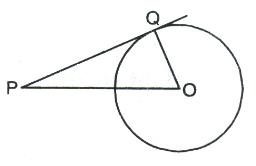
9.
If sum of five numbers in A.P. is 40, then find the middle term.
10.
The internal and external diameters of a hollow hemispherical vessel are 24cm and 25cm respectively.The cost to paint 1cm2 of the surface is Rs.0.05.Find the total cost to painting the vessel all over.
11.
What is the angle subtended at the centre of a circle of radius 6 cm by an arc of length 6\(\pi\) cm.
12.
If x is a positive integer such that the distance between the points P(x,2) and Q(3,-6) is 10 units, then x=?
13.
One-fourth of a herd of camels was seen in a forest. Twice the square root of the herd had gone to mountains and the remaining 15camels were seen on the bank of a river. Find the total number of camels.
14.
Two APs have the same common difference. The difference between their 100th terms is 100, what is the difference between their 1000th terms?
15.
A tangent to a circle intersects it in __________ point(s).
16.
Three points A, B and C are collinear, if any one of the following takes place:
........... + AB = CB
17.
If ABC is an obtuse angled triangle, obtuse angled at B and if AD \(\bot \) CB. Prove that:
AC2 = AB2 + BC2 + 2BC \(\times\)BD
18.
If (5, 2), (-3, 4) and (x, y) are collinear, show that x + 4y - 13 = 0.
19.
If an isosceles ∆ABC in which AB = AC = 6 cm is inscribed in a circle of radius 9 cm, then find the area of the triangle
20.
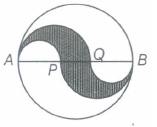
In the given figure, diameter AB is 12 cm long. AB is trisected at points P and Q. Find the area of the shaded region.
21.
A vertical tower is \(2\sqrt { 3 } m\) high and the length of its shadow is 2 m. Find the angle of elevation of the source of light.
22.
Anita, Sita, Gita and Rita are four friends. What is the probability that (in a non-leap year)
(i) all will have same birthday
(ii) their birthdays fall in the month of October.
(iii) their birthdays fall on 10th day of the months.
(iv) their birthdays fall in January or February
23.
The sum of first q terms of an A.P. is 63q - 3q2. If its pth term is -60, find the value of p. Also, find the 11th term of this A.P.
24.
If \(\sqrt { 3 } \sin { \theta } =\cos { \theta } \), find the value of \(\frac { \tan { \theta } (1+\cot { \theta } ) }{ \sin { \theta } +\cos { \theta } } .\)
25.
If polynomial 6x4+8x3+17x2+21x+7 is divided by another polynomial 3x2+4x+1, then what will be the quotient and remainder?
26.
Is product of a rational number and an irrational number, a rational number? Is product of two irrational numbers. rational or irrational number? Justify by giving examples.
27.
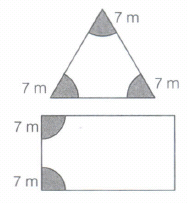
A farmer has two types of fields-In the form of a triangle and a rectangle. Rani is allowed to cut grass of triangular part (shaded) and Ramu of rectangular field (shaded). Calculate the areas of the shaded portion. What value is depicted by the farmer?
28.
The difference between the inner and outer surfaces of a cylinder 14 cm long is 88cm2 If the volume of the cylinder is 176 cm3, then find its inner and outer radii.
29.
Two dice are numbered 1,2,3,4,5,6 and 1,1,2,2,3,3 respectively.They are thrown and the sum of the numbers on them is noted.Find the probability of getting each sum from 2 to 9 separately
30.
The angle of depression of two ships from the top of a lighthouse are 450 are 300 towards east.If the ships are 200m apart, find the height of the lighthouse.
31.
A Segment AB is divided at point P such that \(\frac { PB }{ AB } =\frac { 3 }{ 7 } \) then find the radio AP : PB.
32.
What is the HCF of 1076 and 584
16
4
12
24
33.
If the curved surface area of a right circular cylinder is 1760 cm2 and its radius is 10 cm, then what is its height?
7 cm
24 cm
28 cm
14 cm
34.
The angle formed by the line of sight with the horizontal, when the point being viewed is above the horizontal level is called:
Obtuse angle
Angle of elevation
Angle of depression
Vertical angle
35.
In the triangles PQR and NLM, angle M will be
70°
40°
60°
50°
1.
Modal class = 5-7
l = 5 , f1=80,f0=45,h=2,f2=55
Mode = \(l+\frac { (f_{ 1 }f_{ 0 }) }{ 2f_{ 1 }-f_{ 0 }-f_{ 2 } } \times h\)
\(=5+\frac { 80-45 }{ 160-45-55 } \times 2=5+\frac { 35\times 2 }{ 60 } \)
= 6.17
2.
\(a=-\frac { 3 }{ 2 } \)
3.
Here, (x1, y1)=(3, -7), (x2, y2) = (-8, 6) and (x3, y3) = (5, 10)
\(\therefore \) Coordinates of the centroid of a triangle are \(\left( \frac { 3-8+5 }{ 3 } ,\frac { -7+6+10 }{ 3 } \right) \) i.e. (0, 3).
\(\therefore\) centroid of triangle\(=\left( \frac { { x }_{ 1 }+{ x }_{ 2 }+{ x }_{ 3 } }{ 3 } ,\frac { { y }_{ 1 }+{ y }_{ 2 }+{ y }_{ 3 } }{ 3 } \right) \)
4.
Required probability=1 - p
5.
4 cm
6.
Yes
7.
\(20(\sqrt{3}+2)m\)
8.
3 cm
9.
Let the five numbers in A.P. be
a-2d, a-d, a, a+d, a+2d
Here, sum of five numbers = 40
\(\therefore \) a-2d + a-d + a + a+d + a+2d = 40
\(\Rightarrow \) 5a = 40; \(\Rightarrow \) a = 8
Hence, the middle term is 8.
10.
Internal radius=\(\frac{24}{2}\)cm
External radius=\(\frac{25}{2}\)cm
Area to be painted=outer C.S.A. + inner C.S.A. + area of the ring.
=2πR2+2πr2+π[R2-r2]
=2x\(\frac{22}{7}\)x\(\frac{25}{2}\)x\(\frac{25}{2}\)+2x\(\frac{22}{7}\)x\(\frac{24}{2}\)x\(\frac{24}{2}\)+\(\frac{22}{7}\)\(\left[\left(\frac{25}{2}\right)^{2}-\left(\frac{24}{2}\right)^{2}\right]\)
=2x\(\frac{22}{7}\)x\(\frac{1}{4}\)[625+576]+\(\frac{22}{7}\)\(\left[\frac{25}{2}-\frac{24}{2}\right]\)\(\left[\frac{25}{2}-\frac{24}{2}\right]\)
=\(\frac{22}{7}\)\(\left[\frac{1201}{2}+\frac{1}{2}\times \frac{49}{2}\right]\)
=\(\frac{22}{7}\)x\(\frac{1}{4}\)[2402+49]
=\(\frac{22}{7}\)x\(\frac{1}{4}\)x2451 cm2
Cost of painting=Rs.0.05x\(\frac{22}{7}\)x\(\frac{1}{4}\)x2451=Rs.96.28
11.
\(l=6\pi ,r=6cm,\theta =?\)
\(l=\frac { \theta \pi r }{ { 180 }^{ ° } } \Rightarrow 6\pi =\frac { \theta \times \pi \times 6 }{ { 180 }^{ ° } } \Rightarrow \theta ={ 180 }^{ ° }\)
12.
Distance between the points P(x,2) and Q(3,-6) is 10.Using distance formula PQ=10
\(\Rightarrow \quad \sqrt { { ({ x }-3) }^{ 2 }-{ \{ 2-(-6) }^{ 2 }\} } =10\)
\(\Rightarrow \quad \sqrt { { x }^{ 2 }+{ 3 }^{ 2 }-2\times 3\times x+\left( 2+6 \right) ^{ 2 } } =10\)
\(\Rightarrow \quad \sqrt { { x }^{ 2 }+9-6x+{ 8 }^{ 2 } } =10\)
\(\Rightarrow \quad \sqrt { { x }^{ 2 }+9-6x+64 } =10\)
\(\Rightarrow \quad \sqrt { { x }^{ 2 }-6x+73 } =\quad 10\)
Squaring both sides, we get
\(\quad { x }^{ 2 }-6x+73=100\)
\(\Rightarrow \quad { x }^{ 2 }-6x+73-100=0\)
\(\\ \Rightarrow \quad { x }^{ 2 }-6x-27=0\)
\(\\ \Rightarrow \quad { x }^{ 2 }-9x+3x-27=0\)
\(\Rightarrow x(x-9)+3(x-9)=0\)
\(\Rightarrow \quad (x-9)(x+3)=0\)
\(\Rightarrow \quad either\quad x-9=0\quad or\quad x+3=0\)
\(\Rightarrow \quad x=9\quad or\quad x=-3\)
gnoring x = —3 as it is given that x is a positive Integer.
Thus, only solution is x = 9.
13.
Let number of camels be x
ATQ \(\frac { 1x }{ 4 } +2\sqrt { x } +15=x\)
\(\Rightarrow \frac { x+8\sqrt { x } +60 }{ 4 } =x\)
\(\Rightarrow x+8\sqrt { x } +60=4x\)
\(\Rightarrow 3x-8\sqrt { x } -60=0\)
Let \(\sqrt { x } =1\)
\(\therefore 3t^{ 2 }-8t-60=0\)
\(\Rightarrow 3t^{ 2 }-18t+10t-60=0\)
\(\Rightarrow 3t(t-6)+10(t-6)=0\)
(3t+10)=0 or (t-6)=0
\(\Rightarrow t=\frac { -10 }{ 3 } \) or t=6
Rejecting t = \(\frac { -10 }{ 3 } \Rightarrow t=6\)
\(\Rightarrow \sqrt { x } =6\Rightarrow x=36\)
14.
Let the two APs be a1,a2,a3,.....,an ... and b1, b2, b3, ...., bn.....
Also, let d be the same common difterence of two AP's. Then, the nth term of first AP is
an = a1 + (n - 1)d
and the nth term of second AP is
bn = b1 + (n - 1) d
Now, an - bn = [a1 + (n - 1)d] - [b1 + (n - 1) d]
\(\Rightarrow\) an - bn = a1 - b1, \(\forall\) n \(\in\)N
\(\therefore\) a100 - b100 = a1 - b1 = 100 [given]
So, a1000 - b1000 = a1 - b1
\(\Rightarrow\) a1000 - b1000 = 100 [\(\because\) a1 - b1 = 100]
Hence, the difference between their 1000 th terms is also 100 for all n \(\in\) N.
15.
()
one
16.
()
CA
17.
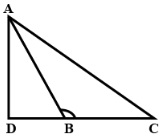
In MDC, By Pythagoras theorem,
AC2 = AD2 + CD2
= AD2 + (BC + BD)2
= AD2 + BC2 + 2BC x BD + BD2
= AB2 + BC2 + 2BC x BD
18.
Since the points are collinear
The area of triangle = 0
Area of triangle \(=\frac { 1 }{ 2 } \left[ { { x }_{ 1 }\left( { y }_{ 2 }-{ y }_{ 3 } \right) +{ x }_{ 2 }\left( { y }_{ 3 }-{ y }_{ 1 } \right) +{ x }_{ 3 }\left( { y }_{ 1 }-{ y }_{ 2 } \right) } \right] \)
\(\Rightarrow \ \frac { 1 }{ 2 }[5(4-y)+(-3)(y-2)+x(2-4)]=0\)
\(\Rightarrow \ \frac { 1 }{ 2 }[20-5y-3y+6+(-2x)]=0\)
\(\Rightarrow \ \frac { 1 }{ 2 }[-2x-8y+26]=0\)
\(\Rightarrow \ x+4y-13=0\)
19.
Let O be the centre and P be the mid-point of BC.Then, OP丄BC.
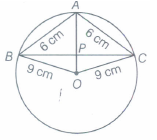
Since, ∆ABC is an isosceles triangle and P is the mid-point of BC. Therefore, AP .L BC as median from the vertex in an isosceles triangle is perpendicular to the base.
Let AP = x
and PB = CP = y
In ΔAPB and ΔOPB,
AB2 = BP2 + AP2
36 = y2 + x2
and OB2=OP2+BP2
81= (9- x)2 + y2
On subtracting Eqq.(i) from Eq.(ii) we get
81- 36 = [(9 - x)2 + y2]- (y2 + x2)
45 =81-18x+x2+y2 -y2 -x2
45=81-18x
18x=81-45
18x = 36
\(x={36\over 18}\)
x=2cm
On putting x = 2 in Eq.(i), we get
36=y2+4
y2=32
\(y=4\sqrt{2}cm\)
BC=2BP
=2y=\(8\sqrt{2}cm\)
Now, area of ∆ABC=\({1\over2}\times BC\times AP\)
\(={1\over2}\times8\sqrt{2}\times2\)
\(=8\sqrt{2}cm^2\)
Hence, the area of ∆ABC is \(=8\sqrt{2}cm^2\)
20.
Area of shaded region = 2 x [Area of semi-circle with diameter AQ -Area of semi-circle with diameter AP].
= 37.68\(\pi\) cm2
21.
60°
22.
(i) \(\frac { 3 }{ 8 } \)
(ii) \(\frac { 1 }{ 2 } \)
(iii) \(\frac { 12 }{ 365 } \)
(iv) \(\frac { 59 }{ 365 } \)
23.
Here, Sq = 63q - 3q2 ....(i)
Also, Sq-1 = 63 ( q - 1 ) - 3 ( q - 1 )2
= 63q - 63 - 3 ( q2 + 1 - 2q )
\(\Rightarrow\) 500 + 100d + 50 + 50 - d = 500 - 100d + 50 + 5 + d - 594
\(\Rightarrow\) 198d = - 594
\(\Rightarrow\) d = - 3
Thus, the three digits are 5 - ( - 3 ), 5 and 5 - 3, (i.e., 8, 5 and 2 )
Hence, the required number is 852.
24.
As, \(\sqrt { 3 } \sin { \theta } =\cos { \theta } \Rightarrow \tan { \theta } =\frac { 1 }{ \sqrt { 3 } } \)
\(\therefore \frac { \sin { \theta } \tan { \theta } (1+\cot { \theta } ) }{ \sin { \theta } +\cos { \theta } } =\frac { \tan { \theta } \tan { \theta } (1+\cot { \theta } ) }{ \tan { \theta } +1 } \)
\(\frac { 1+\sqrt { 3 } }{ 4 } \)
25.
Quotient=2x2+5, remainder=x+2
26.
Consider 2 and \(\sqrt{2}\)
Consider \(2+\sqrt{3}\) and \(2-\sqrt{3}\)
Also, consider \(\sqrt{2} \text { and } \sqrt{3}\)
No, either rational or irrational.
27.
Area of triangular shaded region
\(=\frac { \angle P }{ { 360 }^{ 0 } } \times \frac { 22 }{ 7 } \times { 7 }^{ 2 }+\frac { \angle Q }{ { 360 }^{ 0 } } \times \frac { 22 }{ 7 } \times { 7 }^{ 2 }+\frac { \angle C }{ { 360 }^{ 0 } } \times \frac { 22 }{ 7 } \times { 7 }^{ 2 }\)
\(\left[ \because Arc\ of\ sector=\frac { \theta }{ { 360 }^{ 0 } } \times \pi { r }^{ 2 } \right] \)
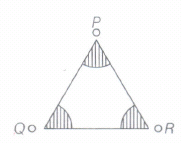
\(=\frac { (\angle P+\angle Q+\angle C) }{ { 360 }^{ 0 } } \times \frac { 22 }{ 7 } \times { 7 }^{ 2 }\)
\(\left[ \because \angle P+\angle Q+\angle R={ 180 }^{ 0 } \right] \)
=11 x 7=77 cm2
Area of the rectangular shaded region
\(=\frac { 90 }{ { 360 }^{ 0 } } \times \frac { 22 }{ 7 } \times { 7 }^{ 2 }+\frac { 90 }{ { 360 }^{ 0 } } \times \frac { 22 }{ 7 } \times { 7 }^{ 2 }+\frac { 90 }{ { 360 }^{ 0 } } \times \frac { 22 }{ 7 } \times { 7 }^{ 2 }\)
\(=2\times \frac { 90 }{ { 360 }^{ 0 } } \times \frac { 22 }{ 7 } \times { 7 }\times 7=77\quad { cm }^{ 2 }\)
The farmer has allowed Rani and Ramu to cut equal amount of grass (77 cm2 ) without any gender bias.
28.
1.5 cm, 2.5 cm
29.
When two dice are thrown simultaneously, then sample space contain ( 6 X6=36) outcomes
Sum 2 i.e., [(1,1),(1,1)] = two outcomes
P( Sum 2) = 2 / 36 = 1 / 18
Sum 3 i.e., (1,2), (1,2), (2,1), (2,1) =4 outcomes.
P( Sum 3) = 4 / 36 = 1 / 9
Sum 4 i.e., [(1,3), (1,3), (2,2), (2,2),(3,1), (3,1)] =6 outcomes
P( Sum 4) = 6 / 36 = 1 / 6
Sum 5 i.e., [(2,3), (2,3), (3,2), (3,2),(4,1), (4,1)] =6 outcomes
P( Sum 5) = 6 / 36 = 1 / 6
Sum 6 i.e., [(3,3), (3,3), (4,2), (4,2),(5,1), (5,1)] =6 outcomes
P( Sum 6) = 6 / 36 = 1 / 6
Sum 7 i.e., [(4,3), (4,3), (5,2), (5,2),(6,1), (6,1)] =6 outcomes
P( Sum 7) = 6 / 36 = 1 / 6
Sum 8 i.e., [(5,3), (5,3), (6,2), (6,2)] =4 outcomes
P( Sum 8) = 4 / 36 = 1 / 9
Sum 9 i.e., [(6,3), (6,3)] =2 outcomes.
P( Sum 9) = 2 / 36 = 1 / 18
30.
273.2
31.
()
Here, AB = 7 I PB = 3
\(\therefore\) AP = AB - PB = 7 - 3 = 4
\(\therefore\)AP : PB = 4: 3
32.
(b)
4
33.
(c)
28 cm
34.
(b)
Angle of elevation
35.
(d)
50°

10th Standard CBSE Syllabus & Materials
10th Standard CBSE
CBSE 10th Social Science PS - Federalism - New Model Questions Papers Study Material - QB365 Set A
NEW10th Standard CBSE
CBSE 10th Social Science PS - Power Sharing - New Model Questions Papers Study Material - QB365 Set A
NEW10th Standard CBSE
CBSE 10th Social Science GEO - Manufacturing Industries - New Model Questions Papers Study Material - QB365 Set A
NEW10th Standard CBSE
CBSE 10th Social Science GEO - Minerals and Energy Resources - New Model Questions Papers Study Material - QB365 Set A



CBSE 10th Standard CBSE Subjects
CBSE Standards





