
 100% FREE ACCESS
10th Standard CBSE Syllabus & Materials
10th Standard CBSE
CBSE 10th Social Science ECO - Globalisation and the Indian Economy - New Model Questions Papers Study Material - QB365 Set A
NEW10th Standard CBSE
CBSE 10th Social Science ECO - Money and Credit - New Model Questions Papers Study Material - QB365 Set A
NEW10th Standard CBSE
CBSE 10th Social Science ECO - Sectors of the Indian Economy - New Model Questions Papers Study Material - QB365 Set A
NEW10th Standard CBSE
CBSE 10th Social Science ECO - Development - New Model Questions Papers Study Material - QB365 Set A
NEW10th Standard CBSE
CBSE 10th Social Science PS - Outcomes of Democracy - New Model Questions Papers Study Material - QB365 Set A
NEW10th Standard CBSE
CBSE 10th Social Science PS - Gender, Religion and Caste - New Model Questions Papers Study Material - QB365 Set A

Published on: 05/08/2019
Coordinate Geometry
Download CBSE Class 10th Standard CBSE Maths question papers, sample papers, important questions, and previous year solved papers in PDF format. Get free study materials, NCERT solutions, and exam preparation resources for Class 10th Standard CBSE Maths
Questions + Answers key
Take MCQ Maths Test
1.
If A(3, 4), B(- 2,3)and C(5, 6) are the vertices of a triangle ABC, find the length of the median AD from A to Be. Also verify that area of \(\triangle ABD\) is equal to area of \(\triangle ACD\)
2.
Find the ratio in which the line segment joining A(1, – 5) and B(– 4, 5) is divided by the x-axis. Also find the coordinates of the point of division.
3.
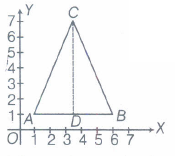
To raise social awareness about hazards of smoking, a school decided to start "NO SMOKING " campaign. 10 students are asked to prepare campaign banners in the shape of triangle (as shown in the figure).
(i) If cost of 1cm2 of banner is Rs.2, then find the overall cost incurred on such campaign.
(ii) Which mathematical concept is used in this question?
(iii) Which value is depicted in this question?
4.
In what ratio does the point (-4,6) divide the line segment joining the point A(-6,10) and B(3,-8)?
5.
Prove that (2,-2),(-2,1) and (5,2) are vertices of a right-angled triangle. Find the area of the triangle and the length of the hypotenuse.
6.
Find a relation between x and y if the points (x,y), (1,2) and (7,0) are collinear.
7.
Find the area of a rhombus if its vertices are (3, 0), (4, 5), (-1, 4) and (-2, -1) taken in order.
8.
Find the distance between the following pairs of points: (2,3),(4,1)
9.
If the centre and radius of circle is (3,4) and 7 units respectively, then what is the position of the point A(5,8) with respect to circle?
10.
Find the distance of a point A(x,y) from the origin.
11.
If point P(2, 1) lies on the line segment joining points A(4, 2) and B(8, 4), then write the relation between AP and AB.
12.
Point A is on x-axis, point B is on y-axis and the point P lies on line segment AB, such that P(4,5) and AP:PB=5:3. Find the coordinates of points A and B.
13.
A circle drawn with origin as the centre passes through \(\left( \frac { 5 }{ 2 } ,0 \right) \). Does the point \(\left( \frac { 5 }{ 2 } ,\frac { 5 }{ 2 } \right) \) lies in its interior or exterior?
14.
If the distance of P(x,y) from the points A(3,6) and B(-3,4) are equal prove that 3x+y=5
15.
If A and B are the points(-6,7) and (-1,-5) respectively then find the distance 2AB.
16.
Show that the points A(5,6), B(1,5), C(2,1) and D(6,2) are the vertices of a square.
17.
Show that points A(7,5),B(2,3) and C(6,-7) are the vertices of a right triangle. Also find its area.
18.
The point of intersection of the medians of a triangle is called the .................. of the triangle.
19.
The distance between the point (2,5) and (7,5) is ...........
20.
Area of triangle formed by the vertices (x1,y1), (x2,y2) and (x3,y3) is the numerical value of ................
21.
.............. is the point of intersection of the axes of coordinates.
1.
Here D is the mid-point of BC, then
\(D=\left( \frac { -2+5 }{ 2 } ,\frac { 3+6 }{ 2 } \right) =\left( \frac { 3 }{ 2 } ,\frac { 9 }{ 2 } \right) \)
Length of AD = \(\sqrt { \left( 3-\frac { 3 }{ 2 } \right) ^{ 2 }+\left( 4-\frac { 9 }{ 2 } \right) ^{ 2 } } \)
\(=\sqrt { \left( \frac { 3 }{ 2 } \right) ^{ 2 }+\left( -\frac { 1 }{ 2 } \right) ^{ 2 } } \)
\(=\sqrt { \frac { 9 }{ 4 } +\frac { 1 }{ 4 } } =\sqrt { \frac { 10 }{ 4 } } \)
\(=\frac { \sqrt { 5 } }{ 2 } \) unit
Area of \(\triangle ABD\)
\(=\frac { 1 }{ 2 } \left[ 3\left( 3-\frac { 9 }{ 2 } \right) -2\left( \frac { 9 }{ 2 } -4 \right) +\frac { 3 }{ 2 } \left( 4-3 \right) \right] \)
\(=\frac { 1 }{ 2 } \left[ -\frac { 9 }{ 2 } -1+\frac { 3 }{ 2 } \right] \)
\(=\frac { 1 }{ 2 } \left[ \frac { -9-2+3 }{ 2 } \right] =\frac { 8 }{ 4 } \)
= - 2 = 2 sq. unit.
Area of \(\triangle ACD\)
\(=\frac { 1 }{ 2 } \left[ 3\left( 6-\frac { 9 }{ 2 } \right) +5\left( \frac { 9 }{ 2 } -4 \right) +\frac { 3 }{ 2 } \left( 4-6 \right) \right] \)
\(=\frac { 1 }{ 2 } \left[ \frac { 9 }{ 2 } +\frac { 5 }{ 2 } -3 \right] =\frac { 1 }{ 2 } \left[ \frac { 9+5-6 }{ 2 } \right] \)
\(=\frac { 8 }{ 4 } =2\) sq. unit.
Hence, Area of \(\triangle ABD\) = Area of \(\triangle ACD\)
2.
Let X-axis divides the line joining the points A(1, -5) and B(-4, 5)in the ratio k : 1 at point M.

By section formula, we get
Coordinates of M = \(\left(\frac{-4 k+1}{k+1}, \frac{5 k-5}{k+1}\right)\) ...(i)
Since, point M lies on X-axis.
\(\therefore\) y-coordinate of M = 0
On equating y-coordinate of M to 0, we get
\(\frac{5 k-5}{k+1}=0 \Rightarrow 5 k-5=0 \Rightarrow k=1\)
On putting k = 1 in Eq. (i) we get
\(\begin{aligned} M=\left(\frac{-4 \times 1+1}{1+1}, \frac{5 \times 1-5}{1+1}\right) & =\left(\frac{-4+1}{2}, \frac{5-5}{2}\right) \\ \end{aligned}\)
\(\begin{aligned} \Rightarrow \quad M & =\left(\frac{-3}{2}, 0\right) \end{aligned}\)
So, the required ratio is 1 : 1 and the coordinates of point of division M is \(\left(\frac{-3}{2}, 0\right)\)
3.
Here, from the figure,
Coordinates of A = (1, 1), coordinates of B = (6, 1) and coordinates of C = \(\left( \frac { 7 }{ 2 } ,2 \right) \)
Also, altitude of \(\Delta \)ABC = CD= 7 - 1 = 6 cm
and base of \(\Delta \)ABC, AB = 6-1 = 5 cm
\(\therefore \) Area of one banner = Area of \(\Delta \)ABC
=\(\frac { 1 }{ 2 } \times \)CD\(\times \)AB
=\(\frac { 1 }{ 2 } \times \)6\(\times \)5
=3\(\times \)5 = 15 cm2
\(\therefore \) Cost of 10 banners at the rate of Rs.2 per m2
=150\(\times \)2=Rs.300
(ii) Coordinate geometry
(iii) Social awareness.
4.
Let (– 4, 6) divide AB internally in the ratio m1 : m2.Using the section formula, we get
\((-4,6)=\left(\frac{3 m_{1}-6 m_{2}}{m_{1}+m_{2}}, \frac{-8 m_{1}+10 m_{2}}{m_{1}+m_{2}}\right)\)
Recall that if (x, y) = (a, b) then x = a and y = b.
So,\(-4=\frac{3 m_{1}-6 m_{2}}{m_{1}+m_{2}}\) and \(6=\frac{-8 m_{1}+10 m_{2}}{m_{1}+m_{2}}\)
Now, \(-4=\frac{3 m_{1}-6 m_{2}}{m_{1}+m_{2}}\) gives us
– 4m1 – 4m2 = 3m1 – 6m2
i.e., 7m1 = 2m2
i.e., m1 : m2 = 2 : 7
You should verify that the ratio satisfies the y-coordinate also.
Now,\(\frac{-8 m_{1}+10 m_{2}}{m_{1}+m_{2}}=\frac{-8 \frac{m_{1}}{m_{2}}+10}{\frac{m_{1}}{m_{2}}+1}\) ,(Dividing throughout by m2)
\(=\frac{-8 \times \frac{2}{7}+10}{\frac{2}{7}+1}=6\)
Therefore, the point (– 4, 6) divides the line segment joining the points A(– 6, 10) and B(3, – 8) in the ratio 2 : 7.
Alternatively : The ratio m1 : m2 can also be written as \(\frac{m_{1}}{m_{2}}: 1\) ,or k : 1. Let (– 4, 6) divide AB internally in the ratio k : 1. Using the section formula, we get
\((-4,6)=\left(\frac{3 k-6}{k+1}, \frac{-8 k+10}{k+1}\right)\)
So, \(-4=\frac{3 k-6}{k+1}\)
i.e., – 4k – 4 = 3k – 6
i.e., 7k = 2
i.e., k : 1 = 2 : 7
You can check for the y-coordinate also.
So, the point (– 4, 6) divides the line segment joining the points A(– 6, 10) and B(3, – 8) in the ratio 2 : 7.
5.
Let P(2, - 2). Q (-2. l) and R(5, 2) are vertices of the right-angled triangle.
PQ = \(\sqrt { (-2-2)^{ 2 }+[1=(-2)]^{ 2 } } \)
= \(\sqrt { 16+9 } \) =\(\sqrt { 25 } \)=5 units
QR= \(\sqrt { [5-(-2)]^{ 2 }+(2-1)^{ 2 } } \)
\(\sqrt { { 7 }^{ 2 }+1^{ 2 } } =\sqrt { 49+1 } =\sqrt { 50 } \) units
PR= \(\sqrt { (2-5)^{ 2 }+(-2-2)^{ 2 } } \)
= \(\sqrt { { 3 }^{ 2 }+4^{ 2 } } =\sqrt { 9+6 } \)
= \(\sqrt { 25 } \) =5 units
PQ2+PR2=52+52 =50 =QR2
\(\therefore \triangle \) PQR is right angled traingle
Hypotenuse =\(\sqrt { 50 } \) units =5 \(\sqrt { 2 } \)units
Area of \(\triangle \) PQR
=\(\frac { 1 }{ 2 } \) |x1(y2-y3)+x2(y3-y2)+x3(y1-y2)|
= \(\frac { 1 }{ 2 } \)|2(1-2)+(-2){2-(-2)}+5(-2-1)|
= \(\frac { 1 }{ 2 } \)2(-1)+(-2)(4)+5(-3)|
= \(\frac { 1 }{ 2 } \) |-25|=\(\frac { 25 }{ 2 } \) sq.units
6.
\(\because\) Points (x,y), (1,2) and (7,0) are colinear
\(\because\) Area of the triangle formed by these pointer is 0.
⇒ \(\frac{1}{2}\)[x(2-0)+1(0-y)+7(y-2)=0
⇒ [2x+1(-y)+7y-14]=0 ⇒ 2x-y+7y-14=0
⇒ 2x+6y-14=0 ⇒ x+3y-7=0
7.
Let A(3, 0), B(4, 5), C(-1, 4) and D(-2, -1) be the vertices of the rhombus ABCD.
\(\begin{aligned} & \therefore \text { Diagonal, } A C=\sqrt{(-1-3)^2+(4-0)^2} \\ \end{aligned}\)
\(\begin{aligned} & {\left[\because \text { distance }=\sqrt{\left(x_2-x_1\right)^2+\left(y_2-y_1\right)^2}\right]} \\ \end{aligned}\)
\(\begin{aligned} & =\sqrt{(-4)^2+4^2} \\ \end{aligned}\)
\(\begin{aligned} & =\sqrt{32}=4 \sqrt{2} \text { units } \end{aligned}\)
Diagonal, \(\begin{aligned} B D & =\sqrt{(-2-4)^2+(-1-5)^2} \\ \end{aligned}\)
\(\begin{aligned} & =\sqrt{(-6)^2+(-6)^2}=\sqrt{36+36} \\ \end{aligned}\)
\(\begin{aligned} & =\sqrt{72}=6 \sqrt{2} \text { units } \end{aligned}\)
\(\therefore\) Area of the rhombus ABCD
\(\begin{aligned} & =\frac{1}{2} \times \text { Product of its diagonals } \\ \end{aligned}\)
\(\begin{aligned} & =\frac{1}{2} \times A C \times B D=\frac{1}{2} \times 4 \sqrt{2} \times 6 \sqrt{2} \\ \end{aligned}\)
\(\begin{aligned} & =2 \times 6 \times \sqrt{2} \times \sqrt{2} \\ \end{aligned}\)
\(\begin{aligned} & =12 \times 2=24 \text { sq units } \end{aligned}\)
8.
Let A(2, 3) and B(4, 1) be the given points.
Here, x1 = 2, y1 = 3 and x2 = 4, y2 = 1
Now, AB = \(\sqrt{\left(x_2-x_1\right)^2+\left(y_2-y_1\right)^2}\)
[by distance formula]
\(\begin{aligned} & =\sqrt{(4-2)^2+(1-3)^2} \end{aligned}\)
\(\begin{aligned} & =\sqrt{(2)^2+(-2)^2}=\sqrt{4+4}=\sqrt{8}=2 \sqrt{2} \text { units } \end{aligned}\)
9.
Distance of the point,
\(a=\sqrt { { \left( 5-3 \right) }^{ 2 }+{ \left( 8-4 \right) }^{ 2 } } \)
\(=\sqrt { 4+16 } =\sqrt { 20 } =2\sqrt { 5 } \)
\(\because 2\sqrt { 5 } \) is less than 7
\(\therefore\) The point lies inside the circle.
10.
Here, given two points are A(x,y) and O(0,0)
\(\therefore \left| AO \right| =\sqrt { { (x-0) }^{ 2 }+{ (y-0) }^{ 2 } } =\sqrt { { x }^{ 2 }+{ y }^{ 2 } } \)
11.
2AP = AB
12.
Let coordinates of A are (x,0) and coordinates of B are (0,y)

Using section formula, we get
\(4=\frac { 5\times 0+3\times x }{ 5+3 } \)
\(\Rightarrow \ 32=3x\ \Rightarrow \ x=\frac { 32 }{ 3 } \)
Similarly, 5=\(\frac { 5\times y+3\times 0 }{ 5+3 } \)
⇒40=5y ⇒ y=8
∴ Coordinates of A are \(\left( \frac { 32 }{ 3 } ,0 \right) \)and
Coordinates of B are (0,8).
13.
No
14.
Distance between P(x,y) and A(3,6) is equal to the distance between P(x,y) and B(-3,4).
⇒ PA=PB
\(\Rightarrow \sqrt { \left( x-3 \right) ^{ 2 }+\left( y-6 \right) ^{ 2 } } =\sqrt { \{ x-\left( -3 \right) ^{ 2 }+\left( y-4 \right) ^{ 2 } } \)
\(\Rightarrow \sqrt { x^{ 2 }+9-6x+y^{ 2 }+36-12y } =\sqrt { x^{ 2 }+9+6x+y^{ 2 }+16-8y } \)
Squaring both sides, we get
\(\Rightarrow \sqrt { x^{ 2 }+9-6x+y^{ 2 }+36-12y } =\sqrt { x^{ 2 }+9+6x+y^{ 2 }+16-8y } \)
\(\Rightarrow \quad 6x+6x-8y-36-12y=0\quad \Rightarrow \quad 12x+4y-20=0\quad \Rightarrow 3x+y=5\)
15.
A(-6,7),B(-1,-5)
Let x1=-6,y1=7;x2=-1,y2=-5
Distance, \(AB=\sqrt { \left( { x }_{ 2 }-{ x }_{ 1 } \right) ^{ 2 }+\left( { y }_{ 2 }-{ y }_{ 1 } \right) ^{ 2 } } \)
\(=\sqrt { { 5 }^{ 2 }+\left( -12 \right) ^{ 2 } } =\sqrt { 25+144 } =\sqrt { 169 } =13\)
2AB=2x13=26
16.
AB = \(\sqrt { { (1-5 })^{ 2 }+{ (5-6) }^{ 2 } } =\sqrt { 17 } \)
BC = \(\sqrt { { (2-1 })^{ 2 }+{ (1-5) }^{ 2 } } =\sqrt { 17 } \)
CD = \(\sqrt { { (6-2 })^{ 2 }+{ (2-1) }^{ 2 } } =\sqrt { 17 } \)
AD = \(\sqrt { { (6-5 })^{ 2 }+{ (2-6) }^{ 2 } } =\sqrt { 17 } \)
AC = \(\sqrt { { (2-5 })^{ 2 }+{ (1-6) }^{ 2 } } =\sqrt { 17 } \)
Now, AB=BC=CD=AD
and AC2 = 34
AB2+BC2 =17+17=34
∴ AC2=AB2+BC2
⇒ ∠ABC = 900
∴ ABCD is a square.
17.
AB = \(\sqrt { ({ 2-7) }^{ 2 }+{ (3-5) }^{ 2 } } =\sqrt { 25+4 } =\sqrt { 29 } \)
BC = \(\sqrt { ({ 6-2) }^{ 2 }+{ (-7-3) }^{ 2 } } =\sqrt { 16+100 } =\sqrt { 116 } \)
CA = \(
\sqrt { ({ 7-6) }^{ 2 }+{ (5+7) }^{ 2 } } =\sqrt { 1+144 } =\sqrt { 145 } \)
Since AB2+BC2 = 29+116 = 145 =CA2.
∴ △ABC is right angled at B.
Area = \(\frac{1}{2} AB \times BC = \frac {1}{2}=\sqrt{29}.\sqrt{116}=\frac {1}{2}\sqrt{29.2}.{2}\sqrt{29}=29\)
18.
()
centroid
19.
()
5 units
20.
()
\({1\over2}[x_1(y_2-y_3)+x_2(y_3-y_1)+x_3(y_1-y_2)]\)
21.
()
origin

10th Standard CBSE Syllabus & Materials
10th Standard CBSE
CBSE 10th Social Science PS - Federalism - New Model Questions Papers Study Material - QB365 Set A
NEW10th Standard CBSE
CBSE 10th Social Science PS - Power Sharing - New Model Questions Papers Study Material - QB365 Set A
NEW10th Standard CBSE
CBSE 10th Social Science GEO - Manufacturing Industries - New Model Questions Papers Study Material - QB365 Set A
NEW10th Standard CBSE
CBSE 10th Social Science GEO - Minerals and Energy Resources - New Model Questions Papers Study Material - QB365 Set A



CBSE 10th Standard CBSE Subjects
CBSE Standards





