
 100% FREE ACCESS
10th Standard CBSE Syllabus & Materials
10th Standard CBSE
CBSE 10th Social Science ECO - Globalisation and the Indian Economy - New Model Questions Papers Study Material - QB365 Set A
NEW10th Standard CBSE
CBSE 10th Social Science ECO - Money and Credit - New Model Questions Papers Study Material - QB365 Set A
NEW10th Standard CBSE
CBSE 10th Social Science ECO - Sectors of the Indian Economy - New Model Questions Papers Study Material - QB365 Set A
NEW10th Standard CBSE
CBSE 10th Social Science ECO - Development - New Model Questions Papers Study Material - QB365 Set A
NEW10th Standard CBSE
CBSE 10th Social Science PS - Outcomes of Democracy - New Model Questions Papers Study Material - QB365 Set A
NEW10th Standard CBSE
CBSE 10th Social Science PS - Gender, Religion and Caste - New Model Questions Papers Study Material - QB365 Set A

Published on: 11/10/2019
Pair of Linear Equation in Two Variables
Download CBSE Class 10th Standard CBSE Maths question papers, sample papers, important questions, and previous year solved papers in PDF format. Get free study materials, NCERT solutions, and exam preparation resources for Class 10th Standard CBSE Maths
Questions + Answers key
Take MCQ Maths Test
1.
Draw the graphs of the following equations:
2x - y = 1,x + 2y =13
Find the solution of the equations from the graph and shade the triangular region formed by the lines and the Y-axis.
2.
The coach of a cricket team buys 3 bats and 6 balls for Rs.3900 later. He buys another bat and 3 more balls of the same kind for Rs.1300. Represent this situation algebraically and geometrically.
3.
A part of monthly charges in a college is fixed and the remaining depend on the number of days one has taken food in the mess. When a student X takes food for 25 days, he has to pay Rs.1750 as hostel charges, whereas a student Y, who takes food for 28 days, pays Rs.1900 as hostel charges. Find the fixed charge and the cost of food per day.
4.
The Resident Welfare Association of a colony decided to build two straight paths in their neighbourhood park such that they do not cross each other, to plant trees along the boundary lines of each path. One of the members of association, Sarika suggested that the paths should be constructed represented by the two linear equations x-3y=2 and -2x+6y=5. Check whether the two paths will cross each other or not. What value is depicted from this action?
5.
A train covered a certain distance at a uniform speed. If the train would have been 10 km/h faster, it would have taken 2 h less than the scheduled time and if the train was slower by 10 km/h, it would have taken 3 h more than the scheduled time. Find the distance covered by the train.
6.
Given the linear equation 2x+3y-8=0, write another linear equation in two variables such that the geometrical representation of the pair so formed is
(i) intersecting lines.
(ii) Parallel llines.
(ii) coincident lines.
7.
Find the solution of the pair of equations \(\frac { x }{ 10 } +\frac { y }{ 5 } -1=0\) and \(\frac { x }{ 8 } +\frac { y }{ 6 } =15\) and find \(\lambda ,\) if \(y=\lambda x+5.\)
8.
In \(\triangle ABC,\quad \angle C=5\angle B=3(\angle A+\angle B)\), find all angles of \(\triangle ABC\) .
9.
Two straight paths are represented by the lines 7x-5y=3 and 21x-15y=5. Check whether the paths cross each other.
10.
Solve graphically the following pair of equations.
2x-y+3=0 and 3x-5y+1=0
11.
Five years ago, Jacob's age was seven times that of his son. After five years, the age of Jacob will be three times that of his son. Represent this situation algebraically and graphically.
12.
If a motorboat can travel 30 km upstream and 28km down stream in 7 h, it can travel 21 km upstream and return in 5 h. Find the speed of the boat in still water and the speed of the stream.
13.
Find the value of k, for which system of equations kx+3y=3 and 12x+ky=6 represent parallel lines.
14.
The area of a rectangle gets reduced by 80 sq units, if its length is reduced by 5 units and the breadth is increased by 2 units. If we increase the length by 10 units and decrease the breadth by 5 units, then the area is increased by 50 q units. Find the length and the breadth of the rectangle.
15.
Two numbers are in the ratio 5:6. If 8 is subtracted from each of the numbers, the ratio becomes 4:5. Find the numbers.
1.
2x - y = 1
\(\Rightarrow\) y = 2x - 1
| x | 0 | 1 | 3 |
| y | -1 | 1 | 5 |
and x + 2y = 13
\(\Rightarrow \quad y=\frac { 13-x }{ 2 } \)
| x | 1 | 3 | 5 |
| y | 6 | 5 | 4 |
Plotting the above points and drawing the lines joining them, we get the graph of above equations. Clearly, two lines intersect at point A(3, 5). Hence, x = 3 and .y = 5 is the solution of above equations.
ABC is the triangular shaded region formed by the lines and the Y-axis.
2.
Let the cost of one bat be Rs.x and one ball be Rs.y.
Then, the algebraic representation is given by the following two equations:
3x+6y = 3900 ...(i)
and x+ 3y = 1300 ....(ii)
Now on plotting the graph similar to question 1, we get the following graphical representation.
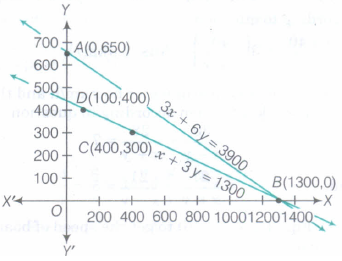
These two lines intersect at point B (1300, O).Thus, we get the required geometrical representation of given situations.
3.
Fixed charges=Rs.500; cost of food per day=Rs.50
4.
Given linear equations are
x-3y=2 x-3y-2=0 ...(i)
and -2x+6y=5 -2x+6y-5=0 ..(ii)
Here,a1=1, b1=-3, c2=-2
and a2=-2, b2=6, c2=-5
Now, \(\frac { { a }_{ 1 } }{ { a }_{ 2 } } =\frac { 1 }{ -2 } =-\frac { 1 }{ 2 } ,\quad \frac { { b }_{ 1 } }{ { b }_{ 2 } } =\frac { -3 }{ 6 } =-\frac { 1 }{ 2 } \)
and \(\frac { { c }_{ 1 } }{ { c }_{ 2 } } =\frac { -2 }{ -5 } =\frac { 2 }{ 5 } \)
Here, \(\frac { { a }_{ 1 } }{ { a }_{ 2 } } =\frac { { b }_{ 1 } }{ { b }_{ 2 } } \neq \frac { { c }_{ 1 } }{ { c }_{ 2 } } \)
So, the paths represented by the equations are parallel, i.e, not intersect each other.
The values depicted from this action are
(i) awareness about environment.
(ii) participatory role of residents in national activities.
5.
Let the actual speed of the train be x km/h and actual time taken be y h.
\(\because \) Distance=speed x Time
\(\therefore\)Distance=xy km
According to the question,
xy=(x+10)(y-2)
\(\Rightarrow\) xy=xy-2x+10y-20
\(\Rightarrow\) 2x-10y+20=0
\(\Rightarrow\) x-5y+10=0 [dividing both sides by 2] ...(i)
and xy=(x-10)(y+3)
\(\Rightarrow\) xy=xy+3x-10y-30
\(\therefore\) 3x-10y-30=0 ..(ii)
On multiplyying Eq. (i) by 3 and the n subtracting Eq, (ii) from Eq. (i), we get
3(x-5y+10)-(3x-10y-30)=0
\(\Rightarrow\) -5y=-60
\(\Rightarrow\) y=12
On putting y=12 in Eq. (i), we get
x-5x12+10=0
\(\Rightarrow\)x-60+10=0 \(\Rightarrow\) x=50
Hence, the distanc coverred by the train
=50x12=600 km
6.
Given linear equation is 2x+3y-8=0. ...(i)
(i) For intersecting lines, \(\frac { { a }_{ 1 } }{ { a }_{ 2 } } \neq \frac { { b }_{ 1 } }{ { b }_{ 2 } } \)
\(\therefore\) Any line intersecting with Eq. (i) may be taken as
3x+2y-9=0 or 3x+2y-7=0
(ii) For parallel lines, \(\frac { { a }_{ 1 } }{ { a }_{ 2 } } =\frac { { b }_{ 1 } }{ { b }_{ 2 } } \neq \frac { { c }_{ 1 } }{ { c }_{ 2 } } \)
\(\therefore\) Any line parallel to Eq. (i) may be taken as
6x+9y+7=0 or 2x+3y-12=0
(iii) For parallel lines, \(\frac { { a }_{ 1 } }{ { a }_{ 2 } } =\frac { { b }_{ 1 } }{ { b }_{ 2 } } =\frac { { c }_{ 1 } }{ { c }_{ 2 } } \)
\(\therefore\) Any line coincident to Eq. (i) may be taken as
4x+6y-16=0
There can be several linear equations in each of (i), (ii) and (iii)
7.
By solving both equations. Find the values of x and y and then put these values in \(y=\lambda x+5\) to get required values of \(\lambda .\)
x=340, y=-165, \(\lambda =-\frac { 1 }{ 2 } \)
8.
Let \(\angle A\) and \(\angle B\) be x0 and y0 , respectively.
Then, \(\angle C=5\angle B=3(\angle A+\angle B)\)
\(\Rightarrow \quad \angle C=5{ y }^{ 0 }\quad \angle C=3({ x }^{ 0 }+{ y }^{ 0 })\)
\(\Rightarrow \quad \angle C=5{ y }^{ 0 }\) and \(\angle C=3({ x }^{ 0 }+{ y }^{ 0 })\)
\(\Rightarrow \quad 5{ y }^{ 0 }=3({ x }^{ 0 }+{ y }^{ 0 })\quad \)
\(\Rightarrow \quad 2{ y }^{ 0 }-3{ x }^{ 0 }=0\quad \quad \quad ..(i)\)
Also, \(\angle A+\angle B+\angle C={ 180 }^{ 0 }\)
\(\Rightarrow \quad { x }^{ 0 }+{ y }^{ 0 }+5{ y }^{ 0 }={ 180 }^{ 0 }\)
\(\Rightarrow \quad { x }^{ 0 }+6{ y }^{ 0 }={ 180 }^{ 0 }\quad ...(ii)\)
Now, solve Eqs. (i) and (ii),
\(\angle A={ 18 }^{ 0 }\angle B={ 27 }^{ 0 }\angle C={ 135 }^{ 0 }\)
9.
Two straight paths are parallel to each other. Hence, they do not cross each other.
10.
x=-2, y=-1
11.
Let present age of Jacob and his son be x and y, respectively.
According to the question,
Condition I. (x-5)=7(y-5) \(\Rightarrow\)x-7y+30=0 ...(i)
Condition II. (x+5)=3(y+5) \(\Rightarrow\)x-3y+10=0 ...(ii)
Hence, algebraic representation is
x-7y+30=0 \(\Rightarrow\)x-3y+10=0
For graphical representation, draw graphs Eq. (i) and Eq. (ii).
12.
Let the speed of steam be x km/h, then speed of person going upstream=(x+5) km/h and speed of person going downstream=(5-x)h
According to question
\(\frac { 4 }{ 5-x } =3\left( \frac { 4 }{ 5-x } \right) \)
2.4 km/h
Lete the speed of boat in still water be x km/h and that of stream be y km/h, then according to question
\(\frac { 30 }{ x-y } +\frac { 28 }{ x+y } =7\quad \quad ...(i)\)
and \(\frac { 21 }{ x+y } +\frac { 21 }{ x-y } =5\quad \quad ...(ii)\)
Solve Eq. (i) and Eq. (ii) to get the speed of boat and speed of stream.
Speed of motorboat in still water=10 km/h
Speed of stream=4 km/h
13.
For parallel lines, \(\frac { { a }_{ 1 } }{ { a }_{ 2 } } =\frac { { b }_{ 1 } }{ { b }_{ 2 } } \neq \frac { { c }_{ 1 } }{ { c }_{ 2 } } \)
k=-6
14.
Let x and y be length and breadth of rectangle.
Then, its area=xy
According to the questions,
9x-5)(y+2)=xy-80 \(\Rightarrow\) 2x-5y=-70
(x+10)(y-5)=xy+50 \(\Rightarrow\) -5x+10y=100
Length=40 units, breadth=30 units
15.
Let the two numbers be x and y, then \(\frac { x }{ y } =\frac { 5 }{ 6 } \quad \Rightarrow \quad y=\frac { 6x }{ 5 } \quad ..(i)\)
Also, \(\frac { x-8 }{ y-8 } =\frac { 4 }{ 5 } \quad \Rightarrow \quad 5x-4y=8\quad \quad ..(ii)\)
Draw graphs of Eq. (i) and Eq. (ii) to get the required numbers.
Numbe0 are 49 and 48.

10th Standard CBSE Syllabus & Materials
10th Standard CBSE
CBSE 10th Social Science PS - Federalism - New Model Questions Papers Study Material - QB365 Set A
NEW10th Standard CBSE
CBSE 10th Social Science PS - Power Sharing - New Model Questions Papers Study Material - QB365 Set A
NEW10th Standard CBSE
CBSE 10th Social Science GEO - Manufacturing Industries - New Model Questions Papers Study Material - QB365 Set A
NEW10th Standard CBSE
CBSE 10th Social Science GEO - Minerals and Energy Resources - New Model Questions Papers Study Material - QB365 Set A



CBSE 10th Standard CBSE Subjects
CBSE Standards





