
 100% FREE ACCESS
10th Standard CBSE Syllabus & Materials
10th Standard CBSE
CBSE 10th Social Science ECO - Globalisation and the Indian Economy - New Model Questions Papers Study Material - QB365 Set A
NEW10th Standard CBSE
CBSE 10th Social Science ECO - Money and Credit - New Model Questions Papers Study Material - QB365 Set A
NEW10th Standard CBSE
CBSE 10th Social Science ECO - Sectors of the Indian Economy - New Model Questions Papers Study Material - QB365 Set A
NEW10th Standard CBSE
CBSE 10th Social Science ECO - Development - New Model Questions Papers Study Material - QB365 Set A
NEW10th Standard CBSE
CBSE 10th Social Science PS - Outcomes of Democracy - New Model Questions Papers Study Material - QB365 Set A
NEW10th Standard CBSE
CBSE 10th Social Science PS - Gender, Religion and Caste - New Model Questions Papers Study Material - QB365 Set A

Published on: 17/08/2019
Pair of Linear Equation in Two Variables
Download CBSE Class 10th Standard CBSE Maths question papers, sample papers, important questions, and previous year solved papers in PDF format. Get free study materials, NCERT solutions, and exam preparation resources for Class 10th Standard CBSE Maths
Questions + Answers key
Take MCQ Maths Test
1.
The sum of a two-digit number and number obtained by reversing the order of digits 99. If the digits of the number differ by 3, then find the numbers.
2.
Verify that x=2 is a solution of the linear equation 2x+7=13-x.
3.
Solve for x and y: 2(3x - y) = 5xy, 2(x + 3y) = 5xy.
4.
The incomes of two persons A and B are in the ratio 8: 7 and the ratio of their expenditures is 19: 16 If their savings are Rs 2550 per month, find their monthly income. What is the importance of saving in life?
5.
Solve the following pair of linear equations by the substitution method
\(\sqrt { 2 } x+\sqrt { 3 } y=0\)
\(\sqrt { 3 } x-\sqrt { 8 } y=0\)
6.
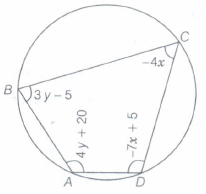
ABCD is a cyclic quadrilateral. Find the angles of the cyclic quadrilateral.
7.
Use elimination method to find all possible solutions of the following pair of linear equation
2x+3y=8 (1)
4x+6y=7 (2)
8.
Two straight paths are represented by the lines 7x-5y=3 and 21x-15y=5. Check whether the paths cross each other.
9.
Solve graphically the following pair of equations.
2x-y+3=0 and 3x-5y+1=0
10.
For what value of k, the pair of linear equations kx - 4y = 3, 6x - 12y = 9 has an infinite number of solutions?
11.
On comparing the ratios \(\frac { { a }_{ 1 } }{ { a }_{ 2 } } ,\frac { { b }_{ 1 } }{ { b }_{ 2 } } and\frac { { c }_{ 1 } }{ { c }_{ 2 } } \), whether the following pairs of linear equations are consistent or inconsistent:
5x-3y = 11,-10x + 6y = -22
12.
Two lines are given to be parallel. The equation of one of the lines is 4x + 3y = 14, then find the equation of the second line.
13.
If ad \(\neq \) bc, then find whether the pairs of linear equations ax + by = p and cx + dy = q has no solution, unique solution or infinitely many solutions.
14.
Find whether the pair of linear equations y = 0 and y = -5 has no solution, unique solution or infinitely many solutions.
15.
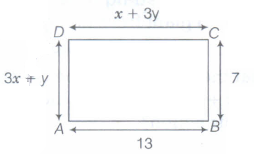
Find the values of x and y in the given rectangle.
16.
Solve the following pair of equations by elimination method.
\(\frac { x }{ 7 } +\frac { y }{ 3 } =5;\frac { x }{ 7 } -\frac { y }{ 9 } =1\)
17.
Solve the following pair of equations by elimination method.
3x+2y=7; 2x-5y+8=0
18.
Solve the following pair of equations by substitution method.
1.4x+3.9y=6.4; 0.2x-1.3y=1.2
19.
If the angles of a triangle are x, y and 400 and the difference between the two angles x and y is 300 . Then, find the values of x and y.
20.
Two straight paths are represented by the lines 7x-5y=3 and 14x-10y=5. Check whether the paths cross each other.
21.
Determine the values of a and b, for which the following pairs of linear equations has infinitely many solutions
3x-(a+1)y=2b-1 and 5x+(1-2a)y=3b
22.
Solve the following pair of linear equation by cross-multiplication method.
2(ax-by)+a+4b=0
2(bx+ay)+b-ra=0
23.
For what value of k, the pair of linear equations x+2y=3, 5x+ky+7=0 represents
(i) Intersecting lines
(ii) Parallel lines
Is there any value of k for which the given equations represents coincident lines?
24.
The area of a rectangle gets reduced by 80 sq units, if its length is reduced by 5 units and the breadth is increased by 2 units. If we increase the length by 10 units and decrease the breadth by 5 units, then the area is increased by 50 q units. Find the length and the breadth of the rectangle.
1.
Let the unit's place digit be x and ten's place digit be y.
Original number=10y+x
Number obtained by reversing the order of digits
=10x+y
Sum of both number=99 [given]
(10y+x)+(10x+y)=99
11x+11y=99
x+y=9 .....(i) [dividing both sides by 11]
Also, given that the digits of the numbers differ by 3.
If y>x, then y=-x=3 ..(ii)
and if y
2y=12
\(\Rightarrow\) \(y= \frac {12}{2}\)=6
Then, from Eq. (i),
x=9-y=9-6=3 [\(\therefore\)y=6]
\(\therefore\)Number=10y+x=10(6)+3=63
Now, adding Eqs. (i) and (iii), we get
2x=12
x=6
Then, from Eq. (i), we get
y=9-x=9-6=3 [\(\therefore\)x=6]
\(\therefore\)Number=10y+x=10(3)+6=36
Hence, the required number 63 and 36
2.
Given linear equation is 2x=7=13-x.
On substituting x=2 in the given equation, we get
LHS=2 \(\times\) 2+7=11 and RHS=13-2=11
\(\therefore\) LHS=RHS
Hence, x=2 is a solution of the equation.
3.
2(3x - y) = 5xy .....(i)
2(x + 3y) = 5xy .....(ii)
Divide eqns. (i) and (ii) by xy,
\(\frac { 6 }{ y } -\frac { 2 }{ x } =5\) .....(iii)
and \(\frac { 2 }{ y } +\frac { 6 }{ x } =5\) ......(iv)
Let \(\frac { 1 }{ y } \) = a and \(\frac { 1 }{ x } \) = b,
then equations (iii) and (iv) become
6a - 2b = 5 ...(v)
2a + 6b = 5 ....(vi)
Multiplying eqn. (v) by 3 and then adding with eqn. (vi),
20a = 20
\(\therefore\) a = 1
Substituting this value of a in eqn. (v),
b = \(\frac { 1 }{ 2 } \)
Now \(\frac { 1 }{ y } =a=1\)
\(\Rightarrow\) y = 1
and \(\frac { 1 }{ x } =b=\frac { 1 }{ 2 } \)
\(\Rightarrow\) x = 2
4.
Let income of A = 8x and income of B = 7x.
Also their expenditures be 19y and 16y.
\(\Rightarrow\) 8x - 19y = 2550 .....(i)
and 7x - 16y = 2550 .....(ii)
Solving the equations
x = 1530 and y = 510
\(\therefore\) Salary of A = 12240
Salary of B = 10710
Importance of saving in life is responsibility and indirectly helping the nation.
5.
Given, a pair of linear equation is:
\(\sqrt { 2 } x+\sqrt { 3 } y=0\) ......(i)
and \(\sqrt { 3 } x-\sqrt { 8 } y=0\quad or\quad y=\frac { \sqrt { 3 } x }{ \sqrt { 8 } } \) ......(ii)
On substituting y from eqn. (ii) in eqn. (i),
\(\sqrt { 2 } x+\sqrt { 3 } \times \left( \frac { \sqrt { 3 } x }{ \sqrt { 8 } } \right) =0\)
\(\Rightarrow \quad \sqrt { 2 } x\times \sqrt { 8 } +3x=0\)
\(\Rightarrow \quad \sqrt { 2 } x+\frac { 3x }{ \sqrt { 8 } } =0\)
\(\Rightarrow \quad \sqrt { 2 } x\times \sqrt { 8 } +3x=0\)
\(\\ \Rightarrow \) 4x + 3x = 0
\(\\ \Rightarrow \) 7x = 0
\(\therefore\) x = 0
On substituting x = 0 in eqn. (ii),
\(y=\frac { \sqrt { 3 } \times 0 }{ \sqrt { 8 } } =0\)
\(\therefore\)y = 0
Hence, x = 0, y = 0
6.
We know that, in a cyclic quadrilateral, the sum of two opposite angles is 180°.
\(\therefore \quad \angle B+\angle D={ 180 }^{ 0 } and \quad \angle A+\angle C={ 180 }^{ 0 }\)
\(\Rightarrow \) 3y-5-7x+5=180 and 4y+20-4x=180
\(\Rightarrow \) 3y-7x=180 ...(i)
and 4y-4x=160
\(\Rightarrow \) y-x=4. [dividing both sides by 4] ...(ii)
On multiplying Eq. (ii) by 7 and then subtracting from Eq. (i), we get
-4y=180-280
\(\Rightarrow \) -4y=-100 y=25
On putting y=25 in Eq. (ii), we get
25-x=40 x=-15
On putting the values of x and y, we calculate the angles as
\(\angle A=4y+20=100+20={ 120 }^{ 0 }.\)
\(\\ \angle B=3y-5=75-5={ 70 }^{ 0 }.\)
\(\\ \angle C=-4x=-4(-15)={ 60 }^{ 0 }.\)
and \( \angle D=-7x+5=105+5={ 110 }^{ 0 }.\)
Hence, the angles are \(\angle A={ 120 }^{ 0 },\angle B={ 70 }^{ 0 },\angle C={ 60 }^{ 0 }\) and \( \angle D={ 110 }^{ 0 }.\)
7.
Step 1 : Multiply Equation (1) by 2 and Equation (2) by 1 to make the coefficients of x equal. Then we get the equations as
4x + 6y = 16 (3)
4x + 6y = 7 (4)
Step 2 : Subtracting Equation (4) from Equation (3),
(4x - 4x) + (6y - 6y) = 16 - 7
i.e., 0 = 9, which is a false statemnt.
Therefore, the pair of equations has no solution.
8.
Two straight paths are parallel to each other. Hence, they do not cross each other.
9.
x=-2, y=-1
10.
Pair of linear equations kx - 4y - 3 = 0 and 6x - 12y - 9 = 0
Condition for infinite solutions: - \(\frac { { a }_{ 1 } }{ a_{ 2 } } =\frac { { b }_{ 1 } }{ { b }_{ 2 } } =\frac { { c }_{ 1 } }{ { c }_{ 2 } } \)
\(\frac { -k }{ 6 } =\frac { -4 }{ -12 } =\frac { 3 }{ 9 } \)
\(\Rightarrow\) k = 2
11.
The given equations can be re-written as :
5x-3y-11 = 0
- 10x + 6y + 22 = 0
On comparing with ax + by + c = 0, we have
a1 = 5, b1 = - 3, c1 = - 11
a2 = - 10, b2 = 6, c2 = 22
\(\frac { { a }_{ 1 } }{ { a }_{ 2 } } =\frac { 5 }{ -10 } =-\frac { 1 }{ 2 } \)
\(\frac { { b }_{ 1 } }{ { b }_{ 2 } } =\frac { -3 }{ 6 } =\frac { -1 }{ 2 } \)
and \(\frac { { c }_{ 1 } }{ { c }_{ 2 } } =\frac { -11 }{ 22 } =\frac { -1 }{ 2 } \)
Thus, \(\frac { -1 }{ 2 } =\frac { -1 }{ 2 } =\frac { -1 }{ 2 } \)
i.e. \(\frac { { a }_{ 1 } }{ { a }_{ 2 } } =\frac { { b }_{ 1 } }{ { b }_{ 2 } } =\frac { { c }_{ 1 } }{ { c }_{ 2 } } \)
Hence, the pair of linear equations is consistent.
12.
The equation of one line is 4x + 3y = 14. We know that if two lines a1x + b1y + c1 = 0 and a2x + b2y + c2 = 0 are parallel, then
\(\frac { { a }_{ 1 } }{ { a }_{ 2 } } =\frac { { b }_{ 1 } }{ { b }_{ 2 } } \neq \frac { { c }_{ 1 } }{ c_{ 2 } } \)
\(\Rightarrow \ \ \ \frac { 4 }{ { a }_{ 2 } } =\frac { 3 }{ { b }_{ 2 } } \neq \frac { { c }_{ 1 } }{ { c }_{ 2 } } \Rightarrow \frac { { a }_{ 2 } }{ { b }_{ 2 } } =\frac { 4 }{ 3 } =\frac { 12 }{ 9 } \)
Hence one of the possible, second parallel line is 12x + 9y = 5
13.
\(ad\neq bc\Rightarrow \frac { a }{ c } \neq \frac { b }{ d } \)
Hence, the pair of given linear equations has unique solution.
14.
The pair of equations y = 0 and y = -5 has no solution.
15.
By property of rectangle, we know that its opposite sides are of equal lengths.
i.e. DC=AB \(\Rightarrow\) x+3y=13 ...(i)
and AD=BC \(\Rightarrow\) 3x+y=7 .....(ii)
On multiplying Eq. (ii) by 3 and then subtracting Eq. (i), we get
| 9x+3y=21 |
| x+3y=13 |
| 8x=8 |
\(\Rightarrow\) x=1
On putting x=1 in Eq. (i), we get
3y=12 \(\Rightarrow\) y=4
Hence, x=1 and y=4.
16.
x=14, y=9
17.
x=1, y=2
18.
\(x=5,\quad y=\frac { 2 }{ 13 } \)
19.
Given that, x, y ane 400 are the angles of a triangle.
\(\therefore\) x+y+400=1800 [\(\because\) sum of all the angles of a triangle is 1800 ]
\(\Rightarrow\)x+y=1400 ...(i)
Also, x-y=300 ...(ii)
On adding Eqs. (i) and (ii), we get
2x=1700 \(\Rightarrow\) x=850
On putting x=850 in Eqs. (i), we get
850+y=1400 \(\Rightarrow\) y=550
Hence, the required values of x and y are 850 and 550 respectively.
20.
Given equation are 7x-5y=3 and 14x-10y=5
Here, a1=7, b1=-5, c2=-3
and a2=14, b2=-10, c2=-5
Now, \(\frac { { a }_{ 1 } }{ { a }_{ 2 } } =\frac { 7 }{ 14 } =\frac { 1 }{ 2 } ,\quad \frac { { b }_{ 1 } }{ { b }_{ 2 } } =\frac { -5 }{ -10 } =\frac { 1 }{ 2 } \) and \(\frac { { c }_{ 1 } }{ { c }_{ 2 } } =\frac { 3 }{ 5 } \)
Thus, for the given equations, we have
\(\frac { { a }_{ 1 } }{ { a }_{ 2 } } =\frac { { b }_{ 1 } }{ { b }_{ 2 } } \neq \frac { { c }_{ 1 } }{ { c }_{ 2 } } \)
So, we conclude that the two paths are parallel to each other. Hence, the paths do not cross each other.
21.
Given, pair of equations is
3x-(a+1)y=2b-1
and 5x+(1-2a)y=3b
Here, a1=3, b1=-(a+1), c2=-(2b-1)
and a2=5, b2=1-2a, c2=-3b
For infinitely many solutions, we must have
\(\underset { I }{ \frac { 3 }{ 5 } } =\underset { II }{ \frac { -(a+b) }{ 1-2a } } =\underset { III }{ \frac { 2b-1 }{ 3b } } \)
Now, take I and II terms, \(\frac { 3 }{ 5 } =\frac { -(a+b) }{ 1-2a } \)
\(\Rightarrow \quad 3-6a=-5a-5\)
\(\Rightarrow \quad a=8\)
Now, take I and III terms,
\(\frac { 3 }{ 5 } =\frac { 2b-1 }{ 3b } \)
\(\Rightarrow \quad 9b=10b-5\quad \Rightarrow \quad b=5\)
22.
By cross-multiplication method,
\(\frac { x }{ -2{ b }^{ 2 }+8a-2{ a }^{ 2 }-8ab } =\frac { y }{ -2ab+8{ b }^{ 2 }-2ab+8{ a }^{ 2 } } \)
\(x=-\frac { 1 }{ 2 } ,\quad y=2\)
23.
(i) k\(\neq\)10
(ii) k=10.
There is no value of k for which given system has infinitely many solutions. i.e, represent coincident lines.
24.
Let x and y be length and breadth of rectangle.
Then, its area=xy
According to the questions,
9x-5)(y+2)=xy-80 \(\Rightarrow\) 2x-5y=-70
(x+10)(y-5)=xy+50 \(\Rightarrow\) -5x+10y=100
Length=40 units, breadth=30 units

10th Standard CBSE Syllabus & Materials
10th Standard CBSE
CBSE 10th Social Science PS - Federalism - New Model Questions Papers Study Material - QB365 Set A
NEW10th Standard CBSE
CBSE 10th Social Science PS - Power Sharing - New Model Questions Papers Study Material - QB365 Set A
NEW10th Standard CBSE
CBSE 10th Social Science GEO - Manufacturing Industries - New Model Questions Papers Study Material - QB365 Set A
NEW10th Standard CBSE
CBSE 10th Social Science GEO - Minerals and Energy Resources - New Model Questions Papers Study Material - QB365 Set A



CBSE 10th Standard CBSE Subjects
CBSE Standards





