
 100% FREE ACCESS
10th Standard CBSE Syllabus & Materials
10th Standard CBSE
CBSE 10th Social Science ECO - Globalisation and the Indian Economy - New Model Questions Papers Study Material - QB365 Set A
NEW10th Standard CBSE
CBSE 10th Social Science ECO - Money and Credit - New Model Questions Papers Study Material - QB365 Set A
NEW10th Standard CBSE
CBSE 10th Social Science ECO - Sectors of the Indian Economy - New Model Questions Papers Study Material - QB365 Set A
NEW10th Standard CBSE
CBSE 10th Social Science ECO - Development - New Model Questions Papers Study Material - QB365 Set A
NEW10th Standard CBSE
CBSE 10th Social Science PS - Outcomes of Democracy - New Model Questions Papers Study Material - QB365 Set A
NEW10th Standard CBSE
CBSE 10th Social Science PS - Gender, Religion and Caste - New Model Questions Papers Study Material - QB365 Set A

Published on: 14/02/2020
10th standard CBSE Mathematics Public Model Question Paper I 2019-2020
Download CBSE Class 10th Standard CBSE Maths question papers, sample papers, important questions, and previous year solved papers in PDF format. Get free study materials, NCERT solutions, and exam preparation resources for Class 10th Standard CBSE Maths
Questions + Answers key
Take MCQ Maths Test
1.
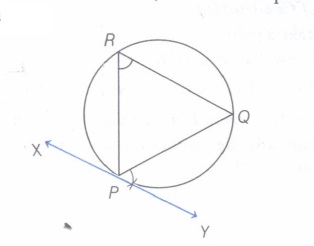
Draw a circle of radius 5 cm. Take a point P on it. Without using the centre of the circle, draw a tangent to the circle at point P.
2.
Find the discriminant of quadratic equation \(x^{ 2 }+4x-1\)
3.
Write the two concepts used for justification in division of a line segment .
4.
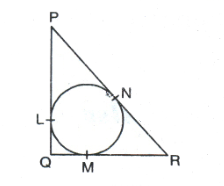
In figure, a circle is inscribed in a triangle PQR with PQ = 10cm, QR = 8 cm and PR = 12 cm. Find the lengths QM, RN and PL.
5.
A player sitting on the top of a tower of height 40m observes the angle of depression of a ball lying on the ground as 600.The distance between the foot of the tower and ball is
6.
The hypotenuse of a right triangle is 4 times the smallest side.The third side is \(\sqrt{735}\) .Find the hypotenuse and the smallest side.
7.
The nth term of an A.P. cannot be n2+1. Justify your answer.
8.
Find the angle of elevation of the sun when the shadow of a pole h metres high is \(\sqrt{3}\) h metres long
9.
The 9th term of an A.P. is equal to 6 times its second term. If its 5th term is 22, find the A.P.
10.
Out of a group of children, \({7\over 2}\) times the square root of the number are creative, the two remaining ones are visionary. What is the total number of children ? How many persons in the group are creative?
Write one-one characteristics each of creativity and vision.
11.
Find the missing term of the A.P. 2, ......, 24, 35
12.
A boy flying a kite has let out 60 m of string. If the angle of elevation of the kite is 60o , calculate the height of the kite above the ground.
13.
Interior angles of a polygon are in AP. If the smallest angle is 120o and common difference is 5o, find the number of sides of the polygon.
14.
Find the angle of elevation of the top of 15 m high tower at a point 15 m away from the base of the tower.
15.
PQ is a tangent drawn from a point P to a circle with centre O and QOR is a diameter of the circle such that \(\angle POR=110^0\)Find \(\angle OPQ.\)
16.
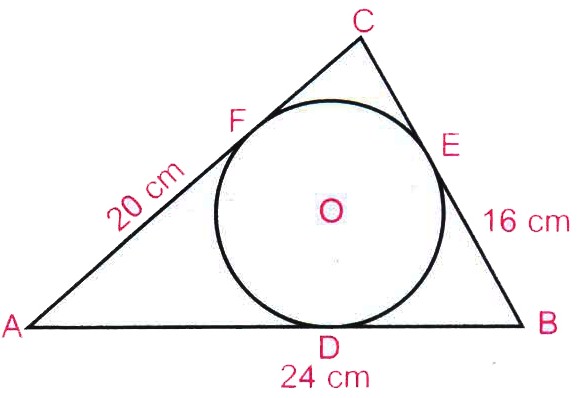
A circle is inscribed in a \(\Delta ABC\) having sides 16cm, 20cm and 24 cm as shown in figure.Find AD, BE and CF.
17.
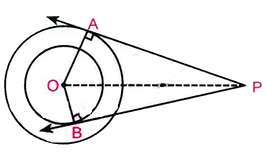
In figure, there are two concentric circles, with centre O and of radii 5cm and 3cm. From an external point P, tangents PA are drawn to these circles. If AP = 12cm, find the length of BP.
-S.jpg)
18.
Is x=-4 a solution of the equation 2x2+5x-12=0
19.
For what value of k, the roots of the quadratic equation kx(x - 2 \(\sqrt { 5 } \) ) + 10 = 0 are equal ?
20.
How many multiples of 4 lie between 11 and 266?
21.
How many terms are there in the sequence 3,6,9,12,...,111?
22.
The sum of the reciprocals of Anjali's age 3yr ago and 5yr from now is \(\frac{1}{3}\) . Find the present age of Anjali.
23.
The angle of elevation of an aeroplane from a point on the level ground is 60°. After 10 s of flight, the angle of elevation changes to 30°. If the aeroplane is flying horizontally at a height of 3000 m, then find the speed of the plane.
24.
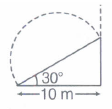
The top of a broken tree has its top touching the ground (shown in the following figure) at a distance of 10 m from the bottom. If the angle made by the broken part with ground is 30°, then find the length of the broken part.
25.
If a line which is perpendicular to the radius of the circle through the point of contact. What will you call that line?
26.
In two concentric circles, a chord of length 24 cm of larger circle becomes a tangent to the smaller circle whose radius is 5 cm. Find the radius of the larger circle.
27.
Find two consecutive positive integers, sum of whose squares in 365.
28.
From the figure, height h is 173.2m
29.
The equation \((x+2)^{ 2 }=0\) has real roots.
30.
Infinite tangents can be drawn from a point lying inside the circle.
31.
The common point of a tangent to a circle with circle is called point of contact.
32.
The sum of first 4 terms and sum of first 13 terms of the A.P. 24, 21, 18, .......... is 78.
33.
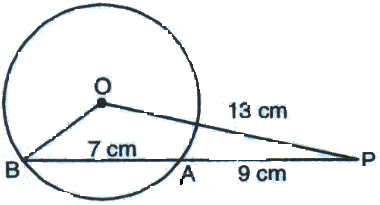
Radius of circle given below is
34.
If one root of the quadratic equation is,\(5 \ - \sqrt {3}\) then other root is
35.
If 12, 52, 72 , 73,......... are in A.P., then value of d.
36.
If angle between two radii of a circle is 130°. The angle between the tangents at the ends of the radii is _______________
37.
In order to divide a line segment internally in the ratio m : n, both m and n are ________________
38.
A tower stands vertically on the ground.From a point on the ground, which is 100m away from the foot of the tower, the angle of elevation of the top of the tower is found to be 600, then the height of the tower is .........
39.
If p(x) is quadratic polynomial, then p(x) = 0 is called a .............. equation.
40.
In an A.P. the common difference is always ...........
41.
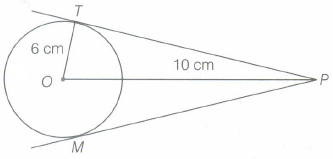
In the given figure, PT and PM are two tangents to the circle with centre O. If OT = 6 cm and OP = 10 cm. then find the length of PT and PM.
42.
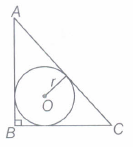
In the adjoining figure, a right angled ΔABC, circumscribes a circle of radius r. If AB and BCare of lengths 8 cm and 6 cm respectively, then find the value of r.
43.
If \({a}_{1},{a}_{2},{a}_{3},...,{a}_{n}\) are in AP, where \({a}_{i}>0\) then find the value of \(\frac { 1 }{ \sqrt { { a }_{ 1 } } +\sqrt { { a }_{ 2 } } } +\frac { 1 }{ \sqrt { { a }_{ 2 } } +\sqrt { { a }_{ 3 } } } +...+\frac { 1 }{ \sqrt { { a }_{ n-1 } } +\sqrt { { a }_{ n } } } \)
44.
The angles of elevation of the top of a tower from two points distant s and t from its foot are complementary. Prove that the height of the tower is \(\sqrt { st } \) .
45.
If the shadow of a tower 30m long, when the sun's elevation is 300.What is the length of the shadow, when sun's elevation is 600 ?
46.
Is it possible to design a rectangular mangrove whose perimeter is 38 m and area is \(84 \ m^{2}\) ? Find its length and breadth.
47.
Find the ratio in which A divides the line segment PQ
48.
Construct an isosceles triangle whose base is 6 cm and altitude 4 cm. Then construct another triangle sides are \(\frac { 3 }{ 4 } \) times the corresponding sides of the isosceles triangle.
49.
The 8th term of 117, 104, 91, 78, …….is.....
26
27
4
17
50.
The solution of x2 + 4x + 4 = 0 is
None of these
0
-2
2
51.
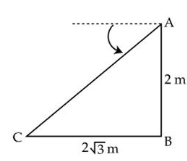
The figure shows the observation of point C from point A. The angle of depression from A is:
30°
60°
75°
45°
52.
In drawing triangle ABC, it is given that AB = 3 cm, BC = 2 cm and AC = 6 cm. It is not possible to draw the triangle as:
AC > AB + BC
AB > BC
AB < AC + BC
AB < AC
53.
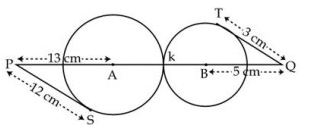
In fig., two circles with centres A and B touch each other externally at k. The length of PQ (in cm) is
24 cm
20 cm
27 cm
18 cm
1.
Given, radius of circle = 5 cm
1.Draw a circle with 0 as centre and radius 5 cm.
2. Draw any chord PQ through the given point P on the circle.
3.Take a point R on the circle and join P and Q to a pointR.
4. Construct \(\angle QPY=\angle PQX\) on the opposite side of the chord PQ.
5. Produce yP to X to get YPX, as the required tangent.
2.
12
3.
The justification will be given by using the basic proportionality theorem and similar triangles.
4.
QM = 3cm, RN = 5cm and PL = 7cm
5.
\({40\over\sqrt{3}}m\)
6.
28 units, 7 units
7.
Here, an = n2+1
Put n = 1, 2, 3, ..., we obtain
a1 = 12+1 = 2
a2 = 22+1 = 5
a3 = 32+1 = 10
Now, list of numbers becomes 2, 5, 10, ......
\(\therefore \) a2 - a1 = 5-2 = 3
a3-a2 = 10-5 = 5
Since 3 \(\neq \) 5 i.e., a2-a1\(\neq \) a3-a2
Thus, it does not form an A.P.
8.
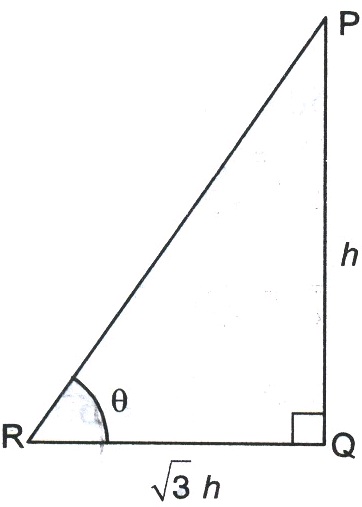
Here, the height of the pole be h m and length of its shadow is \(\sqrt { 3 } \) h .
Let ፀ be the elevation of the sun. Consider right-angle ΔPQR
tanፀ=\(\frac { h }{ \sqrt { 3 } h } =\frac { 1 }{ \sqrt { 3 } } \)
= tan 30\(\unicode{xb0} \)
ፀ = 30\(\unicode{xb0} \)
Hence, the angle of elevation of the sun is 30\(\unicode{xb0} \).
9.
Let a and d be the first term and common difference of the required A.P.
Here, a5 = 22
\(\Rightarrow\) a + 4d = 22 ...(i)
And a9 = 6a2
\(\Rightarrow\) a + 8d = 6 ( a + d )
\(\Rightarrow\) a + 8d = 6a + 6d
\(\Rightarrow\) 5a = 2d ...(ii)
From (i) and (ii), we have
a + 2(5a) = 22
\(\Rightarrow\) 11a = 22
\(\Rightarrow\) a = 2
From (ii), we have 5(2) = 2d \(\Rightarrow\) d = 5
Hence, the required A.P. is 2, 7, 12, 17, ...
10.
16, 14 - Creativity involves in the use of skills and imagination to produce something new and innovative.
Vision - ability to think about future.
11.
13
12.
52 m
13.
9
14.
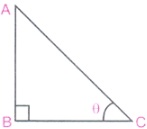
Let AB is the tower, AB = 15 m, BC = 15 m
In right \(\Delta\)ABC, \(\tan { \theta =\frac { AB }{ BC } } \Rightarrow \tan { \theta } =\frac { 15 }{ 15 } \)
\(\Rightarrow\) \(\tan { \theta } =1 \Rightarrow \theta ={ 45 }^{ o }\)
15.
Given: PQ is a tangent to the circle with centre O from a point P. QCR is a diameter of the circle
and \(\angle \)POR = 110°.
To find: \(\angle \)OPQ
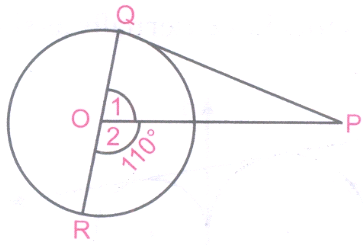
Sol. POR = 110°
QR is the diameter of the circle.
⇒ \(\angle \)1 + \(\angle \)2 = 180° [Linear pair axiom]
⇒ \(\angle \)1 + 110° = 180° ⇒ \(\angle \)1 = 70°
\(\angle \)OQP = 90°
(Tangent makes 90° angle with the radius at the point of contact).
In \(\triangle\)OPQ
\(\angle \)1 + \(\angle \)OQP + \(\angle \)QPO = 180° [Angle sum properety]
⇒ 70° + 90° + \(\angle \)QOP = 180°
⇒ \(\angle \)OPQ = 180° - 160°
⇒ \(\angle \)OPQ = 20°
16.
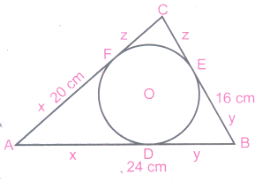
Let AD = AF = x [Tangent form external point are equal]
BD = BE = y and CE = CF = z
According to the question,
AB = x + y = 24cm ....(i)
BC = y + z = 16cm .....(ii)
Ac = x + z = 20cm ....(iii)
subtacting (iii) for (i), we get
y - z = 4 ......(iv)
Adding (ii) and (iv), we get
2y = 20 ⇒ y = 10 cm
Substituting the value of y in (ii) and (i)
we get z = 6 cm; x = 14 cm
ஃ AD = 14 cm, BE = 10 cm
and CF = 6 cm
17.
PA = 12 cm, OA = 5 cm, OB = 3 cm
OP2 = OA2 + AP2 = OB2 + BP2
⇒ 25+14 = 9+BP2
⇒ 169-9 = BP2
⇒ BP = \(\sqrt{160}\) cm = 12.65 cm.(Approx.)
18.
LHS=2x2+5x-12
When x=-4
LHS =2(-4)2+5(-4)-12
=32-20-12=0=RHS
x=-4 is a solution of the given equation.
19.
\(kx(x-2\sqrt { 5 } )+10=0\)
\(\Rightarrow kx^{ 2 }-2\sqrt { 5 } kx+10=0\)
\(a=k,b=-2\sqrt { 5 } k,c=10\)
Given, roots are equal, D = b2- - 4ac = 0
\(\Rightarrow (-2\sqrt { 5k^{ 2 } } -4\times k\times 10=0\)
\(\Rightarrow 20k^{ 2 }-40k=0\)
\(\Rightarrow 20k(k-2)=0\)
k(k-2)=0
k=0
k=2
20.
Here, a = 12, l = 264, d = 4
\(n=\frac { l-a }{ d } +1=\frac { 264-12 }{ 4 } +1\)
\(=\frac { 252 }{ d } +1=63+1=64\)
There are 64 multiples of 4 that lie between 11 and 266.
21.
Given, sequence 3,6,9,12,...,111.
Here, 6 - 3 = 9 - 6 = 12 - 9 = 3
So, it is an AP with first term, a=3 and common difference, d = 3. Let there be n terms in the given sequence.
Then, nth term =1 11
⇒ a + (n-1) d = 111
⇒ 3 + (n-1)\(\times \) 3 = 111
⇒ 3 (1 + n-1) = 111
⇒ \(n=\frac { 111 }{ 3 } \Rightarrow n=37\)
22.
Let the present age of Anjali be x yr.
Anjali's age 3yr ago=(x-3) yr
and Anjali's age 5 yr from now=(x+5)yr
According to the question,
\(\frac { 1 }{ x-3 } +\frac { 1 }{ x+5 } =\frac { 1 }{ 3 } \)
\( \Rightarrow \frac { x+5+x-3 }{ (x-3)(x+5) } =\frac { 1 }{ 3 }\)
\(\Rightarrow \frac { 2x+2 }{ { x }^{ 2 }-3x+5x-15 } =\frac { 1 }{ 3 } \)
\(\Rightarrow 3(2x+2)={ x }^{ 2 }+2x-15\)
\(\Rightarrow 6x+6={ x }^{ 2 }+2x-15\)
\( \Rightarrow { x }^{ 2 }-4x-21=0\)
which is the required quadratic equation.
Now, by factorization method, we get
x2-7x+3x-21=0
x(x-7)+3(x-7)=0
(x-7)(x+3)=0
x=7 or x=-3
But x=-3 is not possible because age cannot be negative.
x=7
Hence, Anjali's present age is 7 yr.
23.
346.4 m/s
24.
\(\frac { 20 }{ \sqrt { 3 } } \)
25.
Tangent
26.
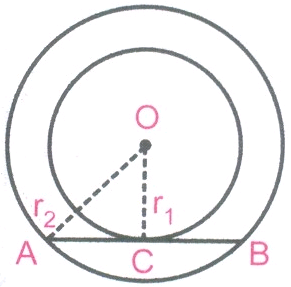
r1 = 5 cm, r2 = ?,
AB = 24 cm
∵ AB is tangent to circle
C(C, r1) at C
ஃ OC ⊥ AB
In circle C(O, r2), AB is a chord and OC ⊥ AB
ஃ AC = BC
[∵ Perpendicular from the centre bisects the chord]
In right \(\triangle\)OCA
OC2 + AC2 = AC2
⇒ 52 + (12)2 = (r2)2
⇒ 25 + 144 = (r2)2 ⇒ (r2)2 = 169
r2 = 13 cm
27.
Let the two consecutive integers be x and x+1
ATQ x2+(x+1)2=365
\(\Rightarrow\) x2+x2+2x+1=365 \(\Rightarrow\) 2x2+2x-364=0
\(\Rightarrow\) x2+x-182=0 \(\Rightarrow\) x2+14x-13x-182=0
\(\Rightarrow\) x(x+14)-13(x+14)=0 \(\Rightarrow\) (x-13)(x+14)=0
\(\Rightarrow\) x=13, -14 (-14 is rejected because it is a negative integer)
Hence, the two consecutive positive integers are 13 and 13+1=14
28.
(b)
29.
(a)
30.
(b)
31.
(a)
32.
(b)
33.
()
5 cm
34.
()
\(5 \ + \sqrt {3}\)
35.
()
24
36.
()
\({ 50 }^{ \circ }\)
37.
()
positive integers
38.
()
173.2m
39.
()
Quadratic
40.
()
constant
41.
8 cm and 8 cm
42.
Given, in ΔBC, L.B = 90°
BC = 6cm
and AB = 8 cm
By Pythagoras theorem,
AC2 = AB2 + BC2
= AC =\(\sqrt{AB^2+BC^2}\)
= \(\sqrt{8^2+6^2}\)
=\(\sqrt{64+36}\)
= \(\sqrt{100}\)
Let AC, AB and BC touch the circle at F, E and D, respectively.
Join OD and OE.
Now, in quadrilateral ODBE,
ㄥD = ㄥB = ㄥE = 90°
ㄥDOE = 90°
BD = BE = r cm
=> ODBE is a square of side r cm
Also, AF = AE
CF=CD
Now, AE = AF = AB - BE = 8 - r
and CF = CD = BC - BD = 6 - r
From Eq. (i), we get
AC = 10 cm
=> AF + CF = 10
=> 8- r + 6 -r = 10
=> 14 - 2r = 10
=> - 2r = 10 - 14 = - 4
=> r = 2
Hence, radius of circle is 2 cm.
43.
\(\frac {n-1}{\sqrt{a_1}+\sqrt{a_n}}\)
44.
29.28 m/s
45.
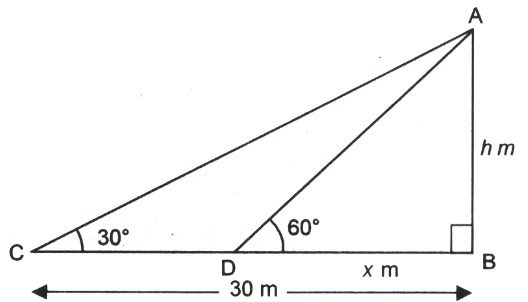
Let AB=h m be height of tower and BC=30 m be length of its shadow when sun's elevation is 300.Let BD=x m be length of shadow when sun's elevation is 60o
As ㄥACB=30o and ㄥADB=60o
Consider rt . ΔABC, we have
\(\frac { AB }{ BC } \)=tan300
⇒ \(\frac { h }{ 30 } =\frac { 1 }{ \sqrt { 3 } } \Rightarrow h=\frac { 30 }{ \sqrt { 3 } } \)
⇒ AB=\(\frac { 30 }{ \sqrt { 3 } } \)m
Consider rt . ΔABD, we have
\(\frac { AB }{ BD } \)=tan600 ⇒ \(\frac { h }{ BD } =\sqrt { 3 } \)
⇒ \(\frac { \frac { 30 }{ \sqrt { 3 } } }{ BD } =\frac { \sqrt { 3 } }{ 1 } \) [∵ h=\(\frac { 30 }{ \sqrt { 3 } } \)]
∴ Length of shadow=10 m
46.
12 m, 7 m
47.
()
1 : 4
48.
Steps of Constructions:
1. Draw a line segment BC = 6 cm
2. Draw a perpendicular bisector of BCwhich cuts the line BCat Q.
3. Cut the line OA = 4 cm.
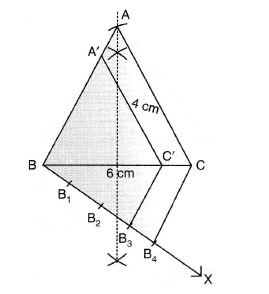
4. Join A to B and C
5. Triangle ABC is the given triangle.
6. Draw a ray BXmaking an acute angle.
7. Mark the four points B1, B2,B3and B4on the ray BX. Join B4C Draw a line parallel through B3 to B4 intersecting extended line segment AB at A'.
Hence A'BC' is a required triangle.
49.
(a)
26
50.
(c)
-2
51.
(a)
30°
52.
(a)
AC > AB + BC
53.
(c)
27 cm

10th Standard CBSE Syllabus & Materials
10th Standard CBSE
CBSE 10th Social Science PS - Federalism - New Model Questions Papers Study Material - QB365 Set A
NEW10th Standard CBSE
CBSE 10th Social Science PS - Power Sharing - New Model Questions Papers Study Material - QB365 Set A
NEW10th Standard CBSE
CBSE 10th Social Science GEO - Manufacturing Industries - New Model Questions Papers Study Material - QB365 Set A
NEW10th Standard CBSE
CBSE 10th Social Science GEO - Minerals and Energy Resources - New Model Questions Papers Study Material - QB365 Set A



CBSE 10th Standard CBSE Subjects
CBSE Standards





