
 100% FREE ACCESS
10th Standard CBSE Syllabus & Materials
10th Standard CBSE
CBSE 10th Social Science ECO - Globalisation and the Indian Economy - New Model Questions Papers Study Material - QB365 Set A
NEW10th Standard CBSE
CBSE 10th Social Science ECO - Money and Credit - New Model Questions Papers Study Material - QB365 Set A
NEW10th Standard CBSE
CBSE 10th Social Science ECO - Sectors of the Indian Economy - New Model Questions Papers Study Material - QB365 Set A
NEW10th Standard CBSE
CBSE 10th Social Science ECO - Development - New Model Questions Papers Study Material - QB365 Set A
NEW10th Standard CBSE
CBSE 10th Social Science PS - Outcomes of Democracy - New Model Questions Papers Study Material - QB365 Set A
NEW10th Standard CBSE
CBSE 10th Social Science PS - Gender, Religion and Caste - New Model Questions Papers Study Material - QB365 Set A

Published on: 14/02/2020
10th standard CBSE Mathematics Public Model Question Paper I 2020
Download CBSE Class 10th Standard CBSE Maths question papers, sample papers, important questions, and previous year solved papers in PDF format. Get free study materials, NCERT solutions, and exam preparation resources for Class 10th Standard CBSE Maths
Questions + Answers key
Take MCQ Maths Test
1.
In the given figure, there are two concentric circles of radii 6 cm and 4 cm with centre O. If AP is a tangent to the larger circle and BP to the smaller circle and length of AF is 8 cm, find the length of BP.
2.
If the common difference of an AP. is - 6, find a16 - a12
3.
Construct a quadrilateral ABCD, in which AB = 2.5 cm, BC = 3.5 cm, AC = 4.2 cm, CD = 3.5 cm and AD = 2.5 cm. Construct another quadrilateral AB' C'D' with diagonal AC' = 6.3 cm such that it is similar to quadrilateral ABCD.
4.
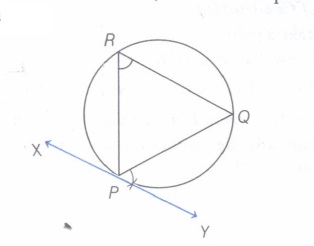
Draw a circle of radius 5 cm. Take a point P on it. Without using the centre of the circle, draw a tangent to the circle at point P.
5.
A bridge in the shape of a straight path, across a river, makes an angle of \({ 60 }^{ ° }\)with the width of the river. If the length of the bridge is 100 m, then find the width of the river.
6.
If the equation \(px^{ 2 }+4x-3=0\) has real roots, then find the value of p
7.
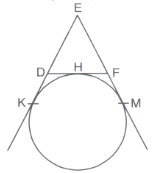
In figure, a circle touches the side DFof at H and touches ED and EF produced at K and M respectively. If EK = 9 cm, then find the perimeter of \(\triangle EDF\) (in cm).
8.
Which is the largest side in the right angled triangle?
9.
A player sitting on the top height 18m observes the angle of depression of a ball lying on the ground as 600.Find the distance between the foot of the tower and the ball.
10.
the height of a tower is 12m.Find the height of its shadow when sun's altitude is 450 .
11.
A boy flying a kite has let out 60m of string if the angle of elevation of the kite is 600 , then the height of the kite above the ground is
12.
Is the following situation possible ? If so, determine their present ages.
The sum of ages of two friends is 25 years. Five years ago, the product of their ages in years was 50.
13.
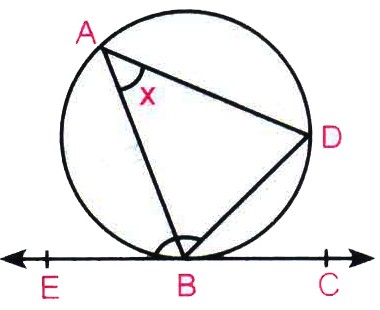
In the given figure, find x if \(\angle EBD=146^0.\)
14.
If the sum of first p terms of an AP is ap2 + bp, find its common difference.
15.
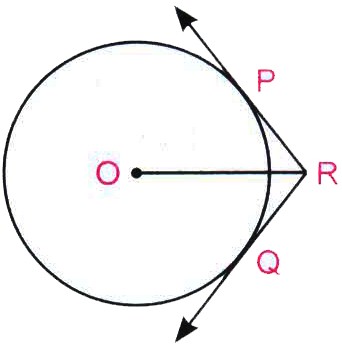
In figure, two tangents RQ and RP are drawn from an external point R to the circle with centre O. If \(\angle PRQ=120^0\) , then prove that OR = PR + RQ
16.
Find the sum of the odd numbers between 0 and 50.
17.
Find the value of p so that the quadratic equation px(x-3)+9=0 has two equal roots.
18.
The 6th term of an Arithmetic Progression (AP) is -10 and its 10th term is -26. Determine the 15th term of the AP.
19.
Find the roots of the following quadratic equations by applying the quadratic formula: \(4x^2+4\sqrt3+3=0\)
20.
Which of the following are APs? If they form an AP, find the common difference d and write three more terms.
-1.2, -3.2, -5.2, -7.2.......
21.
Draw a line segment AB of length 7 cm. Taking A as centre, draw a circle of radius 3 cm and taking B as centre, draw another circle of radius 2 cm. Construct tangents to each circle from the centre of the other circle
22.
How many three digit numbers are such that when divided 7, leave a remainder 3 in each case?
23.
Construct a tangent to a circle of radius 1.8 cm from a point on the concentric circle of radius 2.8 cm and measure its length. Also, verify the measurement by actual calculation.
24.
Find the common difference and the next two terms of the AP 0 6 1 2 18,...
25.
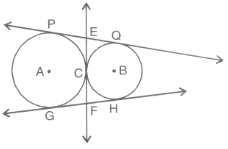
In fig., two circles touch each other externally at C. Prove that the common tangent at C bisects the other two common tangents
26.
A pole 5 m high is fixed on the top of a tower. The angle of elevation of the top of the pole observed from a point 'A' on the ground is 60o and the angle of depression of the point 'A' from the top of the tower is 45o . Find the height of the tower. \((\sqrt { 3 } =1.73)\)
27.
AB is a diameter of a circle. AH and BK are perpendicular from A and B respectively to the tangent at P.Prove that AH + BK = AB.
28.
Seven years ago Varun's age was five times the square of swati's age. Three years hence Swati's age will be two-fifth of Varun's age. Find their present ages.
29.
The denominator of a fraction is two more than its numerator. If the sum of the fraction and its reciprocal is \(\frac { 34 }{ 15 } \) find the fraction
30.
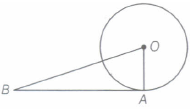
Find the length of tangent to a circle from a point at a distance of 5 cm from centre of the circle of radius 3 cm.
31.
A fire in a building B is reported on telephone to two fire stations P and Q, 20 km apart from each other on a straight road. p observes that the fire is at an angle of\({ 60 }^{ ° }\)to the road and Q observes that it is an angle of \({ 45 }^{ ° }\) to the road.
(i) Which station should send its team and how much will this team have to travel?
(ii) What according to you, are the values displayed by the teams at fire stations P and Q.
32.
Check whether the following quadratic equations
\((x+1)^{ 2 }=2(x-3)\)
33.
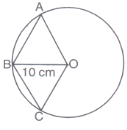
OABC is a rhombus whose three vertices A, B and C lie on a circle with centre O. If the radius of the circle is 10 cm, find the area of the rhombus.
34.
The angles of depression of the top and bottom of a tower as seen from the top of a \(60\sqrt{3}\) m high cliff are 45o and 60o respectively.Find the height of the tower.
35.
At a point A, 20 metres above the level of water in a lake, the angle of elevation of a cloud is 30o . The angle of depression of the reflection of the cloud in the lake, at A is 60o . Find the distance of the cloud from A.
36.
The houses in a row are numbered consecutively from 1 to 49. Show that three exists a value of X such that sum of numbers of houses preceding the house numbered X is equal to sum of the numbers of houses following X.
37.
A pair of tangents can be constructed to a circle inclined at an angle of 170o .
38.
A circle can have maximum two tangents.
39.
The line of sight is the line from the eye of an observer to the point in the viewed by the observer.
40.
The sum of a real number x and its reciprocal from a quadratic equation.
41.
The sequence 6, 6, 6, .......... is not an A.P.
42.
A circle have
43.
Value of m , for which the quadratic equation \(mx^{2} + 8x + 2 = 0\) has real roots.
44.
Sum of n term of the series \(\sqrt{2}+\sqrt{8}+\sqrt{18}+\sqrt{32}+......\) is
45.
A tangent is always ____________ to the radius at the point of contact.
46.
The angle of ....... of an object viewed, is the angle formed by the line of sight with the horizontal when it is above the horizontal level.
47.
To divide the line segment AB in the ratio 2 : 3, a ray AX is drawn such that LBAX is acute, AX is then marked at equal intervals. Find minimum number of these marks
48.
To draw a pair of tangents to a circle which are inclined to each other at an angle of 35o, it is required to draw tangents at the end points of those two radii of the circle, then find the angle between the two radii.
49.
If p, q, r, s, t are the terms of an A.P. with common difference -1 the relation between p and t is
t = p – 6
t = p – 5
t = p + 4
t = p – 4
50.
The equation 4x2 = 4x has following solution/solutions
1
0,1
1,-1
-1,0
51.
If the angle of elevation of a cloud from a point 100 metres above a lake is 30° and the angle of depression of its reflection in the lake is 60°, then the height of the cloud above the lake is
200 m
30 m
500 m
100 m
52.
Which of the following relation would hold true for the sides of the similar triangles in the given diagram?
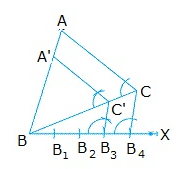
\(\frac { A'B }{ AB } =\frac { A'C }{ AC } =\frac { BC' }{ BC } =\frac { 3 }{ 4 } \)
\(\frac { A'B }{ AB } =\frac { A'C' }{ AC } =\frac { BC' }{ BC' } =\frac { 3 }{ 4 } \)
\(\frac { A'B }{ AB } =\frac { A'C' }{ AC } =\frac { BC' }{ BC } =\frac { 4 }{ 3 } \)
\(\frac { A'B }{ AB } =\frac { A'C' }{ AC } =\frac { BC }{ BC' } =\frac { 4 }{ 2 } \)
A
B
C
D
53.
A circle can pass through
3 non- collinear points
3 collinear points
4 collinear points
2 collinear points
1.
Given, AP = 8 and OA = 6 cm
\(\angle OAP\) = 90° (as radius \(\bot\) tangent)
\(\Rightarrow\) OP2 = AP2 + OA2
= 82 + 62
= 64 + 36
OP2 = 100
\(\Rightarrow\) OP = 10 cm
Now in triangle OPB,
OP = 10 cm, OB = 4 cm
\(\Rightarrow\) OP2 = BP2 + OB2
\(\Rightarrow\) 100 = BP2 + 16
BP2 = 100 - 16 = 84
or BP = \(\sqrt{84}\)
\(=2\sqrt{21}\) cm.
2.
Let the first term of an AP. be a, common difference,
d =-6
a16 = a + (16- 1)(- 6)
= a-90
a12 = a + (12-1)(-6)
= a-66
a16 - a12 = (a - 90) - (a - 66)
=a-90-a+66
=-24
3.
1. Draw a line segment AC = 4.2 cm.
2. With A as a centre and radius 2.5 cm, draw two arcs, one above AC and one below AC.
3. With C as a centre and radius 3.5 cm, two arcs are drawn intersecting previous arcs at Band D.
4.Join AB, BC, AD and CD. Thus, ABCD is the required quadrilateral.
5. taking A as a centre and radius 6.3 cm, draw an arc' which intersects AC produced at C'.
6. Through C', draw C'B' and C'D' parallel to CB and CD, respectively.
Hence, AB'C'D' is the required quadrilateral similar to quadrilateral ABCD.
4.
Given, radius of circle = 5 cm
1.Draw a circle with 0 as centre and radius 5 cm.
2. Draw any chord PQ through the given point P on the circle.
3.Take a point R on the circle and join P and Q to a pointR.
4. Construct \(\angle QPY=\angle PQX\) on the opposite side of the chord PQ.
5. Produce yP to X to get YPX, as the required tangent.
5.
50 m
6.
\(P\ge -\frac { 4 }{ 3 } \)
7.
Since, the tangents drawn from an external point to a circle are equal.
ஃ EK = EM = 9 cm
⇒ ED + DK = EF + FM = 9 cm
⇒ ED + DH = EF + FH = 9 cm
Now, perimeter of \(\triangle\)EDF
= ED + DF + EF
= (ED + DH) + (EF + FH)
= 9 + 9 = 18 cm
8.
Hypotenuse is the largest side in a right triangle.
9.
10.38m
10.
12m
11.
52m
12.
\(x^{2} - 25x + 150 = 0 , x = 15 , 10\)
13.
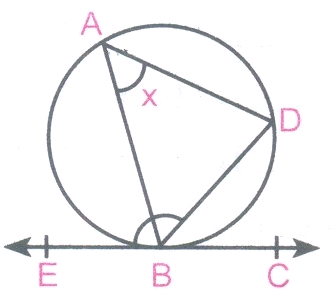
Given: \(\angle \)EBD = 146°
To find: \(\angle \)x.
Proof: \(\angle \)DBC + \(\angle \)EBD = 180° [linear pair]
⇒ \(\angle \)DBC + 146° = 180°
⇒ \(\angle \)DBC = 180° - 146° = 34° ........(i)
⇒ \(\angle \)x = \(\angle \)DBC = 34° [From (i)]
[Angles in the alternate segment]
14.
Sp = ap2 + bp
S1 = a x 12 + b x 1 = a + b = a1
S2 = a x 22 + b x 2 = 4a + 2b
a1 + a2 = 4a + 2b
a + b + a2 = 4a + 2b
a2 = 3a + b
Now, d = a2 - a1 = (3a + b) - (a + b) =2a.
15.
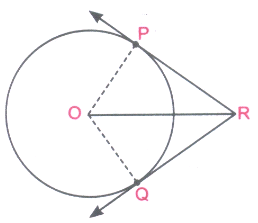
OR bisects \(\angle \)PRQ \(\angle \)PRO = \(\angle \)QRO = 60o
In right \(\triangle\)OPR (∵ OP⊥ PR)
\(PR\over OR\) = cos 60o ⇒ OR = 2PR ....(i)
Similarly \(QR \over OR\) = \(1\over2\)⇒ OR = 2QR .....(ii)
(i) + (ii), we get
2OR = 2PR + 2QR
⇒ OR = PR + RQ
16.
The odd numbers between 0 and 50 are 1,3, 5,., 49 which form an AP.
Here, first term (a) = 1, last term (l) = 49
and common difference (d) = 3 - 1 = 2.
Let there be n numbers in the AP.
Then, nth term (an) = a + (n - 1) d = l
\(\Rightarrow\) 1 + (n - 1) (2) = 49
\(\Rightarrow\) n - 1 = 24 \(\Rightarrow\) n = 25
Now, sum of n terms, \(S_n=\frac{n}{2}(a+l)\)
\(\therefore\) Sum of 25 terms, \(\begin{aligned} S_{25} & =\frac{25}{2}(1+49)=\frac{25}{2} \times 50 \\ \end{aligned}\)
\(\begin{aligned} & =25 \times 25=625 \end{aligned}\)
17.
Px(x-3)+9=.0 \(\Rightarrow \) px2-3px+p=0 Here a=p,b=-3p,c=9
For equal roots D=0 \(\Rightarrow D=b^{ 2 }-4ac\)
\(\Rightarrow (-3p)^{ 2 }-4\times p\times 9=0\quad \Rightarrow 9p^{ 2 }-36p=0\)
\(\Rightarrow 9p(p-4)=0\quad \Rightarrow 9p=0\) or p=4
but p \(\neq 0\) \([\therefore \) In quadratic equation a \(\neq \) 0 ]
18.
Let Ist term of AP = a and common difference = d.
Now, a6 = -10 \(\Rightarrow\) a + 5d = -10 ..(i)
Also, a10 = -26 \(\Rightarrow\) a + 9d = -26 ...(ii)
Subtract (i) from (ii),
a + 9d = - 26
a + 5d = -10
- - +
4d = -16 \(\Rightarrow\) d = - 4
Substituting in (i), we get
a + 5 x ( -4 ) = - 10 \(\Rightarrow\) a = 10
Now, a15 = a + 14d = 10 + 14 X - 4 = - 46
19.
This is of the form ax2+bx+c=0, where a=4, b=4\(\sqrt { 3 } \) and c=3.
Discriminant(D)=b2-4ac=\({ \left( 4\sqrt { 3 } \right) }^{ 2 }\)-4 x 4 x 3=48-48=0
Roots are \(\alpha =\frac { -b+\sqrt { D } }{ 2a } =\frac { -4\sqrt { 3 } +0 }{ 8 } =\frac { -4\sqrt { 3 } }{ 8 } =\frac { -\sqrt { 3 } }{ 8 } \)
and \(\beta =\frac { -b-\sqrt { D } }{ 2a } =\frac { -4\sqrt { 3 } -0 }{ 8 } =\frac { -4\sqrt { 3 } }{ 8 } =\frac { -\sqrt { 3 } }{ 2 } \)
Hence, the roots are \(\frac { -\sqrt { 3 } }{ 2 } ,\frac { -\sqrt { 3 } }{ 2 } \)
20.
Here, we have
a2 - a1 = -3.2 - (-1.2) = -3.2 + 1.2 = -2
a3 - a2 = -5.2 - (-3.2) = -5.2 + 3.2 = -2
a4 - a3 = -7.2 - (-5.2) = -7.2 + 5.2 = -2
and so on.
Since, the difference of any two consecutive terms same. Therefore, the given list of numbers forms a AP and its common difference (d) is - 2.
Now, next three terms of this AP are,
a5 = a4 + d = -7.2 + (-2) = -9.2
a6 = a5 + d = -9.2 + (-2) = -11.2
and a7 = a6 + d = -11.2 + (-2) = -13.2
21.
Steps of Construction:
1. Draw a line segment AB of 7 cm
2. Taking A and B as centre draw two circle of 3 cm and 2 cm radius
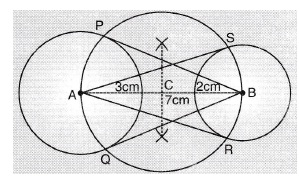
3. Bisect the line AB. Let mid-point of AB is C.
4. Taking C as centre draw a circle of radius AC which will intersect the circle at point P, Q, R and S.
5. Join BP, BQ, AS and AR. These are the required tangents.
22.
Here a = 101, d = 7, an = 997
\(\Rightarrow\) an = a + (n - l)d.
997 = 101 + (n - 1) X 7
\(\therefore\) n = 129
23.
Given, two concentric circles of radii 2.8 cm and 1.8 cm with common centre say, O
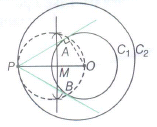
Steps of Construction
1. Draw two circles with common centre 0 and radii 2.8 cm and 1.8 cm.
2. Take a point P on the outer circle and join OP.
3. Now, bisect OP. Let mid-point of OP be M.
4. Taking M as centre and PM as radius, draw a dotted circle, which intersects the inner circle at two points say A and B.
5. Join APand BP. Then, AP and BP are required tangents. On measuring the lengths, we get
PA = PB
= 2.14 cm
Calculation
Join OA. Then, OA = 1.8 cm [radius of inner circle C1]
and OP = 2.8 cm [radius of outer circle C2]
Hence, \(\angle PAO=90°\)
[angle in semi-circle of constructed circle]
So, in \(\Delta PAO\) , by Pythagoras theorem,
OP2=OA2 + AP2 => (2.8)2 = (1.8)2 + AP2
=> 7.84 = 3.24 +AP2 => AP2 =7.84-3.24 = 4.6
=> AP= 2.14 cm => PA = PB = 2.14 cm
Hence, the length of tangents is 2.14 cm
24.
d = 6; Next two terms are 24 and 30
25.
Given: Let PQ and GH are the common tangents to both circles and common tangent at C meets PQ at E and GH at F.
To Prove: EF bisects PQ and GH.
Proof: Tangents'drawn from an external point to a circle are equal.
EP = EC and EQ = EC
⇒ EP = EQ
⇒ PQ is bisected by EF at E.
Similarly, GH is bisected by EF at F.
ஃ The common tangent EF drawn at 'C' bisects the other two common tangents.
26.
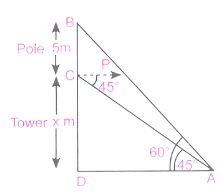
Let CD be a tower of height x m and BC is a pole and ㄥBAD=600 and ㄥPCA=450 ㄥPCA=ㄥCAD=450
In right ΔCDA, \(\frac { CD }{ DA } \)=tan 45o
⇒ \(\frac { x }{ DA } \)=1 ⇒ DA= x m
In right ΔBDA, \(\frac { BD }{ DA } \)=tan 60o
⇒ \(\frac { 5+x }{ x } =\sqrt { 3 } \)
⇒ 5+x=\(\sqrt { 3 } \)x ⇒ 5=(\(\sqrt { 3 } \)-1)x
⇒ x=\(\frac { 5 }{ \sqrt { 3 } -1 } m=\frac { 5(\sqrt { 3 } +1) }{ 2 } m=\frac { 5(1.73+1) }{ 2 } m=\frac { 13.65 }{ 2 } \)m=6.82 m
27.
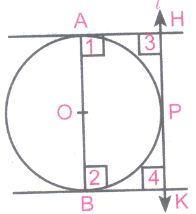
Given: A circle with centre O. AB is the diameter of this circle. I is tangent to the circle. AH and BK are perpendicular to I from A and B at H and K respectively.
To prove: AH + BK = AB
Proof: AH and HP are tangents from the external point H
ஃ AH = HP .....(i)
and BK, KP are tangent from the external point K
ஃ BK = KP ......(ii)
Adding (i) and (ii) we get
AH + BK = HP + PK = HK ......(iii)
AB ⊥ AH
AB ⊥ BK
[Tangent makes 90° angle with radius at the point of contact]
⇒ \(\angle \)1 = \(\angle \)2 = 90°
Given that AH ⊥ i ⇒ \(\angle \)3 = 90°
and BK ⊥ i ⇒ \(\angle \)4 = 90°
∵ \(\angle \)1 = \(\angle \)2 = \(\angle \)3 = \(\angle \)4 = 90°
⇒ AHKB is a rectangle
⇒ AB = HK ......(iv)
[Opposite sides of a rectangle are equal]
From (iii) and (iv) ⇒ PH + PK = AB
AH + BK = AB from (i) and (ii) Hence proved.
28.
Let Varun's present age be x years and Swati's present age be y years
Case I : 7 years ago
Varun's age was (x-7) years and Swati's age was (y-7) years
ATQ (x-7) = 5(y-7)2 \(\Rightarrow x=5(y-7)^{ 2 }+7\) ...(i)
Case II : 3 years hence
Varun's age will be (x+3) years and Swati's age will be (y+3) years
A.T.Q \(y+3=\frac { 2 }{ 5 } (x+3)\)
\(\Rightarrow y+3=\frac { 2 }{ 5 } \left[ 5(y-7)^{ 2 }+7+3 \right] \) [Using eq.(i)]
\(\Rightarrow y+3=\frac { 2 }{ 5 } \times 5(y-7)^{ 2 }+\frac { 2 }{ 5 } \times 10\Rightarrow y+3=22(y^{ 2 }-14y+49)+4\)
\(\Rightarrow y+3=2y^{ 2 }-28y+98+4\Rightarrow 2y^{ 2 }-29y+99=0\)
\(\Rightarrow 2y^{ 2 }-18y-11y+99=0\Rightarrow 2y(y-9)-11(y-9)=0\)
\(\Rightarrow (y-9)(2y-11)=0\Rightarrow y=9,y=\frac { 11 }{ 2 } \) (rejecting)
\(\therefore y=9\) \(\therefore x=5(9-7)^{ 2 }+7\) [From (i)]
x = 27
Present age of Swati = 9 years and Varun =27 years.
29.
Let numerator be
denominator is x + 2.
\(\Rightarrow fraction=\frac { x }{ x+2 } \)
\(\Rightarrow \frac { x }{ x+2 } +\frac { x+2 }{ x } =\frac { 34 }{ 15 } \)
\(\Rightarrow 15(x^{ 2 }+x^{ 2 }+4x+4)=34(x^{ 2 }+2x)\)
\(\Rightarrow 30x^{ 2 }+60x+60=34x^{ 2 }+68x\)
\(\Rightarrow 4x^{ 2 }+8x-60=0\)
\(x^{ 2 }+2x-15=0\)
\(\Rightarrow x^{ 2 }+5x-3x-15=0\)
\(\Rightarrow x(x+5)-3(x+5)=0\)
\(\Rightarrow (x+5)(x-3)=0\)
x=3
Fraction = \(\frac { 3 }{ 5 } \)
30.
Given, OB = 5 cm and radius OA = 3 cm
Use Pythagoras theorem in right \(\Delta\)OAB to find AB
4 cm
31.
(i) Station P should send the team, its distance covered 14.66km.
(ii) Presence of mind and ability to take prompt decisions.
32.
Given equation is
\((x+1)^{ 2 }=2(x-3)\)
\(\Rightarrow x^{ 2 }-2x=(-2)(3-x)\)
\([\because (a+b)^{ 2 }=a^{ 2 }+2ab+b^{ 2 }]\)
\(\Rightarrow x^{ 2 }+1+6=0\)
\(\Rightarrow x^{ 2 }+7=0\)
Which is of the form \(ax^{ 2 }+bx+c=0\) ,where \(a\neq 0andb=0\)
Hence,it is a quadratic equation
33.
Since OABC is a rhombus.
∴ OA = AB = BC = CO
Also, OB = OA = OC [radii Of a circle]
∴ We have OA = OB = AB
and 0B = OC = BC
⇒ \(\triangle\)OAB and \(\triangle\)OBC are equilateral triangles and OB is the diagonal of rhombus OABC.
ஃ Area (rhombus OABC) = 2 x area (\(\triangle\)OAB)
[.∴ diagonal divide rhombus in two triangles of equal areas]
= \(\left( 2\times \frac { \sqrt { 3 } }{ 4 } \times { 10 }^{ 2 } \right) \)cm2
[ ∵ area of equilateral triangle = \(\frac { \sqrt { 3 } }{ 4 } \) (side)2]
= \(\left( 2\times \frac { \sqrt { 3 } }{ 4 } \times { 10 }0 \right) \)cm2
= 50\(\sqrt3\) cm2
34.
Let AB be the tower of height h m and CD be the cliff of height 60\(\sqrt m\) m, such that
\(\angle \)XDA = \(\angle \)DAE = 45o and \(\angle \)XDB = \(\angle \)DBC = 60o
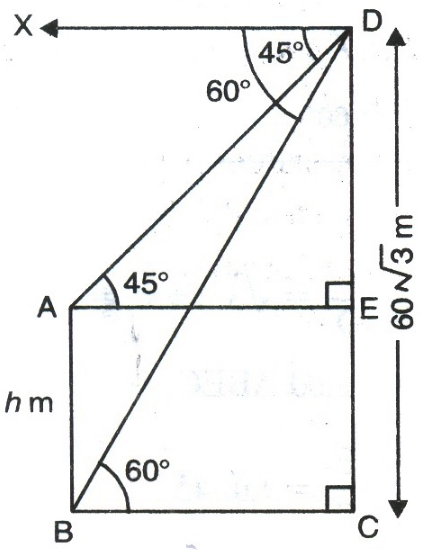
In rt. \(\triangle\)DCB,
\(DC\over BC\)=tan 60o
\(\frac { 60\sqrt { 3 } }{ BC } =\sqrt { 3 } \)
BC = 60m
Now BC = AE = 60m
and DE = DC - CE (or AB)
= \(60\sqrt { 3 } -h\)
Again in rt. \(\triangle\)DEA
\(\angle \)E = 90o
ஃ \(DE\over AE\)=tan 45o
\(\frac { 60\sqrt { 3 } -h }{ 60 } =1\)
⇒ 60\(\sqrt3\) - h = 60
⇒ h = 60\(\sqrt3\) - 60
⇒ h = 60(\(\sqrt3\)-1)
Hence the required height of the tower is 60(\(\sqrt3\)-1)m
35.
Let C is cloud and R is its reflection.
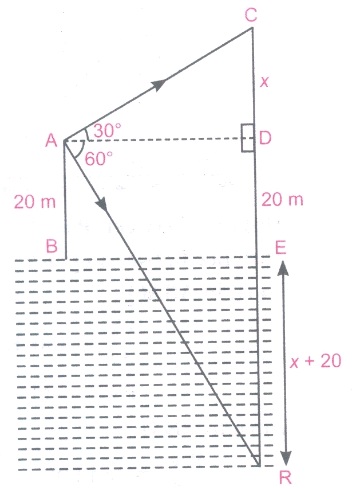
ㄥDAC=30o, ㄥDAR=60o, let CD=x m
∴ Height of the cloud above the lake
=(x+20)m
∴ ER=(20+x)m
Now In right ΔADC,
\(\frac { CD }{ AD } =tan30^{ 0 } \Rightarrow \frac { x }{ AD } =\frac { 1 }{ \sqrt { 3 } } \)
⇒ AD=\(\sqrt { 3 } \)x
In right, ΔADR,
\(\frac { DR }{ AD } \)=tan 60o
⇒ \(\frac { DE+ER }{ AD } =\sqrt { 3 } \)
⇒ \(\frac { 20+20+x }{ \sqrt { 3 } x } =\sqrt { 3 } \) (using (i))
40+x=3x
⇒ x=20 m
Now In right ΔADC, \(\frac { AC }{ DC } \)=cosec 30o
\(\frac { AC }{ 20 } \)=2 ⇒ AC=40 m
∴ Distance of the cloud from A=40 m
36.
Number of houses preceding no.X
= X - 1
Sum of numbers of houses preceding X
= 1 + 2 + 3 + ... + X - 1
Number of houses following X = 49 - X
Sum of numbers on the houses following
X = ( X + 1 ) + ( X + 2 ) + ... + 49
\(={49-X\over2}(X+1+49)\)
\(=\left( 49-X\over2 \right)[X+50]\)
\(={{2450-X-{X}^{2}}\over{2}}\)
Now, \({{{X}^{2}-X}\over{2}}={{2450-{X}-{X}^{2}}\over{2}}\)
\(\Rightarrow\) 2X2 = 2450
\(\Rightarrow\) X2 = 1225
X = \(\sqrt{1225}\) = 35
\(\therefore\) X = 35
37.
(a)
38.
(b)
39.
(a)
40.
(a)
41.
(b)
42.
()
infinite tangents
43.
()
\(m \le 8\)
44.
()
\(\frac{n(n+1)}{\sqrt{2}}\)
45.
()
perpendicular
46.
()
elevation
47.
()
Minimum number of marks = 2 + 3 = 5
48.
()
Angle between the radii = 180o - 35o = 145o
49.
(d)
t = p – 4
50.
(b)
0,1
51.
(d)
100 m
52.
(a)
A
53.
(a)
3 non- collinear points

10th Standard CBSE Syllabus & Materials
10th Standard CBSE
CBSE 10th Social Science PS - Federalism - New Model Questions Papers Study Material - QB365 Set A
NEW10th Standard CBSE
CBSE 10th Social Science PS - Power Sharing - New Model Questions Papers Study Material - QB365 Set A
NEW10th Standard CBSE
CBSE 10th Social Science GEO - Manufacturing Industries - New Model Questions Papers Study Material - QB365 Set A
NEW10th Standard CBSE
CBSE 10th Social Science GEO - Minerals and Energy Resources - New Model Questions Papers Study Material - QB365 Set A



CBSE 10th Standard CBSE Subjects
CBSE Standards





