
 100% FREE ACCESS
10th Standard CBSE Syllabus & Materials
10th Standard CBSE
CBSE 10th Social Science ECO - Globalisation and the Indian Economy - New Model Questions Papers Study Material - QB365 Set A
NEW10th Standard CBSE
CBSE 10th Social Science ECO - Money and Credit - New Model Questions Papers Study Material - QB365 Set A
NEW10th Standard CBSE
CBSE 10th Social Science ECO - Sectors of the Indian Economy - New Model Questions Papers Study Material - QB365 Set A
NEW10th Standard CBSE
CBSE 10th Social Science ECO - Development - New Model Questions Papers Study Material - QB365 Set A
NEW10th Standard CBSE
CBSE 10th Social Science PS - Outcomes of Democracy - New Model Questions Papers Study Material - QB365 Set A
NEW10th Standard CBSE
CBSE 10th Social Science PS - Gender, Religion and Caste - New Model Questions Papers Study Material - QB365 Set A

Published on: 14/02/2020
10th standard CBSE Mathematics Public Model Question Paper II 2020
Download CBSE Class 10th Standard CBSE Maths question papers, sample papers, important questions, and previous year solved papers in PDF format. Get free study materials, NCERT solutions, and exam preparation resources for Class 10th Standard CBSE Maths
Questions + Answers key
Take MCQ Maths Test
1.
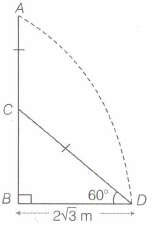
A straight tree is broken due to thunderstorm. The broken part is bent in such a way that the peak of the tree touches the ground at an angle of 60\(°\)at a distance of \(2\sqrt { 3 } m\) Find the whole height of the tree.
2.
As a part of a campaign, a huge balloon with message of ''AWARENESS OF CANCER" was displayed from the terrace of a tall building. It was held by strings of length 8 m each and inclined at an angle of 60° at the point, where it was tied as shown in the figure.
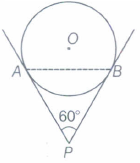
(i) What is the length of AB?
(ii) If the perpendicular distance from the centre of the circle to the chord AB is 3 m, then, find the radius of the circle.
(iii) Which method should be apply to find the radius of circle?
(iv) What do you think of such campaign?
3.
Two poles of equal heights are standing opposite to each other on either side of the road, which is 80 m wide. From a point between them on the road, the angles of elevation of the top of the poles are 60° and 30°, respectively. Find the height of the poles and the distances of the point from the poles.
4.
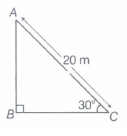
A circus artist is climbing a 20 m long rope, which is tightly stretched and tied from the top of a vertical pole to the ground. Find the height of the pole, if the angle made by the rope with ground level is \(30°\) (see figure)
5.
Find the sums given below: -5 + (-8) + (-11) + ..... + (-230)
6.
In a flight of 2800km, an aircraft was slowed down due to bad weather. Its average speed is reduced by 100km/h and time increased by 30 minutes. Find the original duration of the flight.
7.
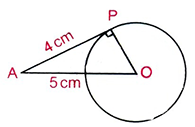
The length of a tangent from a point A at distance 5cm from the centre of the circle is 4cm.Find the radius of the circle.
8.
Two APs have two same common difference. The difference between their 100th terms is 111222333. What is the different between their millionth terms?
9.
Draw a right triangle with sides of length 5 cm and 4 cm making a right angle. Construct another triangle whose sides are \(\frac { 3 }{ 5 } \) times the corresponding sides of the first triangle.
10.
One year ago, a man was 8 times as old as his son. Now, his age is equal to the square of his son's age, Find their present ages.
11.
Find the roots of the quadratic equation \({x+3\over {x + 2}} = {3x - 7 \over {2x - 3 }} ; x \neq -\ 2 , {3 \over 2}.\)
12.
Find the roots of the following quadratic equation (if they exist) by the method of completing square \(25x^{2}-20x+4 = 0\) .
13.
A peacock is sitting on the top of a tree. It observes a serpent on the ground making an angle of depression of 30o . The peacock with the speed of 300 m/minute catches the serpent in 12 seconds. What is the height of the tree?
14.
The 6th and 17th terms of an A.P. are 19 and 41 respectively, find the 40th term.
15.
The shadow of a flagstaff is three times as long as the shadow of the flagstaff when the sunrays meet the ground at an angle of 60o . Find the angle between the sunrays and the ground at the time of longer shadow.
16.
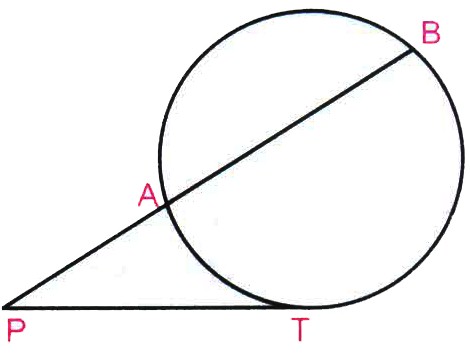
In the given figure, PT is tangent to the circle at T.If PA=4cm and AB=5cm find PT.
17.
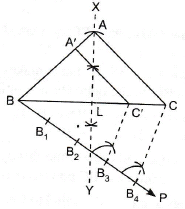
Draw an isosceles \(\triangle ABC\) in which \(BC=5.5cm\) and altitude AL = 3cm. Then construct another triangle whose sides are \(3\over 4\) of the corresponding sides of \(\triangle ABC\).
18.
ABC is an isosceles triangle, in which AB=AC, circumscribed about a circle.Show that BC is bisected at the point of contact.
19.
Draw a line segment of length 7 cm. Find a point P on it which divides it in the ratio 3 : 5.
20.
Solve the following equation for x
\(4x^{ 2 }+4bx-(a^{ 2 }-b^{ 2 })\)
21.
Ho many terms of the A.P.18, 16, 14 ....be taken so tliat their sum is zero?
22.
If the 2nd term of an A.P.is 8 and the 5th term is 17, find its 19th term.
23.
What is the next term of an AP.\( \sqrt { 7 } ,\sqrt { 28 } ,\sqrt { 63 } ,.....?\)
24.
Twenty-seven years hence Sanjay's age will be the square of what it was 29 yr ago. Find his present age.
25.
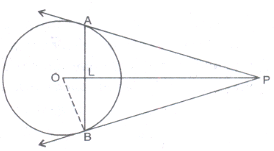
In the given figure, AB is a chord of length 16 cm, of a circle of radius 10 cm. Tangents at A and B intersect at a point P. Find the length of tangent AP.
26.
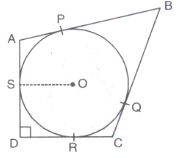
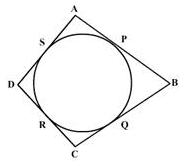
In figure, a circle is inscribed in a quadrilateral ABCD touching the sides AB, BC, CD and AD at P, Q, R and S respectively. If the radius of the circle is 10 cm, BC = 38 cm, PB = 27 cm and , then find the length of CD
.
27.
The angle of elevation of the top of the tower from a point on the ground which is 30m away from foot of the tower is 300.the height of the tower is.
28.
The hypotenuse of a right triangle is 4 times the smallest side.The third side is \(\sqrt{735}\) .Find the hypotenuse and the smallest side.
29.
Niharika's mother is 28 years older than her. Seven years ago, the product of their ages in years was 245. We would like to find Niharika's present age. Represent the given situation in the form of a quadratic equation. How one should care their parents in old age ?
30.
If \(\frac { 3+5+7+...\ to\ n\ terms }{ 5+8+11+...\ to\ 10\ terms } \)=7, then find the value of n.
31.
A ladder 15 m long just reaches the top of a vertical wall. If the ladder makes an angle of 60o with the wall, then find the height of the wall.
32.
Which constant should be added or subtracted to solve the quadratic equation \(4x^{2} - \sqrt {3 }x -5 = 0\) by the method of completing the square?
33.
A tree is broken by the wind. The top struck the ground at an angle of \({ 45 }^{ \circ }\)and it a distance 35m from the foot. Then the whole height of the tree before broken.
34.
Construct a \(\triangle ABC\) in which BC = 9 cm,
35.
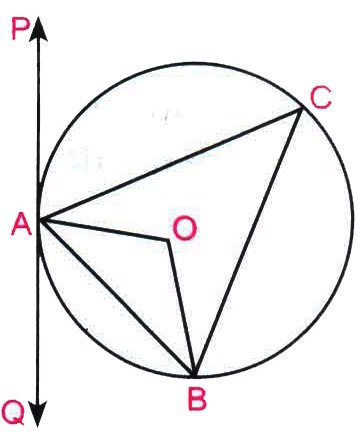
PAQ is a tangent to the circle with centre O at point A as shown in figure.If \(\angle OBA=35^0\), find the value of \(\angle BAQ \ and\ \angle ACB\)
36.
Draw a triangle ABC with sides BC = 6 cm, AB = 5 cm and (Then construct a triangle whose sides are \({3\over 2}\) of the corresponding sides of the triangle ABC.
37.
Find the value of m so that the quadratic mx(x-7)+49=0 has two equal roots.
38.
Radius of circle given below is
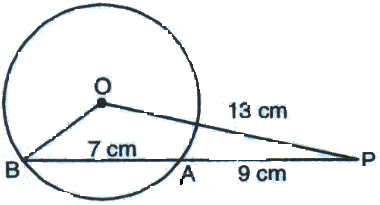
39.
Factors of \(x^{2} - 2x + 1\) .
40.
If \(\frac{2}{3}\), k, \(\frac{5k}{8}\) are in A.P., then value of k.
41.
\({a}_{30}-{a}_{20}\) of AP a, a + d, a + 2d, a + 3d, .... is 10 d.
42.
In the given figure, if AP = 6 cm and BP = 8 cm, then m : n = 3 : 4.
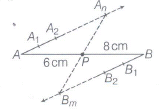
43.
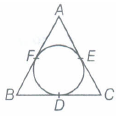
In the given figure, incircle of MBC touches its sides at D, E and F. If perimeter of \(\triangle \) ABC = 24 cm, then AF + BD + CE = 12 cm.
44.
Trigonometric ratios are same for the same angles.
45.
The sum of a real number x and its reciprocal from a quadratic equation.
46.
The length of the tangents drawn from an external point to a circle are _____________
47.
The ................ is the line drawn from the eye of an observer to the point in the object viewed by the observer.
48.
What is the ratio of division of the line segment AB by the point P from A?
49.
To draw a pair of tangents to a circle which are inclined to each other at an angle of 60° , it is required to draw tangents at end points of those two radii of the circle, then find the angle between them.
50.
Draw a right-angled triangle, in which the sides (other than the hypotenuse) are lengths 8 cm and 6 cm. Then, construct another triangle, whose sides are \(\frac { 3 }{ 4 } \) times of the corresponding sides of given triangle. Justify your construction.
51.
Which term of the A.P. 1, 4, 7 … is 88?
35
26
27
30
52.
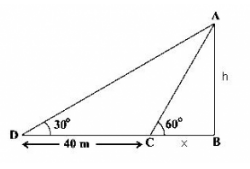
Find AB in the given figure
√3
30√3
20√3
10√3
53.
If four sides of a quadrilateral ABCD are tangential to a circle, then
AC + AD = BD + CD
AB + CD = BC + AD
AB + CD = AC + BC
AC + AD = BC + DB
54.
PQ is a tangent drawn from a point P to a circle with centre O and QOR is a diameter of the circle such that ∠POR=120°, then ∠OPQ is
60o
30o
90o
45o
1.
Let AB be the tree whose part AC breaks and touches the ground at D
Then, BD = \(2\sqrt { 3 } m\)
and AC = CD
In right angled \(\Delta \)CBD,
\(cos 60°=\frac { B }{ H } =\frac { BD }{ CD } \)
\(\Rightarrow \frac { 1 }{ 2 } =\frac { 2\sqrt { 3 } }{ CD } \)
\(\left[ \because cos 60°=\frac { 1 }{ 2 } and BD=2\sqrt { 3 } m \right] \)
\(\Rightarrow\) \(CD=2\times 2\sqrt { 3 } =4\sqrt { 3 } \)
\(=4\times 1.732=6.928\ m [\because \sqrt { 3 } =1.732]\)
\(\therefore\) AC = CD = 6.928 m
Again, in right angled \(\Delta \)CBD,
\(tan\quad 60°=\frac { P }{ B } =\frac { BC }{ BD } \)
\(\Rightarrow \sqrt { 3 } =\frac { BC }{ 2\sqrt { 3 } } [\because tan60°=\sqrt { 3 } and BD=2\sqrt { 3 } m]\)
\(\Rightarrow BC=\sqrt { 3 } \times 2\sqrt { 3 } =6 m\)
Now, AB = AC + BC
= 6.928 + 6 = 12.928 m (approx)
Hence, the height of the tree is 12.928 m.
2.
(i) Given, PA = PB = 8 m
We know that, tangents drawn from an external point to the circle are equal in length.

So, PA and PB are tangents.
Now, draw OP which bisects ㄥAPB and perpendicular to the chord AB.
ㄥAPC = ㄥBPC = 30°
and ㄥACP = ㄥBCP = 90°
In ΔACP, ㄥAPC + ㄥACP + ㄥPAC = 180°
30° + 90° + LPAC = 180°
ㄥPAC = 180° -120° = 60°
Similarly, ㄥPBC = 60°
Thus, ΔAPB is an equilateral triangle.
AB = AP = BP = 8 m
(ii) Given, OC = 3 m
We know that, if a perpendicular drawn from the centre of the circle to the chord of that circle, then it bisects the chord.
∴ \(AC=BC={AB\over 2}={8\over 2}=4\)
In right angled ΔACO,
OA2=AC2+OC2
OA2=(4)4+(3)2
⇒16+9=25
⇒ OA=5m
which is the radius of the circle.
(iii) Pythagoras theorem
(iv) Creating awareness and taking initiative.
3.
Let AB=80 m be the width of the road. On both sides of the road, poles AE = BD = h m are standing. Let C be any point on AB such that from point C, angles of elevation are

\(\angle BCD=60°\), and \(\angle ACE=30°\).
Let BC = x m.
Then, AC = AB - BC = (80 - x)m
In right angled \(\Delta\)CAE, \(\tan 30^{\circ}=\frac{P}{B}=\frac{A E}{A C}\)
\(\begin{aligned} & \Rightarrow \quad \frac{1}{\sqrt{3}}=\frac{h}{80-x} \quad\left[\because \tan 30^{\circ}=\frac{1}{\sqrt{3}}\right] \\ \end{aligned}\)
\(\begin{aligned} & \Rightarrow \quad 80-x=h \sqrt{3} \Rightarrow h \sqrt{3}+x=80 \end{aligned}\) ...(i)
and in right angled \(\Delta\)CBD,
\(\tan 60^{\circ}=\frac{B D}{B C} \Rightarrow \sqrt{3}=\frac{h}{x} \quad\left[\because \tan 60^{\circ}=\sqrt{3}\right]\)
\(\Rightarrow \quad b=\sqrt{3 x}\) ...(ii)
On putting h=\(\sqrt3\)x in Eq. (i), we get
\(\begin{aligned} &\sqrt{3} x(\sqrt{3})+x=80 \Rightarrow 3 x+x=80\\ \end{aligned}\)
\(\Rightarrow\) \(\begin{aligned} &4 x=80 \Rightarrow x=20 \mathrm{~m} \end{aligned}\)
On putting x = 20 m in Eq. (ii), we get
\(h=20 \sqrt{3} \mathrm{~m}\)
Now, AC = 80 - x = 80 - 20 = 60 m
Hence, height of the poles is 20\(\sqrt3\)m and the distances of the point C from the poles are 60 m and 20 m.
4.
In the given figure, AB is the height of the pole and AC = 20 m is the length of rope which is tied from the top of the pole to the ground at point C.
In right angled \(\Delta ABC\) ,
\(sin30°=\frac { AB }{ AC } =\frac { AB }{ 20 } \)
⇒ \(\frac { 1 }{ 2 } =\frac { AB }{ 20 } \Rightarrow AB=\frac { 20 }{ 2 } =10\quad m\)
Hence, the height of the pole is 10 m.
5.
- 5 + ( -8 ) + (-11) + .... + (-230)
Here, a = -5, an = -230
d = - 8 - ( - 5) = -3
an = a + ( n - 1) d
\(\Rightarrow\) -230 = -5 + ( n - 1 ) ( -3 ) \(\Rightarrow\) \(\frac{-225}{-3}\) = n -1
\(\Rightarrow\) 75 + 1 = n or n = 76
\(\therefore\) S76 = \(\frac{76}{2}[-5+(-230)]=38\times(-235)=-8930\)
6.
Let original duration of the flight be x hours.
Distance = 2800 km
\(\therefore \) Usual method = \(\frac { 2800 }{ x } km/h\)
When time = \(\left( x+\frac { 1 }{ 2 } \right) \) hrs
The new speed = \(\frac { 2800 }{ x+\frac { 1 }{ 2 } } =\frac { 5600 }{ 2x+1 } \)
ATQ \(\frac { 2800 }{ x } -\frac { 5600 }{ 2x+1 } =100\quad \Rightarrow \frac { 2800(2x+1)-5600x }{ (2x+1)x } =100\)
\(\Rightarrow 2800=100(2x^{ 2 }+x)\Rightarrow 2x^{ 2 }+x-28=0\)
\(\Rightarrow 2x^{ 2 }+8x-7x-28=0\quad \Rightarrow 2x(x+4)-7(x+4)=0\)
\(\Rightarrow (x+4)(2x-7)=0\quad \Rightarrow x=-4\) (rejected) or x=\(\frac { 7 }{ 2 } =3\frac { 1 }{ 2 } \)
\(\therefore \) Original duration = \(3\frac { 1 }{ 9 } \) hours
7.
OP = Radius of the circle OA = 5 cm; AP = 4 cm
OA2 = AP2 + OP2 [By pythagoras theorem]
52 = 42 + OP2
⇒ 25 = 16 + OP2 ⇒ 25 - 16 = OP2 ⇒ 9 = OP2 ⇒ OP = \(\sqrt9\) = 3
Radius = 3 cm
8.
111222333
9.
Given: A right triangle with sides of length 5 cm and 4 cm making a right angle.
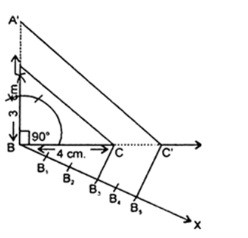
Required: Triangle whose sides are \(\frac { 3 }{ 5 } \) times the corresponding sides of the 1st triangle.
Steps of Construction :
1 . Construct a right triangle ABC right-angled at B with sides BC= 5 cm and AB=4 cm.
2. Through B, construct an acute angle CBX, (<90o).
3. Mark Five points B1, B2, B3,B4,B5 such that BB1 =B1B2=B2B3=B3B4=B4B5.Join B3C.
4. Through B3, draw B3C'||B5C, intersecting BC in C'.
5. Through C', draw C'A'||CA, intersecting AB in A'.
Hence, ΔA 'BC' is the required triangle.
10.
Let present age of his son = x yr
One year ago, his son's age = (x - 1) yr
One year ago, man's age = 8(x - 1) yr = (8x - 8) yr
Present age of man = (8x - 8 + 1) yr = (8x - 7) yr
According to the question,
8x - 7 = x2 ⇒ x2 - 8x + 7 = 0
which is the required quadratic equation.
Now, x2 - 7x - x + 7 = 0 [by factorisation]
⇒ x(x - 7) - l(x - 7) = 0
⇒ (x - 7)(x - 1) = 0
⇒ x - 7 = 0 or x- 1 = 0
⇒ x = 7 or x = 1
But x = 1is not possible because if x = 1, then present age of the son and father are same. So, x = 7.
Hence, present age of his son = 7 yr and present age of man = 8 x 7 - 7 = 49 yr.
11.
\([-1, 5]\)
12.
\(\left[{2\over 5 } , {2\over 5}\right]\)
13.
Let C be the position of peacock and A be the position of serpent.
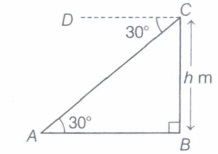
Given, ∠DCA = 30°
\(\Rightarrow \angle B A C=\angle D C A=30^{\circ}\) [alternate angles]
∵ Distance = Speed x Time
∴ \(A C=300 \ \frac{12}{60}\left[\because 12 \mathrm{~s}=\frac{12}{60} \mathrm{~min}\right]\)
\(\Rightarrow A C=60 \mathrm{~m}\)
In right angled ΔABC,
\(\sin 30^{\circ}=\frac{P}{H}=\frac{B C}{A C}=\frac{h}{60}\)
30 m.
14.
87
15.
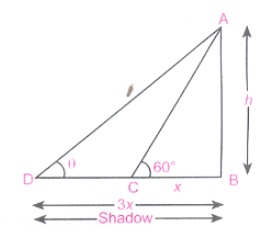
In rt. ΔABC, tan60o = \(\frac { AB }{ BC } =\frac { h }{ x } \)
⇒ \(\sqrt { 3 } =\frac { h }{ x } \Rightarrow h=\sqrt { 3 } x\)
In rt. ∆ABD, tanፀ = \(\frac { AB }{ BD } \)
⇒ tanፀ = \(\frac { h }{ 3x } \)
⇒ tanፀ = \(\frac { \sqrt { 3 } x }{ 3x } =\frac { 1 }{ \sqrt { 3 } } \)⇒ ፀ = 30o
16.
Draw OC ⊥ AB and join OP, OT and AO. in right OCP.
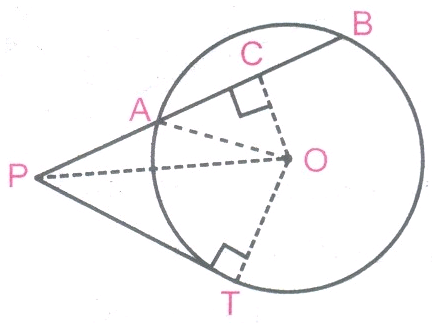
OP2 = PC2 + OC2
OP2=[AP+AC]2 + OC2
OP2=\({ \left[ 4+\frac { 1 }{ 2 } AB \right] }^{ 2 }\) + OC2
[∵ OC⊥AB, ஃ AC=BC]
⇒ OP2=\({ \left[ 4+\frac { 1 }{ 2 } AB \right] }^{ 2 }\)+OC2
⇒ OP2 = \({ \left( \frac { 13 }{ 2 } \right) }^{ 2 }\)+OC2 ......(i)
In right OCA
OA2 = OC2 + AC2
OA2 - AC2 = OC2
OA2 - AC2 = OC2
OA2 - \({ \left( \frac { 13 }{ 2 } \right) }^{ 2 }\) + OC2 .....(ii)
ஃ eq (i) becomes. ......(ii)
OP2 = \({ \left( \frac { 13 }{ 2 } \right) }^{ 2 }\) + OA2 - \({ \left( \frac { 5 }{ 2 } \right) }^{ 2 }\)
OP2 = \(\frac { 169 }{ 4 } -\frac { 25 }{ 4 } \)+OA2
OP2 = \(144\over4\)+OA2
⇒ OP2 = 36 + OA2 ....(iii)
Also, OP2 = OT2 + PT2 ......(iv)
From (iv) and (iii)
PT2 + OT2 = 36 + OA2
⇒ PT2 = 36 [∵ OT = OA = radii]
PT = 6 cm
17.
(i) Draw a line segment BC = 5.5 cm.
(ii) Perpendicular bisector XY of BC is drawn intersecting BC at L.
(iii) Point A is marked on XL such that AL=3 cm
(iv) AB and AC are joined.
(v) An acute ㄥCBP is drawn below BC.
(vi) On BP, points B1 ,B2 ,B3 and B4 are marked such that BB1=B1B2=B2B3=B3B4
(vii) B4C is joined
(viii) B3C' is drawn parallel to B4C interesting BC at C'
(ix) C'A' is drawn parallel to CA intersecting BA at A'
18.
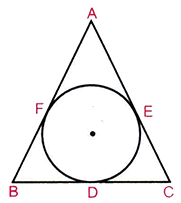
Here, AB = AC (Given) .......(i)
AF = AE (Tangent from A) ......(ii)
AB - AF = AC - AE
⇒ BF = CE
Now, BF = BD (Tangent from B)
Also, CE = CD (Tangent from C)
⇒ BD = CD
19.
Steps of construction:
1. Draw a line segment AB = 7
1. Draw a line segment AB = 7 cm.
2. Draw any ray AX making an acute angle with AB.
3. Draw the point A ll such that
\(A_{ 1 }A_{ 2 },A_{ 3 }.....A_{ 6 }\)
4.Join BAg
5.Through the point A31 draw a line parallel to BAs.
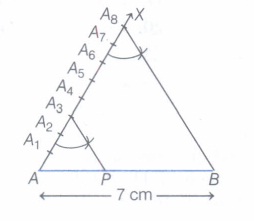
Then AP : PB = 3 : 5
20.
\(4x^{ 2 }+4bx+b^{ 2 }-a^{ 2 }\)
\(\Rightarrow (2x+b)^{ 2 }-a^{ 2 }=0\)
\(\Rightarrow (2x+b+a)(2x+b-a)=0\)
\(\Rightarrow x=\frac { \left( a+b \right) }{ 2 } ,x=\frac { a-b }{ 2 } \)
21.
Here a = 18, d = - 2, Sn = 0
Therefore n/2 [36 + (n -1) (- 2)] = 0
\(\Rightarrow\)n = 19
22.
Let 1st term be a and common difference be d
a2 = a+d
a + d = 8 ...........(i)
as = a + 4d
a + 4d = 17 .......(ii)
From (i) and (ii),
a = 5, d = 3,
a19= a + 18d
= 5 + 54 = 59
23.
Here,
\(a=\sqrt { 7 } ,a+d=\sqrt { 28 } \)
\(d=\sqrt { 28 } -\sqrt { 7 } =2\sqrt { 7 } -\sqrt { 7 } \)
\(=\sqrt { 7 } \)
\(\Rightarrow Next\quad term=\sqrt { 7 } +(4-1)\sqrt { 7 } \)
\(\Rightarrow =\sqrt { 7 } (4)\)
\(\Rightarrow =\sqrt { 7\times 16 } \)
\(=\sqrt { 112 } \)
24.
Let Sanjay's present age = x
Sanjay's age 27 yr hence = (x + 27)
29yr ago = (x - 29)
37 yr.
25.
Let O be the centre of a circle of radius 10 cm.
Here, chord AB = 16 cm
Since OP bisects chord AB
ஃ AL = LB = 8 cm
Consider rt, \(\angle \)ed \(\triangle\)OLB, by using Pythagoras Theorem,
we have OL2 = OB2 - LB2
= 102 - 82 = 100 - 64 = 36
OL = 6 cm
Let PL be x cm
ஃ OP = OL + PL = (6+x)cm
In rt ed BLP, we have
PB2 = BL2 + PL2
PB2 = 82 + x2 ........(i)
⇒ x2 = PB2 - 64
Again, in rt, \(\angle \)ed \(\triangle\)OBP, we have
PB2 = OP2 - OB2
PB2 = (6 x)2 - 102 ......(ii)
From (i) and (ii), we obtain
(6+x)2 - 100 = 64 + x2
36 + x2 + 12x - 100 - 64 - x2 = 0
12x - 128 = 0
\(x={128\over12}={32\over3}cm\)
From (i), we have
PB2 = 64 + \(({32\over3})^2\)
PB2 = \(64+{1024\over9}={576+1024\over9}={1600\over9}\)
PB = \(40\over3\) cm
26.
We know that, length of the tangents from an external to a circle point are equal.
⇒ BP = BQ = 27 cm and
BC = 38
⇒ BQ + CQ = 38
CQ = 38 - BQ = 38 -27 = 11 cm
Now, CR = CQ = 11 cm
Join OR ⇒ OS ⊥ AD and OR ⊥ DC
⇒ DROS is a square of side 10 cm.
therefore, DR = 10 cm
Thus, CD = CR + DR = 11 + 10 = 21 cm
27.
\(10\sqrt{3}m\)
28.
28 units, 7 units
29.
\(x^{2} + 14x - 392 = 0\) ; Never leave your old parents alone.
30.
Here, \(\frac { 3+5+7+...to\quad n\quad terms }{ 5+8+11+...to\quad 10\quad terms } =7\)
\(\Rightarrow \frac { \frac { n }{ 2 } \left\{ 2(3)+(n-1)2 \right\} }{ \frac { 10 }{ 2 } \left\{ 2(5)+(10-1)3 \right\} } =7\)
\(\Rightarrow \frac { n\left\{ 6+2n-2 \right\} }{ 10\left\{ 10+27 \right\} } =7\)
\(\Rightarrow \frac { 2n^{ 2 }+4n }{ 370 } =7\)
\(\Rightarrow \) 2n2+ 4n - 2590 = 0
\(\Rightarrow \) n2 + 2n - 1295 = 0
\(\Rightarrow \) (n + 37) (n - 35) = 0
\(\Rightarrow \) n = 35 or n = 37
rejecting n = - 37
\(\therefore \) No of terms cannot be negative.
We have n = 35
31.
\({15\over2}{\sqrt {3}} \ m \)
32.
\({3\over16}\)
33.
\(35\left( 1+\sqrt { 2 } \right) m\)
34.
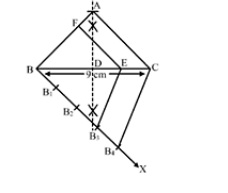
Steps of Construction:
(i) A line segment BC = 9 cm is drawn.
(ii) ㄥABC = 60o is constructed at B.
(iii) An arc of 6 cm radius to be drawn with B as centre, cutting BA at A.
(iv) A and C are joined. Then triangle ABC is constructed.
(v) An acute angle CBX is drawn below BC.
(vi) Points B1,B2,B3 are taken on BX, such that BB1= B1B2 = B2B3.
(vii) B3 and C are joined.
(viii) B2C' is drawn parallel to B3C, meeting BC at C'
(ix) C'A' is drawn parallel to CA, meeting BA at A'.
(x) A' BC' is the required triangle similar to ΔABC whose sides are \(\frac { 2 }{ 3 } \) of the corresponding sides of Δ ABC.
35.
Given: PAQ is a tangent to the circle with centre O at a point A as shown in figure \(\angle \)OBA = 35o
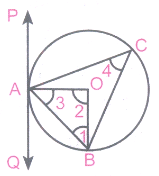
To find: \(\angle \)BAQ and \(\angle \)ACB
Proof: OA = OB [Radii of the same circle]
⇒ \(\angle \)3 = 35o [Angles opposite to equal sides of a triangle are equal]
but, \(\angle \)1 + \(\angle \)2 + \(\angle \)3 = 180o [Angle sum property]
⇒ 35o + 35o + \(\angle \)2 = 180o
36.
Steps of Construction:
1. Draw a line segment BC = 6 cm and at point B draw a ㄥABC = 60o.
2. Cut AB 5 cm. Join AC. We obtain ABC is triangle.
3. Draw a ray BX making an acute angle with BC on the side opposite to the vertex A.
4. Locate 4 points A1,A2,A3 and A4 on the ray BX so that BA1=A1A2=A2A3=A3A4.
5. Join A4 to C.
6. At A3 draw A3C' || A4C. Where C' is a point on the line segment BC.
7. At C' draw C'A' || CA, where A' is a point on the line segment BA.
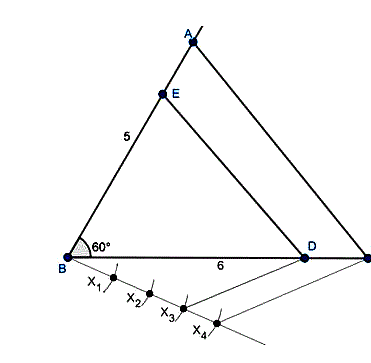
Δ A'BC' is the required triangle.
Justification:
In Δ A'BC' and ΔABC A'C' || AC
∴ By BPT \(\frac { A'B }{ AB } =\frac { BC' }{ BC } \) ...(i)
From (i) and (ii),
\(\frac { A'B' }{ AB } =\frac { 3 }{ 4 } \Rightarrow A'B=\frac { 3 }{ 4 } AB\)
In ΔBA3C' and ΔBA4C
\(\frac { BC' }{ BC } =\frac { { BA }_{ 3 } }{ { BA }_{ 4 } } =\frac { 3 }{ 4 } \) ...(ii)
∴ Sides of new triangle formed are \(\frac { 3 }{ 4 } \) times the corresponding sides of first triangle.
37.
mx(x-1)+49=0
\(\Rightarrow \) mx2-7mx+49=0
Here a=m,b=-7m,c=49
For equal roots ,D=0
\(\Rightarrow D=b^{ 2 }-4ac\)
\(\Rightarrow 0=(-7m)^{ 2 }-4\times m\times 49\)
\(\Rightarrow 0=49m^{ 2 }-196m\)
\(\Rightarrow 49m^{ 2 }-196m=0\)
\(\Rightarrow 7m(7m-28)=0\)
\(\Rightarrow 7m=0\) or 7m-28 =0
\(\Rightarrow m=0\) or \(m=\frac { 28 }{ 7 } =4\)
but \(m\neq 0\) [ \(\therefore \) In quadratic equation \(a\neq 0\) ]
38.
()
5 cm
39.
()
(x - 1) (x - 1)
40.
()
\(\frac{16}{33}\)
41.
(a)
42.
(a)
43.
(a)
44.
(a)
45.
(a)
46.
()
equal
47.
()
line of sight
48.
()
The ratio of division of the line segment AB by the point P from A is AP : AB = 3: 5.
49.
()
Angle between the radii = 180° - 60° = 120°
50.
Given A right-angled triangle with sides of lengths 8 cm and 6 cm making a right angle. Required Triangle whose sides are \(\frac { 3 }{ 4 } \) times of the corresponding sides of given triangle.
Steps of Construction
1. Construct a right angled \(\angle ABC\) right angle at B with sides BC = 8 cm and AB = 6 cm
2. Through B, construct an acute LCBX on the side \(\angle CBX\) opposite to the vertex A.
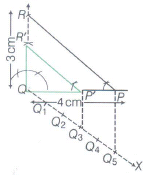
3. Mark four points B1, B2 , B3, and B4 on BX such that BB1 = B1B2 = B2B3,= B3B4
4. Join B4C
5. Through B3, draw B3C' II B4C intersecting BC .at C'.
6. Through C', draw C'A' II CA intersecting AB at A'. Hence, \(\Delta A'BC'\) is the required triangle.
51.
(d)
30
52.
(c)
20√3
53.
(b)
AB + CD = BC + AD
54.
(b)
30o

10th Standard CBSE Syllabus & Materials
10th Standard CBSE
CBSE 10th Social Science PS - Federalism - New Model Questions Papers Study Material - QB365 Set A
NEW10th Standard CBSE
CBSE 10th Social Science PS - Power Sharing - New Model Questions Papers Study Material - QB365 Set A
NEW10th Standard CBSE
CBSE 10th Social Science GEO - Manufacturing Industries - New Model Questions Papers Study Material - QB365 Set A
NEW10th Standard CBSE
CBSE 10th Social Science GEO - Minerals and Energy Resources - New Model Questions Papers Study Material - QB365 Set A



CBSE 10th Standard CBSE Subjects
CBSE Standards





