
 100% FREE ACCESS
10th Standard CBSE Syllabus & Materials
10th Standard CBSE
CBSE 10th Social Science ECO - Globalisation and the Indian Economy - New Model Questions Papers Study Material - QB365 Set A
NEW10th Standard CBSE
CBSE 10th Social Science ECO - Money and Credit - New Model Questions Papers Study Material - QB365 Set A
NEW10th Standard CBSE
CBSE 10th Social Science ECO - Sectors of the Indian Economy - New Model Questions Papers Study Material - QB365 Set A
NEW10th Standard CBSE
CBSE 10th Social Science ECO - Development - New Model Questions Papers Study Material - QB365 Set A
NEW10th Standard CBSE
CBSE 10th Social Science PS - Outcomes of Democracy - New Model Questions Papers Study Material - QB365 Set A
NEW10th Standard CBSE
CBSE 10th Social Science PS - Gender, Religion and Caste - New Model Questions Papers Study Material - QB365 Set A

Published on: 14/02/2020
10th standard CBSE Mathematics Public Model Question Paper III 2019-2020
Download CBSE Class 10th Standard CBSE Maths question papers, sample papers, important questions, and previous year solved papers in PDF format. Get free study materials, NCERT solutions, and exam preparation resources for Class 10th Standard CBSE Maths
Questions + Answers key
Take MCQ Maths Test
1.
In the figure, QR is a common tangent to given circle which meet at T. Tangent at T meets QR at P. If QP = 3.8 cm, then find length of QR.
2.
Solve the following quadratic equation for x :
x2-2ax-(4b2-a2)=0
3.
Solve the following quadratic equation \(\sqrt { 3 } { x }^{ 2 }+11x+6\sqrt { 3 } =0\)
4.
Draw a circle of radius 4 cm. Take a point P outside the circle. Without using the centre of the circle, draw two tangents to the circle from P.
5.
Find the common difference of an AP, whose first term is \(\frac {1}{2}\) and 8th term is \(\frac {17}{6}.\)
6.
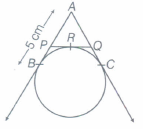
In the given figure, AB, AC and PQ are tangents. If AB = 5 cm, then find the perimeter of \(\triangle \)APQ.
7.
The tops of two poles of heights 16 m and 10 m are connected by a wire. If the wire makes an angle of \({ 30 }^{ ° }\)\(\)with the horizontal, then find the width of the river.
8.
The angle of depression of the top of a tower at a point 100m from the house is 450 , then the height of the tower is
9.
Define tangent to a circle.
10.
The shadow of tower standing on a level plane is found to be 50m longer when sun's elevation is 30o than when it is 60o. Find the height of the tower.
11.
Find the common difference of the A.P. 2, 2 + \(\sqrt{2}\) , 2 + 2\(\sqrt{2}\) , 2 + 3\(\sqrt{2}\),.......
12.
Find the sum of the first n positive integers
13.
An observer 1.5 m tall is 20.5 m away from a tower 22 m high. Determine the angle of elevation of the top of the tower from the eye of the observer.
14.
If the discriminant of \(3x^{2} + 2x\ +a = 0\) is double the discriminant of \(x^{2}-4x + 2 = 0\) , then find the value of a.
15.
C(0, r1) and C(0, r2) are two concentric circles, with r1 > r2.AB is a chord of C(0, r1) touching C(0, r2) at C, then the relation between AB, r1 and r2.
16.
Find the sum of the following AP: 0.6, 1.7, 2.8, ........, to 100 terms
17.
Prove that the tangents drawn at the ends of a diameter of a circle are parallel.
18.
Find the sum of 10 terms of an AP: 50,46,42,... .
19.
Solve the following quadratic equations
\(x^{ 2 }-55x+750=0\)
20.
If from an external point B of a circle with centre O, two tangents BC and BD are drawn such that \(\angle DBC={ 120 }^{ \circ }\), prove that BC + CD = BO i.e., BO = 2BC.
21.
At a point on level ground, the angle of elevation of a vertical tower is found to be such that its \(5\over12\).On walking 192m towards the tower, the tangent of the angle is found to be \(3\over4\) .Find the height of the tower.
22.
From an aeroplane vertically above a straight horizontal plane, the angles of depression of two consecutive kilometre stones on the opposite sided of the aeroplane are found to be \(\alpha\) and \(\beta\), show that the height of the aeroplane is \(\frac { tan\alpha tan\beta }{ tan\alpha +tan\beta } \).
23.
At a point A, 20 metres above the level of water in a lake, the angle of elevation of a cloud is 30o . The angle of depression of the reflection of the cloud in the lake, at A is 60o . Find the distance of the cloud from A.
24.
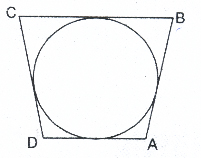
In figure, a circle touches all four sides of quadrilateral ABCD with AB = 18 cm, BC = 21 cm and CD = 12 cm, AD =________
25.
Factors of \(x^{2} - 2x + 1\) .
26.
10th term of -0.1, -0.2, -0.3,....
27.
In \(\triangle ABC\), AB = AC. If the interior circle of \(\triangle ABC\) touches the sides AB, BC and CA at D, E, F respectively. Prove that E bisects BC.
28.
Examine that the list of numbers obtained from following situation, will be in the form of an AP. "Amount left with Sandeep (in RS) out of the total amount of RS.12000 which he had in the beginning, when he spends RS.500 in the beginning of every month."
29.
If -4 is a root of the quadratic equation x2+px-4=0 and the equation 2x2+px+k=0 has equal roots, then find the value of k.
30.
Using the quadratic formula, solve the quadratic equation.
\(\sqrt { 3 } { x }^{ 2 }+11x+6\sqrt { 3 } =0\)
31.
The angle of elevation of a jet fighter from a point A on the ground is \({ 60 }^{ ° }\). After a flight of 10 s, the angle of elevation charge to \({ 30 }^{ ° }\) .
If the jet is flying at a speed of 432 Km/h, then find the constant height at which the jet is flying.
32.
Draw an equilateral \(\Delta ABC\) of each side 4 cm.Construct a triangle similar to it and of scale factor \(\frac{3}{5}\).Is the new triangle also an equilateral?
33.
In an AP, given a = 2, d = 8, \({S}_{n}=90,\) find n and \({a}_{5}.\)
34.
The angle of elevation of an aeroplane from a point on the level ground is 60°. After 10 s of flight, the angle of elevation changes to 30°. If the aeroplane is flying horizontally at a height of 3000 m, then find the speed of the plane.
35.
At the point of contact the angle between radius and tangent to a circle is 90o.
36.
One year ago, a man was 8 times as old as his son. Now, his age is equal to the square of his son's age, Find their present ages.
37.
If \({T}_{an}=6n+5,\) then common difference is 6.
38.
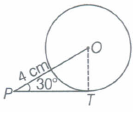
In the figure, PT is a tangent to the circle with centre O such hat OP is 4 cm and \(\angle OPT={ 30 }^{ \circ }\) , then length of tangent is 5 cm.
39.
At least three parts are sufficient for construction of a triangle.
40.
Two posts are 120m apart and the height of one is double that of the other.If from the middle point of the line joining their feet, an observer finds that the angular elevations of their tops to be complementary, then the height of the poles are \(30\sqrt{2}m\) and \(60\sqrt{2}m\)
41.
x = -1 is a root of the quadratic equation \(3x^{2} - x - 4 = 0\) .
42.
The height of a tower is 10m.The height of its shadow when sun's altitude is 450 , is ...........
43.
In drawing a triangle, if AB = 3 cm, BC = 2 cm and AC = 6 cm. What is the possibility that a triangle cannot be drawn.
44.
To divide a line segment AB in the ratio 5 : 7, first a ray AX is drawn so that \(\angle BAX\) is an acute angle then find the minimum number of such points marked at equal distances on the ray AX.
45.
Draw two tangents from the end points of the diameter of a circle of radius 4.0 cm. Are these tangents parallel?
46.
How many terms of AP 54, 51, 48… are required to give a sum of 513
21 or 25
23 or 24
18 or 19
22 or 23
47.
If the length of the rectangle is one more than the twice its width, and the area of the rectangle is 300 square meter. What is the measure of the width of the rectangle?
-25
12
24
25
48.
The ——– is the line drawn from the eye of an observer to the point in the object viewed by the observer
Line of sight
Line of sight propagation
Line of symmetry
Line of incidence
49.
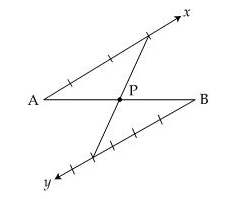
In the figure, P divides AB internally in the ratio
3 : 7
4 : 7
4 : 3
3 :4
50.
The angle between two tangents drawn from an external point to a circle is 110°. The angle subtended at the centre by the segments joining the points of contact to the centre of circle is:
70o
90o
55o
110o
1.
QP = 3.8
QP = PT
(Length of tangents from external points are equal)
\(\Rightarrow\) PT = 3.8 cm
PR = PT = 3.8 cm
\(\Rightarrow\) QR = 7.6 cm
2.
x2-2ax-(4b2-a2)=0
Given equation can be written as
x2-2ax-+a2-4b2=0
or (x-a)2(2b)2=0
(x-a+2b)(x-a-2b)=0
x=a-2b,x=a+2b
3.
ac=\(\left( \sqrt { 3 } \right) \left( 6\sqrt { 3 } \right) \) =18, take factors such that their sum should be 11 and product is 18.
4.
1. Draw a circle of centre O and radius 4 cm.
2. Take a point P outside the circle and draw a secant PAB, intersect~ng the circle at A and B.
3. Produce AP to C such that AP = CP.
4. Draw a semi-circle with CB as diameter.
5. Draw \(PD\bot CB\) intersecting the semi-circle at D.
6. With P as centre and PD as radius, draw arcs to intersect the given circle at T and T'.
7. Join PT and PT'. Thus, PT and PT' are the required tangents.
5.
Let d be the common difference of an AP,
Given, \(a = \frac {1}{2}\) and \({a}_{8}=\frac{17}{6}\)
We know that,
\(a+(n-1)d={ a }_{ 8 }\)
\(\therefore\) \({ a }_{ 8 }=a+\left( 8-1 \right) d=\frac { 17 }{ 6 } \)
\(\Rightarrow\) \(a+7d=\frac { 17 }{ 6 } \)
\(\Rightarrow\) \(\frac { 1 }{ 2 } +7d=\frac { 17 }{ 6 } \) \(\left[ \because a=\frac { 1 }{ 2 } \right] \)
\(\Rightarrow\) \(7d=\frac { 17 }{ 6 } -\frac { 1 }{ 2 } \)
\(\Rightarrow\) \(7d=\frac { 17 }{ 6 } -\frac { 1 }{ 2 } \)
\(\Rightarrow\) \(7d=\frac { 14 }{ 6 } \)
\(\Rightarrow\) \(d=\frac { 1 }{ 3 } \)
Hence, the common difference is 1/3.
6.
Let PQ touch the circle at the point R.
We known that tangents drawn from an external point to a circle are equal in length.
\(\therefore\) AB = AC = 5 cm
\(\Rightarrow\) AP+BP = AQ + QC = 5 cm
\(\Rightarrow\) AP + PR = AQ + QR = 5 cm ..........(i)
[\(\because\) BP = PR and QC = QR]
Now, perimeter of APQ = AP+PQ+AQ
=AP + RP + QR + AQ
= 5 + 5 [from Eq. (i)]
= 10 cm
7.
12 m
8.
100m
9.
A line which touches a circle only in one point, is called a tangent line to a circle.
10.
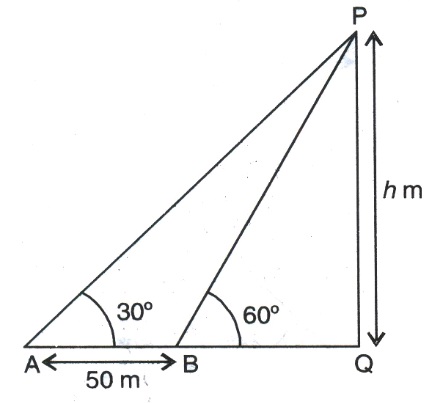
Here, let PQ be the tower of height h m . A and B be the positions of the sun's elevation, such that
AB=50 m, ㄥPAQ=30o, ㄥPBQ=60o
Now, consider rt. ㄥed ΔPBQ
\(\frac { PQ }{ BQ } =tan60^{ 0 }\Rightarrow \frac { PQ }{ BQ } =\sqrt { 3 } \)
⇒ h=\(\sqrt { 3 } \) BQ ..........(i)
\(\frac { PQ }{ AQ } \)=tan 300
⇒ \(\frac { PQ }{ AB+BQ } =\frac { 1 }{ \sqrt { 3 } } \)
⇒ \(\frac { h }{ 50+BQ } =\frac { 1 }{ \sqrt { 3 } } \)
⇒ \(\sqrt { 3 } \)h=50+BQ
⇒ \(\sqrt { 3 } \)h=50+\(\frac { h }{ \sqrt { 3 } } \) [using (i)]
⇒ 3h=50\(\sqrt { 3 } \)+h
⇒ 2h=50\(\sqrt { 3 } \)
⇒ h=25\(\sqrt { 3 } \)
Hence, the height of the tower is 25\(\sqrt { 3 } \) m.
11.
\(\sqrt{2}\)
12.
Let Sn = 1 + 2 + 3 + . . . + n
Here a = 1 and the last term l is n.
Therefore, \(\mathrm{S}_{n}=\frac{n(1+n)}{2} \text { or } \mathrm{S}_{n}=\frac{n(n+1)}{2}\)
So, the sum of first n positive integers is given by
\(\mathrm{S}_{n}=\frac{n(n+1)}{2}\)
13.
\(45^{\circ}\)
14.
a = -1
15.
\(AB=2\sqrt{2r_1r_2-r^{2}_{2}}\)
16.
0.6, 1.7, 2.8, ........, to 100 terms
Here, a = 0.6, d = 1.7 - 0.6 = 1.1, n = 100, S10=?
Sn = \(\frac{n}{2}\)[2a + (n - 1)d]
S10 = \(\frac{100}{2}\)[2 x 0.6 + (100 - 1)1.1]
= 50[1.2 + 108.9]
= 50 x 110.1 = 5505
17.
Let AB be a diameter of a given circle and LM and PQ be the tangent lines drawn to the circle at points A and B, respectively.
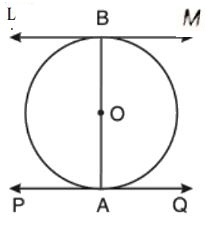
To prove LM || PQ
Proof We know that the tangent at any point of a circle is perpendicular to the radius through the point of contact.
\(\therefore\) OA \(\perp\) PQ and OB \(\perp\) LM
\(\Rightarrow\) AB \(\perp\) PQ
and AB \(\perp\) LM
\(\Rightarrow\) \(\angle\)PAB = 90°
and \(\angle\)ABM = 90°
\(\Rightarrow\) \(\angle\)PAB = \(\angle\)ABM
[each = 90°]
But these are alternate angles.
\(\therefore\) PQ || LM
Hence, the tangents drawn at the ends of a diameter of a circle are parallel.
Hence proved.
18.
320
19.
Given equation is \(x^{ 2 }-55x+750=0\)
\(\Rightarrow x^{ 2 }+-30x-25x+750=0\)
\(\left[ \because 30X-25=750\\ and-30-25=-55 \right] \)
\(\Rightarrow x(x-30)-25(x-30)=0\)
\(\Rightarrow x(x-30)(x-25)=0\)
\(\Rightarrow x-30=0\Rightarrow x=30\)
and x-25=0 \(\Rightarrow x=25\)
Hence, the roots of the equation \(x^{ 2 }-55x+750=0\) are 25 and 30.
20.
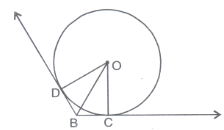
Join OC and OD.
ஃ OC ⊥ BC
[tangent to any circle is perpendicular to its radius at point of contact]
ஃ \(\angle \)OCB = 90°
In \(\triangle\)OCB and \(\triangle\)ODB, we have
CB = DB
[tangent from an external point]
OB = OB [common side]
OC = OD [radii of a circle]
ஃ By SSS congruency, we have
\(\triangle\)OCB ≅\(\triangle\)ODB
⇒ \(\angle \)OBC = \(\angle \)OBD
= \(1\over2\) \(\angle \)CBD = \(1\over2\) x 120° = 60°
ஃ \(BC\over BO\)=cos 60°
⇒ \(BC\over BO\) = \(1\over2\)
⇒ BO = 2BC
Also, BO = BC + BC
⇒ BO = BC + BD [∵ BC = BD]
21.
180m
22.
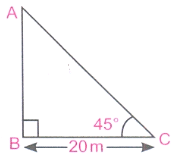
Let aeroplane is at A and B, C are two consecutive kilometre stones such that
ㄥXAB=α and ㄥYAC=β
∴ ㄥABD=α and ㄥACD=β
Let BD=x km
AD is height of aeroplane
In ΔADB, \(\frac { AD }{ BD } \)=tanα
⇒ \(\frac { AD }{ x } =tan\alpha \quad \Rightarrow \quad x=\frac { AD }{ tan\alpha } \) ........(i)
In ∆ADC, \(\frac { AD }{ DC } \)=tanβ
⇒ \(\frac { AD }{ 1-x } =tan\beta \)
⇒ \(\frac { AD }{ 1-\frac { AD }{ tan\alpha } } =tan\beta \) [From (i)]
⇒ \(\frac { AD\quad tan\alpha }{ tan\alpha -AD } =tan\beta \)
⇒ AD tanα=tanα.tanβ-AD tanβ
⇒ AD tanα+AD tanβ=tanα.tanβ
⇒ AD=\(\frac { tan\alpha .tan\beta }{ tan\alpha +tan\beta } \) Hence proved.
23.
Let C is cloud and R is its reflection.
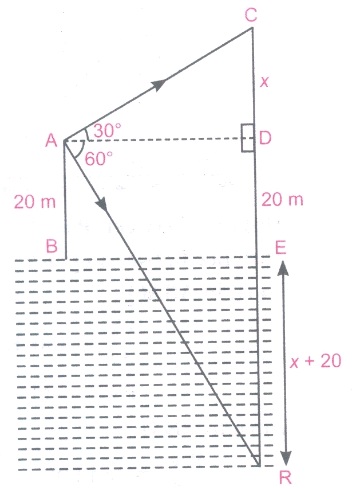
ㄥDAC=30o, ㄥDAR=60o, let CD=x m
∴ Height of the cloud above the lake
=(x+20)m
∴ ER=(20+x)m
Now In right ΔADC,
\(\frac { CD }{ AD } =tan30^{ 0 } \Rightarrow \frac { x }{ AD } =\frac { 1 }{ \sqrt { 3 } } \)
⇒ AD=\(\sqrt { 3 } \)x
In right, ΔADR,
\(\frac { DR }{ AD } \)=tan 60o
⇒ \(\frac { DE+ER }{ AD } =\sqrt { 3 } \)
⇒ \(\frac { 20+20+x }{ \sqrt { 3 } x } =\sqrt { 3 } \) (using (i))
40+x=3x
⇒ x=20 m
Now In right ΔADC, \(\frac { AC }{ DC } \)=cosec 30o
\(\frac { AC }{ 20 } \)=2 ⇒ AC=40 m
∴ Distance of the cloud from A=40 m
24.
()
9 cm
25.
()
(x - 1) (x - 1)
26.
()
-1
27.
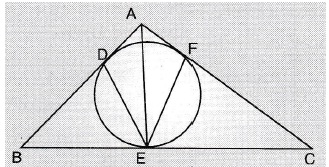
AF = AD
BE = BD,
(tangents from external points)
CE = CF
AB = AC
AD + BD = AF + FC
\(\Rightarrow\) BD = FC (\(\because\) AD = AF)
BE = EC (\(\because\) BD = BE, CE = CF)
\(\therefore\) E bisects BC.
28.
Given, total amount Sandeep had=RS.12000
In the beginning of every month, he spend=RS.500
So, in the beginning of 1st month, he had amount, t1=RS.12000
In the beginning of 2nd month, he had amount, t2=12000-500=RS.11500
In the beginning of 3rd month, he had amount, t3=1500-500=RS.11000
In the beginning of 4th month, he had amount, t4=11000-500=RS.10500 and so on.
Now, the list of amount is 12000, 11500, 11000, 10500, ...Here, t2 - t1 = t3 - t2 = t4 - t3 =-500
i.e. tk+1-tk is the same everytime.
So, the above list of numbers forms an AP.
29.
\(\frac { 9 }{ 8 } \)
30.
The given equation is \(\sqrt { 3 } { x }^{ 2 }+11x+6\sqrt { 3 } =0\)
On comparing with \({ ax }^{ 2 }+bx+c=0\)
\(a=\sqrt { 3 } ,b=11\quad c=6\sqrt { 3 } \)
On substituting the values of a,b and c in the quadratic formula.
\(x=\frac { -b\pm \sqrt { { b }^{ 2 }-4ac } }{ 2a } \\ x=\frac { -11\pm \sqrt { { \left( 11 \right) }^{ 2 }-4\left( \sqrt { 3 } \right) \left( 6\sqrt { 3 } \right) } }{ 2(\sqrt { 3 } ) } \\ x=\frac { -11\pm \sqrt { 121-72 } }{ 2\sqrt { 3 } } \\ =\frac { -11\pm \sqrt { 49 } }{ 2\sqrt { 3 } } =\frac { -11\pm 7 }{ 2\sqrt { 3 } } \\ x=\frac { -11+7 }{ 2\sqrt { 3 } } =\frac { -4 }{ 2\sqrt { 3 } } =\frac { -2 }{ \sqrt { 3 } } \\ x=\frac { -11-7 }{ 2\sqrt { 3 } } =\frac { -18 }{ 2\sqrt { 3 } } =\frac { -9 }{ \sqrt { 3 } } \)
Hence, \(\frac { -2 }{ \sqrt { 3 } } \) and \(\frac { -9 }{ \sqrt { 3 } } \) are the required solutions of the given equation.
31.
1039.2 m
32.
Yes, the new triangle is also equilateral.
33.
Here, a = 2, d = 8 and \({S}_{n}=90\)
\(\therefore\) \({S}_{n}=90\)
\(\Rightarrow \frac { n }{ 2 } \left[ 2\times 2\left( n-1 \right) 9 \right] =90\)
\(\left[ \because { S }_{ n }=\frac { n }{ 2 } \left\{ 2a+\left( n-1 \right) d \right\} \right] \)
\(\Rightarrow \quad \frac { n }{ 2 } \left( 4+8n-8 \right) =90\)
\(\Rightarrow \quad \frac { n }{ 2 } \left( 8n-4 \right) =90\)
\(\Rightarrow \quad \quad n\left( 4n-2 \right) =90\)
\(\Rightarrow \quad \quad 4{ n }^{ 2 }-2n-90=0\)
\(\therefore \quad n=\frac { -\left( -2 \right) \pm \sqrt { { \left( -2 \right) }^{ 2 } } -4\times 4\left( -90 \right) }{ 2\times 4 } \)
[\(\because\) By quadratic formula, ]
\(=\frac { 2\pm \sqrt { 4+1440 } }{ 8 } =\frac { 2\pm \sqrt { 1444 } }{ 8 } \)
\(=\frac { 2\pm 38 }{ 8 } =\frac { 40 }{ 8 } ,\frac { -36 }{ 8 } =5,\frac { -9 }{ 2 } \)
Since, n cannot be negative.
\(\therefore\) n = 5
Now, \({ a }_{ 5 }=2+\left( 5-1 \right) 8\)
\(\left[ \because { a }_{ n }=a+\left( n-1 \right) d \right] \)
\(=2+32=34\)
Hence, n =5 and \({ a }_{ 5 }=34.\)
34.
346.4 m/s
35.
Given: A circle C (O, r) with centre O. AB is a tangent to the circle at the point p.
To Prove: OP ⊥ AB
Const: Take any point Q on AB other than P and join OQ.
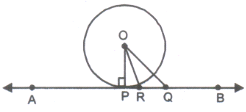
OR > OP .........(ii)
Thus, we find that among all such line segments, the line segment OP is the shortest, which is possible only when OP is perpendicular to AB.
Hence, OP ⊥ AB.
36.
Let present age of his son = x yr
One year ago, his son's age = (x - 1) yr
One year ago, man's age = 8(x - 1) yr = (8x - 8) yr
Present age of man = (8x - 8 + 1) yr = (8x - 7) yr
According to the question,
8x - 7 = x2 ⇒ x2 - 8x + 7 = 0
which is the required quadratic equation.
Now, x2 - 7x - x + 7 = 0 [by factorisation]
⇒ x(x - 7) - l(x - 7) = 0
⇒ (x - 7)(x - 1) = 0
⇒ x - 7 = 0 or x- 1 = 0
⇒ x = 7 or x = 1
But x = 1is not possible because if x = 1, then present age of the son and father are same. So, x = 7.
Hence, present age of his son = 7 yr and present age of man = 8 x 7 - 7 = 49 yr.
37.
(a)
38.
(b)
39.
(a)
40.
(a)
41.
(a)
42.
()
10m
43.
()
When AB + BC < AC triangle cannot be drawn.
44.
()
Minimum number of points = 5 + 7 = 12
45.
yes
46.
(c)
18 or 19
47.
(b)
12
48.
(a)
Line of sight
49.
(d)
3 :4
50.
(a)
70o

10th Standard CBSE Syllabus & Materials
10th Standard CBSE
CBSE 10th Social Science PS - Federalism - New Model Questions Papers Study Material - QB365 Set A
NEW10th Standard CBSE
CBSE 10th Social Science PS - Power Sharing - New Model Questions Papers Study Material - QB365 Set A
NEW10th Standard CBSE
CBSE 10th Social Science GEO - Manufacturing Industries - New Model Questions Papers Study Material - QB365 Set A
NEW10th Standard CBSE
CBSE 10th Social Science GEO - Minerals and Energy Resources - New Model Questions Papers Study Material - QB365 Set A



CBSE 10th Standard CBSE Subjects
CBSE Standards





