
 100% FREE ACCESS
10th Standard CBSE Syllabus & Materials
10th Standard CBSE
CBSE 10th Social Science ECO - Globalisation and the Indian Economy - New Model Questions Papers Study Material - QB365 Set A
NEW10th Standard CBSE
CBSE 10th Social Science ECO - Money and Credit - New Model Questions Papers Study Material - QB365 Set A
NEW10th Standard CBSE
CBSE 10th Social Science ECO - Sectors of the Indian Economy - New Model Questions Papers Study Material - QB365 Set A
NEW10th Standard CBSE
CBSE 10th Social Science ECO - Development - New Model Questions Papers Study Material - QB365 Set A
NEW10th Standard CBSE
CBSE 10th Social Science PS - Outcomes of Democracy - New Model Questions Papers Study Material - QB365 Set A
NEW10th Standard CBSE
CBSE 10th Social Science PS - Gender, Religion and Caste - New Model Questions Papers Study Material - QB365 Set A

Published on: 14/02/2020
10th standard CBSE Mathematics Public Model Question Paper IV 2019-2020
Download CBSE Class 10th Standard CBSE Maths question papers, sample papers, important questions, and previous year solved papers in PDF format. Get free study materials, NCERT solutions, and exam preparation resources for Class 10th Standard CBSE Maths
Questions + Answers key
Take MCQ Maths Test
1.
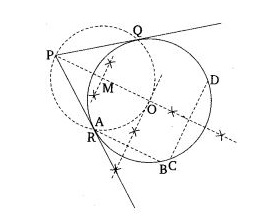
Let ABC be a right triangle in which AB = 6 Cm, BC = 8 cm and \(\angle B=90^{ 0 }\) BD is perpendicular from B to AC. The circle through BCD is drawn. Construct the tangents from A to the circle
2.
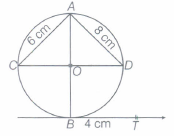
In the given figure, AD = 8 cm, C = 6 cm and TB is the tangent at B to the circle with centre O.Find OT, if BT is 4 cm.
3.
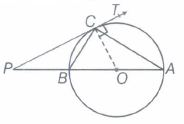
PC is a tangent to the circle at C. AOB is the diameter which when extended meets the tangent at P. Find \(\angle \)CBA, \(\angle \)AOC and \(\angle \)BCO, if \(\angle \)PCA = 110°.
4.
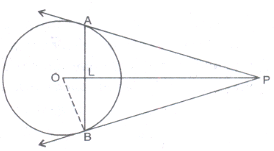
In the given figure, AB is a chord of length 16 cm, of a circle of radius 10 cm. Tangents at A and B intersect at a point P. Find the length of tangent AP.
5.
If \(\alpha\) and \(\beta\) are the roots of a quadratic equation \(x^{2} - 7x + 12 = 0\) , then form an equation in x having roots \(\alpha + 2\) and \(\beta + 2\) .
6.
A boy flying a kite has let out 60m of string if the angle of elevation of the kite is 600 , then the height of the kite above the ground is
7.
From the top of a tower h m high, the angles of depression of two objects, which are in line with the foot of the tower, are \(\alpha\) and \(\beta\) \((\beta > \alpha)\) .Find the distance between the two objects.
8.
Determine the A.P. whose fifth term is 19 and the difference of the eighth term from the thirteenth term is 20.
9.
Solve for x ;
\({1\over x-2 } + {2\over x - 1} = {6\over x} ; x\ne 0, 1, 2\)
10.
Find number of two-digit numbers divisible by 5.
11.
The length of the string between a kite and a point on the ground is 90 m. The string makes an angle of 60o with the level ground. Assuming that there is no slack in the string, find the height of the kite.
12.
From the top of a lighthouse, 40 m above the water, the angle of depression of a small boat is 20o . Estimate how far the boat is from the base of the lighthouse?
13.
Find the length of the shadow of a tree 7 m high, when the sun's elevation is 45o .
14.
Find the roots of k, the equation \(kx^{2} - 6x - 2 = 0\) has equal roots?
15.
Draw a circle with the help of a bangle. Take a point outside the circle. Construct the pair of tangents from this point to the circle.
16.
The coefficient of x in the quadratic equation x2+bx+c=0 was taken as 17 in place of 13, its roots were found to be -2 and -15. Find the roots of the original equation.
17.
Is it possible to design a rectangular mango grove whose length is twice its breadth, and the area is 800m2? If, so, find its length and breadth
18.
Find k, if the given value of x is the kth term of the given AP
25, 50, 75, 100,..... x = 1000
19.
Find the value of p, when px2+\(\left( \sqrt { 3 } -\sqrt { 2 } \right) x-1\)=0 and x=\(\frac { 1 }{ \sqrt { 3 } } \)
20.
Draw a circle' of radius 5 cm. From a point 13 cm away from its centre, construct a pair of tangents to the circle and measure their lengths.
21.
An aeroplane, when 3000 m high, passes vertically above another aeroplane at an instant, when the angles of elevation of the two aeroplanes from the same point on the ground are \({ 60 }^{ ° }\)and \({ 45 }^{ ° }\), respectively, Find the vertical distance between the two aeroplanes.
22.
The sum of the ages of father and his son is 45yr. Five years ago, the product of their ages was 124 yr.Find their present ages.
23.
A highway leads to the foot of 300 m high tower. An observatory is set at the top of the tower. It sees a car moving towards it with an angle of depression becomes 60°.
(i) Find the distance travelled by the car during this time.
(ii) How this observatory is helpful to regulate the traffic on the highway?
24.
At the point of contact the angle between radius and tangent to a circle is 90o.
25.
Draw a triangle with sides 5 cm, 6 cm and 7 cm. Then draw another triangle whose sides are \(\frac { 4 }{ 5 } \) of the corresponding sides of first triangle.
26.
Which term of the A.P., -2, -7, -12, ...... will be -77? Find the sum of this A.P. upto the term -77.
27.
How many terms of the A.P. 3, 9, 15, 21,... must be taken to give a sum of 1875.
28.
A circle have
29.
If one root of the quadratic equation is,\(5 \ - \sqrt {3}\) then other root is
30.
The common difference of the A.P given by an = 3n + 2
31.
The number of terms of the AP 3, 6, 9, ..., 111 is 37.
32.
A triangle similar to \(\Delta ABC\) is to be drawn. If scale factor is greater than 1, then we get enlarged figure.
33.
The length of shadow of a tree 7 m high, when Sun's elevation is \({ 45 }^{ ° }\)is 7 m.
34.
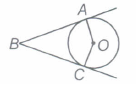
In the given figure, BA and BC are tangents to a circle with centre O. If \(\angle ABC={ 63 }^{ \circ }\), then \(\angle AOC={ 117 }^{ \circ }.\)
35.
A quadratic equation \(ax^{2} + bx + c = 0, a\neq 0 \) , has coincident roots, if \(b^{2}-4ac < 0\)
36.
A tangent to a circle intersects it in __________ point(s).
37.
The ................ is the line drawn from the eye of an observer to the point in the object viewed by the observer.
38.
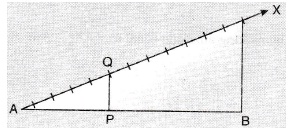
To divide a line segment AB in the ratio 5 : 7, first AX is drawn, so that LBAX is an acute angle and then at equal distance, points are marked on the ray AX, find the minimum number of these points.
39.
Given a triangle with side AB = 8 cm. To get a line segment AB' = \(\frac{3}{4}\) of AB, find the ratio in which line segment AB is divided.
40.
If the height and length of the shadow of a man are the same, then find the angle of elevation of the sun.
41.
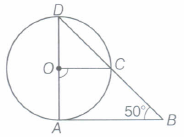
In the given figure, AD is a diameter of a circle with centre 0 and AB is a tangent at A.C is a point on the circle such that DC produced intersects the tangent at Band ㄥABC = 50°. Find ㄥCOA.
42.
Find the sum of first n terms from the APs given below. 34+32+30+....+10
43.
Find the values of k for each of the following quadratic equation, so that they have two equal roots \(kx(x-2)+6=0\)
44.
Construct an isosceles triangle whose base is 6 cm and altitude 4 cm. Then construct another triangle sides are \(\frac { 3 }{ 4 } \) times the corresponding sides of the isosceles triangle.
45.
If p, q, r, s, t are the terms of an A.P. with common difference -1 the relation between p and t is
t = p – 6
t = p – 5
t = p + 4
t = p – 4
46.
If ax2 + bx + c , a≠0 is factorizable into product of two linear factors, then roots of ax2 + bx + c = 0 can be found by equating each factor to
1
-1
2
0
47.
If the height and length of the shadow of a man are the same, then the angle of elevation of the sun is
60°
45°
30°
15°
48.
In which of the following ratios a line segment cannot be divided using ruler and compass?
5:9
√4 : 5
√2 + 1 : √2 – 1
√5 : 1/ √5
49.
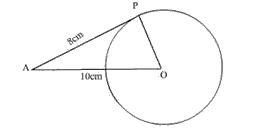
From a point A, the length of a tangent to a circle is 8cm and distance of A from the circle is 10cm. The length of the diameter of the circle is
6 cm
12 cm
16 cm
14 cm
1.
The steps of construction are as follows :
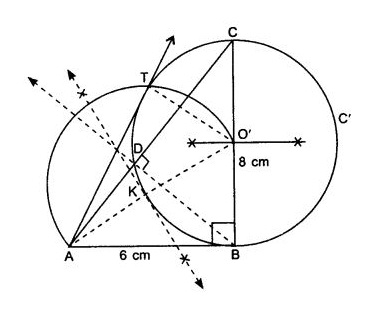
1. Construct the triangle ABC in which AB = 6 cm, BC = 8 cm and \(\angle B=90^{ 0 }\)
2. Draw a perpendicular BD from B to AC.
3. Bisect BC at E.
4. With E as centre and radius EC, draw a circle which will pass through B, C and O.
5. Join AE.
6. Bisect AE at F.
7. With F as centre and radius FE, draw a circle which intersects the circle (with centre E) at P and B.
8. Join AP and AB. and AP and AB are the two required tangents.
2.
Given, AD = 8 cm, AC = 6 cm and BT = 4 cm
⇒ \(\angle\)CAD = 90° [angle in a semi-circle]
So, in \(\angle\)ACD,
CD2 = AC2 + AD2 = 36 +64 = 100
[by Pythagoras rheorerrf]
⇒ CD =10cm
Therefore, OC = OD = OB =\({10\over 2}cm\) = 5 cm
Now, ㄥOBT = 90°
[angle between radius and tangent]
So, in ΔOBT, OT2 = OB2 + BT2 = 25 + 16 = 41
[by Pythagoras theorem]
=> OT = \(\sqrt{41}cm\)
3.
Given, \(\angle PCA={ 110 }^{ \circ }\)
Join CO and a tangent PC.
\(\because\) \(\angle PCA={ 110 }^{ \circ }\)
Then \(\angle ACT={ 180 }^{ \circ }-{ 110 }^{ \circ }={ 70 }^{ \circ }\) [linear pair]
But \(\angle OCT={ 90 }^{ \circ }\) [radius and tangent]
So, \(\angle OCA={ 90 }^{ \circ }-{ 70 }^{ \circ }={ 20 }^{ \circ }\) \(\left[ \because OA=OC \right] \)
Hence, \(\angle OAC=\angle OAC={ 20 }^{ \circ }\)
\(\because\) \(\angle CBA={ 90 }^{ \circ }\angle OAC\)
\(={ 90 }^{ \circ }-{ 20 }^{ \circ }={ 70 }^{ \circ } \ \ \ \ \ \ \ \ \ \ \ \ \ \ \ \ \ \ \ \ \left[ \because\angle ACB={ 90 }^{ \circ } \right] \)
Again, \(\angle AOC={ 180 }^{ \circ }\angle OCA-\angle OAC \ \ \ \ \ \ \ \ \ \ \ \ \ \ \left[angle\ \ sum \ \ property \ \ of \ \ a \ \ triangle \right] \)
\(\Rightarrow\) \(\angle AOC={ 180 }^{ \circ }-{ 20 }^{ \circ }-{ 20 }^{ \circ }={ 140 }^{ \circ }\)
Now, \(\angle BCO=\angle OBC=\angle CBA\) \(\left[ \because OB=OC \right] \)
So, \(\angle BCO={ 70 }^{ \circ }\)
4.
Let O be the centre of a circle of radius 10 cm.
Here, chord AB = 16 cm
Since OP bisects chord AB
ஃ AL = LB = 8 cm
Consider rt, \(\angle \)ed \(\triangle\)OLB, by using Pythagoras Theorem,
we have OL2 = OB2 - LB2
= 102 - 82 = 100 - 64 = 36
OL = 6 cm
Let PL be x cm
ஃ OP = OL + PL = (6+x)cm
In rt ed BLP, we have
PB2 = BL2 + PL2
PB2 = 82 + x2 ........(i)
⇒ x2 = PB2 - 64
Again, in rt, \(\angle \)ed \(\triangle\)OBP, we have
PB2 = OP2 - OB2
PB2 = (6 x)2 - 102 ......(ii)
From (i) and (ii), we obtain
(6+x)2 - 100 = 64 + x2
36 + x2 + 12x - 100 - 64 - x2 = 0
12x - 128 = 0
\(x={128\over12}={32\over3}cm\)
From (i), we have
PB2 = 64 + \(({32\over3})^2\)
PB2 = \(64+{1024\over9}={576+1024\over9}={1600\over9}\)
PB = \(40\over3\) cm
5.
Since α and β are roots of x2-7x+12=0
∴ Sum of the roots, α+β=7 and
Product of roots (αβ)=12
Sum of roots=(α+2)+(β+2)
=α+β+4
=7+4=11
Product of roots=(α+2)(β+2)
=αβ+2(α+β)+4
=12+2(7)+4
=12+14+4=30
Thus, the required equation in x is
x2-11x+30=0
6.
52m
7.
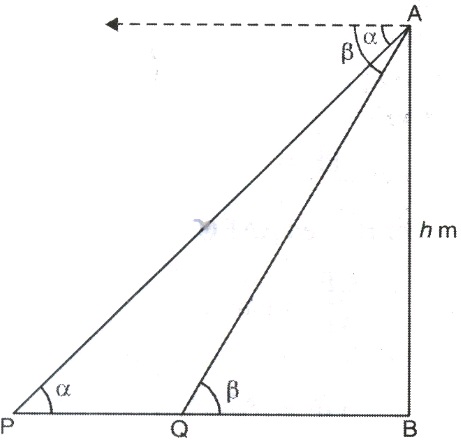
Let AB be the tower of height h m, P and Q be the two points in line with the foot of the tower AB, such that
ㄥAPB=∝ and ㄥAQB=β
Consider rt. ㄥed ΔQBA,
\(\frac { AB }{ QB } \)=tan β
QB=AB.\(\frac { 1 }{ tan\beta } \)
=AB cot β....(i)
Again consider rt ㄥed ΔPBA,
\(\frac { AB }{ PB } \)=tan α
\(\frac { AB }{ PQ+QB } \)=tan α
⇒ PQ+QB=AB.\(\frac { 1 }{ tan\alpha } \)
=AB cot α....(ii)
Subtracting (i) from (ii), we obtain
PQ=AB cot α - AB cot β
PQ=AB (cot α - cot β)
PQ=h(cot α - cot β)
8.
Let a be the first term and d be the common difference og given A>P
a5 = a + 4d = 19 ......... (i)
And a13 - a8 = 20
a + 12d - a - 7d = 20
5d = 20
d = 4
From (i), we have
a + 4(4)=19
a=19 - 6 = 3
Hence,the required A.P is 3,7,11,15,.....
9.
\(x = {4 \over 3}\) or 3
10.
Two-digit numbers divisible by 5 are 10, 15, 20,....., 95
an = a + (n - 1)d
\(\Rightarrow\) 95 = 10 + (n - 1)5
\(\Rightarrow\) 95 = 10 + 5n - 5
\(\Rightarrow\) 5n = 90
\(\Rightarrow\) n = 18
11.
77.94 m
12.
109.9 m
13.
7 m
14.
\(K = {-9\over 2}\)
15.
Steps of Construction:
1. Draw a circle C' with the help ofa bangle, for finding the centre, take three non collinear points A, B and C, lying on the circle. Join AB and BC and draw perpendicular bisector of AB and BC, both intersect at a point O, 'O' is centre of the circle.
2. Take a point P outside the circle. Join OP.
3. Draw perpendicular bisector of OP, which intersects OP at point O'.
4. Take O' as the centre with OO' as radius draw a circle which passes through O and P, intersecting previous circle at points R and Q.
5. Join PQ and PR.
6. PQ and PR are the required pair of tangents.
Justification:
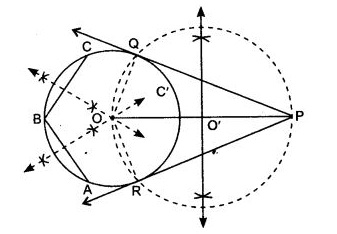
Join OQ and OR.
In ΔOQP and ΔOPR
OQ = OR [Radii of the circle]
OP = OP [Common]
ㄥQ = ㄥR = 90o [Radius is 丄 to tangent]
ΔOQP ≅ ΔORP [by RHS]
PQ = PR
A pair Of tangents can be drawn to a circle from an externar point lying outside the circle.
These two tangents are equal in lengths.
∴ PQ = PR
16.
x2+17x+c=0
Roots are -2 and -15
\(\Rightarrow \) (-2)2+17x(-2)+c=0
\(\Rightarrow \) 4-34+c=0 \(\Rightarrow \) c=30
Original equation, x2+13x+30=0
\(\Rightarrow \) x2+10x+3x+30=0
\(\Rightarrow \) x(x+10)+3(x+10) =0
\(\Rightarrow \) x(x+10) + 3(x+10)=0
\(\Rightarrow \) x=-10 or x=-3
Hence original roots are -10 and -3
17.
Let breadth of a rectangular mango grove be x m
Then, length of a rectangular mango grove = 2x m
According to the question,
Area of rectangular mango grove = 800 m2
\(\Rightarrow\) 2x(x) = 800 [\(\because\) Area = length \(\times\) breadth]
\(\Rightarrow\) 2x2 = 800 \(\Rightarrow\) x2 = 400
\(\Rightarrow\) x = \(\pm\)20
But, x = -20 is not possible because breadth can never be negative. so, x = 20.
Thus, length = 2x = 40 m and breadth = 20 m.
18.
a = 25, d = 50 - 25 = 25, x = 1000
A.T.Q., ak = x
\(\Rightarrow\) a + (k - 1)d = 1000
\(\Rightarrow\) 25 + (k - 1)25 = 1000
\(\Rightarrow\) (k - 1)25 = 975
\(\Rightarrow\) k - 1 = \(\frac{975}{25}\)
\(\Rightarrow\) k - 1 = 39
\(\Rightarrow\) k = 40
19.
Given quadratic equation is px2+\(\left( \sqrt { 3 } -\sqrt { 2 } \right) x-1\)=0
and x=\(\frac { 1 }{ \sqrt { 3 } } \) is a root of this equation.
On putting x=\(\frac { 1 }{ \sqrt { 3 } } \) in a given equation we get
\(p{ \left( \frac { 1 }{ \sqrt { 3 } } \right) }^{ 2 }+\left( \sqrt { 3 } -\sqrt { 2 } \right) \frac { 1 }{ \sqrt { 3 } } -1=0\)
\(\frac { p }{ 3 } +\frac { \sqrt { 3 } -\sqrt { 2 } -\sqrt { 3 } }{ \sqrt { 3 } } =0\)
\(\frac { p }{ 3 } -\frac { \sqrt { 2 } }{ \sqrt { 3 } } =0\)
\(p=\frac { \sqrt { 2 } }{ \sqrt { 3 } } \times 3=\frac { 3\sqrt { 2 } }{ \sqrt { 3 } } \times \frac { \sqrt { 3 } }{ \sqrt { 3 } }\)
\(=\frac { 3\sqrt { 2 } \times \sqrt { 3 } }{ 3 } =\sqrt { 2 } \times \sqrt { 3 } =\sqrt { 6 } \)
Hence, the value of p is \(\sqrt { 6 } \)
20.
12 cm
21.
1268 m
22.
36yr, 9yr
23.
(i) 14.66 km
(ii) Presence of mind, ability to take promote decisions.
24.
Given: A circle C (O, r) with centre O. AB is a tangent to the circle at the point p.
To Prove: OP ⊥ AB
Const: Take any point Q on AB other than P and join OQ.
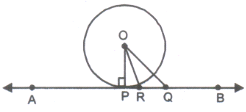
OR > OP .........(ii)
Thus, we find that among all such line segments, the line segment OP is the shortest, which is possible only when OP is perpendicular to AB.
Hence, OP ⊥ AB.
25.
Given : A ΔABC, in which AB = 5 cm, BC = 6 cm and CA = 7 cm.
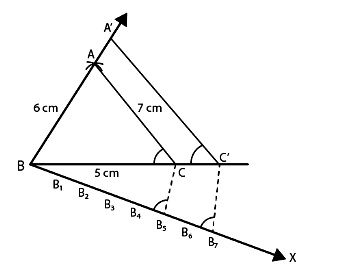
Required: ΔA'BC' ∼ ΔABC with \(\frac { 4 }{ 5 } \) (reduced) scale-factor.
Steps of Construction :
1. Construct ΔABC, such that AB=5cm, BC = 6 cm and CA = 7 cm.
2. Through B, construct an acute ㄥCBX, 90o).
3. Mark five points on BX such that BB1 = B1B2 = B2B3 - B3B4 = B4B5.
4. Join B5C.
5. Through B4, draw B4C'||B5C, intersecting BC in C'.
6. Through C', draw C'A'||CA, intersecting BA in A'.
Hence, ΔA'BC' is the required triangle.
26.
Here a=-2, d=-7-(-2)=-5 and an= -77
\(\therefore \) a+(n-1)d=an
\(\Rightarrow \quad -2+(n-1)\quad (-5)=-77\\ \Rightarrow \quad (n-1)(-5)=-75\\ \Rightarrow \quad n-1=15\\ \Rightarrow \quad n=16\)
Now, \({ S }_{ 16 }=\frac { 16 }{ 2 } (a+l) \)
\(\\=8[-2+(-77)]\\ =8(-79)=-632\quad \)
Hence, -77 is the 16th term and sum of these 16 terms are -632.
27.
25 terms
28.
()
infinite tangents
29.
()
\(5 \ + \sqrt {3}\)
30.
()
3
31.
(a)
32.
(a)
33.
(a)
34.
(a)
35.
(b)
36.
()
one
37.
()
line of sight
38.
()
Minimum number of points marked on
AX = 5 + 7 = 12
39.
()
3 : 1
40.
Let SQ be the height and PQ be the shadow of a man.
According to the question, SQ = PQ
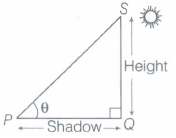
Again, let the angle of elevation of the sun be \(\theta \)
In right angled \(\\ \Delta PQS\)
\(tan\theta =\frac { perpendicular }{ Base } =\frac { QS }{ PQ }\)
\( \Rightarrow tan\theta =\frac { QS }{ QS } \left[ \because PQ = QS \right]\)
\( \\ \Rightarrow tan\theta =1=tan 45° \left[ \because tan 45°=1 \right] \)
\( \therefore \theta =45°\)
Hence, the angle of elevation of the sun is 45\(°\)
41.
Since, AD is a diameter of a circle, so AD is perpendicular to the tangent AB.
ㄥDAB =90°
In ΔABD,
ㄥDAB + ㄥABD +ㄥADB = 180°
90° + 50° + ㄥADB = 180°
ㄥADB = 180° -140° = 40°
In ΔODC,
OD = OC [same radii of circle]
ㄥOCD = ㄥCDO = 40°
ㄥDOC + ㄥOCD + ㄥCDO = 180°
ㄥDOC + 40° + 40° = 180°
ㄥDOC = 1,00°
Since, AD is a straight line.
ㄥDOC +ㄥCOA = 180°
100° +ㄥCOA = 180°
ㄥCOA = 80°
42.
Given AP is 34+32+30+...+10.
Here, first term, a = 34
Common difference, d = 32 - 34 = -2 and last term, \({ l }={ a }_{ n }=10\)
\(\because\) \({ a } _ { n } = a + ( n-1 ) d\)
\(\therefore\) 10 = 34 + (n-2) (-2)
\(\Rightarrow\) (-2) (n-1) = 10 - 34
\(\Rightarrow\) (-2) (n-1) = -24
\(\Rightarrow\) n-1 = 12
\(\Rightarrow\) n = 12 + 1 = 13
\(\because\) Sum of n terms of an AP, \({ S } _ { n } = \frac { n } { 2 } { (a + 1) }\)
\(\therefore\) \({ S } _ { 13 } = \frac { 13 } { 2 } (34 +10) = \frac { 13 }{ 2 } \times 44\)
\(= 13 \times 22 = 286\)
43.
kx(x - 2) + 6 = 0
or kx2 - 2kx + 6 = 0
Comparing this equation with ax2 + bx + c = 0, we get
a = k, b = - 2k and c = 6
= ( - 2k)2 - 4 (k) (6)
= 4k2 - 24k
For equal roots,
b2 - 4ac = 0
4k2 - 24k = 0
4k (k - 6) = 0
Either 4k = 0 or
k = 6 = 0
k = 0 or k = 6
However, if k = 0, then the equation will not have the terms 'x2' and 'x'.
Therefore, if this equation has two equal roots, k should be 6 only.
44.
Steps of Constructions:
1. Draw a line segment BC = 6 cm
2. Draw a perpendicular bisector of BCwhich cuts the line BCat Q.
3. Cut the line OA = 4 cm.
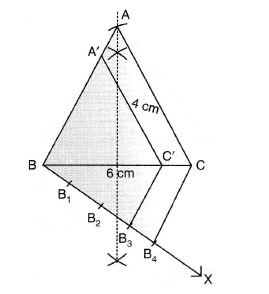
4. Join A to B and C
5. Triangle ABC is the given triangle.
6. Draw a ray BXmaking an acute angle.
7. Mark the four points B1, B2,B3and B4on the ray BX. Join B4C Draw a line parallel through B3 to B4 intersecting extended line segment AB at A'.
Hence A'BC' is a required triangle.
45.
(d)
t = p – 4
46.
(d)
0
47.
(b)
45°
48.
(c)
√2 + 1 : √2 – 1
49.
(b)
12 cm

10th Standard CBSE Syllabus & Materials
10th Standard CBSE
CBSE 10th Social Science PS - Federalism - New Model Questions Papers Study Material - QB365 Set A
NEW10th Standard CBSE
CBSE 10th Social Science PS - Power Sharing - New Model Questions Papers Study Material - QB365 Set A
NEW10th Standard CBSE
CBSE 10th Social Science GEO - Manufacturing Industries - New Model Questions Papers Study Material - QB365 Set A
NEW10th Standard CBSE
CBSE 10th Social Science GEO - Minerals and Energy Resources - New Model Questions Papers Study Material - QB365 Set A



CBSE 10th Standard CBSE Subjects
CBSE Standards





