
 100% FREE ACCESS
10th Standard CBSE Syllabus & Materials
10th Standard CBSE
CBSE 10th Social Science ECO - Globalisation and the Indian Economy - New Model Questions Papers Study Material - QB365 Set A
NEW10th Standard CBSE
CBSE 10th Social Science ECO - Money and Credit - New Model Questions Papers Study Material - QB365 Set A
NEW10th Standard CBSE
CBSE 10th Social Science ECO - Sectors of the Indian Economy - New Model Questions Papers Study Material - QB365 Set A
NEW10th Standard CBSE
CBSE 10th Social Science ECO - Development - New Model Questions Papers Study Material - QB365 Set A
NEW10th Standard CBSE
CBSE 10th Social Science PS - Outcomes of Democracy - New Model Questions Papers Study Material - QB365 Set A
NEW10th Standard CBSE
CBSE 10th Social Science PS - Gender, Religion and Caste - New Model Questions Papers Study Material - QB365 Set A

Published on: 14/02/2020
10th standard CBSE Mathematics Public Model Question Paper IV 2020
Download CBSE Class 10th Standard CBSE Maths question papers, sample papers, important questions, and previous year solved papers in PDF format. Get free study materials, NCERT solutions, and exam preparation resources for Class 10th Standard CBSE Maths
Questions + Answers key
Take MCQ Maths Test
1.
Construct a triangle similar to a given MBC such Construct a triangle similar to it and of scale factor . that each of its sides is of the corresponding sides of MBC. It is given that AB = 4 cm, BC = 5 cm and AC = 6 cm.
2.
In fig., PA and PB are tangents to the circle with centre O such that \(\angle APB={ 50 }^{ ° }\) Write the measure of \(\angle OAB\) .
3.
If x = - \(\frac{1}{2}\), is a solution of the quadratic equation 3x2 + 2kx- 3 = 0, find the value of k
4.
The angle of elevation of the top of the tower from a point on the ground which is 30m away from foot of the tower is 300.the height of the tower is.
5.
The angle of elevation of the top of a tower at a distance of 150 m from its foot on a horizontal plane is found to be 30o . Find the height of the tower, correct to one place of decimal.
6.
Name the line drawn from the eve of an observer to the point in the object viewed by the observer.
7.
Two APs have the same common difference. The first term of one AP is 2 and that of the other is 7. The difference between their 10th terms is the same as the difference between their 21st terms, which is the same as the difference between any two corresponding terms. Why?
8.
Find the sum of n terms of the series \(\sqrt{2} + \sqrt{ 8}+ \sqrt{ 18}+ \sqrt{ 32}+....\)
9.
A kite is flying at a height of 30 m from the ground. The length of the string from kite to the ground is 60 m. Assuming that there is no slack in the string, find the angle of elevation of the kite at the ground.
10.
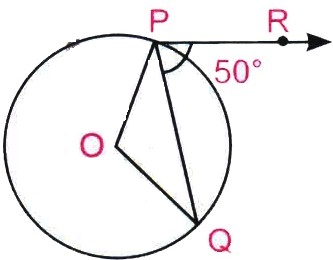
In figure id O is the centre of a circle, PQ is a chord and the tangent PR at P makes an angle of 500 with PQ. Find \(\angle POQ.\)
11.
Find the value of m so that the quadratic mx(x-7)+49=0 has two equal roots.
12.
A man bought a certain number of toys for Rs.180, he kept one for his own use and sold the rest for one rupee each more than he gave for them, besides getting his own toy for nothing he made a profit of Rs.10. Find the number of toys.
13.
In the given figure, TA S is a tangent to the circle, with centre O, at the point A. If \(\angle OBA=32^0\), find the value of x.
-S.jpg)
14.
Which of the following are APs? If they form an AP, find the common difference d and write three more terms.
-1.2, -3.2, -5.2, -7.2.......
15.
For the following APs, write the first term and the common difference:
3, 1, -1, -3,.......
16.
The length of the hypotenuse of a right triangle exceeds the length of its base by 2 crn and exceeds twice the length of altitude by 1 cm. Find the length of each side of the triangle.
17.
Find the middle terms of the sequence formed by all numbers 9 and 95, which leave a remainder 1 when divided by 3. Also find the sum of the numbers on both sides of the middle term separately.
18.
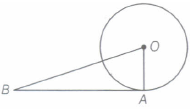
Find the length of tangent to a circle from a point at a distance of 5 cm from centre of the circle of radius 3 cm.
19.
Choose the correct option and given justification:
In the given figure, if TP and TO are the two tangents to a circle with centre O, so that \(\angle\)POQ = 110°, then \(\angle\)PTO is equal to

(a) \(60^{ \circ }\)
(b) \(70^{ \circ }\)
(c) \(80^{ \circ }\)
(d) \(90^{ \circ }\)
20.
The angle of elevation of the top of a tower 30m high from the foot of another tower in the same plane is 600 and the angle of elevation of the top of the second tower from the foot of the first tower is 300.Find the distance between the two tower and also, the height of the other tower.
21.
A boy standing on a horizontal plane finds a bird flying at a distance of 100 m from him at an elevation of 30o. A girl standing on the roof of 20 metre high building, finds the angle of elevation of the same bird to be 45o. Both the boy and the girl are on opposite sides of the bird. Find the distance of bird from the girl. [given \(\sqrt2\) = 1414]
22.
A kite is flying at a height of 60 m above the ground. The string attached to the kite is temporarily tied to a point on the ground. The inclination of the string with the ground is 60o . Find the length of the string, assuming that there is no slack in the string.
23.
A passenger, while boarding the plane, slipped from the stairs and got hurt. The pilot took the passenger in the emergency clinic at the airport for treatment. Due to this, plane got delayed by hall an hour. To reach the destination 1500 km away in time, so that the passengers could catch the connecting flight, the speed of the plane was increased by 250 km/ hour than the usual speed. What is the usual speed of the Plane? What value is depicted in this question?
24.
Draw a circle of radius 5 cm. From a point 13 cm away from its centre, construct a pair of tangents to the circle and measure their lengths.
25.
In a class test, the sum of marks obtained by Mohan in English and Sanskrit is 28. Had he got 3 more marks in English and 4 marks less in Sanskrit, the product of marks obtained in the two subjects would have been 180. Find the marks obtained in the two subjects separately.
26.
Find the sum of first 25 terms of an AP whose nth term is 1-4n.
27.
The lengths of tangents drawn from an external point to a circle are equal.
28.
Draw a circle and two lines parallel to a given line, such that one is a tangent and other a secant to the circle.
29.
Draw two concentric circles of radii 2.5 cm and 5 cm. Choose any point P on the larger circle and construct a pair of tangents to the smaller circle. Measure their lengths.
30.
Find the sum of all three-digit natural numbers, which are multiples of 11.
31.
A statue 1.46 m tall stand on the top of a pedestal. From a point on the ground, the angle of elevation of the top of the statue is 60o and from the same point, the angle of elevation of the top of the pedestal is 45o . Find the height of the pedestal. \((\sqrt { 3 } =1.73)\) .
32.
A pole 5 m high is fixed on the top of a tower. The angle of elevation of the top of the pole observed from a point 'A' on the ground is 60o and the angle of depression of the point 'A' from the top of the tower is 45o . Find the height of the tower. \((\sqrt { 3 } =1.73)\)
33.
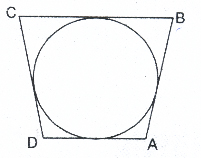
In figure, a circle touches all four sides of quadrilateral ABCD with AB = 18 cm, BC = 21 cm and CD = 12 cm, AD =________
34.
If roots of \(ax^{2} + bx + c = 0\) are equal , then value of c.
35.
10th term of -0.1, -0.2, -0.3,....
36.
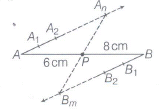
In the given figure, if AP = 6 cm and BP = 8 cm, then m : n = 3 : 4.
37.
A bridge across a river makes an angle of \({ 45 }^{ ° }\)with the river bank. If the length of the bridge across the river is 150m, then width of river is 100m.
38.
If the product ac in the quadratic equation \(ax^{ 2 }+bx+c\) negative, then the equation cannot have non-real roots
39.
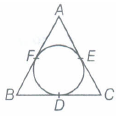
In the given figure, incircle of MBC touches its sides at D, E and F. If perimeter of \(\triangle \) ABC = 24 cm, then AF + BD + CE = 12 cm.
40.
12, 22, 32, 42 ,...... are in A.P.
41.
A 6m tall tree casts a shadow of length 4m.If at the same time a flagpole casts a shadow 50m in length, then the length of the flagpole is...........
42.
To find a point P on the line segment AB = 6 cm, such than \(\frac { AP }{ AB } =\frac { 2 }{ 5 } \) which ratio the line segment AB is divided.
43.
To draw a pair of tangents to a circle which are inclined to each other at an angle of 60° , it is required to draw tangents at end points of those two radii of the circle, then find the angle between them.
44.
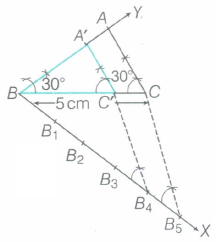
Construct a \(\Delta ABC\) , in which BC = 5cm, \(\angle CAB=120°\)and \(\angle ABC=30°\) . Then, construct another triangle whose sides are \(\frac{4}{5}\)times of the corresponding sides of \(\Delta ABC\) . Justify your construction.
45.
A tree in each year grows 4cm less than it grew in previous year. If it grew 1 metre in the first year, in how many years will it have ceased growing and what will be its height then,
1300
2600
26
1500
46.
If 1/2 is a root of the equation x2 + kx-5/4 = 0 then the other root of the quadratic equation is
1/4
-5/2
-2
1/2
47.
If the height and length of the shadow of a man are the same, then the angle of elevation of the sun is
60°
45°
30°
15°
48.
PT and PS are tangents drawn to a circle, with cantre C, from a point P. If ∠TPS = 50° , then the measure of ΔTCS is
150o
120o
100o
130o
49.
The angle between two tangents drawn from an external point to a circle is 110°. The angle subtended at the centre by the segments joining the points of contact to the centre of circle is:
70o
90o
55o
110o
1.
A triangle ABC' is to be constructed such that
\(\frac { CA^{ ' } }{ CA } =\frac { BA^{ ' } }{ BA } =\frac { B^{ ' }C }{ BC } =\frac { 2 }{ 3 } \)
Thi.s means that the ABC 3 triangle ABC is similar to the triangle ABC with scale factor as \(\frac { 2 }{ 3 } \)
Steps of construction:
Draw a line segment BC = 5 cm
2. With B as centre and radius = AB = 4 cm, draw an arc.
3. With C as centre and radius = AC = 6 cm, draw another arc, meeting the arc drawn in step 2 at the point A.
4. Join AB and AC to obtain \(\triangle ABC\)
5.. Below BC, make an acute angle \(\angle CBX\)
6.Along BX mark off three points B1 ,B2, , B3 such that BB1 = B1 B2
7. Join BC
8. From B2, draw B2C II B3C
9. From C, draw CA' II CA, meeting BA at the point A'. Then ABC is the required triangle
2.
Here, \(\angle APB={ 50 }^{ ° }\)
\(\angle PAB=\angle PBA=\frac { { 180 }^{ ° }-{ 50 }^{ ° } }{ 2 } ={ 65 }^{ ° }\)
\(\angle OAB={ 90 }^{ ° }-\angle PAB\)
\(={ 90 }^{ ° }-{ 65 }^{ ° }={ 25 }^{ ° }\)
3.
Putting x = -\(\frac{1}{2}\). in 3x2 + 2kx - 3 = 0
\(3\left( -\frac { 1 }{ 2 } \right) ^{ 2 }+2k\left( -\frac { 1 }{ 2 } \right) -3=0\)
⇒ \(\frac{3}{4}\) - k- 3 = 0
⇒ k = \(\frac{3}{4}\)- 3
⇒ k = \(\frac{3-12}{4}\)
⇒ k = \(\frac{-9}{4}\)
4.
\(10\sqrt{3}m\)
5.
86.6 m
6.
line of sight
7.
Yes
8.
Here a= \(\sqrt { 2 } \) , d= \(\sqrt { 8 } -\sqrt { 2 } =\sqrt { 2 } \)
Sn = \(\frac { n }{ 2 } \left[ 2a+(n-1)(d) \right] \)
\(\frac { n }{ 2 } \left[ 2\sqrt { 2 } +(n-1)\sqrt { 2 } \right] \)
\(=\frac { n }{ 2 } \left[ \sqrt { 2 } +\sqrt { 2 } n \right] \)
\(\frac { n(n+1) }{ \sqrt { 2 } } \)
9.
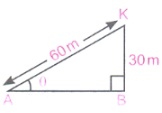
Let kite is at point K
AK = length of string
\(\therefore\) In right \(\Delta\)ABK, \(\frac { BK }{ AK } =\sin { \theta } \)
\(=\sin { \theta } =\frac { 30 }{ 60 } \Rightarrow \sin { \theta } =\frac { 1 }{ 2 } \Rightarrow \theta ={ 30 }^{ o }\)
10.
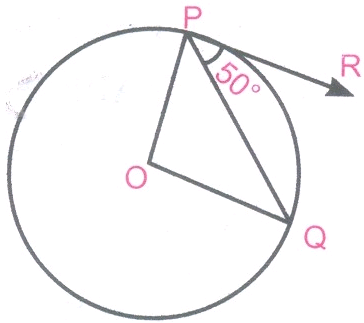
OP ⊥ PR
[ ∵ Tangent and
radius are ⊥ to each other at the point of contact]
\(\angle \)OPQ = 90° -50°
= 40°
OP = OQ
[By isosceles triangle's property]
\(\angle \)OPQ = \(\angle \)OQP = 40°
In \(\triangle\)OPQ,
⇒ \(\angle \)O + \(\angle \)P + \(\angle \)Q = 180°
⇒ \(\angle \)O + 40° + 40° = 180°
\(\angle \)O = 180° - 80° = 100°
11.
mx(x-1)+49=0
\(\Rightarrow \) mx2-7mx+49=0
Here a=m,b=-7m,c=49
For equal roots ,D=0
\(\Rightarrow D=b^{ 2 }-4ac\)
\(\Rightarrow 0=(-7m)^{ 2 }-4\times m\times 49\)
\(\Rightarrow 0=49m^{ 2 }-196m\)
\(\Rightarrow 49m^{ 2 }-196m=0\)
\(\Rightarrow 7m(7m-28)=0\)
\(\Rightarrow 7m=0\) or 7m-28 =0
\(\Rightarrow m=0\) or \(m=\frac { 28 }{ 7 } =4\)
but \(m\neq 0\) [ \(\therefore \) In quadratic equation \(a\neq 0\) ]
12.
Let number of toys be x
\(\therefore \) Cost of one toy = \(\frac { 180 }{ x } \)
Number of toys sold = x-1
Selling price per toy = Rs \(\left( \frac { 180 }{ x } +1 \right) \)
Total SP =CP+profit
ATQ (x-1) \(\left( \frac { 180 }{ x } +1 \right) \)=180+10
\(\Rightarrow (x-1)\left( \frac { 180 }{ x } +1 \right) =190\)
\(\Rightarrow x^{ 2 }+179x-180=190x\)
\(\Rightarrow x^{ 2 }-11x-180=0\)
\(\Rightarrow (x-20)(x+9)=0\)
\(\Rightarrow x=20,-9\)
\(\Rightarrow x=20\) [Rejected x=-9]
13.
Given: TAS tangent to the circle with centre O at A.
\(\angle \)OBA = 32o
To find: x
Sol. In \(\triangle\)OAB OA=OB [RAdii of the same circle]
⇒ \(\angle \)1 = 32o [Angle opposite to equal sides of a triangle are equal]
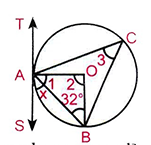
In OAB
\(\angle \)1 + \(\angle \)2 + 32o = 180o [Angle sum property of a triangle]
⇒ \(\angle \)2 + 32o + 32o = 180o ⇒ <2 = 180o - 64o = 116o
\(\angle \)3 = \(1\over2\)\(\angle \)2 = \(1\over2\) x 116o = 58o
TAS is tangent to the circle (Given)
\(\angle \)x = \(\angle \)ABC = 58o [Angles in the alternate segments are equal]
14.
Here, we have
a2 - a1 = -3.2 - (-1.2) = -3.2 + 1.2 = -2
a3 - a2 = -5.2 - (-3.2) = -5.2 + 3.2 = -2
a4 - a3 = -7.2 - (-5.2) = -7.2 + 5.2 = -2
and so on.
Since, the difference of any two consecutive terms same. Therefore, the given list of numbers forms a AP and its common difference (d) is - 2.
Now, next three terms of this AP are,
a5 = a4 + d = -7.2 + (-2) = -9.2
a6 = a5 + d = -9.2 + (-2) = -11.2
and a7 = a6 + d = -11.2 + (-2) = -13.2
15.
First term (a) = 3
and common difference (d) = 2nd term - 1st term
= 1-3 = -2
16.
Let altitude of triangle = x.
∴ hypotenuse of triangle = 2x + 1and base of traiangle = 2x-1
Using Pythagoras theoram,
(2x+1)2=x2+(2x-1)2
\(\Rightarrow 4x^{ 2 }+1+4x=x^{ 2 }+(2x-1)^{ 2 }\)
\(\Rightarrow x^{ 2 }-8x=0\)
\(\Rightarrow x(x-8)=0\)
either x = 0 or x - 8 = 0
Rejecting x = 0,:. x = 8
∴ altitude of triangle = 8 cm
hypotenuse of triangle 2 x 8 + 1 = 17 cm
and base of triangle 2 x 8 - 1 = 15 cm
17.
The sequence is 10, 13, ..... 94.
94 = 10 + (n - 1) 3 \(\Rightarrow\) n = 29
Therefore \(\\ \frac { 29+1 }{ 2 } \) = 15th term is the middle term
Middle term = 10 + 14 \(\times\) 3 = 52
Sum of first 14 terms = 14 [20 + 13 \(\times\) 3] = 413
Sum of the last 14 terms = \(\frac { 14 }{ 2 } [110+13\times 3]\)
= 1043
18.
Given, OB = 5 cm and radius OA = 3 cm
Use Pythagoras theorem in right \(\Delta\)OAB to find AB
4 cm
19.
Given, TP and TQ are two tangents to a circle and \(\angle\)POQ = 110°. Join PQ.
In \(\triangle OPQ\), OP = OQ [radii of circle]
\(\Rightarrow\) \(\angle OPQ=\angle OQP\) [angles corresponding to equal sides are equal]
Then, \(\angle OPQ=\angle OQP=\frac { { 180 }^{ \circ }-{ 110 }^{ \circ } }{ 2 } =35^{ \circ }\)
Since, [\(\because\)radius of a circle is perpendicular to the tangent at the point of contact]
\(\therefore \angle OPT={ 90 }^{ \circ }\)
\(\Rightarrow\) \(\angle OPQ=\angle OQP={ 90 }^{ \circ }\)
\(\Rightarrow\) \(\angle OPQ+\angle OPT={ 90 }^{ \circ }\)
\(\Rightarrow\) \({ 35 }^{ \circ }+\angle OPT={ 90 }^{ \circ }\)
\(\Rightarrow\) \(\angle OPT={ 55 }^{ \circ }\)
\(\Rightarrow\) \(\angle OQT={ 90 }^{ \circ }\)
\(\Rightarrow\) \(\angle OQP+\angle PQT={ 90 }^{ \circ }\)
\(\Rightarrow\) \({ 35 }^{ \circ }+\angle PQT={ 90 }^{ \circ }\)
\(\Rightarrow\) \(\angle PQT={ 55 }^{ \circ }\)
Now, in \(\triangle PTQ,\quad \angle QPT+\angle PQT+\angle PTQ=180^{ \circ }\)
[\(\because\)sum of all angles in a triangle is 180°]
\(\Rightarrow\) \( { 55 }^{ \circ }+{ 55 }^{ \circ }+\angle PTQ={ 180 }^{ \circ }\)
\(\Rightarrow\angle PTQ={ 180 }^{ \circ }-\left( { 55 }^{ \circ }+{ 55 }^{ \circ } \right) ={ 70 }^{ \circ }\quad \)
20.
Here, let us assume that AB and CD be the two towers of heights h m and 30 m respectively.
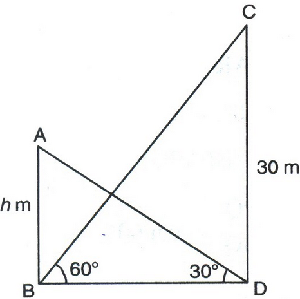
∠CBD=60o and ∠ADB=30o
Consider rt. ∠ed ΔCBD, we obtain
\(\frac { CD }{ BD } ={ tan\quad 60 }^{ o }\)
\(\Rightarrow \quad \frac { 30 }{ BD } =\sqrt { 3 } \Rightarrow BD=\frac { 30 }{ \sqrt { 3 } } \) ...(i)
Consider rt. ∠ed ΔADB, we obtain
\(\frac { AB }{ BD } ={ tan\quad 30 }^{ o }\)
\(\Rightarrow \quad \frac { h }{ BD } =\frac { 1 }{ \sqrt { 3 } } \Rightarrow \sqrt { 3 } h=BD\) ...(ii)
From (i) and (ii), we have
\(\sqrt { 3 } h=\frac { 30 }{ \sqrt { 3 } } \)
\(\Rightarrow h=\frac { 30 }{ 3 } =10m\)
Also, from (ii), we have BD = \(10\sqrt { 3 } \) m
Hence, the distance between two towers is \(10\sqrt { 3 } \) m
and the height of the other tower is 10 m.
21.
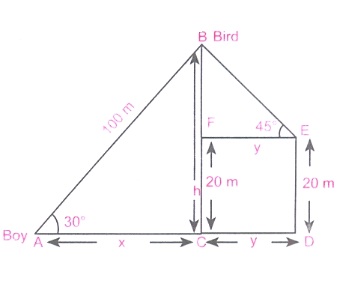
Given: A boy is standing at a distance of 100 m from the bird flying at an elevation of 30o. A girl is standing on the roof of 20 m high building finds the angle of elevation of the bird to be 45o Boy and girl are on opposite side of the bird.
To find: Distance between the bird and the girl i.e., BE.
Solution: In ΔACB,
⇒ \(\frac { h }{ 100 } \) = sin 300 ⇒ h = \(\frac { 1 }{ 2 } \) x 100 = 50 m
⇒ BF = h - 20 = (50 - 20) m = 30 m
In ΔBFE,\(\frac { 30 }{ BE } =sin{ 45 }^{ 0 }\Rightarrow \frac { 30 }{ BE } =\frac { 1 }{ \sqrt { 2 } } \Rightarrow 30\sqrt { 2 } \) = BE
BE = 30 x 1.414 = 42.420 = 42.42 m
22.
Let C be the position of the kite and AC be the length of the string which makes an angle of 60° on the ground. The height of the kite from the ground is BC =60 m.
In right angled \(\Delta\)ABC,

\(\begin{aligned} \sin 60^{\circ} & =\frac{P}{H}=\frac{B C}{A C} \\ \end{aligned}\)
\(\begin{aligned} \Rightarrow \quad \frac{\sqrt{3}}{2} & =\frac{60}{A C} \end{aligned}\) \(\left[\because \sin 60^{\circ}=\frac{\sqrt{3}}{2}\right]\)
\(\begin{aligned} \therefore \quad A C & =\frac{60 \times 2}{\sqrt{3}} \times \frac{\sqrt{3}}{\sqrt{3}} \\ \end{aligned}\) [rationalising]
\(\begin{aligned} =\frac{120 \sqrt{3}}{3}=40 \sqrt{3} \mathrm{~m} \end{aligned}\)
Hence, the length of the string is 40\(\sqrt3\)m.
23.
Let the usual speed of plane be x km/h,
\(\frac { 1500 }{ x } -\frac { 1500 }{ x+250 } =\frac { 1 }{ 2 } \)
\(\Rightarrow x^{ 2 }+250x-750000=0\)
\((x+1000)(x-750)=0\)
x = 750
Speed of plane = 750 km/h.
Values depicted here are:
(i) Helping the needy.
(ii) Quick help to the injured.
24.
12 cm
25.
English-12 Sanskrit-16, or English-9 Sanskrit-19
26.
-1275
27.
We are given a circle with centre O, a point P lying outside the circle and two tangents PQ, PR on the circle from P see fig. We are required to prove that PQ = PR.
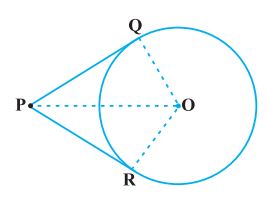
For this, we join OP, OQ and OR. Then \(\angle\)OQP and \(\angle\)ORP are right angles, because these are angles between the radii and tangents, and according to Theorem 10.1 they are right angles. Now in right triangles OQP and ORP,
OQ = OR (Radii of the same circle)
OP = OP (Common)
Therefore, \(\Delta\)OQP \(\cong\)\(\Delta\) ORP (RHS)
This gives PQ = PR (CPCT)
28.
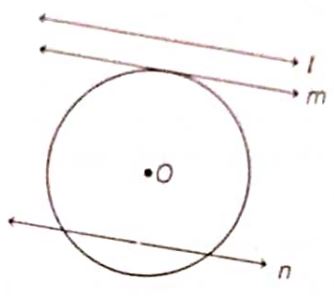
First,draw a circle with centre O and draw a line l. Now, we draw two lines parallel to l, such that one line say m, is a tangent to the cirde and another say n, is a secant to the cirde.
29.
4.3 cm ; 4.3 cm
30.
We know that, in natural numbers, the smallest and the largest number of three-digits which are multiples of 11 are 110 and 900 respectively. Therefore, the sequence of three-digit numbers which are multiples of 11 are 110, 121, 132, ..., 990. Thus, it is an A.P. with first term a = 110, common difference d = 9 and last term (an) = l = 990.
Let there are n terms in this sequence.
\(\therefore\) an = 999
\(\Rightarrow\) a + ( n - 1 )d = 999
\(\Rightarrow\) 110 + ( n - 1)11 = 999
\(\Rightarrow\) 11n = 990 - 99
\(\Rightarrow\) 11n = 891 \(\Rightarrow\) n = 81
Hence, the equired sum = \({81 \over 2}(110+990)\)
\(={81\times1100 \over 2}\)
= 81 x 550 = 44550
31.
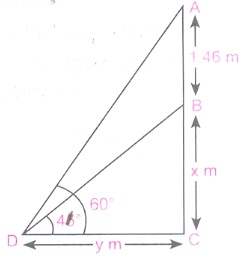
Let AB is statue, BC is pedestal and BC=x m, CD=y m.
In right ΔBCD, ΔBCD, \(\frac { BC }{ CD } \)=tan 45o
⇒, \(\frac { x }{ y } \)=1 ⇒ x=y .....(i)
In right ΔACD, \(\frac { AC }{ CD } \)=tan 600
⇒ \(\frac { x+1.46 }{ y } =\sqrt { 3 } \)
⇒ \(\frac { x+1.46 }{ x } \)=1.73 [Using (i)]
⇒ x+1.46=1.73x ⇒ 0.73x=1.46 ⇒ x=2
32.
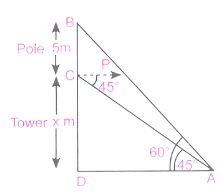
Let CD be a tower of height x m and BC is a pole and ㄥBAD=600 and ㄥPCA=450 ㄥPCA=ㄥCAD=450
In right ΔCDA, \(\frac { CD }{ DA } \)=tan 45o
⇒ \(\frac { x }{ DA } \)=1 ⇒ DA= x m
In right ΔBDA, \(\frac { BD }{ DA } \)=tan 60o
⇒ \(\frac { 5+x }{ x } =\sqrt { 3 } \)
⇒ 5+x=\(\sqrt { 3 } \)x ⇒ 5=(\(\sqrt { 3 } \)-1)x
⇒ x=\(\frac { 5 }{ \sqrt { 3 } -1 } m=\frac { 5(\sqrt { 3 } +1) }{ 2 } m=\frac { 5(1.73+1) }{ 2 } m=\frac { 13.65 }{ 2 } \)m=6.82 m
33.
()
9 cm
34.
()
\(b^{2}\over 4a\)
35.
()
-1
36.
(a)
37.
(b)
38.
(b)
39.
(a)
40.
(b)
41.
()
75m
42.
()

The line segment AB is divided in the ratio AP : PB = 2 : (5 - 2) = 2 : 3
43.
()
Angle between the radii = 180° - 60° = 120°
44.
Given A\(\Delta ABC\) , in which BC=5cm, \(\angle CAB=120°\) and \(\angle ABC=30°\) .
Then, \(\angle BCA=180°-30°-120°=30°\)
45.
(a)
1300
46.
(b)
-5/2
47.
(b)
45°
48.
(d)
130o
49.
(a)
70o

10th Standard CBSE Syllabus & Materials
10th Standard CBSE
CBSE 10th Social Science PS - Federalism - New Model Questions Papers Study Material - QB365 Set A
NEW10th Standard CBSE
CBSE 10th Social Science PS - Power Sharing - New Model Questions Papers Study Material - QB365 Set A
NEW10th Standard CBSE
CBSE 10th Social Science GEO - Manufacturing Industries - New Model Questions Papers Study Material - QB365 Set A
NEW10th Standard CBSE
CBSE 10th Social Science GEO - Minerals and Energy Resources - New Model Questions Papers Study Material - QB365 Set A



CBSE 10th Standard CBSE Subjects
CBSE Standards





