
 100% FREE ACCESS
10th Standard CBSE Syllabus & Materials
10th Standard CBSE
CBSE 10th Social Science ECO - Globalisation and the Indian Economy - New Model Questions Papers Study Material - QB365 Set A
NEW10th Standard CBSE
CBSE 10th Social Science ECO - Money and Credit - New Model Questions Papers Study Material - QB365 Set A
NEW10th Standard CBSE
CBSE 10th Social Science ECO - Sectors of the Indian Economy - New Model Questions Papers Study Material - QB365 Set A
NEW10th Standard CBSE
CBSE 10th Social Science ECO - Development - New Model Questions Papers Study Material - QB365 Set A
NEW10th Standard CBSE
CBSE 10th Social Science PS - Outcomes of Democracy - New Model Questions Papers Study Material - QB365 Set A
NEW10th Standard CBSE
CBSE 10th Social Science PS - Gender, Religion and Caste - New Model Questions Papers Study Material - QB365 Set A

Published on: 14/02/2020
10th standard CBSE Mathematics Public Model Question Paper V 2020
Download CBSE Class 10th Standard CBSE Maths question papers, sample papers, important questions, and previous year solved papers in PDF format. Get free study materials, NCERT solutions, and exam preparation resources for Class 10th Standard CBSE Maths
Questions + Answers key
Take MCQ Maths Test
1.
In the given figure, from a point P, two tangents PT and PS are drawn to a circle with centre O such that \(\angle SPT\) = 120°, Prove that OP = 2 PS
2.
solve for x : \(9x^{ 2 }-6ax+(a^{ 2 }+b^{ 2 })=0\)
3.
To locate a point Q on PR such that \(QR=\frac { 2 }{ 3 } PQ\),at what ratio the line segment PR should be divided?
4.
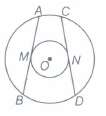
In two concentric circles, prove that all chords of the outer circle which touch the inner circle are of equal length.
5.
Two APs have the same common difference. The first term of an AP is 2 and that of the other is 7. The difference between their 10th terms is the same as the difference between their 21st terms, which is the same as the difference between any two corresponding terms? Why?
6.
Find the common difference of an AP, whose first term is \(\frac {1}{2}\) and 8th term is \(\frac {17}{6}.\)
7.
What will be the value of p for which the equation \(x^{ 2 }-4x+p=0\) has equal roots?
8.
At one end A of a diameter AB of a circle of radius 5 cm, tangent XAY is drawn to the circle. Find the length of the chord CD parallel to XY and at a distance 8 cm from A.
9.
A girl of height 100cm stands in front of lamppost and cast a shadow of length \(100\sqrt{3}\)cm on the ground.The angle of elevation of the top of the lamppost is
10.
The angel of elevation of an aeroplane from a point on the ground is 45o. After a flight for 15 seconds, the elevation changes to 30o. If the aeroplane is flying at a height of 3000m, find the speed of the aeroplane.
11.
From the top of a tower h m high, the angles of depression of two objects, which are in line with the foot of the tower, are \(\alpha\) and \(\beta\) \((\beta > \alpha)\) .Find the distance between the two objects.
12.
Which of the following are A.P.s? If they from an A.P., find the common difference d and write three more terms: a = ...., d = -5, n = 20, an = -15
13.
If a pole of height 12 m throws shadow of \(4\sqrt { 3 } \) m. then find the angle of elevation of sun.
14.
A straight highway leads to the foot of a 100 m tall tower. From the top of the tower, angle of depression of a car on the highway is 30o . Find the distance of the car from foot of the tower.
15.
Construct tangents to a circle of radius 3 cm from a point on concentric circle of radius 5 cm and measure its length.
16.
Write the nature of roots of the quadratic equation 9x2-6x-2=0
17.
Find the 10th term of the AP : 2, 7, 12, . . .
18.
Check whether the following are quadratic equations: (x+2)3=2x(x2-1)
19.
Point A(-1, y) and B(5, 7) lie on a circle with centre 0(2, - 3y). Find the values of y. Hence find the radius of the circle.
20.
A journey of 192 krn from a town A to town B takes 2 hours more by an ordinary passenger train than a super fast train. If the speed of the faster train is 16 krn!h more, find the speed of the faster and the passenger train.
21.
Determine the height of a mountain, if the elevation of its top at an unknown distance from the base is 30\(°\) and at a distance 10 km further off from the mountain, along the same line, the angle of elevation is 15\(°\) (Take tan 15\(°\) = 0.27)
22.
Draw a circle of diameter AB = 6 cm with centre O and then draw a tangent to the circle at point A or B.
23.
Draw an equilateral \(\Delta ABC\) of each side 4 cm.Construct a triangle similar to it and of scale factor \(\frac{3}{5}\).Is the new triangle also an equilateral?
24.
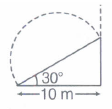
The top of a broken tree has its top touching the ground (shown in the following figure) at a distance of 10 m from the bottom. If the angle made by the broken part with ground is 30°, then find the length of the broken part.
25.
The interior angles of a polygon are in AP. The smallest angle is \(120^0\) and the common difference is \({ 5 } ^ { 0 }\) . Find the number of sides of the polygon.
26.
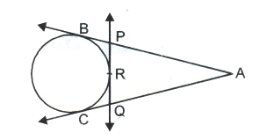
Two tangents are drawn to a circle from an exterior point A, touching the circle at B and C. From another point R, on circle a third tangent is drawn to the circle intersecting AB in P and AC in Q and touching the circle at R. If AB = 20 units, find the perimeter of \(\triangle APQ\).
27.
The first term of an A.P. is -5 and the last term 45. If the sum of the terms of the A.P. is 120, then find the number of terms and the common difference.
28.
The product of two successive integral multiples of 5 is 300. Determine the multiples.
29.
If the equations 2x2-7x+3=0 and 4x2 +ax-3=0 have common roots then what is the value of a?
30.
Anand is watching a circus artist climbing a 15m long rope, which is tightly stretched and tired from the top of a vertical pole to the ground.
(i) Find the height of the pole, if the angle made by rope with ground level is \({ 45 }^{ ° }\) .
(ii) Which mathematical concept is used to solve this question?
(iii) What value is experienced by Anand?
31.
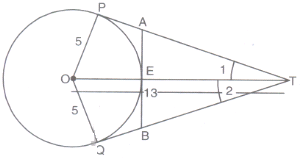
In figure, O is the centre of a circle of radius 5 cm. T is a point such that OT = 13 cm and OT intersects circle at E. If AB is a tangent to the circle at E, find the length of AB, where TP and TQ are two tangents to the circle.
32.
The shadow of a tower, when the angle of elevation of the sun is 450, is found to be 40 40m longer than when it is 600.Find the height of the tower.
33.
Solve the following quadratic equation for x ;
\((a + b^{2})x^{2} - 4abx - (a-b)^{2} = 0\)
34.
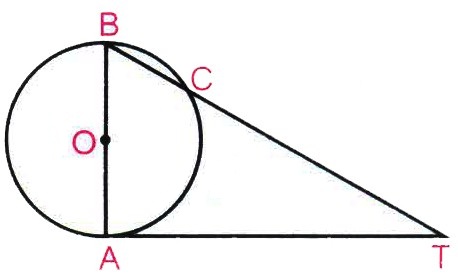
In the given figure, AB is a diameter of the circle. The length of AB = 5 cm. If O is the centre of the circle and the length of tangent segment AT = 12cm, determine CT.
35.
Deepak repays his total loan of Rs.1,18,000 by paying every month starting with the first instalment of Rs.1000. If he increase the instalment by Rs.100 every month, what amount will be paid as the last instalment of loan? What amount of loan he still have to pay after the 30th instalment?
36.
A line segment drawn through the end of a radius and perpendicular to it, is a ___________to the circle.
37.
If the angle of elevation of the top of a tower from two points distance and t from its foot are complementary, the height of the tower is ........
38.
The quadratic equation \(x^{2} - 10 x + 2 = 0\) has ........... roots.
39.
If the nth term of an A.P. is 2n + 1, then the sum of first n-terms of the A.P. is .............
40.
In a \(\Delta ABC\) , we draw \(\Delta AB'C'\sim \Delta ABC\) with scale factor \(\frac { 13 }{ 15 } \) . Then, perimeter of \(\Delta ABC\) > perimeter of \(\Delta AB'C'\)
41.
The length of shadow of a tree 7 m high, when Sun's elevation is \({ 45 }^{ ° }\)is 7 m.
42.
The length of the tangent is the length of the segment from an external point to the point of contact.
43.
A quadratic equation \(ax^{2} + bx + c = 0\) has real roots if \(b^{2} \ge 4ac.\)
44.
If nth term of an A.P. is 6n + 2, then common difference is 6.
45.
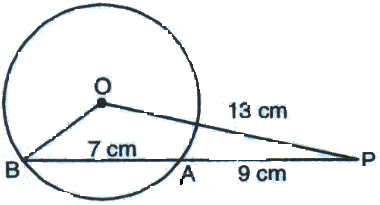
Radius of circle given below is
46.
If the roots of the equation \((b - c)x^{2} + (c -a) x + (a - b) = 0 \) are equal, then ..
47.
If a10 - a5 = 400, then common difference is
48.
To divide a line segment AB in the ratio 2 : 5, a ray. AX is drawn such that \(\angle BAX\) is acute. Then points are marked at equal intervals at AX. What is the minimum number of these points?
49.
To divide a line segment AB in the ratio p : q, draw a ray AX so that \(\angle BAX\) is an acute angle. How many points mark on ray AX?
50.
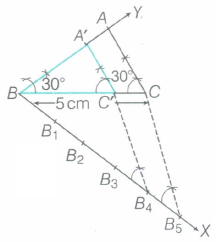
Construct a \(\Delta ABC\) , in which BC = 5cm, \(\angle CAB=120°\)and \(\angle ABC=30°\) . Then, construct another triangle whose sides are \(\frac{4}{5}\)times of the corresponding sides of \(\Delta ABC\) . Justify your construction.
51.
The first and last terms of an AP are 1 and 11. If the sum of all its terms is 36, then the number of terms will be
8
5
6
7
52.
An observer 1.5 m tall is 28.5 m away from a tower. The angle of elevation of the top of the tower from his eyes is 45°. The height of the tower is
30 m
20 m
40 m
10 m
53.
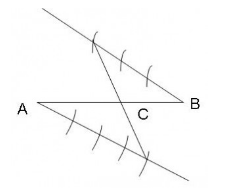
In the given figure, AC: CB is
4:3
3:2
2:3
3:4
54.
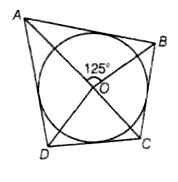
in figure , if ㄥAOB = 125o, then ㄥCOD is equal to
62o
45o
35o
55o
1.
Given that \(\angle SPT\) = 120°
\(\Rightarrow \angle OPS=\frac { { 120 }^{ ° } }{ 2 } =60^{ ° }\)
(as OP bisects \(\angle SPT\))
Also, \(\angle PTO=90^{ ° }\)
(as radius \(\bot\) tangent)
\(\therefore\) In right triangle POS.
\(\cos { \angle OPS } =\frac { PS }{ OP } \)
\(\Rightarrow \frac { 1 }{ 2 } =\frac { PS }{ OP } \)
\(\Rightarrow OP=2PS\)
2.
Given equation \(9x^{ 2 }-6ax+(a^{ 2 }+b^{ 2 })=0\)
\(x=\frac { 6a\pm \sqrt { (-6a)^{ 2 }-4\times 9\times (a^{ 2 }-b^{ 2 }) } }{ 2\times 9\\ } \)
\(\Rightarrow \quad x=\frac { 6a\pm \sqrt { 36a^{ 2 }-36a^{ 2 }-36b^{ 2 }) } }{ 18\\ } \)
\(\Rightarrow x=\frac { 6a+6b }{ 18 } ,x\frac { 6a-6b }{ 18 } \)
\(\Rightarrow x=\frac { 6a+b }{ 18 } ,x\frac { 6a-b }{ 18 } \\ \Rightarrow x=\frac { a+b }{ 3 } ,x=\frac { a-b }{ 3 } \)
3.
3 : 2
4.
Given In two concentric circles with common centre O, two chords of the outer circle which touch the inner circle at M and N.
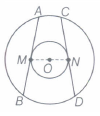
To prove: AB = CD
Construction: Join OM and ON.
Proof Since, OM and ON are radii of the inner circle through the points of contact M and N of the tangents AB and CD.
Also, OM = ON [radii of the inner circle]
AB and CD are two chords of the outer circle which are equidistant from its centre O.
Hence, AB = CD
5.
Let the same common difference of two APs be d. Given that, the first term of first AP and second AP are 2 and 7 respectively, then the APs are
2, 2 + d, 2 + 2d, 2 + 3d,...
and 7, 7 + d, 7+ 2d, 7 + 3d,...
Now, 10th terms of first and second APs are 2 + 9d and 7 + 9d, respectively.
So, their difference
7 + 9d - (2 + 9d) = 5
Also, 21st terms of first and second Aps are 2 + 20d and 7 + 20d, respectively.
So, their difference is
7 + 20d -(2 + 20d) = 5
Also, if the \({a}_{n}\) and \({b}_{n}\) are the nth terms of first ans second AP.
Then,
\({b}_{n}-{a}_{n}=\left[7+\left(n-1\right)d\right]-\left[2+\left(n-1\right)d\right]=5\)
Hence, the difference between any two corresponding terms of such APs is the same as the difference between their first terms.
6.
Let d be the common difference of an AP,
Given, \(a = \frac {1}{2}\) and \({a}_{8}=\frac{17}{6}\)
We know that,
\(a+(n-1)d={ a }_{ 8 }\)
\(\therefore\) \({ a }_{ 8 }=a+\left( 8-1 \right) d=\frac { 17 }{ 6 } \)
\(\Rightarrow\) \(a+7d=\frac { 17 }{ 6 } \)
\(\Rightarrow\) \(\frac { 1 }{ 2 } +7d=\frac { 17 }{ 6 } \) \(\left[ \because a=\frac { 1 }{ 2 } \right] \)
\(\Rightarrow\) \(7d=\frac { 17 }{ 6 } -\frac { 1 }{ 2 } \)
\(\Rightarrow\) \(7d=\frac { 17 }{ 6 } -\frac { 1 }{ 2 } \)
\(\Rightarrow\) \(7d=\frac { 14 }{ 6 } \)
\(\Rightarrow\) \(d=\frac { 1 }{ 3 } \)
Hence, the common difference is 1/3.
7.
4.
8.
Here, KAY is a tangent through one end A of a diameter Of a circle
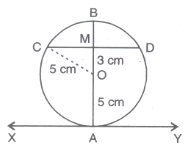
Also, CD || XAY ⇒ AB ⊥ CD
Since OM is perpendicular from centre O to the chord CD.
ஃ OM is perpendicular bisector of chord CD.
i.e., CM = MD = \(1\over2\)CD
Now, AM = 8 cm (given)
⇒ OM = AM - AO = 8 - 5 = 3 cm
In rt, \(\triangle\) OMC, we obtain
CM = \(\sqrt { { OC }^{ 2 }-{ OM }^{ 2 } } \)
= \(\sqrt { { 5 }^{ 2 }-{ 3 }^{ 2 } } \) = \(\sqrt{16}\) = 4 cm
Hence, CD = 2 CM = 2 x 4 = 8 cm.
9.
300
10.
527.04km/h
11.
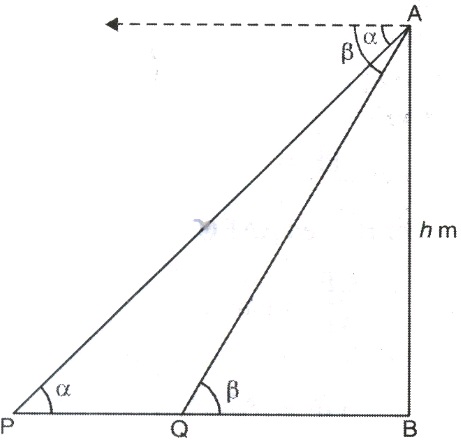
Let AB be the tower of height h m, P and Q be the two points in line with the foot of the tower AB, such that
ㄥAPB=∝ and ㄥAQB=β
Consider rt. ㄥed ΔQBA,
\(\frac { AB }{ QB } \)=tan β
QB=AB.\(\frac { 1 }{ tan\beta } \)
=AB cot β....(i)
Again consider rt ㄥed ΔPBA,
\(\frac { AB }{ PB } \)=tan α
\(\frac { AB }{ PQ+QB } \)=tan α
⇒ PQ+QB=AB.\(\frac { 1 }{ tan\alpha } \)
=AB cot α....(ii)
Subtracting (i) from (ii), we obtain
PQ=AB cot α - AB cot β
PQ=AB (cot α - cot β)
PQ=h(cot α - cot β)
12.
a = 80
13.
\(60^{\circ}\)
14.
Let AB is tower and car is at C on the highway.
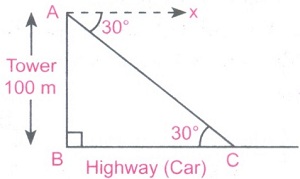
In right \(\Delta\)ABC,
\(\frac { AB }{ BC } =\tan { { 30 }^{ o } } \)
\(\Rightarrow\) \(\frac { 100 }{ BC } =\frac { 1 }{ \sqrt { 3 } } \)
\(\Rightarrow\) \(BC=100\sqrt { 3 }\) m
15.
AB'C' is the required triangle.
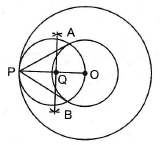
(i) Draw a circle of radius 3 cm with O as its centre
(ii) Draw AB as diameter of thc circle.
(iii) A point P is taken on outer circle and OP is joined.
(iv) Perpendicular bisector of Op is drawn interesting OP at Q.
(v) With Q as centre and OQ as radius a circle is drawn intersecting the smaller circle at A and B
(vi) PA and PB is joined
(vii) PA and PB are the required tangents.
Length of tangent = 4 cm.
16.
Given quadratic equation 9x2-6x-2=0
Here a=9, b=-6, c=-2
D=b2-4ac
D=(-6)2-4X9X(-2)=36+72=108 > 0
Given quadratic has two unequal real roots.
17.
Here, a = 2, d = 7 – 2 = 5 and n = 10.
We have an = a + (n – 1) d
So, a10 = 2 + (10 – 1) × 5 = 2 + 45 = 47
Therefore, the 10th term of the given AP is 47.
18.
Given, equation is (x+2)3=2x(x2-1)
\(\Rightarrow\) x3 + 8 + 3x2(2) + 3x (2)2 = 2x3 - 2x
[\(\because\) (a + b)3 = a3 + b3 + 3a2b + 3ab2]
\(\Rightarrow\) x3 + 8 + 6x2 + 12x = 2x3 - 2x
\(\Rightarrow\) x3 + 8 + 6x2 + 12x - 2x3 + 2x = 0
\(\Rightarrow\) -x3 + 6x2 + 14x + 8 = 0
which is not of the form ax2 + bx + c = 0,
because it has cubic term, i.e. x3.
\(\therefore\) It is not a quadratic equation.
19.
Since, A(-1, y) and B(5, 7) lie on a circle with centre 0(2,-3y), Distance between OA and OB are equal
OA = OB
i.e., \(\sqrt { { \left( -1-2 \right) }^{ 2 }+{ \left( y+3y \right) }^{ 2 } } =\sqrt { { \left( 5-2 \right) }^{ 2 }+{ \left( 7+3y \right) }^{ 2 } } \)
\(\Rightarrow \quad \sqrt { 9+{ \left( 4y \right) }^{ 2 } } =\sqrt { { 3 }^{ 2 }+{ \left( 7+3y \right) }^{ 2 } } \)
Squaring on both sides, we get
9 + 16y2 = 9y2 + 42y + 58
\(\Rightarrow\) y2 - 6y - 7 = 0
\(\Rightarrow\) (y + 1)(y - 7) = 0
\(\therefore\) y = - 1, 7
Radius of circle, when y = - 1
(x - 2)2 + (y - 3)2 = r2
\(\because\) (5, 7) lie on the circle,
\(\therefore\) (5 - 2)2 + (7 - 3)2 = r2
\(\Rightarrow\) 9 + 16 = r2
\(\Rightarrow\) r = 5 cm
20.
By question \(T_{ passenger }=\frac { 192 }{ x } \)
\(\Rightarrow \frac { 192 }{ x } -\frac { 192 }{ x+16 } =2\)
\(\Rightarrow 192(x+16)-192x=2(x^{ 2 }+16x)\)
\(\Rightarrow 192x+192\times 16-192x=2(x^{ 2 }+16x)\)
\(\Rightarrow x^{ 2 }+48x-32x-1536=0\)
\(\Rightarrow x(x+48)-32(x+48)=0\)
\(\Rightarrow x(x-32(x+48)=0\)
\(\Rightarrow (x-32)(x+48)=0\)
x=32 or -48
Since speed can't be negative, therefore - 48 is not possible.
:. Speed of passenger train = 32 km/!h % and Speed of fast train = 48 km/h.
21.
Let AB = h km be the height of the mountain. Let C be a point at a distance of x km from the base of the mountain such that \(\angle\)ACB = 30\(°\) and let D be a point at a distance of 10 km from C along the same line. Then \(\angle\)ADB = 15\(°\) and AD = AC + DC = (x + 10) km
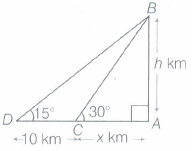
\(In\quad \Delta BAC,\quad tan\quad 30°=\frac { P }{ B } =\frac { AB }{ AC } \)
\(\Rightarrow \frac { 1 }{ \sqrt { 3 } } =\frac { h }{ x } \left[ \because tan 30°=\frac { 1 }{ \sqrt { 3 } } \right] \)
\(\Rightarrow x= h\sqrt { 3 } \) ......(i)
\(In \Delta BAD, tan 15°=\frac { AB }{ AD } \)
\(\Rightarrow 0.27=\frac { h }{ x+10 } \left[ given, tan 15°=0.27 \right] \)
\(\Rightarrow\) 0.27(x + 10) = h ......(ii)
On putting x = \(\sqrt { 3 } h\) from Eq. (i) in Eq. (ii), we get
\(0.27(\sqrt { 3 } h+10)=h\)
\(\Rightarrow 0.27\times \sqrt { 3 } h+0.27\times 10=h\)
\(\Rightarrow h(1-0.27\times \sqrt { 3 } )=0.27\times 10\)
\(\Rightarrow h(1-0.27\times 1.732)=2.7\) \(\left[ \because \sqrt { 3 } =1.732 \right] \)
\(\Rightarrow\) h(1-0.47) = 2.7
\(\Rightarrow 0.53h=2.7\Rightarrow h=\frac { 2.7 }{ 0.53 } =5.09\approx 5km\)
Hence, the height of mountain is 5 km.
22.
Given, diameter of circle = AB = 6 cm and centre is O.
Radius = OA = OB = 6/2 = 3 cm
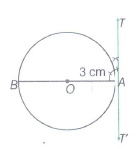
Steps of construction
Step 1: Take a point O as centre and draw a circle of radius 3 cm
Step 2: Draw diameter AOB and take a point A on the circle
Step 3: Take OA as base and construct \(\angle OAT=90°\)at A
Step 4: Produce TA to T' to get the required tangent TAT' .Similarly, we can draw a tangent at point B or any point on the circle.
23.
Yes, the new triangle is also equilateral.
24.
\(\frac { 20 }{ \sqrt { 3 } } \)
25.
Let n be the number of sides of the polygon.
We know that, sum of interior angles of a polygon of n sides
\(= ( 2n -4 ) \times { 90 } ^ { 0 }\) ...(i)
Given, interior angles of polygon are in AP.
So, smallest angle = first term = a = \({ 120 } ^ { 0 }\)
and common difference, \(d = { 5 } ^ {0}\)
Then, sum of interior angles, \({ S }_{ n }=\frac { n }{ 2 } \left[ 2\left( { 120 }^{ 0 } \right) +\left( n-1 \right) { 5 }^{ 0 } \right] \)
\(\left[ \because { S }_{ n }=\frac { n }{ 2 } \left\{ 2a+\left( n-1 \right) d \right\} \right] \)
\(={ \left\{ \frac { n }{ 2 } \left( 240+5n-5 \right) \right\} }^{ 0 }={ \left\{ \frac { n }{ 2 } \left( 5n+235 \right) \right\} }^{ 0 }\) ...(ii)
From Eqs. (i) and (ii), we get
\(={ \left\{ \frac { n }{ 2 } \left( 5n+235 \right) \right\} }^{ 0 }=\left( 2n-4 \right) \times { 90 }\)
\(\Rightarrow\) \(5{ n }^{ 2 }+235b=\left( 2n-4 \right) \times 90\times \)
\(\Rightarrow\) \(5{ n }^{ 2 }+235n=360n-720\)
\(\Rightarrow\) \(5{ n }^{ 2 }+235n=360n-720\)
\(\Rightarrow\) \(5{ n }^{ 2 }-125n+720=0\)
\(\Rightarrow\) \({ n }^{ 2 }-25n+144=0\) [dividing by 5]
\(\Rightarrow\) \({ n }^{ 2 }-9n-16n+144=0\)
\(\Rightarrow\) \(n\left( n-9 \right) -16\left( n-9 \right) =0\)
\(\Rightarrow\) \(\left( n-9 \right) -16\left( n-9 \right) =0\)
\(\Rightarrow\) \(n=9,16\)
In n = 16, then the greatest angle, i.e.
\({ a }_{ 16 }={ 120 }^{ 0 }+\left( 16-1 \right) { 5 }^{ 0 }={ 195 }^{ 0 }\)
which is not possible, since no interior angle of a polygon can be more than \({ 180 }^{ 0 }\)
\(\therefore\) n = 9
Hence, nuumber of sides of the polygon is 9.
26.
40 units
27.
Here, first term (a) of an A.P. is -5 and the last term (an) is 45.
Let d be the common difference and n be the number of terms.
\(\therefore\) a + ( n - 1 )d = an
\(\Rightarrow\) - 5 + ( n - 1 )d = 45
\(\Rightarrow\) ( n - 1 )d = 50 ...(i)
Also, Sn = 120
\(\Rightarrow\) \({n\over2}(a+l)=120\)
\(\Rightarrow\) n ( - 5 + 45 ) = 240
\(\Rightarrow\) n ( 40 ) = 240
\(\Rightarrow\) n = 6
From (i), we have|
( 6 - 1 )d = 50
\(\Rightarrow\) 5d = 50
\(\Rightarrow\) d = 10
Hence, the required number of terms is 6 and the common difference is 10.
28.
Let two successive integral multiples of 5
be x and x + 5.
ATQ x (x + 5) = 300
\(\Rightarrow x^{ 2 }+5x-300=0\)
\(\Rightarrow (x+20)(x-15)=0\)
\(\Rightarrow \) x=-20 or x=15
When x=-20, multiples are -20 and -20+5= -15
When x=15 , multiples are 15 and 15+5 =20
29.
-11 or 4
30.
Let AB=b m be the height of the pole and AC=15 m be the length of the rope which is tied from top of the pole.
In \(\Delta ABCsin { { 45 }^{ ° } } =\frac { AB }{ AC } \)
\(\Rightarrow \frac { 1 }{ \sqrt { 2 } } =\frac { b }{ 15 } \)
\(\Rightarrow b=\frac { 15 }{ \sqrt { 2 } } \)
\(\Rightarrow b=\frac { 15 }{ \sqrt { 2 } } \times \frac { \sqrt { 2 } }{ \sqrt { 2 } } \)
\(\Rightarrow b=\frac { 15\times 1.414 }{ 2 } [\because \sqrt { 2 } =1.414]\)
\( \Rightarrow b=10.6m\)
Hence, the height of the pole is 10.6 m.
(ii) Applications of trigonometry.
(iii) Fun and entertainment.
31.
As tangent radius are perpendicular to each other
∴ \(\angle \)OPT = 90°
Now, using Pythagoras theorem,
PT2 = OT2 - OP2
⇒ PT2 = (13)2 - (5)2
PT2 = 169 - 25 = 144
⇒ PT = 12 cm
In \(\triangle\)TAE and \(\triangle\)TBE
\(\angle \)1 = \(\angle \)2
TE = TE [common]
\(\angle \)TEA = \(\angle \)TEB
[each = 90° i.e., radius is ⊥ to tangent]
\(\triangle\)TAE = \(\triangle\)TBE [by ASA congruence axiom]
ஃ AE = EB and TB = TA [c.p.c.t.]
In \(\triangle\)AET
AE2 = AT2 - ET2
AE2 = AT2 - (8)2
⇒ x2 = (12-x)2 - 64
[ where, AE = x and AE = AP = x]
⇒ x2 = 144 + x2 - 24x - 64
⇒ 24 x = 144 - 64
⇒ x = \({80\over24}={10\over3}\)
32.
94.64m
33.
\(x = 1 , x = - {(a - b)^{2} \over (a + b)^{2}}\)
34.
Given: In the given figure AB be a diameter. At is a tangent segment.
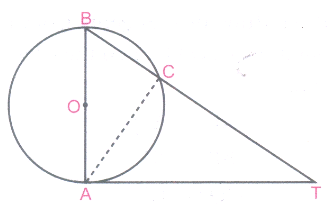
∴ ABT be a right-angled triangle.
Since AB = 5 cm, AT = 12 cm
∴ BT = \(\sqrt { { 5 }^{ 2 }+{ 12 }^{ 2 } } =13\quad cm\)
Construction: Join AC.
Since AB be a diameter. ∴ ACB = 90°
Here the right angled \(\triangle\)'s ABT and ACT are similar.
ஃ \(\frac { BT }{ AT } =\frac { AT }{ CT } \Rightarrow CT=\frac { { (AT) }^{ 2 } }{ BT } \)
= \(\frac { 12\times 12 }{ 13 } =\frac { 144 }{ 13 } cm\)
35.
Ist instalment = Rs 1000
IInd instalment = Rs 1000 + Rs 100 = IIIrd instalment = Rs 1100 + Rs 100 = Rs 1200 and so on
Let number of instalments = n
\(\therefore\) 1000 + 1100 + 1200 + .... up to n terms = 118000
\(\Rightarrow\) \({n\over2}[2\times1000+(n-1)100]=118000\)
\(\Rightarrow\) n( 100n + 1900 ) = 236000
\(\Rightarrow\) 100n2 + 1900n - 2360 = 0
\(\Rightarrow\) n2 + 19n - 2360 = 0
\(\Rightarrow\) ( n + 59 ) ( n - 40 ) = 0.
\(\Rightarrow\) n = - 59 ( rejected ) or n = 40
\(\therefore\) Total no. of instalment = 40th instalment
\(\therefore\) a40 = a + 39d
= 1000 + 39 x 100
= Rs 4900
Loan repaid i 30 instalments = \({30\over2}[2\times1000+(30-1)\times100]\)
\(={30\over2}(2000+2900)\)
= 15 x 4900 = Rs 73500
\(\therefore\) Amount to be repaid after 30th instalment = 118000 - 73500 = Rs 44500
36.
()
tangent line.
37.
()
\(\sqrt{st}\)
38.
()
Real and distinct
[ \(\because\) discriminant = \(b^{2} - 4ac\)
= \((-10)^{2} - 4 \times 1 \times 2\)
= 100 - 8
= 92 > 0 ]
39.
()
n (n + 2) [\(\because\) We know that, Sn = \(\frac{n}{2}\)(a + an)
[\(\because\) an = 2n + 1, and a = a1 = 2.1 + 1 = 3]
Sn = \(\frac{n}{2}\)(3 + 2n + 1)
Sn = \(\frac{n}{2}\)(2n + 4) = n(n + 2) ]
40.
(a)
41.
(a)
42.
(a)
43.
(a)
44.
(a)
45.
()
5 cm
46.
()
2b = a + c
47.
()
80
48.
()
Minimum number of points marked will be = 2 + 5 = 7
49.
()
Minimum number of points mark on ray AX = p + q.
50.
Given A\(\Delta ABC\) , in which BC=5cm, \(\angle CAB=120°\) and \(\angle ABC=30°\) .
Then, \(\angle BCA=180°-30°-120°=30°\)
51.
(c)
6
52.
(a)
30 m
53.
(a)
4:3
54.
Since, the opposite sides of a quadrilateral circumscribing a circle subtend supplementary angles at the centre of the circle.
i.e ㄥAOB + ㄥCOD = 180o
⇒ ㄥCOD =180o - ㄥAOB
⇒ ㄥCOD = = 180o - 125o = 55o

10th Standard CBSE Syllabus & Materials
10th Standard CBSE
CBSE 10th Social Science PS - Federalism - New Model Questions Papers Study Material - QB365 Set A
NEW10th Standard CBSE
CBSE 10th Social Science PS - Power Sharing - New Model Questions Papers Study Material - QB365 Set A
NEW10th Standard CBSE
CBSE 10th Social Science GEO - Manufacturing Industries - New Model Questions Papers Study Material - QB365 Set A
NEW10th Standard CBSE
CBSE 10th Social Science GEO - Minerals and Energy Resources - New Model Questions Papers Study Material - QB365 Set A



CBSE 10th Standard CBSE Subjects
CBSE Standards





