
 100% FREE ACCESS
10th Standard CBSE Syllabus & Materials
10th Standard CBSE
CBSE 10th Social Science ECO - Globalisation and the Indian Economy - New Model Questions Papers Study Material - QB365 Set A
NEW10th Standard CBSE
CBSE 10th Social Science ECO - Money and Credit - New Model Questions Papers Study Material - QB365 Set A
NEW10th Standard CBSE
CBSE 10th Social Science ECO - Sectors of the Indian Economy - New Model Questions Papers Study Material - QB365 Set A
NEW10th Standard CBSE
CBSE 10th Social Science ECO - Development - New Model Questions Papers Study Material - QB365 Set A
NEW10th Standard CBSE
CBSE 10th Social Science PS - Outcomes of Democracy - New Model Questions Papers Study Material - QB365 Set A
NEW10th Standard CBSE
CBSE 10th Social Science PS - Gender, Religion and Caste - New Model Questions Papers Study Material - QB365 Set A

Published on: 30/08/2019
Quadratic Equations
Download CBSE Class 10th Standard CBSE Maths question papers, sample papers, important questions, and previous year solved papers in PDF format. Get free study materials, NCERT solutions, and exam preparation resources for Class 10th Standard CBSE Maths
Questions + Answers key
Take MCQ Maths Test
1.
If 1 is a root of the equations \(ay^{2}+ ay + 3 = 0\) and \(y^{2}+y + b = 0\) , then find ab.
2.
If p and q are the roots of quadratic equation \(x^{2} - px + q = 0\) , then find the values of p and q.
3.
If \(\sqrt {x+ \sqrt {x +\sqrt {x +.... \infty }}} = 6\) . then find the value of x.
4.
Check whether the following are quadratic equations: (x+2)3=2x(x2-1)
5.
Check whether the following are quadratic equations: (2x – 1)(x – 3) = (x + 5)(x – 1)
6.
Find three consecutive positive integers whose product is equal to sixteen times their sum.
7.
A takes 6 days less than the time taken by B to finish a piece of work. If both A and B together can finish it in 4 days, find the time taken by B to finish the work.
8.
Three consecutive positive integers are such that the sum of the square of the first and the product of the other two is 46, find the integers.
9.
A two digit number is such that the product of its digits is 15. If 18 is added to the number, the digits interchange their places. Find the number.
10.
Solve for x: \(x^2+5x-(a^2+a-6)=0\)
11.
For the quadratic equation \(x^{2} + 4x + b = 0\) , the discriminant D = ................... .
12.
Any equation of the form p(x) = 0, where p(x) is a polynomial of degree one, is a quadratic equation.
13.
A quadratic equation in the variable x is of the form \(ax^{2} + bx + c =0, a \neq 0\), where a, b and c are real numbers.
14.
If the discriminant of a quadratic equation is zero, then the equation has no real roots.
1.
Since 1 is a root of equation ay2+ay+3=0,
\(\therefore\) a(1)2+a(1)+3=0
\(\Rightarrow\) 2a+3=0 \(\Rightarrow\) a=\(\frac {-3}{2}\)
Also, 1 is a root y2+y+b=0
\(\therefore\) (1)2+(1)+b=0
\(\Rightarrow\) 2+b=0 \(\Rightarrow\) b=-2
Now, ab=\(\left( \frac { -3 }{ 2 } \right) \)(-2)=3
Hence, the value of ab is 3.
2.
Since p and q are the roots of x2-px+q=0
\(\therefore \) Sum of roots=p+q=p is q=0
Also, product of roots=pq=q
\(\Rightarrow\) pq-q=0
\(\Rightarrow\) q(p-1)=0
\(\Rightarrow\) q=0 or p=1
Hence, the value of p and q are 1 and 0 respectively.
3.
Here, \(\sqrt { x+\sqrt { x+\sqrt { x+....\infty } } } =6\)
\(\Rightarrow \quad \sqrt { x+6 } =6\)
Squaring both sides, we have
x+6=36
\(\Rightarrow\) x=36-6=30
Hence, the value of x is 30.
4.
Given, equation is (x+2)3=2x(x2-1)
\(\Rightarrow\) x3 + 8 + 3x2(2) + 3x (2)2 = 2x3 - 2x
[\(\because\) (a + b)3 = a3 + b3 + 3a2b + 3ab2]
\(\Rightarrow\) x3 + 8 + 6x2 + 12x = 2x3 - 2x
\(\Rightarrow\) x3 + 8 + 6x2 + 12x - 2x3 + 2x = 0
\(\Rightarrow\) -x3 + 6x2 + 14x + 8 = 0
which is not of the form ax2 + bx + c = 0,
because it has cubic term, i.e. x3.
\(\therefore\) It is not a quadratic equation.
5.
(2x-1)(x-3)=(x+5)(x-1)
2x2-6x-x+3=x2-x+5x-5
2x2-6x-x+3-x2+x-5x+5=0
x2-11x+8=0
Which is of the form ax2+bx+c=0. Hence the given equation is a quadratic equation.
6.
Let Integers be x,x+1 and x+2
ATQ x(x+1) (x+2) =16(x+x+1+x+2)
\(\Rightarrow (x^{ 2 }+x)(x+2)=16(3x+3)\)
\(\Rightarrow x^{ 3 }+2x^{ 2 }+x^{ 2 }+2x=48+48 \)
\(\Rightarrow x^{ 3 }+3x^{ 2 }-46x-48=0\)
LHS when x=-1, we have
(x+1) is a factor
For others factor
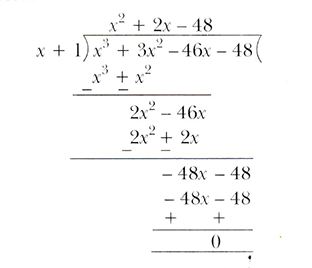
\(\therefore x^{ 3 }+3x^{ 2 }-46x-48=0\)
\(\Rightarrow (x+1)(x^{ 2 }+2x-48=0)\)
\(\Rightarrow (x+1)(x+8)(x-6)=0\)
\(\Rightarrow x=-1,x=-8,x=6\)
Rejecting -ve values x = 6 \(\therefore \) positive integers are 6,
7.
Let number of days taken by B to finish a work = x
Number of days taken by A to finish a work = (x — 6)
Number of days taken by A and B together = 4
Now
As one day work + B's one day work = one day's work of A and B together
\(\Rightarrow \frac { 1 }{ x-6 } +\frac { 1 }{ x } =\frac { 1 }{ 4 } \Rightarrow \frac { x+x-6 }{ (x-6)x } =\frac { 1 }{ 4 } \)
\(\Rightarrow 8x-24=x^{ 2 }-6x\Rightarrow x^{ 2 }-14x+24=0\)
\(\Rightarrow (x-12)(x-2)=0\Rightarrow x=12,x=2\) (not possible)
Number of days taken by B to finish the work = 12
8.
Let consecutive positive integers be n, + I and n + 2
According to the question,
n2+(n+1)(n+2) =46 \(\Rightarrow \) 2n2+3n-44=0
\(\Rightarrow 2n^{ 2 }+11n-8n-44=0\Rightarrow n(2n-11)-4(2n+11)=0\)
\(\Rightarrow (n-4)(2n+11)=0\Rightarrow n-4=0\) or 2n+11=0
\(\Rightarrow n=4\) or \(n=\frac { 11 }{ 2 } \)
Integers are 4,5,6
9.
Let digit at ten's place be x
and digit at unit's place be y
Also xy=15 \(\Rightarrow x=\frac { 15 }{ y } \) ....(i)
ATQ
10x+y+18=10y+x
\(\Rightarrow \) 9x-9y+18=0
\(\Rightarrow \) x-y+2=0
\(\Rightarrow \frac { 15 }{ y } -y+2=0\) [From (i)]
\(\Rightarrow \) 15-y2+2y=0
\(\Rightarrow \) y2-2y-15=0
\(\Rightarrow \) (y-5) (y+3) =0
\(\Rightarrow \) y=5, y=3 [y=-3 rejected]
On putting the value of y= 5 in equation
(i). we get
\(x=\frac { 15 }{ 5 } =3\)
\(\therefore \) Number = 3X10+5 = 35
10.
x2+5x-(a2+a-6)=0
D=(5)2-4x1x[-(a2+a-6)]
=25+4a2+4a-24
=4a2+4a+1=(2a+1)2
\(\therefore x=\frac { -b\pm \sqrt { D } }{ 2a } =\frac { -5\pm \sqrt { (2a+1) } ^{ 2 } }{ 2\times 1 } \)
\(=\frac { -5\pm (2a+1) }{ 2 } =\frac { -4+2a }{ 2 } ,\frac { -6-2a }{ 2 } \)
=-2+a,-3-a
11.
()
16 - 4b
[ \(\because\)discriminant = \(b^{2} - 4ac\)
= \(4^{2} - 4 \times 1 \times b\)
= 16 - 4b ]
12.
(b)
13.
(a)
14.
(b)

10th Standard CBSE Syllabus & Materials
10th Standard CBSE
CBSE 10th Social Science PS - Federalism - New Model Questions Papers Study Material - QB365 Set A
NEW10th Standard CBSE
CBSE 10th Social Science PS - Power Sharing - New Model Questions Papers Study Material - QB365 Set A
NEW10th Standard CBSE
CBSE 10th Social Science GEO - Manufacturing Industries - New Model Questions Papers Study Material - QB365 Set A
NEW10th Standard CBSE
CBSE 10th Social Science GEO - Minerals and Energy Resources - New Model Questions Papers Study Material - QB365 Set A



CBSE 10th Standard CBSE Subjects
CBSE Standards





