
 100% FREE ACCESS
10th Standard CBSE Syllabus & Materials
10th Standard CBSE
CBSE 10th Social Science ECO - Globalisation and the Indian Economy - New Model Questions Papers Study Material - QB365 Set A
NEW10th Standard CBSE
CBSE 10th Social Science ECO - Money and Credit - New Model Questions Papers Study Material - QB365 Set A
NEW10th Standard CBSE
CBSE 10th Social Science ECO - Sectors of the Indian Economy - New Model Questions Papers Study Material - QB365 Set A
NEW10th Standard CBSE
CBSE 10th Social Science ECO - Development - New Model Questions Papers Study Material - QB365 Set A
NEW10th Standard CBSE
CBSE 10th Social Science PS - Outcomes of Democracy - New Model Questions Papers Study Material - QB365 Set A
NEW10th Standard CBSE
CBSE 10th Social Science PS - Gender, Religion and Caste - New Model Questions Papers Study Material - QB365 Set A

Published on: 30/09/2019
Quadratic Equations
Download CBSE Class 10th Standard CBSE Maths question papers, sample papers, important questions, and previous year solved papers in PDF format. Get free study materials, NCERT solutions, and exam preparation resources for Class 10th Standard CBSE Maths
Questions + Answers key
Take MCQ Maths Test
1.
If two pipes function simultaneously, the reservoir will be filled in 12 hours. One pipe fills the reservoir 10 hours faster than the other. How many hours does the second pipe take to fill the reservior?
2.
Two squares have sides x cm and (x + 4) cm. The sum of their areas is 656 sq.cm.Express this as algebraic equation in x and slove the equation to find the sides of the square.
3.
The hypotenuse of a right triangle is \(3\sqrt {5} \ \ cm\). If the smaller side is tripled and the larger side is doubled, the new hypotenuse will be 15 cm, find the length of each side.
4.
The sides of right-angled triangle containing the right angle are 3(x + 1)cm and (2x - 1)cm. If the area of the triangle be \(30 \ cm^{2}\) , find the sides of the triangle.
5.
Solve for x: \(2({x+2\over2x-3})-9({2x-3\over x+2})=3\); given that \(x\ne -2, x\ne{3\over2}\)
6.
Solve for x : \(({{4x-3}\over2x+1})-10({2x+1\over4x-3})=3; x\ne{-1\over2};x\ne{3\over4}\)
7.
Solve for x \({x-2\over x-3}+{x-4\over x-5}={10\over 3}, x\ne3,5\)
8.
Find three consecutive positive integers whose product is equal to sixteen times their sum.
1.
30 hours
2.
\(x^{2}+4x - 320 = 0, \ 20 \ cm ; 16 \ cm\)
3.
3 cm, 6 cm
4.
5 cm, 12 cm, 13 cm
5.
Let \(\frac { x+2 }{ 2x-3 } =y\) ...(i)
\(\therefore \) Given equation becomes
2y-9 \(\times \frac { 1 }{ y } =3\)
\(\Rightarrow 2y^{ 2 }-3y-9=0\)
\(\Rightarrow 2y^{ 2 }-6y+3y-9=0\)
\(\Rightarrow 2y(y-3)+3(y-3)=0\)
\(\Rightarrow (2y+3)(y-3)=0\)
\(\Rightarrow y=-\frac { 3 }{ 2 } \) or y=3
Putting the value of y in equation (i), we get
\(\Rightarrow \frac { x+2 }{ 2x-3 } =-\frac { 3 }{ 2 } \) or \(\frac { x+2 }{ 2x-3 } \)=3
\(\Rightarrow 2x+4=-6x+9\)
or x+2 =6x-9
\(\Rightarrow 8x=5\) or -5x =-11
\(\Rightarrow x=\frac { 5 }{ 8 } \) or \(x=\frac { 11 }{ 5 } \)
6.
Let \(\frac { 4x-3 }{ 2x+1 } =y\)
\(\therefore
\) Given equations becomes
\(\quad y-10\times \frac { 1 }{ y } =3\\ \Rightarrow \quad { y }^{ 2 }-3y-10=0\\ \Rightarrow \quad (y-5)(y+2)=0\\ \Rightarrow \quad y=5\quad or\quad y=-2\\ \Rightarrow \quad \frac { 4x-3 }{ 2x+1 } =5\quad or\quad \frac { 4x-3 }{ 2x+1 } =-2\\ \Rightarrow \quad 4x-3=10x+5\quad or\quad 4x-3\quad =-4x-2\\ \Rightarrow \quad -6x=8\quad or\quad 8x=1\\ \Rightarrow \quad x=\frac { -4 }{ 3 } ,\frac { 1 }{ 8 } \)
7.
Consider the equation \(\Rightarrow \frac { x-2 }{ x-3 } +\frac { x-4 }{ x-5 } =\frac { 10 }{ 3 } \)
\(\Rightarrow 1+\frac { 1 }{ x-3 } +1+\frac { 1 }{ x-5 } =\frac { 10 }{ 3 } \)
\(\Rightarrow \frac { 1 }{ x-3 } +\frac { 1 }{ x-5 } =\frac { 10 }{ 3 } \)
\(\Rightarrow \frac { x-5+x-3 }{ (x-3)(x-5) } =\frac { 4 }{ 3 } \)
\(\Rightarrow \frac { 2x-8 }{ x^{ 2 }-8x+15 } =\frac { 4 }{ 3 } \)
\(\Rightarrow 4x^{ 2 }-32x+60=6x-24\)
\(\Rightarrow 4x^{ 2 }-38x+84=0\)
\(\Rightarrow 2x^{ 2 }-19x+42=0\)
\(\Rightarrow 2x^{ 2 }-12x-7x+42=0\)
\(\Rightarrow 2x^{ 2 }-12x-7x+42=0\)
\(\Rightarrow 2x(x-6)-7(x-6)=0\)
\(\Rightarrow (2x-7)(x-6)=0\)
\(\Rightarrow \) Either 2x-7 =0 x-6=0
\(\Rightarrow x=\frac { 7 }{ 2 } ,6\)
8.
Let Integers be x,x+1 and x+2
ATQ x(x+1) (x+2) =16(x+x+1+x+2)
\(\Rightarrow (x^{ 2 }+x)(x+2)=16(3x+3)\)
\(\Rightarrow x^{ 3 }+2x^{ 2 }+x^{ 2 }+2x=48+48 \)
\(\Rightarrow x^{ 3 }+3x^{ 2 }-46x-48=0\)
LHS when x=-1, we have
(x+1) is a factor
For others factor
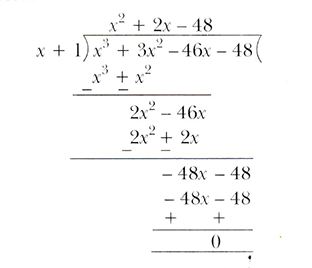
\(\therefore x^{ 3 }+3x^{ 2 }-46x-48=0\)
\(\Rightarrow (x+1)(x^{ 2 }+2x-48=0)\)
\(\Rightarrow (x+1)(x+8)(x-6)=0\)
\(\Rightarrow x=-1,x=-8,x=6\)
Rejecting -ve values x = 6 \(\therefore \) positive integers are 6,

10th Standard CBSE Syllabus & Materials
10th Standard CBSE
CBSE 10th Social Science PS - Federalism - New Model Questions Papers Study Material - QB365 Set A
NEW10th Standard CBSE
CBSE 10th Social Science PS - Power Sharing - New Model Questions Papers Study Material - QB365 Set A
NEW10th Standard CBSE
CBSE 10th Social Science GEO - Manufacturing Industries - New Model Questions Papers Study Material - QB365 Set A
NEW10th Standard CBSE
CBSE 10th Social Science GEO - Minerals and Energy Resources - New Model Questions Papers Study Material - QB365 Set A



CBSE 10th Standard CBSE Subjects
CBSE Standards





