
 100% FREE ACCESS
10th Standard CBSE Syllabus & Materials
10th Standard CBSE
CBSE 10th Social Science ECO - Globalisation and the Indian Economy - New Model Questions Papers Study Material - QB365 Set A
NEW10th Standard CBSE
CBSE 10th Social Science ECO - Money and Credit - New Model Questions Papers Study Material - QB365 Set A
NEW10th Standard CBSE
CBSE 10th Social Science ECO - Sectors of the Indian Economy - New Model Questions Papers Study Material - QB365 Set A
NEW10th Standard CBSE
CBSE 10th Social Science ECO - Development - New Model Questions Papers Study Material - QB365 Set A
NEW10th Standard CBSE
CBSE 10th Social Science PS - Outcomes of Democracy - New Model Questions Papers Study Material - QB365 Set A
NEW10th Standard CBSE
CBSE 10th Social Science PS - Gender, Religion and Caste - New Model Questions Papers Study Material - QB365 Set A

Published on: 08/10/2019
Real Number
Download CBSE Class 10th Standard CBSE Maths question papers, sample papers, important questions, and previous year solved papers in PDF format. Get free study materials, NCERT solutions, and exam preparation resources for Class 10th Standard CBSE Maths
Questions + Answers key
Take MCQ Maths Test
1.
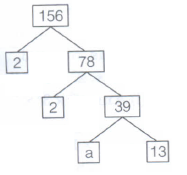
See the following factor tree for factorisation of 156. Find the value of a.
2.
In the next Republic Day parade, the commander of an army contingent consisting of 624 members wants to march his contingent behind an army band of 32 members such that the two groups march in the same number of columns.
(i) What is the maximum number of columns in which the two groups can march?
(ii) What value is depicted from this action?
3.
Prove that \(\sqrt { 5 } \) is irrational number.
4.
The decimal expansion of the rational number \(\frac { 43 }{ { 2 }^{ 4 }\times { 5 }^{ 3 } } \) will terminate after how many places of decimal?
5.
Without actually performing the long division, state whether \(\frac{543}{225}\) has a terminating decimal expansion or non-terminating recurring decimal expansion.
6.
If the HCF of 150 and 100 is 50, find the LCM of 150 and 100.
7.
If the LCM of 26 and 91 is 182. find their HCF.
8.
Use Euclid's division algorithm to the HCF of the following three numbers.
(i) 441, 567 and 693
(ii) 1620, 1725 and 255
9.
Show that the square of an odd positive integer is of the form 8m + 1, where m is some whole number.
10.
Prove that \(3+2\sqrt { 5 } \) is irrational.
1.
a x 13 = 39
= 3
2.
(i) 16 (ii) Unity and Discipline.
3.
Suppose, \(\sqrt { 5 } \) is a rational number. Then, \(\sqrt { 5 } \) can be expressed in the form \(\frac{a}{b}\), where a and b are coprime integers and \(b\neq 0\).
\(\therefore \sqrt { 5 } =\frac { a }{ b } \)
On squaring both sides, we get
\(5=\frac { { a }^{ 2 } }{ { b }^{ 2 } } \quad \Rightarrow { a }^{ 2 }=5{ b }^{ 2 }\) ....(i)
\(\Rightarrow \) 5 divides a2.
\(\Rightarrow \) 5 divides a. [by theorem 1] ...(ii)
So, we can take a = 5m
\(\Rightarrow \) a2 = 25m2 [squaring both sides]
On putting the value of a2 in Eq. (i), we get
\(\Rightarrow \) 5 divides b2
\(\Rightarrow \) 5 divides b. [by theorem 1] ... (iii)
Thus, from Eq.(ii), 5 divides a and from Eq. (iii), 5 divides b. It means 5 is a common factor of a and b. This contradicts that there is no common factor of a and b.
This contradiction arises by assuming that \(\sqrt { 5 } \) is rational.
Hence, \(\sqrt { 5 } \) is irrational number.
4.
Decimal expansion of \(\frac { 43 }{ { 2 }^{ 4 }\times { 5 }^{ 3 } } =\frac { 43\times 5 }{ { 2 }^{ 4 }\times { 5 }^{ 3 }\times 5 } =0.0215\) 4 places of decimal
5.
If the factors of denominator of the given rational number is the form 2n 5m , where n and m are non-negative integers, then the decimal expansion of the rational number is terminating otherwise non-terminating recurring.
Ans . Non-terminating recurring decimal expansion.
6.
Given, HCF (150, 100) = 50
\(\therefore \ LCM(150,100)=\frac { 150\times 100 }{ HCF(150,100) } =\frac { 150\times 100 }{ 50 } =300\)
7.
Given, LCM (26, 91) = 182
\(\therefore \quad HCF(26,91)=\frac { 26\times 91 }{ LCM(26,91) } =\frac { 26\times 91 }{ 182 } =13\)
8.
First, use Euclid's division algorithm for two larger numbers any of three and get the HCF of these two. After that take the third number and resulting HCF of two numbers and apply again Euclid's division algorithm and get the required HCF.
(i) 63 (ii) 15
9.
Let a be any positive integer.
We know that, any odd positive integer is of the form 2q + 1, where q is a whole number.
\(\therefore \) a = 2q + 1
\(\Rightarrow \) a2 = (2q + 1)2 [squaring both sides]
\(\Rightarrow \) a2 = 4q(q + 1) + 1 ...(i)
Note that q(q + 1) is either '0' or even, for any whole number q.
So, let q(q + 1) = 2m where m is a whole number.
From Eq.(i), we get a2 = 4(2m) + 1 = 8m + 1
10.
Let us assume to the contrary that \(3+2\sqrt { 5 } \) is a rational number. Then, it can be expressed in the form \(\frac{a}{b}\), where a, b are coprime integers and \(b\neq 0\)
Now, \(3+2\sqrt { 5 } \) = a/b, where a,b are integers and \(b\neq 0\)
On rearranging, we get
\(2\sqrt { 5 } =\frac { a }{ b } -3\quad or\quad \sqrt { 5 } =\frac { a }{ 2b } -\frac { 3 }{ 2 } \)
Since, a, b are integers and \(b\neq 0\) , therefore \(\frac{a}{2b}\) is rational number and so \(\frac{a}{2b}\) - \(\frac{3}{2}\) is a rational number.
[since, difference of two rational numbers is also a rational number]
\(\Rightarrow \sqrt { 5 } \) is a rational number. But \(\sqrt { 5 } \) is an irrational number.
This shows that our assumption is incorrect.
So, \(3+2\sqrt { 5 } \) is irrational.

10th Standard CBSE Syllabus & Materials
10th Standard CBSE
CBSE 10th Social Science PS - Federalism - New Model Questions Papers Study Material - QB365 Set A
NEW10th Standard CBSE
CBSE 10th Social Science PS - Power Sharing - New Model Questions Papers Study Material - QB365 Set A
NEW10th Standard CBSE
CBSE 10th Social Science GEO - Manufacturing Industries - New Model Questions Papers Study Material - QB365 Set A
NEW10th Standard CBSE
CBSE 10th Social Science GEO - Minerals and Energy Resources - New Model Questions Papers Study Material - QB365 Set A



CBSE 10th Standard CBSE Subjects
CBSE Standards





