
 100% FREE ACCESS
10th Standard CBSE Syllabus & Materials
10th Standard CBSE
CBSE 10th Social Science ECO - Globalisation and the Indian Economy - New Model Questions Papers Study Material - QB365 Set A
NEW10th Standard CBSE
CBSE 10th Social Science ECO - Money and Credit - New Model Questions Papers Study Material - QB365 Set A
NEW10th Standard CBSE
CBSE 10th Social Science ECO - Sectors of the Indian Economy - New Model Questions Papers Study Material - QB365 Set A
NEW10th Standard CBSE
CBSE 10th Social Science ECO - Development - New Model Questions Papers Study Material - QB365 Set A
NEW10th Standard CBSE
CBSE 10th Social Science PS - Outcomes of Democracy - New Model Questions Papers Study Material - QB365 Set A
NEW10th Standard CBSE
CBSE 10th Social Science PS - Gender, Religion and Caste - New Model Questions Papers Study Material - QB365 Set A

Published on: 03/10/2019
Some Applications of Trigonometry
Download CBSE Class 10th Standard CBSE Maths question papers, sample papers, important questions, and previous year solved papers in PDF format. Get free study materials, NCERT solutions, and exam preparation resources for Class 10th Standard CBSE Maths
Questions + Answers key
Take MCQ Maths Test
1.
From an aeroplane vertically above a straight horizontal road, the angles of depression of two consecutive kilometre stone on opposite sides of the aeroplane are observed to be 600 and 300 show that height (in metres) of aeroplane above the road is \(\sqrt{3}\over4\)km.
2.
The length of the shadow of a tower standing on level ground is found to 2x meter longer when the sun,s altitude is 30o than when it was 45o. Prove that the height of tower is (\(\sqrt{3}+1\) )x metres .
3.
If the shadow of a tower 30m long, when the sun's elevation is 300.What is the length of the shadow, when sun's elevation is 600 ?
4.
From top of a 7m high building, the angle of elevation of the top of a cable tower is 600 and the angle of depression of its foot is 45o. Determine the height of the tower.
5.
From the top of a tower, the angles of depression of two objects on the same side of the tower are found to be \(\alpha\) and \(\beta\) (\(\alpha\) > \(\beta\)). If the distance between the objects is 'p' metres, show that the height 'h' of the tower is given by \(h=\frac { p\quad tan\alpha \quad tan\beta }{ tan\alpha -tan\beta } \) . Also determine the height of the tower, if p = 50 m,\(\alpha\) = 60o,\(\beta\)=30o.
6.
From an aeroplane vertically above a straight horizontal plane, the angles of depression of two consecutive kilometre stones on the opposite sided of the aeroplane are found to be \(\alpha\) and \(\beta\), show that the height of the aeroplane is \(\frac { tan\alpha tan\beta }{ tan\alpha +tan\beta } \).
7.
Two stations due south of a leaning tower which leans towards north are at distances a and b from its foot. If \(\alpha\) and \(\beta\) be the elevation of the top of the tower from these stations, prove that its inclination \(\theta\) to the horizontal is given by \(cot\theta =\frac { b\quad cot\alpha -a\quad cot\beta }{ b-a } \).
8.
A path separates two walls. A ladder leaning against one wall rests at a point on the path. It reaches a height of 90 m on the wall and makes an angle of 60o with the ground. If while resting at the same point on the path, it were made to lean against the other wall, it would have made an angle of 45o with the ground. Find the height it would have reached on the second wall.
9.
At the foot of a mountain, the elevation of its summit is 45o . After ascending 1000 m towards the mountain up a slope of 30o inclination, the elevation is found to be 60o . Find the height of the mountain.
10.
A bird is sitting on the top of a tree, which is 80 m high. The angle of elevation of the bird, from a point on the ground is 45o . The bird flies away from the point of observation horizontally and remains at a constant height. After 2 seconds, the angle of elevation of the bird from the point of observation becomes 30o . Find the speed of flying of the bird.
1.
Let AD = h km be the height of aeroplane above the road and B, C are positions of two stones on the road. so ∠ABD = 60o, ∠ACB = 30o, BC = 1 km
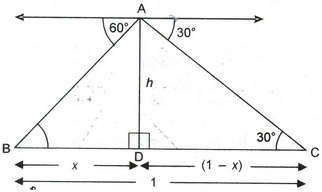
Let BD = x km, then CD = (1 —x) km
Consider a rt. ΔABD, we have
\(\frac { AD }{ BD } ={ tan\quad 60 }^{ o }\)
\(\Rightarrow \frac { h }{ x } =\sqrt { 3 } \)
\(\Rightarrow h=\sqrt { 3 } x\) ...(i)
Now, consider a rt. ΔACD, we have
\(\frac { AD }{ CD } ={ tan\quad 30 }^{ o }\)
\(\Rightarrow \frac { h }{ 1-x } =\frac { 1 }{ \sqrt { 3 } } \)
\(\Rightarrow \sqrt { 3 } h=1-x\)
\(\Rightarrow \sqrt { 3 } \times \sqrt { 3 } x=1-x\) [using (i)]
⇒ 3x=1-x
⇒ 4x=1
\(\Rightarrow x=\frac { 1 }{ 4 } km\)
Putting the value of x in (i), we have
\(h=\sqrt { 3 } \times \frac { 1 }{ 4 } =\frac { \sqrt { 3 } }{ 4 } km\)
∴ Height of aeroplane =\(\frac { \sqrt { 3 } }{ 4 } km\)
2.
Let AB = h m be height of tower and CB and DB are its shadow when sun's altitudes are 30o and 45o respectively. As ㄥACB= 30o and ㄥABC = 45o
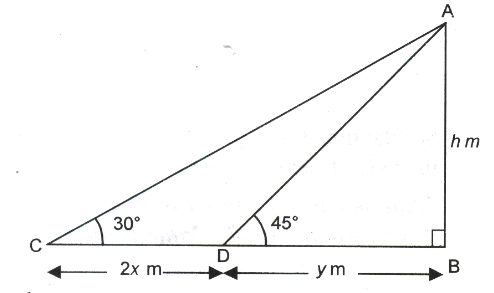
CD=2x m and BD=y m
consider rt.ΔABD, we have
\(\frac{AB}{BD}\)=tan 45o
\(\Rightarrow\)\(\frac {h}{y}\)=1
\(\Rightarrow\)h=y ....(i)
consider rt.ΔABC, we have
\(\frac{AB}{BC}\)=tan 30o
\(\frac { h }{ 2x+y } =\frac { 1 }{ \sqrt { 3 } } \)
\(\sqrt { 3 } h=2x+h\because From\ (i)\quad h=y]\)
\(h(\sqrt { 3 } -1)=2x\)
\(h=\frac { 2x }{ \sqrt { 3 } -1 } \times \frac { \sqrt { 3 } +1 }{ \sqrt { 3 } +1 } \)
\(h=\frac { 2x(\sqrt { 3 } +1) }{ 2 } =x(\sqrt { 3 } +1)\)
\(\therefore\) Height of the tower=\((\sqrt { 3 } +1)xm\)
3.
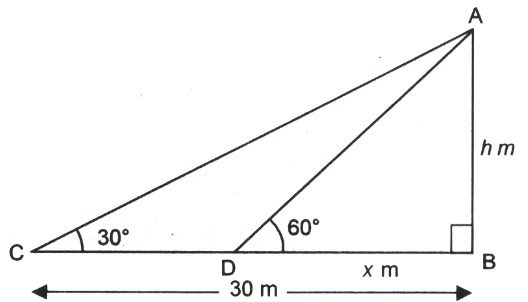
Let AB=h m be height of tower and BC=30 m be length of its shadow when sun's elevation is 300.Let BD=x m be length of shadow when sun's elevation is 60o
As ㄥACB=30o and ㄥADB=60o
Consider rt . ΔABC, we have
\(\frac { AB }{ BC } \)=tan300
⇒ \(\frac { h }{ 30 } =\frac { 1 }{ \sqrt { 3 } } \Rightarrow h=\frac { 30 }{ \sqrt { 3 } } \)
⇒ AB=\(\frac { 30 }{ \sqrt { 3 } } \)m
Consider rt . ΔABD, we have
\(\frac { AB }{ BD } \)=tan600 ⇒ \(\frac { h }{ BD } =\sqrt { 3 } \)
⇒ \(\frac { \frac { 30 }{ \sqrt { 3 } } }{ BD } =\frac { \sqrt { 3 } }{ 1 } \) [∵ h=\(\frac { 30 }{ \sqrt { 3 } } \)]
∴ Length of shadow=10 m
4.
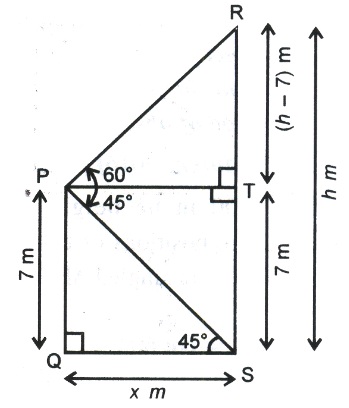
Let us assume that PQ is the building of height 7 m and RS is the cable tower of height h m , such that ㄥRPT=60o
∴ ㄥTPS=45o=ㄥQSP
∴ PQ=7m=TS
∴ RT=RS-TS=(h-7)m
Let QS=x m
Consider a rt . ΔPQS. we have
tan45o=\(\frac { PQ }{ QS } \)
⇒ 1=\(\frac { 7 }{ x } \)
⇒ x=7 ...........(i)
Now, PT=QS=x m=7 m
Again, consider art. ΔPTR, we have
tan600=\(\frac { RT }{ PT } \)
⇒ \(\sqrt { 3 } =\frac { h-7 }{ 7 } \) [cross-multiply]
⇒ h-7=7\(\sqrt { 3 } \)
⇒ h=7+7\(\sqrt { 3 } \)
⇒ h=7(\(\sqrt { 3 } \)+1)m
Hence, the height of the cable tower is 7(\(\sqrt { 3 } \) +1)m.
5.
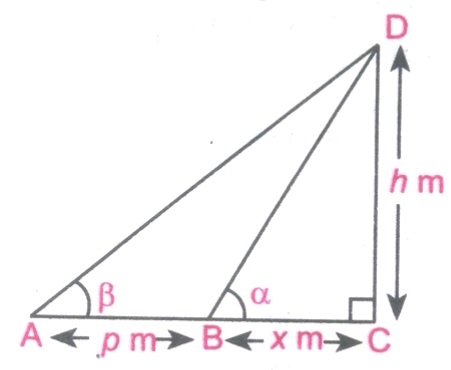
Let A and B are the objects p m apart, DC is the tower of height h. Let BC=x m.
In ∆ACD, \(\frac { CD }{ AC } \)=tanβ
⇒ \(\frac { h }{ p+x } =tan\beta \) ...........(i)
In ΔBCD, \(\frac { CD }{ BC } \)=tan α
⇒ \(\frac { h }{ x } =tan\alpha \quad \Rightarrow \quad x=\frac { h }{ tan\alpha } \)
Substituting in (i), we get
\(\frac { h }{ p+\frac { h }{ tan\alpha } } =tan\beta \)
⇒ h=\(p\quad tan\beta +\frac { h\quad tan\beta }{ tan\alpha } \)
⇒ h(tanα=p tanα tanβ+h tanβ
⇒ h(tanα-tanβ)=p tanα tanβ
h=\(\frac { p\quad tan\alpha \quad tan\beta }{ tan\alpha -tan\beta } \)
When p=50 m, ∝=600, β=300
h=\(\frac { 50\times tan60^{ 0 }.tan{ 30 }^{ 0 } }{ tan{ 60 }^{ 0 }-tan30^{ 0 } } \)
=\(\frac { 50\times \sqrt { 3 } \times \frac { 1 }{ \sqrt { 3 } } }{ \sqrt { 3 } -\frac { 1 }{ \sqrt { 3 } } } =\frac { 50\sqrt { 3 } }{ 2 } =25\sqrt { 3 } \)m
6.
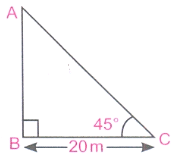
Let aeroplane is at A and B, C are two consecutive kilometre stones such that
ㄥXAB=α and ㄥYAC=β
∴ ㄥABD=α and ㄥACD=β
Let BD=x km
AD is height of aeroplane
In ΔADB, \(\frac { AD }{ BD } \)=tanα
⇒ \(\frac { AD }{ x } =tan\alpha \quad \Rightarrow \quad x=\frac { AD }{ tan\alpha } \) ........(i)
In ∆ADC, \(\frac { AD }{ DC } \)=tanβ
⇒ \(\frac { AD }{ 1-x } =tan\beta \)
⇒ \(\frac { AD }{ 1-\frac { AD }{ tan\alpha } } =tan\beta \) [From (i)]
⇒ \(\frac { AD\quad tan\alpha }{ tan\alpha -AD } =tan\beta \)
⇒ AD tanα=tanα.tanβ-AD tanβ
⇒ AD tanα+AD tanβ=tanα.tanβ
⇒ AD=\(\frac { tan\alpha .tan\beta }{ tan\alpha +tan\beta } \) Hence proved.
7.
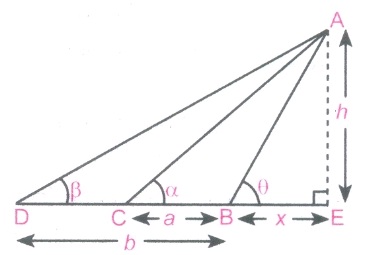
Let AB is the leaning tower, BC=a and BD=bLet AE is the perpendicular distance of A from the horizontal ground.
In right ∆AED.
⇒ \(\frac { DE }{ AE } \)=cotβ
⇒ \(\frac { h+x }{ h } \)=cotβ
⇒ h cotβ=b+x .......(i)
⇒ h=\(\frac { h+x }{ cos\beta } \) .......(ii)
In right ∆AEC,
\(\frac { CE }{ AE } \)=cotα
⇒ a+x=h cotα ........(iii)
and \(\frac { a+x }{ h } \)=h ..........(iv)
From (ii) and (iv)
\(\frac { b+x }{ cos\beta } =\frac { a+x }{ cot\alpha } \)
⇒ b cotα+x cotα=a cotβ-x cotβ
⇒ x(cotα-cotβ)=a cotβ-b cotα
⇒ x=\(\frac { a\quad cot\beta \quad -\quad b\quad cot\alpha }{ cot\alpha \quad -\quad cot\beta } \)
In right ∆AEB,
cotፀ=\(\frac { BE }{ AE } \)
⇒ cotፀ=x/h
⇒ \(cos\theta =\frac { \frac { a\quad cot\beta -b\quad cot\alpha }{ cot\alpha -cot\beta } }{ h } \)
⇒ \(\frac { a\quad cot\beta -b\quad cot\alpha }{ h\quad cot\alpha -h\quad cot\beta } \)
⇒ cotθ=\(\frac { a\quad cot\beta -b\quad cot\alpha \qquad }{ a-b } \)
=\(\frac { b\quad cot\alpha -a\quad cot\beta }{ b-a } \).
8.
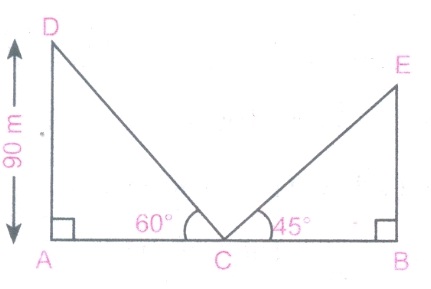
Let AB is path
In rt. ΔDAC, \(\frac { DC }{ AD } \)=cosec 600
⇒ \(\frac { DC }{ 90 } =\frac { 2 }{ \sqrt { 3 } } \)
DC=\(\frac { 2 }{ \sqrt { 3 } } \times 90\quad m\quad =\frac { 180 }{ \sqrt { 3 } } \)m
Now DC=CE [length of ladder]
∴ CE=\(\frac { 180 }{ \sqrt { 3 } } \)m
In rt. ΔEBC, \(\frac { BE }{ CE } \)=sin450
⇒ BE=\(\frac { 1 }{ \sqrt { 2 } } \times \frac { 180 }{ \sqrt { 3 } } \)m
⇒ BE=73.47 m.
9.
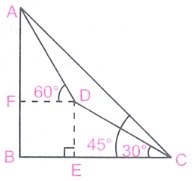
Let AB is the height of the mountain and C is the foot of the mountain
ㄥACB=45o
ㄥBAC=45o
After moving 1000 along CD at an angle of 300 with the horizontal the angle of inclination at D=600
⇒ ㄥADF=60o
⇒ Draw DE⏊BC
In right ΔDEC, \(\frac { DE }{ DC } \)=sin 30o
⇒ \(\frac { DE }{ 1000 } =\frac { 1 }{ 2 } \Rightarrow DE=\frac { 1 }{ 2 } \times 1000\)=500 m
DE=BF=500 m
Now ㄥACD=45o-30o=15o
In right ΔAFD, ㄥADF=60o
ㄥFAD=30o
ㄥDAC=45o-30o=15o
∴ In ΔCDA,
AD=CD
⇒ AD=1000 m
In right ΔADF, \(\frac { AF }{ AD } \)=sin 60o
⇒ \(\frac { AF }{ 1000 } =\frac { \sqrt { 3 } }{ 2 } \Rightarrow AF=500\sqrt { 3 } \)m
Now AF=AF+BF
=(500\(\sqrt { 3 } \)+500)m=500(\(\sqrt { 3 } \)+1)m
=500(1.732+1)=500 x 2.732=1366 m.
10.
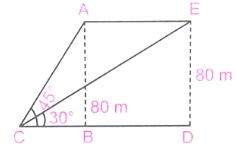
Let bird is at A and after 2 seconds it reaches at E.
∴ Distance covered=AE
In right ΔABC, \(\frac { BC }{ AB } \)=cot 45o
\(\frac { BC }{ 80 } \)=1
⇒ BC=80 m
In right ΔEDC, \(\frac { DC }{ DE } \)=cot 30o
⇒ DC=80 x \(\sqrt { 3 } \) [∵ DE=AB]
Now, BD=CD-BC
=\(80\sqrt { 3 } -80=80\sqrt { 3 } -1)\)=80 x 0.732=58.56 m
Now, BD=AE=58.56 m
∴ Speed of bird=\(\frac { 58.56 }{ 2 } \)=29.28 m/sec.

10th Standard CBSE Syllabus & Materials
10th Standard CBSE
CBSE 10th Social Science PS - Federalism - New Model Questions Papers Study Material - QB365 Set A
NEW10th Standard CBSE
CBSE 10th Social Science PS - Power Sharing - New Model Questions Papers Study Material - QB365 Set A
NEW10th Standard CBSE
CBSE 10th Social Science GEO - Manufacturing Industries - New Model Questions Papers Study Material - QB365 Set A
NEW10th Standard CBSE
CBSE 10th Social Science GEO - Minerals and Energy Resources - New Model Questions Papers Study Material - QB365 Set A



CBSE 10th Standard CBSE Subjects
CBSE Standards





