
 100% FREE ACCESS
10th Standard CBSE Syllabus & Materials
10th Standard CBSE
CBSE 10th Social Science ECO - Globalisation and the Indian Economy - New Model Questions Papers Study Material - QB365 Set A
NEW10th Standard CBSE
CBSE 10th Social Science ECO - Money and Credit - New Model Questions Papers Study Material - QB365 Set A
NEW10th Standard CBSE
CBSE 10th Social Science ECO - Sectors of the Indian Economy - New Model Questions Papers Study Material - QB365 Set A
NEW10th Standard CBSE
CBSE 10th Social Science ECO - Development - New Model Questions Papers Study Material - QB365 Set A
NEW10th Standard CBSE
CBSE 10th Social Science PS - Outcomes of Democracy - New Model Questions Papers Study Material - QB365 Set A
NEW10th Standard CBSE
CBSE 10th Social Science PS - Gender, Religion and Caste - New Model Questions Papers Study Material - QB365 Set A

Published on: 21/09/2019
Some Applications of Trigonometry
Download CBSE Class 10th Standard CBSE Maths question papers, sample papers, important questions, and previous year solved papers in PDF format. Get free study materials, NCERT solutions, and exam preparation resources for Class 10th Standard CBSE Maths
Questions + Answers key
Take MCQ Maths Test
1.
Determine the height of a mountain, if the elevation of its top at an unknown distance from the base is 30\(°\) and at a distance 10 km further off from the mountain, along the same line, the angle of elevation is 15\(°\) (Take tan 15\(°\) = 0.27)
2.
From a 60 m high building, the angle of depression of the top and bottom of a lamppost are \({ 30 }^{ ° }\)and \({ 60 }^{ ° }\) , respectively. Find the distance between lamppost and building. Also, find the difference of heights between building and lamppost.
3.
From the top of a hill \(200\sqrt { 3 } \) m high, the angle of depression of a ship moving towards the hill is 30°. After 2 min, its angle of depression becomes 60°. Find the speed of the ship assuming it to be uniform.
4.
A man who is \(1\frac { 3 }{ 4 } \)tall sees that angle of elevation
5.
Two boats approach a lighthouse in mid - sea from opposite directions. The angles of elevations of the top of the lighthouse from two boats are 30o and 45o respectively. If the distance between two boats is 100 m, find the height of the lighthouse.
6.
The horizontal distance between two poles is 15 m. The angle of depression of the top of first pole as seen from the top of second pole is 30o . If the height of the second pole is 24 m, find the height of the first pole. \((Use\sqrt { 3 } =1.732)\)
7.
A ladder of length 6 m makes an angle of 45o with the floor while leaning against one wall of a room. If the foot of the ladder is kept fixed on the floor and it is made to lean against the opposite wall of the room, it makes an angle of 60o with the floor. Find the distance between these two walls of the room.
8.
On a horizontal plane there is a vertical tower with a flag pole on the top of the tower. At a point 9 metres away from the foot of the tower the angles of elevation of the top and bottom of the flag pole are 60o and 30o respectively. Find the heights of the tower and flag pole mounted on it.
9.
A statue 1.46 m tall stand on the top of a pedestal. From a point on the ground, the angle of elevation of the top of the statue is 60o and from the same point, the angle of elevation of the top of the pedestal is 45o . Find the height of the pedestal. \((\sqrt { 3 } =1.73)\) .
10.
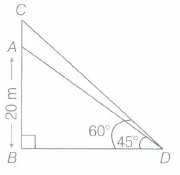
There is a flag staff on a tower of height 20 m. At a point on the ground, the angles of elevation of the foot and top of the ground, the angles of elevation of the foot and top of the flag are 45\(°\) and 60\(°\) respectively. Find the height of the flag staff.
11.
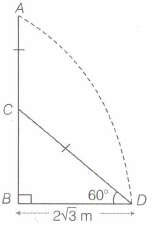
A straight tree is broken due to thunderstorm. The broken part is bent in such a way that the peak of the tree touches the ground at an angle of 60\(°\)at a distance of \(2\sqrt { 3 } m\) Find the whole height of the tree.
12.
A bridge on a river makes an angle of 45\(°\) with its edge. If the length along the bridge from one edge to the other is 150 m, then find the width of the river.
13.
If 300\(\sqrt { 3 } \) m high tower makes angle of elevation at a point on ground which is 300 m away from its foot, then find the angle of elevation.
14.
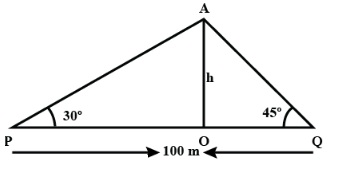
There is a small island in the middle of a 100m wide river and a tall tree stands on the island. P and Q are points directly opposite to each other on two banks and in line with the tree. If the angles of elevation of the top of the tree from p and Q are respectively \({ 30 }^{ \circ }\)and \({ 45 }^{ \circ }\)
(i) Find the height of the tree. [take, \(\sqrt3\) = 1732]
(ii) Determine the distance between two trees.
(iii) Which point is farthest from the island?
15.
The length of the shadow of a tower standing on level ground is found to 2 x metre longer when the sun's altitude is 30o than when it was 45o. Prove that the height of tower is \(x(\sqrt { 3 } +1)\) metres.
1.
Let AB = h km be the height of the mountain. Let C be a point at a distance of x km from the base of the mountain such that \(\angle\)ACB = 30\(°\) and let D be a point at a distance of 10 km from C along the same line. Then \(\angle\)ADB = 15\(°\) and AD = AC + DC = (x + 10) km
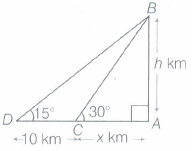
\(In\quad \Delta BAC,\quad tan\quad 30°=\frac { P }{ B } =\frac { AB }{ AC } \)
\(\Rightarrow \frac { 1 }{ \sqrt { 3 } } =\frac { h }{ x } \left[ \because tan 30°=\frac { 1 }{ \sqrt { 3 } } \right] \)
\(\Rightarrow x= h\sqrt { 3 } \) ......(i)
\(In \Delta BAD, tan 15°=\frac { AB }{ AD } \)
\(\Rightarrow 0.27=\frac { h }{ x+10 } \left[ given, tan 15°=0.27 \right] \)
\(\Rightarrow\) 0.27(x + 10) = h ......(ii)
On putting x = \(\sqrt { 3 } h\) from Eq. (i) in Eq. (ii), we get
\(0.27(\sqrt { 3 } h+10)=h\)
\(\Rightarrow 0.27\times \sqrt { 3 } h+0.27\times 10=h\)
\(\Rightarrow h(1-0.27\times \sqrt { 3 } )=0.27\times 10\)
\(\Rightarrow h(1-0.27\times 1.732)=2.7\) \(\left[ \because \sqrt { 3 } =1.732 \right] \)
\(\Rightarrow\) h(1-0.47) = 2.7
\(\Rightarrow 0.53h=2.7\Rightarrow h=\frac { 2.7 }{ 0.53 } =5.09\approx 5km\)
Hence, the height of mountain is 5 km.
2.
34.64 m; 20 m
3.
200 m/min
4.
10.41 m
5.
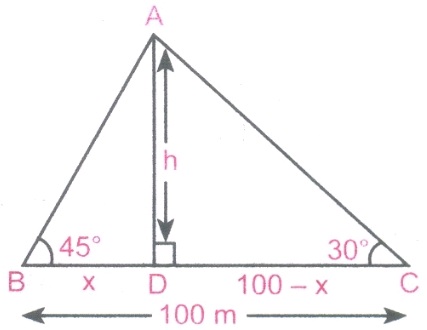
AD is the lighthouse, Find AD=?
In right ΔABD,
h=x
\(\frac { h }{ x } \)=tan45o
\(\frac { h }{ 100-x } \)=tan30o ......(ii)
Solve for h and x.
⇒ \(\frac { h }{ 100-x } =\frac { 1 }{ \sqrt { 3 } } \Rightarrow \sqrt { 3 } h\)=100-x
⇒ \(\sqrt { 3 } \)x=100-x [Using eq (i)]
⇒ (\(\sqrt { 3 } \)+1)x=100 ⇒ x=\(\frac { 100 }{ \sqrt { 3 } +1 } \)
⇒ x=\(\frac { 100(\sqrt { 3 } -1) }{ (\sqrt { 3 } +1)(\sqrt { 3 } -1) } \)
⇒ x=\(\frac { 100(\sqrt { 3 } -1) }{ 2 } =50(\sqrt { 3 } -1)\)m
∴ h=height of lighthouse=\(50(\sqrt { 3 } -1)\)m
6.
Let AB is Ist pole and CD is IInd pole.
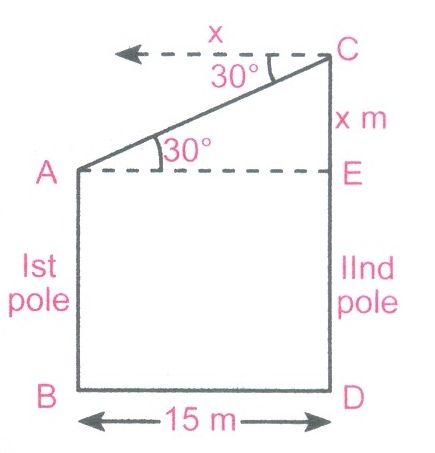
CD = 24 m and BD = 15 m
AE is horizontal line.
In rectangle
ABDE,
AE = BD = 15 m
Let CE = x m.
In right \(\Delta \) CEA,
\(\frac { CE }{ AE } =tan{ 30 }^{ o }\Rightarrow \frac { x }{ 15 } =\frac { 1 }{ \sqrt { 3 } } \)m
7.
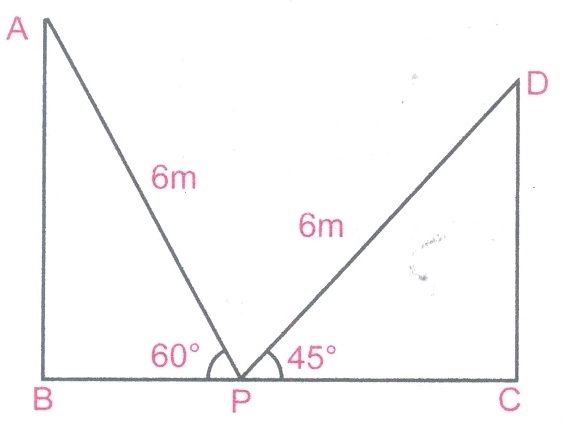
Let AP and DP be the position of the ladder whose length is 6 m.
In rt.ΔABP, \(\frac { BP }{ AP } =cos60^{ 0 }\Rightarrow \frac { BP }{ 6 } =\frac { 1 }{ 2 } \)
⇒ BP=1/2 x 6=3m
In rt, ΔDCP, \(\frac { PC }{ DP } =cos45^{ 0 }=\frac { PC }{ 6 } =\frac { 1 }{ \sqrt { 2 } } \)
⇒ PC=\(\frac { 6 }{ \sqrt { 2 } } \times \frac { \sqrt { 2 } }{ \sqrt { 2 } } =\frac { 6\sqrt { 2 } }{ 2 } =3\sqrt { 2 } m\)
Distance between two walls
=BP+PC=3+3\(\sqrt { 2 } \)
=3+3 x 1.41
=3(1+1.41)=7.23 m
8.
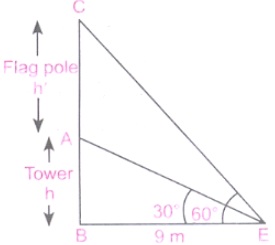
Given: AB be the tower and AC the flag pole on top of the tower.
ㄥCEB=60o, ㄥAEB=30o
To find Height of the tower and the height of the flag pole. Let height of the tower and flag pole be h m and h'm respectively.
Solution: In right ∆ABE
=\(\frac { AB }{ BE } =tan{ 30 }^{ 0 }\Rightarrow \frac { h }{ 9 } =\frac { 1 }{ \sqrt { 3 } } \)
h=\(\frac { 9 }{ \sqrt { 3 } } m=\frac { 9 }{ \sqrt { 3 } } =\frac { 9\sqrt { 3 } }{ 3 } m=3\sqrt { 3 } =5.196\)m .....(i)
In right ΔCBE,
\(\frac { CB }{ BE } =tan600\Rightarrow \frac { h+{ h }^{ ' } }{ BE } =tan60^{ 0 }\)
\(\frac { h+h' }{ BE } =\sqrt { 3 } \)
⇒ h+h'=\(9\sqrt { 3 } \) .......(ii)
\(h'=\frac { 27-9 }{ \sqrt { 3 } } =\frac { 18\times \sqrt { 3 } }{ \sqrt { 3 } \times \sqrt { 3 } } =\frac { 18\sqrt { 3 } }{ 3 } =6\sqrt { 3 } \)m
=6 x 1.732 m=10.392 m
Height of flag pole mounted on tower=10.392 m.
9.
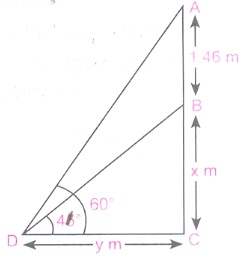
Let AB is statue, BC is pedestal and BC=x m, CD=y m.
In right ΔBCD, ΔBCD, \(\frac { BC }{ CD } \)=tan 45o
⇒, \(\frac { x }{ y } \)=1 ⇒ x=y .....(i)
In right ΔACD, \(\frac { AC }{ CD } \)=tan 600
⇒ \(\frac { x+1.46 }{ y } =\sqrt { 3 } \)
⇒ \(\frac { x+1.46 }{ x } \)=1.73 [Using (i)]
⇒ x+1.46=1.73x ⇒ 0.73x=1.46 ⇒ x=2
10.
Let AB be the tower and AC be the flag staff on the tower. Let D be a point on the ground such that the angles of elevation of foot A and top C of the flag staff are 45\(°\) and 60\(°\) respectively.
Then, we have AB = 20 m, \(\angle ADB=45° and \angle CDB=60°\)
In right angled \(\Delta ABD,\)
\(tan\quad 45°=\frac { AB }{ BD } \left[ \because tan\theta =\frac { P }{ B } \right] \)
\(\Rightarrow 1=\frac { 20 }{ BD } \)
\(\Rightarrow BD=20\quad m \left[ \because tan45°=1 \right] \)
and in right angled \(\Delta CBD,\)
\(tan 60°=\frac { BC }{ BD } \)
\(\sqrt { 3 } =\frac { BC }{ 20 } \left[ \because tan60°=\sqrt { 3 } \right] \)
\(\Rightarrow BC=20\sqrt { 3 } =20\times 1.732 \left[ \because \sqrt { 3 } =1,732 \right] \)
= 34.64 m (approx)
Now, AC = BC - AB = 34.64 - 20
=14.64 m (approx)
Hence, the height of the fleg staff is 14.64 m.
11.
Let AB be the tree whose part AC breaks and touches the ground at D
Then, BD = \(2\sqrt { 3 } m\)
and AC = CD
In right angled \(\Delta \)CBD,
\(cos 60°=\frac { B }{ H } =\frac { BD }{ CD } \)
\(\Rightarrow \frac { 1 }{ 2 } =\frac { 2\sqrt { 3 } }{ CD } \)
\(\left[ \because cos 60°=\frac { 1 }{ 2 } and BD=2\sqrt { 3 } m \right] \)
\(\Rightarrow\) \(CD=2\times 2\sqrt { 3 } =4\sqrt { 3 } \)
\(=4\times 1.732=6.928\ m [\because \sqrt { 3 } =1.732]\)
\(\therefore\) AC = CD = 6.928 m
Again, in right angled \(\Delta \)CBD,
\(tan\quad 60°=\frac { P }{ B } =\frac { BC }{ BD } \)
\(\Rightarrow \sqrt { 3 } =\frac { BC }{ 2\sqrt { 3 } } [\because tan60°=\sqrt { 3 } and BD=2\sqrt { 3 } m]\)
\(\Rightarrow BC=\sqrt { 3 } \times 2\sqrt { 3 } =6 m\)
Now, AB = AC + BC
= 6.928 + 6 = 12.928 m (approx)
Hence, the height of the tree is 12.928 m.
12.
Let BC be the width of the river and A, B be the ends of river such that
AB = 150 m = Length of the bridge
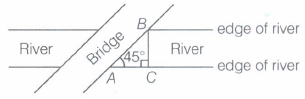
and \(\angle\)BAC = 45 \(°\)
In right angled \(\Delta ACB,\)
\(sin\quad 45°=\frac { P }{ H } \)
\(\Rightarrow \frac { 1 }{ \sqrt { 2 } } =\frac { BC }{ AB } =\frac { BC }{ 150 } \)
\(\therefore BC=\frac { 150 }{ \sqrt { 2 } } \times \frac { \sqrt { 2 } }{ \sqrt { 2 } } \) [by rationalising]
\(=\frac { 150 }{ 2 } \sqrt { 2 } =75\sqrt { 2 } \)
\(\\ =75\times 1.414\quad [\because \sqrt { 2 } =1.414]\)
=106.05 m (approx)
Hence, width of the river is 106.05 m.
13.
Let AB be the tower whose height is 300\(\sqrt { 3 } \) m, Again, let C be the point at a distance of 300 m from the foot of the tower, i.e. AC = 300 m.
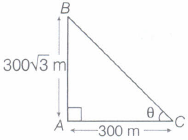
Here, the angle of elevation is unknown, so let it be \(\theta \)
Since, here base and perpendicular are given.
So, in right angled \(\Delta \)BAC,
\(tan \theta =\frac { perpendicular }{ Base } =\frac { AB }{ AC } =\frac { 300\sqrt { 3 } }{ 300 } \)
\(\Rightarrow tan \theta =\sqrt { 3 } =tan\quad 60°\)
\(\\ \therefore \theta =60°\)
Hence, the required angle of elevation is 60\(°\)
14.
(i) Let OA be the tree of height bm.
Given PQ = 100m and angles of elevation are
\(\angle APO={ 30 }^{ \circ } \angle OQA={ 45 }^{ \circ }\)
In right angled \(\Delta POA,\) \(\tan { { 30 }^{ \circ } } =\frac { OA }{ OP } \)
\(\Rightarrow \frac { 1 }{ \sqrt { 3 } } =\frac { b }{ OP } \Rightarrow OP=\sqrt { 3b } .....(i)\)
Now, in right angled \(\Delta QOA,\)
\(\tan { { 45 }^{ \circ } } =\frac { OA }{ OQ } \Rightarrow 1=\frac { b }{ OQ } \Rightarrow OQ=b\ ....(ii)\)
On adding Eqs. (i) and (ii), we get
\(OP+OQ=\sqrt { 3b } +b\)
\(\Rightarrow PQ=(\sqrt { 3 } +1)b\)
\(\Rightarrow 100=(\sqrt { 3 } +1)b[\because PQ=100m, give]\)
\(\\ \Rightarrow b=\frac { 100 }{ \sqrt { 3 } +1 } \times \frac { \sqrt { 3 } -1 }{ \sqrt { 3 } -1 } \)
\( \Rightarrow b=50(\sqrt { 3 } -1)=50(1.732-1) [\because \sqrt { 3 } =1.732]\)
\( \Rightarrow b=36.6m\)
Hence, height of the tree is 36.6m
(ii) 99.99 m,
(iii) Point P
15.
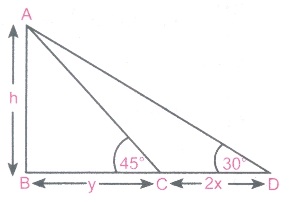
Given: tower AB height h m . BC is the shadow when sun's altitude is 45o and shadow is BD, when the sun's altitude is 30o.
To find: The height of tower
Solution: In rt. ΔABC,
\(\frac { AB }{ BC } =tan{ 45 }^{ 0 }\Rightarrow \frac { h }{ y } =1\)
or h = y .....(i)
⇒ \(\frac { AB }{ BD } =\frac { h }{ y+2x } \) = tan30o
⇒ \(\frac { h }{ y+2x } =\frac { 1 }{ \sqrt { 3 } } \)
\(\sqrt { 3 } \)h = y + 2x ......(ii)
From (i) and (ii), we have
\(\sqrt { 3 } \)h = h +2 x ⇒ \(\sqrt { 3 } \)h - h = 2x
⇒ (\(\sqrt { 3 } \) - 1)h = 2x
⇒ h = \(\frac { 2x }{ (\sqrt { 3 } -1) } =\frac { 2x(\sqrt { 3 } +1) }{ (\sqrt { 3 } -1)(\sqrt { 3 } +1) } \)
= \(\frac { 2x(\sqrt { 3 } +1) }{ (\sqrt { 3 } )^{ 2 }-1^{ 2 } } =\frac { 2x(\sqrt { 3 } +1) }{ 3-1 } \)
= \(\frac { 2x(\sqrt { 3 } +1) }{ 2 } =x(\sqrt { 3 } +1)\) m

10th Standard CBSE Syllabus & Materials
10th Standard CBSE
CBSE 10th Social Science PS - Federalism - New Model Questions Papers Study Material - QB365 Set A
NEW10th Standard CBSE
CBSE 10th Social Science PS - Power Sharing - New Model Questions Papers Study Material - QB365 Set A
NEW10th Standard CBSE
CBSE 10th Social Science GEO - Manufacturing Industries - New Model Questions Papers Study Material - QB365 Set A
NEW10th Standard CBSE
CBSE 10th Social Science GEO - Minerals and Energy Resources - New Model Questions Papers Study Material - QB365 Set A



CBSE 10th Standard CBSE Subjects
CBSE Standards





