
 100% FREE ACCESS
10th Standard CBSE Syllabus & Materials
10th Standard CBSE
CBSE 10th Social Science ECO - Globalisation and the Indian Economy - New Model Questions Papers Study Material - QB365 Set A
NEW10th Standard CBSE
CBSE 10th Social Science ECO - Money and Credit - New Model Questions Papers Study Material - QB365 Set A
NEW10th Standard CBSE
CBSE 10th Social Science ECO - Sectors of the Indian Economy - New Model Questions Papers Study Material - QB365 Set A
NEW10th Standard CBSE
CBSE 10th Social Science ECO - Development - New Model Questions Papers Study Material - QB365 Set A
NEW10th Standard CBSE
CBSE 10th Social Science PS - Outcomes of Democracy - New Model Questions Papers Study Material - QB365 Set A
NEW10th Standard CBSE
CBSE 10th Social Science PS - Gender, Religion and Caste - New Model Questions Papers Study Material - QB365 Set A

Published on: 14/09/2019
Some Applications of Trigonometry
Download CBSE Class 10th Standard CBSE Maths question papers, sample papers, important questions, and previous year solved papers in PDF format. Get free study materials, NCERT solutions, and exam preparation resources for Class 10th Standard CBSE Maths
Questions + Answers key
Take MCQ Maths Test
1.
As observed from the top of a light - house, 100 m high above sea level, the angle of depression of a ship, sailing directly towards it, changes from 30o to 60o . Determine the distance travelled by the ship during the period of observation. \((Use\sqrt { 3 } =1.732)\)
2.
A straight highway leads to the foot of a tower. A man standing at the top of the tower observes a car at an angle of depression of 30o , which is approaching the foot of the tower with a uniform speed. Six seconds later, the angle of depression of the car is found to be 60o . Find the time taken by the car to reach the foot of the tower from this point.
3.
From the top of a 7 m high building, the angle of elevation of the top of a cable tower is 60o and the angle of depression of its foot is 45o. Determine the height of the tower.
4.
From a point on the ground, the angles of elevation of the bottom and the top of a transmission tower fixed at the top of a 20 m high building are 45° and 60°. Find the height of the tower.
5.
The angle of elevation of the top of a tower from a point on the ground, which is 30 m away from the foot of the tower is 30o . Find the height of the tower.
6.
Mahesh, a fireman while throwing water on the fire of a burning house noticed a child in the first floor of burning house crying help Mahesh at once tied a rope at the top of a pole near the burning house and its other end tied at the ground. He climbed the rope and from top of the pole picked the child and save her life. If the height of the pole is 12metre and the angle made by the rope with ground is 30o, calculate the distance covered by the fireman to reach the top of the pole
(i)What do you consider the act done by fireman to save the child?
7.
Find the angle of elevation of the sun when the shadow of a pole h metres high is \(\sqrt{3}\) h metres long
8.
A kite is flying at a height of 75 m from the level ground, attached to a string inclined at 60o to the horizontal. Find the length of the string to the nearest metre.
9.
The angle of elevation of the top of a vertical tower from a point on the ground is 60o , From another point 10 m vertically above the first, its angle of elevation is 30o . Find the height of the tower.
10.
If a pole 6 m high throws shadow of \(2\sqrt { 3 } \) m, then find the angle of elevation of the sun.
11.
An observer, 1.7 m tall, is \(20\sqrt { 3 } \) m away from a tower. The angle of elevation from the eye of observer to the top of tower is 30o . Find the height of tower.
12.
The angle of elevation of the top of a building from the foot of a tower is 30o and the angle of elevation of the top of the tower from the foot of the building is 60o. If the tower is 50 m high, find the height of the building.
13.
A spherical balloon of radius 'r' subtends an angle \(\theta\) at the eye of an observer.If the angle of elevation of is \(\phi \), find the height of the centre of the balloon.
1.
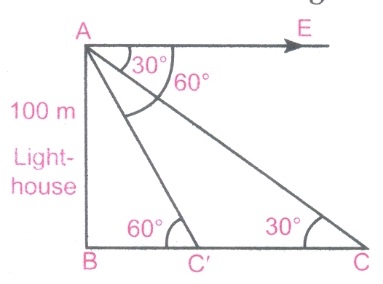
Given: AB the lighthouse 100 m above sea level and C is a ship sailing towards AB.
⇒ ㄥEAC = 30\(\unicode{xb0} \)
After travelling from C to C' angle of depression changes from ㄥEAC = 30\(\unicode{xb0} \) to ㄥEAC' = 60\(\unicode{xb0} \)
To Find: CC'
Solution: AE||BC
[Line of sight and line of horizontal]
⇒ ㄥACC' = ㄥEAC = 30\(\unicode{xb0} \) [Alternate angles]
ㄥAC'B = ㄥEAC' = 60\(\unicode{xb0} \) [Alternate angles]
In right ΔABC', \(\frac { AB }{ BC } \) = tan30o
\(\frac { 100 }{ BC } =\frac { 1 }{ \sqrt { 3 } } \Rightarrow BC=100\sqrt { 3 } \)
CC' = BC - BC'
=\(\left( 100\sqrt { 3 } -\frac { 100 }{ \sqrt { 3 } } \right) \)m
=\(\frac { 100\times 3-100 }{ \sqrt { 3 } } \)
=\(\frac { 200 }{ \sqrt { 3 } } m=\frac { 200\sqrt { 3 } }{ 3 } m\) = 115.466 m
2.
Let CD = h m be the height of the tower. At point D of the tower, a man is standing and observes the car at an angle of depression of 30°. After six seconds, the angle of depression of the car is 60°.
i.e. \(\angle\)ODA = 30° and \(\angle\)ODB = 60°
\(\Rightarrow\) \(\angle\)DAC = \(\angle\)ODA = 30° [alternate angles]
and \(\angle\)DBC = \(\angle\)ODB = 60° [alternate angles]
Let AB = y m and BC = x m
In right angled \(\Delta\)BCD,

\(\begin{array}{rlrl} \tan 60^{\circ} & =\frac{P}{B}=\frac{C D}{B C} \\ \end{array}\)
\(\begin{array}{rlrl} \Rightarrow \quad \sqrt{3} & =\frac{h}{x} \\ \end{array}\)
\(\begin{array}{rlrl} \Rightarrow \quad h & =\sqrt{3} x & {\left[\because \tan 60^{\circ}=\sqrt{3}\right]} \end{array}\)
\(\Rightarrow \quad h = \sqrt3 x\)....(i)
In right angled \(\Delta\)ACD,
\(\begin{array}{rlrl} \tan 30^{\circ} & =\frac{C D}{A C}=\frac{C D}{A B+B C} & & {[\because A C=A B+B C]} \\ \end{array}\)
\(\begin{array}{rlrl} \Rightarrow \quad \frac{1}{\sqrt{3}} & =\frac{h}{x+y} & & {\left[\because \tan 30^{\circ}=\frac{1}{\sqrt{3}}\right]} \\ \end{array}\)
\(\begin{array}{rlrl} \Rightarrow \quad x+y & =h \sqrt{3} & \end{array}\)
\(\Rightarrow \quad x + y=\sqrt3 x(\sqrt3)\) [from Eq. (i)]
\(\Rightarrow\) x + y = 3x .....(ii)
It is given that a car moves from point A to B in six seconds. Let its speed be k km/s.
\(\therefore \quad \text { Time }=\frac{\text { Distance }}{\text { Speed }}\)
\(\Rightarrow \quad 6=\frac{y}{k} \Rightarrow y=6 k\)
On putting y = 6k in Eq. (ii), we get
x + 6k = 3x \(\Rightarrow\) 6k - 2x \(\Rightarrow\) x = 3k
\(\therefore \quad \text { Time }=\frac{\text { Distance }}{\text { Speed }}=\frac{x}{k}=\frac{3 k}{k}=3 \mathrm{~s}\)
Hence, the car moves from point B to point C in 3s.
3.
Let AD = 7 m be the height of the building and BC = h m be the height of the cable tower. From the top of the building D, the angles of elevation and depression are \(\angle\)CDE = 60o and \(\angle\)EDB = 45o
From the point D, draw a line DE || AB.
Then, \(\angle\)EDB = \(\angle\)ABD = 45o [alternate angles]

Also, let AB = DE = x m be the distance between building and tower.
In right angled \(\Delta\)BAD,
\(\begin{array}{rlrl} \tan 45^{\circ} & =\frac{P}{B}=\frac{A D}{A B} \\ \end{array}\)
\(\begin{array}{rlrl} \Rightarrow \quad 1 & =\frac{7}{x} & {\left[\because \tan 45^{\circ}=1\right]} \end{array}\)
\(\Rightarrow\) x = 7 m ....(i)
and in right angled \(\Delta\)CED,
\(\begin{aligned} & \tan 60^{\circ}=\frac{C E}{D E}=\frac{C B-B E}{A B}[\because C E=C B-B E] \\ \end{aligned}\)
\(\begin{aligned} & \Rightarrow \quad \sqrt{3}=\frac{b-7}{x} \quad\left[\because \tan 60^{\circ}=\sqrt{3}\right\} \\ \end{aligned}\)
\(\begin{aligned} & \Rightarrow \quad b-7=x \sqrt{3} \\ \end{aligned}\)
\(\begin{aligned} & \Rightarrow \quad h=x \sqrt{3}+7 \\ \end{aligned}\)
\(\begin{aligned} & \Rightarrow \quad h=7 \sqrt{3}+7 \quad \text { [from Eq. (i)] } \\ \end{aligned}\)
\(\begin{aligned} & \Rightarrow \quad h=7(\sqrt{3}+1) \mathrm{m} \\ \end{aligned}\)
Hence, the height of the tower is \(7(\sqrt{3}+1) \mathrm{m} .\)
4.
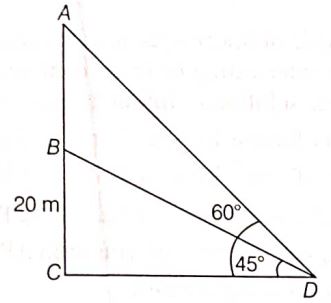
Let BC be the building, AB be the transmission tower and D be the point on the ground from where the angles of elevations are to be measured.
\(\begin{array}{rlrl}
\text { In } \triangle B C D, & \tan 45^{\circ} =\frac{B C}{C D} \\
\end{array}\)
\(\begin{array}{rlrl}
\Rightarrow 1 =\frac{20}{C D} \Rightarrow C D=20 \mathrm{~m}
\end{array}\)
\(\begin{array}{llrl}
\text { In } \triangle A C D, & \tan 60^{\circ} =\frac{A C}{C D}
\end{array}\)
\(\begin{array}{llrl}
\Rightarrow \sqrt{3} =\frac{A B+B C}{C D} \\
\end{array}\)
\(\begin{array}{llrl}
\Rightarrow \sqrt{3} =\frac{A B+20}{20} \\
\end{array}\)
\(\Rightarrow A B =20 \sqrt{3}-20=20(\sqrt{3}-1) \mathrm{m}\)
Thus, the height of the tower is \(20(\sqrt{3}-1) \mathrm{m}\).
5.
Let BC be the height of the tower which is standing on the ground. Let A be a point on the ground which is 30 m away from the foot of tower.

Then, AB = 30 m and \(\angle\)BAC = 30°.
In right angled \(\Delta\)ABC,
\(\begin{array}{rlrl} \tan 30^{\circ} =\frac{B C}{A B}&&{\left[\because \tan \theta=\frac{P}{B}\right]} \\ \end{array}\)
\(\begin{array}{rlrl} \Rightarrow \quad \frac{1}{\sqrt{3}} & =\frac{B C}{30} & {\left[\because \tan 30^{\circ}=\frac{1}{\sqrt{3}}\right]} \\ \end{array}\)
\(\begin{array}{rlrl} \Rightarrow \quad B C & =\frac{30}{\sqrt{3}} \times \frac{\sqrt{3}}{\sqrt{3}}=10 \sqrt{3} \mathrm{~m} \end{array}\) [rationalising]
Hence, the height of the tower is 10\(\sqrt3\) m.
6.
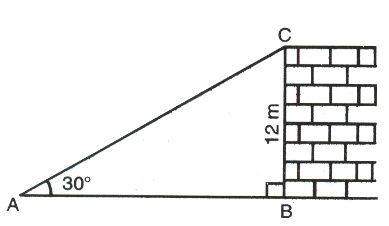
Let C be the top of the pole BC
Height of pole=12 m
The distance covered by the fireman to reach the top of the pole =AC
In right-angled triangle ABC, we have
\(\frac { BC }{ AC } \)=sin 30o
⇒ \(\frac { 12 }{ AC } =\frac { 1 }{ 2 } \) ⇒ AC=24
Hence, distance covered by Mahesh is 24 metres.
(i) Humanity and act of bravery.
7.
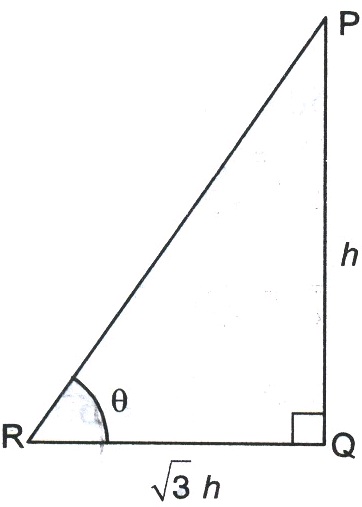
Here, the height of the pole be h m and length of its shadow is \(\sqrt { 3 } \) h .
Let ፀ be the elevation of the sun. Consider right-angle ΔPQR
tanፀ=\(\frac { h }{ \sqrt { 3 } h } =\frac { 1 }{ \sqrt { 3 } } \)
= tan 30\(\unicode{xb0} \)
ፀ = 30\(\unicode{xb0} \)
Hence, the angle of elevation of the sun is 30\(\unicode{xb0} \).
8.
87 m
9.
Let AB is tower and BC=x
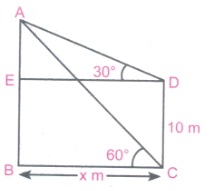
∵ BE=CD ⇒BE=10 m
Also BC=DE=x m. Take AE=y m
In right ΔAED, \(\frac { AE }{ DE } \)=tan 30o
⇒ \(\frac { y }{ x } =\frac { 1 }{ \sqrt { 3 } } \Rightarrow \sqrt { 3 } y\) ....(i)
In right ΔABC, \(\frac { AB }{ BC } \)=tan 60o
⇒ \(\frac { y+10 }{ 2 } =\sqrt { 3 } \)
y+10=\(\sqrt { 3 } \)x
y+10=\(\sqrt { 3 } \)(\(\sqrt { 3 } \)y)
⇒ y+10=3y
⇒ y=5m
Height of tower=AE+BE=5+10
=15 m
10.
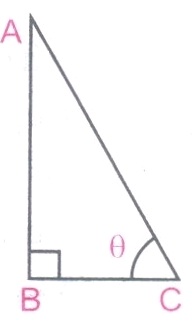
Let AB is pole and BC is its shadow
∴ AB = 6m, BC = 2\(\\ \\ \\ \\ \sqrt { 3 } \) m
In right ΔABC, \(\frac { AB }{ BC } \)=tanፀ
⇒ tanፀ = \(\frac { 6 }{ 2\sqrt { 3 } } \)
⇒ tanፀ = \(\sqrt { 3 } \)
⇒ ፀ = 60o
11.
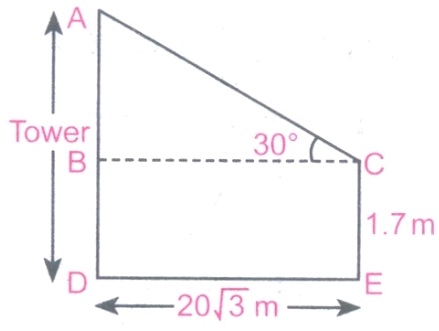
In right ΔABC, \(\frac { AB }{ BC } \) = tan30o
⇒ \(\frac { AB }{ 20\sqrt { 3 } } =\frac { 1 }{ \sqrt { 3 } } \) ⇒ AB = 20 m
Height of tower AD = AB + BD
= 20 + 1.7 = 21.7 m
12.

Let BC = 50 m be the height of the tower and AD = h m be the height of the building. Angle of elevation of the top of the building from the foot of the tower is \(\angle\)DBA = 30° and angle of elevation of the top of the tower from the foot of the building \(\angle\)CAB = 60°. Also, let AB = x m be the distance between foots of the tower and the building.
In right angled \(\Delta\)BAD, tan 30°=\(\frac{P}{B}=\frac{A D}{A B}\)
\(\begin{array}{lll}
\Rightarrow & \frac{1}{\sqrt{3}}=\frac{h}{x} & {\left[\because \tan 30^{\circ}=\frac{1}{\sqrt{3}}\right]} \\
\end{array}\)
\(\begin{array}{lll}
\Rightarrow & b=\frac{x}{\sqrt{3}}
\end{array}\) ...(i)
and in right angled \(\Delta\)CBA, tan 60° = \(\frac{B C}{A B}\)
\(\begin{array}{lll}
\Rightarrow & \sqrt{3}=\frac{50}{x} & {\left[\because \tan 60^{\circ}=\sqrt{3}\right]} \\
\end{array}\)
\(\begin{array}{lll}
\Rightarrow & x=\frac{50}{\sqrt{3}} \mathrm{~m}
\end{array}\)
On putting \(x=\frac{50}{\sqrt{3}}\) in Eq. (i), we get
\(h=\frac{50}{\sqrt{3}} \times \frac{1}{\sqrt{3}}=\frac{50}{3}=16 \frac{2}{3} \mathrm{~m}\)
Hence, the height of the building is \(16 \frac{2}{3} \mathrm{~m}\).
13.
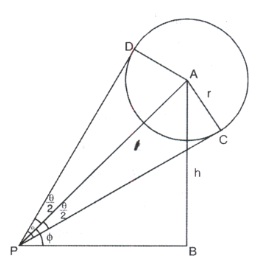
Let A be the centre of the balloon (spherical) whose radius is r.
Let AB be the height of the ballon i.e., h units, such that
ㄥDPC=ፀ, ㄥAPB-ф
Since ΔPDA and ΔPCA are congruent, therefore
ㄥAPC=ㄥAPD=ፀ/2
In rt. ㄥed ΔPCA,
\(\frac { AC }{ AP } =sin\frac { \theta }{ 2 } \)
⇒ AP=\(AC\frac { 1 }{ sin\frac { \theta }{ 2 } } =r.cosec\frac { \theta }{ 2 } \) or
Consider rt . ㄥed ΔPBA, we have
\(\frac { AB }{ AP } \)=sin ф
AB=AP.sinф
h=r.cosec\( \frac { \theta }{ 2 } \).sinф
h=r sinф.cosec\( \frac { \theta }{ 2 } \).

10th Standard CBSE Syllabus & Materials
10th Standard CBSE
CBSE 10th Social Science PS - Federalism - New Model Questions Papers Study Material - QB365 Set A
NEW10th Standard CBSE
CBSE 10th Social Science PS - Power Sharing - New Model Questions Papers Study Material - QB365 Set A
NEW10th Standard CBSE
CBSE 10th Social Science GEO - Manufacturing Industries - New Model Questions Papers Study Material - QB365 Set A
NEW10th Standard CBSE
CBSE 10th Social Science GEO - Minerals and Energy Resources - New Model Questions Papers Study Material - QB365 Set A



CBSE 10th Standard CBSE Subjects
CBSE Standards





