
 100% FREE ACCESS
10th Standard CBSE Syllabus & Materials
10th Standard CBSE
CBSE 10th Social Science ECO - Globalisation and the Indian Economy - New Model Questions Papers Study Material - QB365 Set A
NEW10th Standard CBSE
CBSE 10th Social Science ECO - Money and Credit - New Model Questions Papers Study Material - QB365 Set A
NEW10th Standard CBSE
CBSE 10th Social Science ECO - Sectors of the Indian Economy - New Model Questions Papers Study Material - QB365 Set A
NEW10th Standard CBSE
CBSE 10th Social Science ECO - Development - New Model Questions Papers Study Material - QB365 Set A
NEW10th Standard CBSE
CBSE 10th Social Science PS - Outcomes of Democracy - New Model Questions Papers Study Material - QB365 Set A
NEW10th Standard CBSE
CBSE 10th Social Science PS - Gender, Religion and Caste - New Model Questions Papers Study Material - QB365 Set A

Published on: 14/08/2019
Surface Areas and Volumes
Download CBSE Class 10th Standard CBSE Maths question papers, sample papers, important questions, and previous year solved papers in PDF format. Get free study materials, NCERT solutions, and exam preparation resources for Class 10th Standard CBSE Maths
Questions + Answers key
Take MCQ Maths Test
1.
A hemispherical bowl of internal radius 9 cm is full of water. Its contents are emptied in a cylindrical vessel of internal radius 6 cm. Find the height of water in the cylindrical vessel.
2.
The size of the base of a cane full of kerosene is 20 cm x 20 cm and its height is 45 cm. The kerosene of this cane is poured into another cane having base of size 25 cm x 15 cm and height 50 cm. Determine the height of the kerosene in the second cane.
3.
A hemisphere bowl of internal radius 9cm is full of water.Its contents are emptied in a cylindrical vessel of internal radius 6cm.Find the height of water in the cylindrical vessel.
4.
A hemispherical depression is cut out from one face of a cubical wooden block such that the diameter l of the hemisphere is equal to the edge of the cube. Determine the surface area of the remaining solid.
5.
If a cone is cut into two parts by a horizontal plane passing through the mid-points of its axis, find the ratio of the volume of the upper part and the cone.
6.
Volumes of two spheres are in the ratio 64 : 27, find the ratio of their surface areas.
7.
The radius of sphere is r cm. It is divided into two equal parts. Find the whole surface of two parts.
8.
Find the volume of the largest sphere that can be cut from cylindrical log of wood of base radius 1 m and height 4 m.
9.
In a box whose dimensions are 12cm x 4cm x 3cm, what is the length of the longest stick that can be placed?
10.
A container open at the top, is in the form of a frustum of a cone of height 24 cm with radii of its lower and upper circular ends as 8 cm and 20 cm respectively. Find the cost of milk which can completely fill the container at the rate of Rs.21 per litre. [Use \(\pi=\frac{22}{7}\)]
11.
What length of a solid cylinder 2 cm in diameter must be taken to recast into a hollow cylinder of length 16 cm, external diameter 20 cm and thickness 2.5 mm?
12.
A toy is in the shape of a right circular cylinder with a hemisphere on one end and a cone on the other.The radius and height of the the cylindrical part are 5cm and 13cm respectively part.The radii of the hemispherical and conical parts are the same as that of the cylinder part.Find the surface area of the toy if the total height of the toy is 30cm.
13.
The surface areas of a sphere and a cube are equal.Prove that their volumes are in the ratio \(1:\sqrt{\pi/6}\) .
14.
A solid cylinder of radius r and height h is placed over other cylinder of same height and radius.The surface area of the shape so formed is \(4\pi rh+4\pi r^2\)
15.
Find the radius of a sphere whose surface area is 154cm2
16.
The patients in a hospital are given soup daily in a cylindrical bowl of diameter 7 cm. On a particular day, the girls of kanya Mahavidyalaya decided to cook the soup for the patients.
(i) If they fill the bowl with soup to a height of 5 cm, then how much soup is to be cooked for 300 patients?
(ii) Which value is depicted by the girls?
17.
From each end of a solid metal cylinder, metal was scooped out in hemispherical form of same diameter. The height of the cylinder is 10 cm and its base is of radius 4.2 cm. The rest of the cylinder is melted and converted into a cylindrical wire of 1.4 cm thickness. Find the length of the wire.[Use \(\pi =22/7\)]
18.
Metallic spheres of radii 6cm, 8cm and 10cm, respectively, are melted to form a single solid sphere.Find the radius of the resulting sphere.
19.
A tent is in the shape of a right circular cylinder up to a height of 3m and then becomes a right circular cone with a maximum height of 13.5m above the ground.Calculate the cost of painting the inner side of the tent at the rate of Rs.2 per m2 , if the radius of the base is 14m.
20.
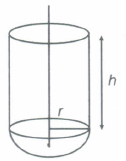
Volume of given figure\(=\pi { r }^{ 2 }(...+...)\)
21.
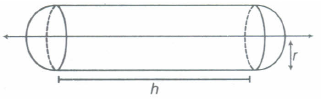
Total surface area of given figure = ... (... + ... )
22.
A hollow sphere of internal and external radii 2 cm and 4 cm respectively is melted into a cone of base radius 4 cm, the height of the cone is ..............
23.
If the surface area of a sphere is 6161 cm2, then its radius is equal to ...............
24.
Toy (Latto) is a solid which is a combination of ............. and .............
25.
Frustum is a latin word, meaning ............
26.
Total surface area of a cone= .........
1.
Volume of hemisphere = \(\frac { 2 }{ 3 } { \pi r }^{ 3 }=\frac { 2 }{ 3 } \pi \left( 9\times 9\times 9 \right) \)
Let height of water in cylindrical vessel be h cm.
\(\therefore\) Volume of cylindrical vessel = Volume of hemisphere
\(\pi\) (6 x 6) x h = \(\frac{2}{3}\pi\) (9 x 9 x 9)
h = \(\frac { 2 }{ 3 } \times \frac { 9\times 9\times 9 }{ 6\times 6 } \) = 13.5
\(\therefore\) Height of water in cylindrical vessel = 13.5 cm.
2.
Volume of kerosene in case
= 20 x 20 x 45 = 25 x 15 x h (Volume in second cane)
\(\Rightarrow\) h = \(\frac{20\times20\times45}{25\times15}\) = 48 cm
3.
Radius of hemispherical bowl r = 9cm
\(\therefore \) Volume of water in the bowl = volume of hemispherical bowl
= \(\frac { 2 }{ 3 } \pi r^{ 3 }=\frac { 2 }{ 3 } \pi \times (9)^{ 3 }=486\pi cm^{ 3 }\)
Radius of culindrical vessel = R= 6 cm
Let height of water in the vessel be h cm
\(\therefore \) Volume of water = \(\pi r^{ 2 }h=\pi (6)^{ 2 }h=36\pi hcm^{ 3 }\)
\(\Rightarrow 36\pi h=480\pi \Rightarrow h=13.5cm\)
4.
Given, side of the cube = Diameter of the hemisphere = l units
\(\therefore\) Radius of the hemisphere, \(r=\frac{l}{2}\) units
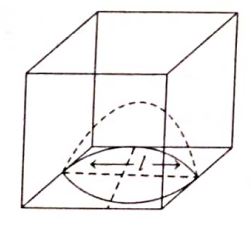
Now, required surface area of the remaining solid = TSA of the cube + CSA of hemisphere - Area of circular base of hemisphere
\(\begin{aligned} & =6 \times(\text { Edgc })^2+2 \pi r^2-\pi r^2 \\ \end{aligned}\)
\(\begin{aligned} & =6 \times l^2+2 \pi \times\left(\frac{l}{2}\right)^2-\pi\left(\frac{l}{2}\right)^2 \\ \end{aligned}\)
\(\begin{aligned} & =6 l^2+2 \pi \times \frac{l^2}{4}-\pi \frac{l^2}{4}=6 l^2+\pi \frac{l^2}{4} \\ \end{aligned}\)
\(\begin{aligned} & =\frac{l^2}{4}(\pi+24) \text { sq units } \end{aligned}\)
5.
Volume of upper cone\(=\frac { 1 }{ 3 } \pi { \left( \frac { r }{ 2 } \right) }^{ 2 }\times \frac { h }{ 2 } \)
\(=\frac { 1 }{ 3 } \pi \frac { { r }^{ 2 } }{ 2 } \times \frac { h }{ 2 } \)
\(=\frac { 1 }{ 3 } \pi \frac { { r }^{ 2 }h }{ 2 } \)
Volume of cone\(=\frac { 1 }{ 3 } \pi { r }^{ 2 }h\)
\(\frac { Volume \ of \ upper \ part \ of \ cone }{ Volume \ of \ cone } =\frac { \frac { 1 }{ 3 } \pi \frac { { r }^{ 2 }h }{ 2 } }{ \frac { 1 }{ 3 } \pi { r }^{ 2 }h } \)
\(=\frac { 1 }{ 8 } \)
= 1:8
6.
\(\frac { Volume \ of \ { 1 }^{ st } \ sphere }{ Volume \ of \ { 11 }^{ nd } \ sphere } =\frac { \frac { 4 }{ 3 } \pi { r }_{ 1 }^{ 3 } }{ \frac { 4 }{ 3 } \pi { r }_{ 2 }^{ 3 } } =\frac { 64 }{ 27 } \)
\(\therefore \ =\frac { { r }_{ 1 }^{ 3 } }{ { r }_{ 2 }^{ 3 } } =\frac { 64 }{ 27 } \)
\(=\frac { { r }_{ 1 } }{ { r }_{ 2 } } =\frac { 4 }{ 3 } \)
Ratio of their surface areas=\(\frac { Surface \ are \ of \ { I }^{ st } \ sphere }{ Surface \ are \ of \ { II }^{ nd } \ sphere } \)
\(=\frac { 4\pi { r }_{ 1 }^{ 2 } }{ 4\pi { r }_{ 2 }^{ 2 } } ={ \left( \frac { { r }_{ 1 } }{ { r }_{ 2 } } \right) }^{ 2 }\)
\(={ \left( \frac { 4 }{ 3 } \right) }^{ 2 }=\frac { 16 }{ 9 } \)
=16:9
7.
\(\because\) Whole surface of each part=\(=2\pi { r }^{ 2 }+\pi { r }^{ 2 }=3\pi { r }^{ 2 }\)
\(\therefore\) Total surface of two parts=\(=3\pi { r }^{ 2 }+3\pi { r }^{ 2 }=6\pi { r }^{ 2 }\)
8.
The largest sphere of 1 m can be cut from cylindrical log of wood of base 1 m and height 4 m
\(\therefore Volume \ of \ sphere=\frac { 4 }{ 3 } \pi { \left( 1 \right) }^{ 3 }{ m }^{ 3 }=\frac { 4 }{ 3 } \pi { m }^{ 3 }\)
9.
Length of the longest stick that can be placed inside the box = length of its diagonal
Diagonal of the cuboid=\(\sqrt{l^{2}+b^{2}+h^{2}}\)
=\(\sqrt{(12)^{2}+(4)^{2}+(3)^{2}}\)
=\(\sqrt{144+16+9}=\sqrt{169}\)
= 13 cm
10.
Radius of lower end (r1)= 8 cm
Radius of upper end (r2) = 20 cm
Height of frustum = 24 cm
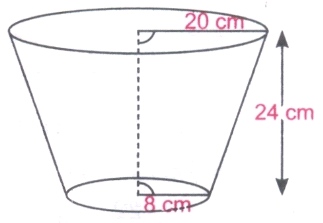
Volume of the container=\(\frac{\pi{h}}{3}\)(r12+r22+r1r2)
=\(\frac{22}{7}\times{\frac{24}{3}}\)[(8)2+(20)2+8x20]
=\(\frac{22}{7}\)x8(64+400+160)
=\(\frac{22}{7}\)x8x624 cm3=15869.14 cm3
=15.68914 l
Cost of milk which can completely fill the container=Rs.21 x 15.68914
=Rs.329.47
11.
r= 1 cm,h = ? , H = 16 cm, R1 = 10 cm, Thickness = 2.5 mm = 0.25 cm
Internal radius ofcylinder = (10 — 0.25) cm = 9.75 cm = r1
Volume of hollow cylinder = πH(R12-r12)...(i)
Volume of solid cylinder=Volume of hollow cylinder
Obtain volume of hollow cylinder from (i)
⇒ πr2h=πH(R12-r12)...(ii)
Volume of hollow cylinder=πx16x[(10)2-(9.75)2]=79π cm3
Volume of solid cylinder = volume of hollow cylinder =79π
=πr2h=79π
⇒ πx(1)2xh=79π⇒ h=79 cm
12.
Radius of cylinder=radius of cone=radius of hemisphere
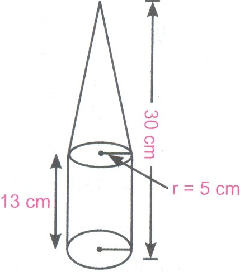
Total height of the toy = 30 cm
height of cone =30 cm-(height of cylinder + r of hemisphere)
= 30 cm - (13+5) cm =12 cm
l of cone=\(\sqrt { { r }^{ 2 }+{ h }^{ 2 } } =\sqrt { { 12 }^{ 2 }+{ 5 }^{ 2 } } \)
\(=\sqrt { 144+25 } =\sqrt { 169 } =13cm\)
C.S.A. of toy = C.S.A of cone + C.S.A of cylinder + C.S.A. of hemisphere
\(=\pi rl+2\pi rh+{ 2\pi r }^{ 2 }=\pi r(l+2h+2r)\)
\(=\frac { 22 }{ 7 } \times 5(13+2\times 13+2\times 5)\)
\(=\frac { 22 }{ 7 } \times 5(13+26+10)=770{ cm }^{ 2 }\)
13.
Let surface area of sphere be x cm2
⇒ 4πr2=x cm2 ⇒ r=\(\sqrt{\frac{x}{4\pi}}\)cm
Volume of sphere=\(\frac{4}{3}\pi \times \left(\frac{x}{4\pi}\right)^{3/2}\)cm3
Also surface area of cube be x cm2
⇒ 6 x side2=x cm2 ⇒ side=\(\sqrt{\frac{x}{6}}\)cm
Volume of cube=\(\left(\frac{x}{6}\right)^{3/2}\)cm3
Volume of sphere : Volume of cube
=\(\frac{4}{3}\pi \times \left(\frac{x}{4\pi}\right)^{3/2}\):\(\left(\frac{x}{6}\right)^{3/2}\)=1:\(\sqrt{\frac{\pi}{6}}\)
14.
False.

Total surface area of the figure = \(\frac { 2\pi { r }h+\pi { r }^{ 2 } }{ upper\quad cylinder } +\frac { \pi { r }^{ 2 }+2\pi { r }h }{ lower\quad cylinder } =4\pi { r }h+2\pi { r }^{ 2 }\)
15.
Surface area=154 cm2
\(\Rightarrow\ \ 4\pi r^2=154\ \ \Rightarrow r^2={154\times7\over4\times22}\)
\(\Rightarrow\ \ r=\sqrt{7\times7\over2\times2}={7\over2}=3.5\)
16.
(i) 57.750 L
(ii) Social cohension
17.
Radius of hemisphere = 4.2 cm
Volume of hemisphere =\(\frac { 2 }{ 3 } \pi \) r3
=\(\frac { 2 }{ 3 } \pi \times (4.2)^{ 3 }{ cm }^{ 3 }\) =49.329 \(\pi \) cm3
∴ volume of 2 hemispheres
=2 X =98.392\(\pi \) cm3 = 98.784\(\pi \) cm3
Height of cylinder =10 cm
Radius =4.2 cm
∴ volume of cylinder =\(\pi \) r2h
=\(\pi \) X (4.2)2X 10=176.4 \(\pi \)
∴ volume of metal left
=176.4\(\pi \) -98.3784\(\pi \) =77.616\(\pi \) cm3
Radius of wire =0.7 cm
let length of wire be x
Volume of wire =\(\pi \) X 0.7 X 0.7 X x
=0.49\(\pi \) x cm3
⇒ 0.49\(\pi \)x =77.616 \(\pi \)
⇒ x= 158.4 cm
∴ length of wire =158.4 cm
18.
Radius (r1) of 1st sphere = 6 cm
Radius (r2) of 2nd sphere = 8 cm
Radius (r3) of 3rd sphere = 10 cm
Let the radius of the resulting sphere be r.
The object formed by recasting these spheres will be same in volume as the sum of the volumes of these spheres.
Volume of 3 spheres = Volume of resulting sphere
\(\begin{array}{l} \frac{4}{3} \pi\left[r_{1}^{3}+r_{2}^{3}+r_{3}^{3}\right]=\frac{4}{3} \pi r^{3} \\ \frac{4}{3} \pi\left[6^{3}+8^{3}+10^{3}\right]=\frac{4}{3} \pi r^{3} \end{array}\)
r3 = 216 + 512 + 1000 = 1728
r = 12 cm
Therefore, the radius of the sphere so formed will be 12 cm.
19.
Radius = 14 m
Height of cylinder = 3m
Height of cone = (13.5- 3) = 10.5m
Slant height of cone = \(\sqrt { r^{ 2 }+h^{ 2 } } \)
\(=\sqrt { (14)^{ 2 }+(10.5)^{ 2 } } =\sqrt { 306.25 } =17.5m\)
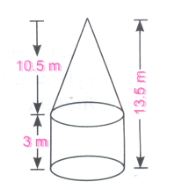
Area to be painted = \(2\pi rh+\pi rl=\pi r(2h+l)\)
= \(\frac { 22 }{ 7 } \times 14(2\times 3+17.5)\)
= 44(6+17.5) = 1034 m2
Cost of painting 1 m2 = Rs 2
Cost of painting 1034 m2 = Rs 2 x 1034 = Rs 2068
20.
()
\(\left( \frac { 2r }{ 3 } +h \right) \)
21.
()
\(2\pi r(2r+h)\)
22.
()
14 cm
23.
()
7 cm
24.
()
Cone and hemisphere.
25.
()
piece cut off
26.
()
\(\pi rl+\pi { r }^{ 2 }\quad or\quad \pi r(l+r)\)

10th Standard CBSE Syllabus & Materials
10th Standard CBSE
CBSE 10th Social Science PS - Federalism - New Model Questions Papers Study Material - QB365 Set A
NEW10th Standard CBSE
CBSE 10th Social Science PS - Power Sharing - New Model Questions Papers Study Material - QB365 Set A
NEW10th Standard CBSE
CBSE 10th Social Science GEO - Manufacturing Industries - New Model Questions Papers Study Material - QB365 Set A
NEW10th Standard CBSE
CBSE 10th Social Science GEO - Minerals and Energy Resources - New Model Questions Papers Study Material - QB365 Set A



CBSE 10th Standard CBSE Subjects
CBSE Standards





