
 100% FREE ACCESS
10th Standard CBSE Syllabus & Materials
10th Standard CBSE
CBSE 10th Social Science ECO - Globalisation and the Indian Economy - New Model Questions Papers Study Material - QB365 Set A
NEW10th Standard CBSE
CBSE 10th Social Science ECO - Money and Credit - New Model Questions Papers Study Material - QB365 Set A
NEW10th Standard CBSE
CBSE 10th Social Science ECO - Sectors of the Indian Economy - New Model Questions Papers Study Material - QB365 Set A
NEW10th Standard CBSE
CBSE 10th Social Science ECO - Development - New Model Questions Papers Study Material - QB365 Set A
NEW10th Standard CBSE
CBSE 10th Social Science PS - Outcomes of Democracy - New Model Questions Papers Study Material - QB365 Set A
NEW10th Standard CBSE
CBSE 10th Social Science PS - Gender, Religion and Caste - New Model Questions Papers Study Material - QB365 Set A

Published on: 16/09/2019
Surface Areas and Volumes
Download CBSE Class 10th Standard CBSE Maths question papers, sample papers, important questions, and previous year solved papers in PDF format. Get free study materials, NCERT solutions, and exam preparation resources for Class 10th Standard CBSE Maths
Questions + Answers key
Take MCQ Maths Test
1.
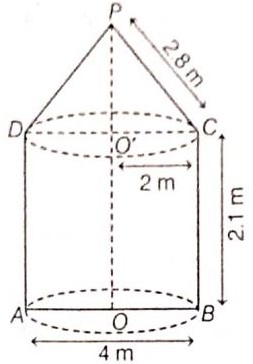
A tent is in the shape of a cylinder surmounted by a conical top. If the height and diameter of the cylindrical part are 2.1 m and 4 m respectively, and the slant height of the top is 2.8 m, find the area of the canvas used for making the tent. Also, find the cost of the canvas of the tent at the rate of Rs. 500 per m2 . (Note that the base of the tent will not be covered with canvas.)
2.
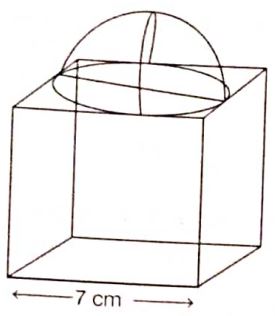
A cubical block of side 7 cm is surmounted by a hemisphere. What is the greatest diameter the hemisphere can have? Find the surface area of the solid.
3.
From a solid cylindrical whose height is 2.4cm and diameter 1.4cm, a conical cavity of the same height and same diameter is hollowed out.Find the total surface area of the remaining solid to the nearest cm2 .
4.
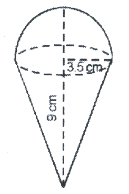
An ice-cream cone consisting of a cone surmounted by a hemisphere. The radius of the hemisphere is 3.5 cm and height of the ice-cream cone is 12. 5 cm. Calculate the volume of the ice-cream in the cone.
5.
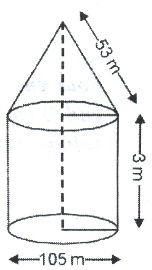
A circus tent is cylindrical upto a height of 3 m and conical above it. If the diameter of the base is 105 m and the slant height of the conical part is 53 m, find the total canvas used in making the tent.
6.
Three cubes of metal whose edges are 3 cm, 4 cm and 5 cm are melted and a single cube is formed. Find the edge of the single cube so formed.
7.
A metallic right circular cone 20 cm high and whose vertical angle is 60o is cut into two parts at the middle of its height by a plane parallel to its base. If the frustum so obtained be drawn into a wire of diameter \(\frac{1}{16}\) cm, find the length of the wire.
8.
A plot of land in the form of a rectangle has dimensions 240 m x 180 m. A drainlet 10 m wide is dug all around it (on the outside) and the earth dug out is evenly spread over the plot, increasing its surface level by 25 cm. Find the depth of the drainlet.
9.
One iron solid is a cuboid of dimensions 30cm x 30cm x 42.65cm.It is melted and cubes each of side 3cm are moulded from it.Find the number of cubes formed.
10.
The area of the base of a cone is 770 cm2 and the curved surface area is 814 cm2 . Find the volume of the cone.
11.
A cone of height 10 cm and radius 10 cm is to be divided into two parts by cutting through the mid point of the vertical axis. Find the volume of the upper conical part.
12.
A factory manufactures 1,20,000 pencils daily. The pencils are cylindrical in shape, each of length 25 cm and circumference 1.5 cm. Determine the cost of colouring the curved surfaces of the pencils manufactured in one day at Rs. 0.05 per dm2 .
13.
The length of a hall 20m and width 16m.The sum of the areas of the floor and the flat roof is equal to the sum of the four walls.Find the height and the volume of the hall.
14.
The sum of the radius of the base and the height of a solid cylinder is 37cm.If the total surface area of the of the solid cylinder is 1628cm2, find the volume of the cylinder.\([\pi=22/7]\)
15.
Rachel, an engineering student, was asked make a model shaped like a cylinder with two cones attached at its two ends by using a thin aluminium sheet.The diameter of the model is 3cm and its length is 12cm.
If each cone has a height of 2 cm, find the volume of air contained in the model that Rachel made.(Assume the outer and inner dimensions of the model to be nearly the same.)
1.
Given that, tent is a combination of a cylinder and a cone.
For conical portion,
Slant height, l = 2.8 m
Radius, r = Radius of cylinder \(=\frac{\text { Diameter }}{2}=\frac{4}{2}=2 \mathrm{~m}\)
For cylindrical portion,
Radius, r = \(\frac{4}{2}=2 \mathrm{~cm}\)
Height, h = 2.1 m
\(\therefore\) Required surface area of the tent = CSA of cone + CSA of cylinder
\(\begin{aligned} & =\pi r l+2 \pi r h=\pi r(l+2 h) \\ \end{aligned}\)
\(\begin{aligned} & =\frac{22}{7} \times 2 \times(2.8+2 \times 2.1) \\ \end{aligned}\)
\(\begin{aligned} & =\frac{44}{7}(2.8+4.2)=\frac{44}{7} \times 7=44 \mathrm{~m}^2 \end{aligned}\)
Now, cost of the canvas of the tent at the rate of Rs 500 per m2 = Surface area \(\times\) Cost per m2 = 44 \(\times\) 500 = Rs 22000
2.
Given, a cubical block is surmounted by a hemisphere. Therefore, diameter of hemisphere must be equal to the side of cubical block and it is the greatest diameter of hemisphere.
For cubical portion,
Edge = 7 cm
For hemispherical portion,
Diameter = 7 cm
\(\therefore\) Radius, r = \(\frac{7}{2}\)cm
Now, required surface area of solid = TSA of the cube + CSA of hemisphere - Area of circular base of hemisphere.
\(\begin{aligned} & =6 \times(\text { Edge })^2+2 \pi r^2-\pi r^2 \\ \end{aligned}\)
\(\begin{aligned} & =6 \times(7)^2+2 \times \frac{22}{7} \times \frac{7}{2} \times \frac{7}{2}-\frac{22}{7} \times \frac{7}{2} \times \frac{7}{2} \\ \end{aligned}\)
\(\begin{aligned} & =294+11 \times 7-\frac{11 \times 7}{2} \\ \end{aligned}\)
\(\begin{aligned} & =294+77-\frac{77}{2} \end{aligned}\)
= 371 - 38.5 = 332.5 cm2
3.
Given that,
Height (h) of the conical part = Height (h) of the cylindrical part = 2.4 cm
Diameter of the cylindrical part = 1.4 cm
Therefore, radius (r) of the cylindrical part = 0.7 cm
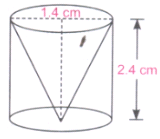
Slant height of the conical activity l=\(\sqrt{\left(Radius \ of \ base\right)^{2}+\left(Height \ of \ cylinder\right)^{2}}\)
=\(\sqrt{\left(0.7\right)^{2}+\left(2.4\right)^{2}}\)=\(\sqrt{0.49+5.76}\)
=\(\sqrt{6.25}\)=2.5 cm
Total surface area of the remaining solid will be = CSA of cylindrical part + CSA of conical part + Area of cylindrical base
= 2πrh + πrl + πr2
\(=2 \times \frac{22}{7} \times 0.7 \times 2.4+\frac{22}{7} \times 0.7 \times 2.5+\frac{22}{7} \times 0.7 \times 0.7\)
= 4.4 x 2.4 + 2.2 x 2.5 + 2.2 x 0.7
=10.56+5.50+1.54 = 17.60 cm2
The total surface area of the remaining solid to the nearest cm2 is 18 cm2.
4.
Radius of hemisphere and cone = 3.5 cm
Height of conical portion = 9 cm
\(\therefore\) Volume of the ice-cream in the cone
= Volume of hemisphere + Volume of cone
\(={{2}\over{3}}{\pi r}^{3}+{{1}\over{3}}{\pi r}^{2}h={{1}\over{3}}{\pi r}^{2}(2r+h)\)
\(={{1}\over{3}}\times{{22}\over{7}}\) x 3.5 x 3.5 x [ 2x 3.5 + 9 ]
\(={{1}\over{3}}\times{{22}\over{7}}\) x 3.5 x 3.5 x 16
= 205.33 cm3
5.
Here, radius of cylindrical portion and conical portion = \(\frac{105}{2}\) m.
Slant height of conical portion = 53 m
Total canvas used in making the tent = C.S.A. of cylindrical portion + C.S.A. of conical portion
=2πrh+πrl
=2x\(\frac{22}{7}\times{\frac{105}{2}}\times{3}+\frac{22}{7}\times{\frac{105}{2}}\times{53}\)
=990+8745=9735 m2
6.
Volume of first cube =3x3x3
= 27 cm3
Volume of second cube = 4x4x4
= 64 cm3
Volume of third cube = 5x5x5
= 125 cm3
Volume of single cube = 27 + 64 + 125
= 216 cm3
Edge Of single cube = 6 cm
Hence, the edge of single cube so formed is 6 cm.
7.
Let ADC is a cone with vertical angle 600
Now, cone is cut into two parts, parallel to its base at height 10cm.
Radius of larger end of the frustum=R1
In ΔAO'C, tan 300=\(\frac{O'C}{O'A}\)
\(\frac{1}{\sqrt{3}}\)=\(\frac{O'C}{20}\)=\(\frac{R_{1}}{20}\)⇒ R1=\(\frac{20}{\sqrt{3}}\)cm
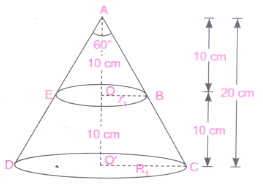
In ΔAOB, tan 300=\(\frac{r_{1}}{OA}\)
⇒ \(\frac{1}{\sqrt{3}}\)=\(\frac{r_{1}}{10}\)⇒ r1=\(\frac{10}{\sqrt{3}}\)cm
Volume of frustum=\(\frac{\pi{h}}{3}\)(R12+r12+R1r1)
=\(\frac{22}{7}\times{\frac{10}{3}}\left[\left(\frac{20}{\sqrt{3}}\right)^{2}+\left(\frac{10}{\sqrt{3}}\right)^{2}+\frac{20\times{10}}{\sqrt{3}\times{\sqrt{3}}}\right]\)
=\(\frac{22}{7}\times{\frac{10}{3}}\left[\frac{400}{3}+\frac{100}{3}+\frac{200}{3}\right]=\frac{22}{7}\times\frac{10}{3}\times{\frac{700}{3}}=\frac{22\times{10}\times{100}}{9}\)
A wire be formed having diameter \(\frac{1}{16}\)cm and length be h cm
Volume of wire so obtained=πr2h
=\(\frac{22}{7}\times{\left(\frac{1}{16\times{2}}\right)}^{2}\times{h}=\frac{22}{7}\times{\frac{1}{32}}\times\frac{1}{32}\times{h}\)
According to the question,
\(\frac{22\times{10}\times{100}}{9}=\frac{22}{7}\times{\frac{1}{32}}\times{\frac{1}{32}}\times{h}\)
⇒ \(\frac{22\times{10}\times{100}\times{32}\times{32}\times{7}}{22\times{9}}\)=h⇒ 796444.44 cm ⇒ h=7964.4 m
8.
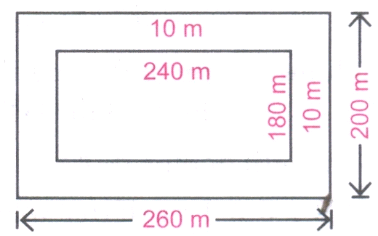
Let the depth of drainlet be h m
Volume of the earth taken out
=260 x 200 x h -240 x 180 x h
= 100 x h[26 x 20-24 x 18]
Level is raised by 25 cm=\(\frac{25}{100}\)=\(\frac{1}{4}\)m
Volume of earth taken out = volume of the platform
⇒ 100 x h[520-24x18]=240x180x\(\frac{1}{4}\)
⇒ (88)h x 100=60x180
⇒ h=1.227m=1.23m
9.
Let the number of cubes be n
Volume of a cuboid=l x b x h
=30 x 30 x 42.6cm2
Volume of cube=33
Volume of cuboid=nx volume of one cube
30 x 30 x 42.6=3 x 3 x 3 x n \(\Rightarrow\ n={30\times30\times42.6\over3\times3\times3}=1420\)
10.
\(616\sqrt {5} \ cm^{2}\)
11.
\({125\over3} \pi \ cm^{3}\)
12.
Rs 2250
13.
Let the height of the hall be h m.
Then, sum of areas of four walls=2(l+b)h m2
=2(20+16)h m2=72 h m2
Sum of the areas of the floor and the flat roof=(20x16+20x16)m2=640 m2
It is given that the sum of areas of four walls is equal to the sum of the areas of the floor and roof.
72h=640⇒h=\(\frac{640}{72}\)m=\(\frac{80}{9}\)m=8.88m
So, height of the hall=8.88m
Volume of the hall=(20x16x\(\frac{80}{9}\))m3=\(\frac{25600}{9}\)m3=2844.4 m3
14.
Let radius of the base be r
r+h=37 cm
h=(37-r)cm
Total surface area=2πr(r+h)⇒1628=2x\(\frac{22}{7}\)xrx37
r=1628x\(\frac{7}{22\times{2}\times{37}}\)=7cm
h=(37-7)cm=30 cm
Volume of cylinder=πr2h=\(\frac{22}{7}\)x(7)2x30 cm3=22x7x30 cm3
=4620 cm3
15.
Given, model is a combination of a cylinder and two cones. clearly, volume of the air will be equal to the sum of the volumes of two cones and one cylinder.
We have, diameter of the model, BC = ED = 3 cm
\(\therefore\) Radius of cone = radius of cylinder, \(r=\frac{3}{2}=1.5 \mathrm{~cm}\)
Length of cone, h1 = 2 cm
Total length of the model, AF = 12 cm
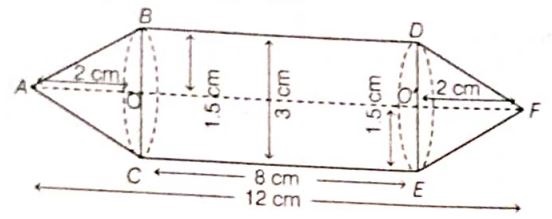
\(\therefore\) Length of the cylinder, OO' = AF - (AO + O' F)
= 12 - (2 + 2) = 8 cm = h2
Now, volume of the air inside the model = Volume of air inside (cone + cylinder + cone)
\(\begin{aligned} & =\left(\frac{1}{3} \pi r^2 h_1+\pi r^2 h_2+\frac{1}{3} \pi r^2 h_1\right) \\ \end{aligned}\)
\(\begin{aligned} & =\frac{1}{3} \pi r^2\left(h_1+3 h_2+h_1\right) \\ \end{aligned}\)
\(\begin{aligned} & =\frac{1}{3} \times \frac{22}{7} \times 1.5 \times 1.5(2+3 \times 8+2) \\ \end{aligned}\)
\(\begin{aligned} & =\frac{22}{7} \times \frac{2.25}{3} \times(2+24+2) \\ \end{aligned}\)
\(\begin{aligned} & =\frac{22}{7} \times 0.75 \times 28=22 \times 3=66 \mathrm{~cm}^3 \end{aligned}\)

10th Standard CBSE Syllabus & Materials
10th Standard CBSE
CBSE 10th Social Science PS - Federalism - New Model Questions Papers Study Material - QB365 Set A
NEW10th Standard CBSE
CBSE 10th Social Science PS - Power Sharing - New Model Questions Papers Study Material - QB365 Set A
NEW10th Standard CBSE
CBSE 10th Social Science GEO - Manufacturing Industries - New Model Questions Papers Study Material - QB365 Set A
NEW10th Standard CBSE
CBSE 10th Social Science GEO - Minerals and Energy Resources - New Model Questions Papers Study Material - QB365 Set A



CBSE 10th Standard CBSE Subjects
CBSE Standards





