
 100% FREE ACCESS
10th Standard CBSE Syllabus & Materials
10th Standard CBSE
CBSE 10th Social Science ECO - Globalisation and the Indian Economy - New Model Questions Papers Study Material - QB365 Set A
NEW10th Standard CBSE
CBSE 10th Social Science ECO - Money and Credit - New Model Questions Papers Study Material - QB365 Set A
NEW10th Standard CBSE
CBSE 10th Social Science ECO - Sectors of the Indian Economy - New Model Questions Papers Study Material - QB365 Set A
NEW10th Standard CBSE
CBSE 10th Social Science ECO - Development - New Model Questions Papers Study Material - QB365 Set A
NEW10th Standard CBSE
CBSE 10th Social Science PS - Outcomes of Democracy - New Model Questions Papers Study Material - QB365 Set A
NEW10th Standard CBSE
CBSE 10th Social Science PS - Gender, Religion and Caste - New Model Questions Papers Study Material - QB365 Set A

Published on: 08/10/2019
Triangles
Download CBSE Class 10th Standard CBSE Maths question papers, sample papers, important questions, and previous year solved papers in PDF format. Get free study materials, NCERT solutions, and exam preparation resources for Class 10th Standard CBSE Maths
Questions + Answers key
Take MCQ Maths Test
1.
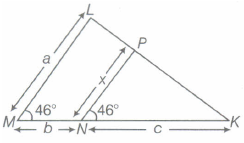
In the given figure, \(\angle M=\angle N=\) 46°. Express x in terms of a, b and c, where a, b and c are the lengths of LM, MN and NK respectively.
2.
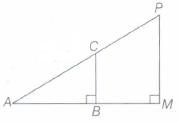
\(\triangle ABC\) and \(\triangle AMP\) are two right angled triangles. right angled at B and M, respectively. Prove that CA x MP = PA x BC
3.
In \(\triangle PQR\) and \(\triangle MST\) , \(\angle P={ 55 }^{ ° }\), \(\angle Q={ 25 }^{ ° }\), \(\angle M={ 100 }^{ ° }\) and \(\angle S={ 25 }^{ ° }\). Is \(\triangle QPR\sim \triangle TSM\) ? Why?
4.
Find the value of unknown variables, if \(\triangle ABC\) and \(\triangle PQR\)are similar.
-q.png)
-q.png)
5.
For going to city B from city A, there is a route via city C such that \(AC\bot CB\) , AC = 2x km and CB = 2 (x + 7) km. It is proposed to construct a 26 km highway, which directly connects the two cities A and B. Find how much distance will be saved in reaching city B from city A after the construction on the highway?
6.
If the lengths of the diagonals of rhombus are 16 cm and 12 cm. Then, find the length of the sides of the rhombus.
7.
Find the third side of a right angled triangle whose hypotenuse is of length p cm, one side of length q cm and p - q = 1.
8.
A ladder 17 m long, reaches at a window of a building 15 m above the ground. Find the distance of the foot of the ladder from the building.
9.
AD is an altitude of an equilateral \(\triangle ABC\) . In AD as base another equilateral triangle is ADE is constructed. Prove that \(ar\left( \triangle ADE \right) =ar\left( ABC \right) =3:4\) .
10.
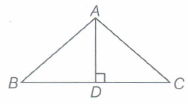
In the given figure, if \(\angle BAC\) = 90° and \(AD\bot BC\) . prove thart AD2 = BD.CD
1.
Prove \(\triangle PNK\) and \(\triangle LMK\), similar then, \(\frac { NK }{ MK } =\frac { PN }{ LM } \)
\(\frac { c }{ b+c } =\frac { x }{ a } \Rightarrow x=\frac { ac }{ b+c } \)
2.
Prove \(\triangle ABC\) and \(\triangle AMP\) are similar.
then take ratio \(\frac{AC}{AP}=\frac{BC}{MP}\)
3.
-s.png)
-s.png)
The correct correspondence will be \(\triangle QRP\sim \triangle SMT\) No
4.
\(\triangle ABC\) and \(\triangle PQR\) are similar
\(\frac { AB }{ PQ } =\frac { BC }{ QR } \Rightarrow \frac { x }{ 4.8 } =\frac { 2 }{ 6.4 } \Rightarrow x=1.5\)
and \(\frac { AC }{ PR } =\frac { BC }{ QR } \Rightarrow \frac { 4 }{ y } =\frac { 2 }{ 6.4 } \Rightarrow x=12.8\)
x = 1.5 cm and y = 12.8 cm
5.
Draw the figure according to the given conditions and use Pythagoras theorem to find the value of x, then required saved distance will be equal to the difference of (AC + BC) and 26.
8 km.
6.
Diagonals of a rhombus bisect each other at right angles.
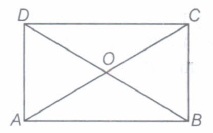
So, OA = OC = 8 cm
and OB = OD = 6 cm
Now use pythagoras theorem in ΔAOB
10 cm.
7.
Apply Pythagoras theorem, and use the result p - q = 1
8.
Use Pythagoras theorem, to find the distance of the foot of the ladder from the building.
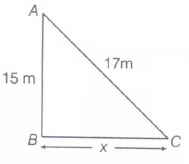
= 8 m
9.
We know that perpendicular draw from a vertex to its opposite base bisects the base in an equilateral triangle.
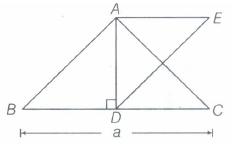
\(BD=\frac { BC }{ 2 } =\frac { a }{ 2 } \)
In \(\triangle ADB,\angle ADB={ 90 }^{ ° }\)
AB2 = AD2 + BD2
[using Pythagoras theorem]
\({ a }^{ 2 }={ AD }^{ 2 }+\left( \frac { a }{ 2 } \right) ^{ 2 }\)
\(\Rightarrow AD=\frac { \sqrt { 3 } }{ 2 } \)
\(\triangle ABC\) and \(\triangle ADE\) are equilateral triangles and hence equiangular.
\(\therefore \triangle ABC\sim \triangle ADE\)
\(\frac { ar\left( \triangle ADE \right) }{ ar\left( \triangle ABC \right) } =\frac { { AD }^{ 2 } }{ { AB }^{ 2 } } =\frac { \left( \frac { \sqrt { 3 } }{ a } \right) ^{ 2 } }{ { a }^{ 2 } } =\frac { 3 }{ 4 } \)
10.
Prove \(\triangle ADB\sim \triangle ADC\), then \(\frac { BD }{ AD } =\frac { AD }{ CD } \)
\(\Rightarrow \) AD2 = BD.CD

10th Standard CBSE Syllabus & Materials
10th Standard CBSE
CBSE 10th Social Science PS - Federalism - New Model Questions Papers Study Material - QB365 Set A
NEW10th Standard CBSE
CBSE 10th Social Science PS - Power Sharing - New Model Questions Papers Study Material - QB365 Set A
NEW10th Standard CBSE
CBSE 10th Social Science GEO - Manufacturing Industries - New Model Questions Papers Study Material - QB365 Set A
NEW10th Standard CBSE
CBSE 10th Social Science GEO - Minerals and Energy Resources - New Model Questions Papers Study Material - QB365 Set A



CBSE 10th Standard CBSE Subjects
CBSE Standards





