
 100% FREE ACCESS
10th Standard CBSE Syllabus & Materials
10th Standard CBSE
CBSE 10th Social Science ECO - Globalisation and the Indian Economy - New Model Questions Papers Study Material - QB365 Set A
NEW10th Standard CBSE
CBSE 10th Social Science ECO - Money and Credit - New Model Questions Papers Study Material - QB365 Set A
NEW10th Standard CBSE
CBSE 10th Social Science ECO - Sectors of the Indian Economy - New Model Questions Papers Study Material - QB365 Set A
NEW10th Standard CBSE
CBSE 10th Social Science ECO - Development - New Model Questions Papers Study Material - QB365 Set A
NEW10th Standard CBSE
CBSE 10th Social Science PS - Outcomes of Democracy - New Model Questions Papers Study Material - QB365 Set A
NEW10th Standard CBSE
CBSE 10th Social Science PS - Gender, Religion and Caste - New Model Questions Papers Study Material - QB365 Set A

Published on: 19/08/2019
Triangles
Download CBSE Class 10th Standard CBSE Maths question papers, sample papers, important questions, and previous year solved papers in PDF format. Get free study materials, NCERT solutions, and exam preparation resources for Class 10th Standard CBSE Maths
Questions + Answers key
Take MCQ Maths Test
1.
A man steadity goes 8 m due East and then 6 m due North.
(i) Find the distance from initial point to last point.
(ii) Which mathematical concept is used in this problem?
(iii) What value is indicated in this question?
2.
If \(\triangle ABC\sim \triangle DFE\), \(\angle A={ 30 }^{ ° }\) , \(\angle C={ 50 }^{ ° }\) , AB = 5 cm, AC = 8 cm and DF = 75 cm, then find DE and \(\angle F\)
3.
In the given figure, CB II QR and CA II PR. If AQ = 12 cm, AR = 20 cm, PB = CQ = 15 cm, calculate PC and BR.
4.
ABC is a right triangle right angled at C. Let BC=1, CA=b, AB=c and p be the length of perpendicular from C on AB. Prove that cp=ab.
5.
If triangle ABC is similar to triangle DEF such that 2AB = DE and BC = 8 cm, then find EF.
6.
In the given figure, if DE || BC, then calculate x.
7.
If ratio of corresponding sides of two similar triangles is 5 : 6, then find ratio of their areas.
8.
Are two triangle with equal corresponding sides always similar? Two triangles having corresponding sides equal are similar.
9.
In the given figure, if \(\angle\)A=900, \(\angle\)B=900, OB=4.5 cm, OA=6 cm and AP=4 cm, then find the QB.
10.
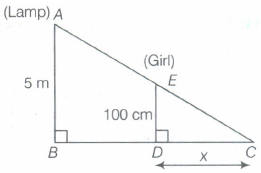
A girl of height 100 cm is walking away from the base of a lamppost at a speed of 1.9 m/s. If the lamp is 5 m above the ground, find the length of her shadow after 4s.
11.
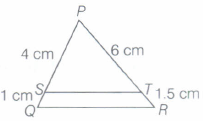
In the given figure, PS, SQ, PT and TR are 4 cm, 1 cm, 6 cm and 1.5 cm respectively.
Prove that \(ST\parallel QR\) . Also, find \(\frac { ar\left( \triangle PST \right) }{ ar\left( trapezium\quad QRTS \right) } \)
12.
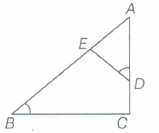
In \(\triangle ABC\) , if \(\angle ADE=\angle B\) , then prove that \(\triangle ADE\sim \triangle ABC\) . Also, if AD = 7.6 cm, AE = 7.2 cm, BE = 4.2 cm and BC = 8.4 cm, find DE.
13.
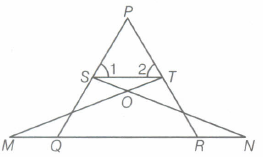
In the given figure, if \(\angle1=\angle2\) and \(\triangle NSQ\cong \triangle MTR\) , prove that \(\triangle PTS\sim \triangle PRQ\)
14.
An equilateral triangle is inscribed in a circle of radius 6 cm. Find its side.
15.
In a right angled triangle, if hypotenuse is 20 cm and the ratio of other two sides is 4 : 3, find the other sides.
16.
If the areas of two similar triangles are respectively 81 cm2 and 49 cm2 Find the ratio of their corresponding medians.
17.
In the given figure, BC II PQ and BC = 8 cm, PQ = 4 cm, BA = 6.5 cm, AP =2.8 cm. Find CA and AQ.
18.
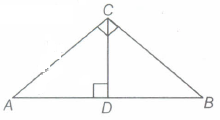
In the given figure, \(\triangle ACB={ 90 }^{ ° }\) and \(CD\bot AB\) . Prove that \(\frac { { BC }^{ 2 } }{ { AC }^{ 2 } } =\frac { BD }{ AD } \)
19.
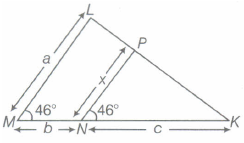
In the given figure, \(\angle M=\angle N=\) 46°. Express x in terms of a, b and c, where a, b and c are the lengths of LM, MN and NK respectively.
20.
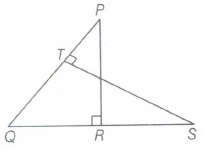
In the given figure, PQR and QST are two right angled triangles, right angled at R and T, respectively. Prove that QR x QS = QP x QT.
21.
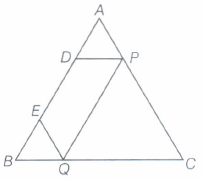
In the given figure, D and E are two points lying on side AB, such that AD = BE. If \(DP\parallel BC\) and \(EQ\parallel AC\), then prove that \(PQ\parallel AB\).
22.
\(\triangle ABC\) and \(\triangle AMP\) are two right angled triangles. right angled at B and M, respectively. Prove that CA x MP = PA x BC
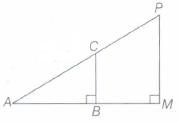
23.
In the given figure, \(DE\parallel BC\) . If AD = 3 cm, DB = 4 cm and AE = 6 cm, find EC.
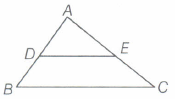
24.
If D and E are points on the respective sides AB and AC of \(\triangle ABC\) such that AD = 6 cm. BD = 9 cm, AE = 8 cm, EC = 12 cm. Prove that \(DE\parallel BC\).
25.
If \(\triangle ABC\sim \triangle PQR\), AB = 6.5 cm, PQ = 10.4 cm and perimeter of \(\triangle ABC\) = 60 cm, find the perimeter of \(\triangle PQR\).
26.
ABC is a triangle. PQ is a line segment intersecting AB at P and AC at Q such that \(PQ\parallel BC\) and divides \(\triangle ABC\) into two parts equal in area. Find BP / AB.
1.
(i) Man is at distance of 10 m from the initial position.
(ii) Right angled triangle pythagoras theorem.
(iii) Knowledge of direction and speed save the time.
2.
As \(\triangle ABC\sim \triangle DFE\)
\(\angle D=\angle A={ 30 }^{ ° }\)
\(\angle C=\angle E={ 50 }^{ ° }\)
\(\angle B=\angle F={ 180 }^{ ° }-\left( { 50 }^{ ° }+{ 30 }^{ ° } \right) ={ 100 }^{ ° }\)
Now, \(\frac { AB }{ DF } =\frac { AC }{ DE } \)
\(\frac { 5 }{ 7.5 } =\frac { 8 }{ DE } \)
\(\Rightarrow DE=12cm,\angle F={ 100 }^{ ° }\)
3.
In \(\triangle\) PQR, CA || PR
\(\therefore \quad \frac { PC }{ CQ } =\frac { RA }{ AQ } (By\quad BPT)\)
\(\Rightarrow \quad \frac { PC }{ 15 } =\frac { 20 }{ 12 } \)
\(\Rightarrow \quad PC=\frac { 20\times 15 }{ 12 } =25\)
\(\therefore \quad PC=25\quad cm\)
In \(\triangle\) PQR , CB || QR
\(\therefore \quad \frac { PC }{ CQ } =\frac { PB }{ BR } (By\quad BPT)\)
\(\Rightarrow \quad \frac { 25 }{ 15 } =\frac { 15 }{ BR } \)
\(\Rightarrow \quad BR=\frac { 15\times 15 }{ 25 } =9\quad cm\)
4.
Let \(CD\bot AB,\)
then CD=p
Area of \(\triangle\)ABC= \(\frac {1}{2}\) x base x height
\(\Rightarrow\)Area of \(\triangle\)ABC=\(\frac {1}{2}\) x AB x CD= cp
Also, Area of \(\triangle\)ABC=\(\frac {1}{2}\) x BC x AC= ab
\(\frac {1}{2}\)cp=\(\frac {1}{2}\)ab
\(\Rightarrow\)cp=ab.
5.
Given 2AB = DE and BC = 8 cm
\(\triangle\)ABC ~ \(\triangle\)DEF
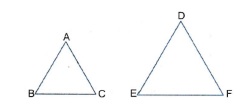
So \(\frac { AB }{ BC } =\frac { DE }{ EF } \)
\(\Rightarrow d \frac { AB }{ 8 } =\frac { 2AB }{ EF } \)
\(\therefore EF=2\times 8=16 cm.\)
6.
Given DE || BC, then
\(\frac { AD }{ AB } =\frac { DE }{ BC } \) (By Thales Theorem)
\(\Rightarrow \quad \frac { 3 }{ AD+DB } =\frac { x }{ 14 } \\ \Rightarrow \frac { 3 }{ 3+4 } =\frac { x }{ 14 } \\ \Rightarrow \quad \frac { 3 }{ 7 } =\frac { x }{ 14 } \)
\(\Rightarrow \) 7x=14 x 3
\(\therefore \quad x=\frac { 14\ \times 3 }{ 7 } =6\)
7.
Let the triangles be \(\triangle\)ABC and \(\triangle\)DEF
\(\frac { ar(\triangle ABC) }{ ar(\triangle DEF) } =\left( \frac { 5 }{ 6 } \right) ^{ 2 }=\frac { 25 }{ 36 } \)
25 : 36
8.
No, Angle included should be same.
9.
In \(\triangle\)PAO and \(\triangle\)QBO
\(\angle\)A=\(\angle\)B=900
\(\angle\)POA=\(\angle\)QOB (Vertically Opposite Angle)
\(\triangle\)PAO~\(\triangle\)QBO, (by AA)
\(\therefore \quad \frac { OA }{ OB } =\frac { PA }{ QB } \\ \Rightarrow \frac { 6 }{ 4.5 } =\frac { 4 }{ QB } \\ \Rightarrow \quad QB=\frac { 4\times 4.5 }{ 6 } \\ \therefore \quad QB=3\quad cm\)
10.
Let AB be the lamp-post and ED be the position of girl after 4s.
Given, height of the girl, ED = 100 cm
and height of the lamp-post, AB = 5 m = 500 cm
Distance of the girl from lamp-post after 4 s
= 1.9 x 4 = 7.6 m = 760 cm
[\(\because\) distance = speed x time]
i.e. BD = 760 cm
Let DC = x cm
In \(\triangle CDE\) and \(\triangle CBA\),
\(\angle DCE=\angle BCA\) [common angle]
\(\angle CDE=\angle CBA\) [each 90°]
\(\therefore \triangle CDE\sim \triangle CBA\) [by AA similarity criterion]
So, \(\frac { CD }{ CB } =\frac { DE }{ BA } \Rightarrow \frac { x }{ x+760 } =\frac { 100 }{ 500 } \)
\(\Rightarrow\) 5x = x + 760
\(\Rightarrow\) 4x = 760
\(\Rightarrow\) x = 190 cm
Hence, the length of her shadow 4s is 190 cm.
11.
\(\frac{16}{9}\)
12.
In \(\triangle ADE\) and \(\triangle ABC\),
\(\angle ADE=\angle ABC\) [given]
\(\angle DAE=\angle BAC\) [common angle]
So, \(\triangle ADE\sim \triangle ABC\)
[by AA similarity criterion]
Then, \(\frac{AD}{AB}=\frac{AE}{AC}=\frac{DE}{BC}\)
[since, corresponding sides of similar triangles are proportional]
\(\Rightarrow \frac{7.6}{7.2 + 4.2}=\frac{DE}{8.4}\) [\(\because\) AB = AE + BE]
\(\Rightarrow \frac{7.6}{11.4}\times 8.4=DE \Rightarrow\) DE = 5.6 m
13.
Given \(\triangle NSQ\cong \triangle MTR\) and \(\angle1=\angle2\)
To prove \(\triangle PTS\sim \triangle PRQ\)
Proof Since, \(\triangle NSQ\cong \triangle MTR\)
\(\therefore\) SQ = TR ... (i)
Also, \(\angle1=\angle2\)
\(\Rightarrow\) PT = PS .... (ii)
[since, sides opposite to equal angles are also equal]
From Eqs.(i) and (ii), \(\frac{PS}{SQ}=\frac{PT}{TR}\)
\(\Rightarrow ST\parallel QR\)
[by converse of basic proportionality theorem]
\(\therefore \angle 1=\angle PQR\) and \( \angle 2=\angle PRQ\)
[\(\therefore\) atternate exterior angle]
In \(\triangle PTS\) and \(\triangle PRQ\),
\(\angle P=\angle P\) [common angle]
\(\angle 1=\angle PQR\) [proved above]
and \(\angle 2=\angle PRQ\)
\(\therefore \triangle PTS\sim \triangle PRQ\)
[by AAA similarity criterion]
14.
Let \(\Delta A B C\) is an equilateral triangle of each side '2a' inscribed in a circle of radius 6 ern and centre O.
Draw AD⊥BC. Then, BD = DC [∵ In an equilateral triangle, perpendicular bisects the base]
Also, O lies on AD [∵ In an equilateral triangle circumcentre and centroid coincides]
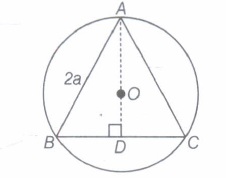
Thus, OA : OD = 2 : 1
\(\Rightarrow \frac{6}{O D}=\frac{2}{1} \Rightarrow O D=3 \mathrm{~cm}, \text { then } A D=9 \mathrm{~cm}\)
Now, use pythagoras theorem in ΔABD.
\(6 \sqrt{3} \mathrm{~cm}\)
15.
12 cm, 16 cm
16.
9 : 7
17.
In \(\triangle\)ABC and \(\triangle\)AOQ.
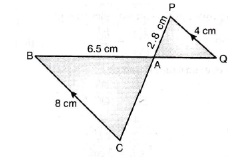
BC II PQ (Given)
\(\therefore\) \(\angle\)CBA = \(\angle\)AQP (Alternate angles)
\(\angle\)BAC = \(\angle\)PAQ (Vertically opposite angles)
\(\therefore\) \(\triangle\)ABC - \(\triangle\)AQP (AA Similarity)
\(\Rightarrow \frac { AB }{ AQ } =\frac { BC }{ QP } =\frac { AC }{ AP } \)
\(\Rightarrow \frac { 6.5 }{ AQ } =\frac { 8 }{ 4 } =\frac { AC }{ 2.8 } \)
\(\Rightarrow AQ=\frac { 6.5 }{ 2 } =3.25 cm,\)
and AC = 2 x 2.8 = 5.6 cm.
18.
In \(\triangle ADC\) and \(\triangle ACB\),
\(\angle ADC=\angle ACB\) [each 90°]
\(\angle DAC=\angle CAB\) [common angle]
So, \(\triangle ADC\sim \triangle ACB\)
[by AA similarity criterion]
Then, \(\frac{AD}{AC}=\frac{AC}{BA}\)
[since, corresponding sides of similar triangles are proportional]
\(\Rightarrow \) AC2 = AB x AD ..... (i)
Similarity, \(\triangle BDC\sim \triangle BCA\)
\(\therefore \frac{BD}{BC}=\frac{BC}{AB}\)
[since, corresponding sides of similar triangles are proportional]
\(\Rightarrow \) BC2 = AB x BD ..... (ii)
On dividing Eq (ii) by Eq (i), we get
\(\frac { { BC }^{ 2 } }{ { AC }^{ 2 } } =\frac { BD }{ AD } \)
19.
Prove \(\triangle PNK\) and \(\triangle LMK\), similar then, \(\frac { NK }{ MK } =\frac { PN }{ LM } \)
\(\frac { c }{ b+c } =\frac { x }{ a } \Rightarrow x=\frac { ac }{ b+c } \)
20.
In \(\triangle PRQ\) and \(\triangle STQ\),
\(\angle PRQ=\angle STQ\) [each 90°]
\(\angle PQR=\angle SQT\) [common angle]
So, \(\triangle PRQ\sim \triangle STQ\) [by AA similarity criterion]
Then, \(\frac { QR }{ QT } =\frac { QP }{ QS } \)
[since, corresponding sides of similar triangles are proportional]
\(\Rightarrow \) QR x QS = QP x QT
21.
\(DP\parallel BC\) and \(EQ\parallel AC\)
\(\frac { AD }{ DB } =\frac { AP }{ PC } \) and \(\frac { BE }{ EA } =\frac { BQ }{ QC } \)
\(\frac { AD }{ DB } =\frac { AP }{ PC } \) and \(\frac { AD }{ DB } =\frac { BQ }{ QC } \)
[EA = ED + DA = ED + BE = BD \(\Rightarrow \) AD = BE]
\(\Rightarrow \frac { AP }{ PC } =\frac { BQ }{ QC } \)
In \(\triangle ABC\), P and Q divides sides CA and CB respectively, in the same ratio
\(\Rightarrow PQ\parallel AB\)
22.
Prove \(\triangle ABC\) and \(\triangle AMP\) are similar.
then take ratio \(\frac{AC}{AP}=\frac{BC}{MP}\)
23.
In \(\triangle ABC, DE\parallel BC\)
Let EC = x cm
\(\Rightarrow \frac { AD }{ DB } =\frac { AE }{ EC } \)
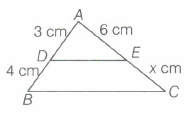
[by basic proportionality theorem]
\(\Rightarrow \frac { 3 }{ 4 } =\frac { 6 }{ x } \Rightarrow \) x = 8 cm
\(\therefore \) EC = 8 cm
24.
In \(\triangle ABC\), \(\frac { AD }{ DB } =\frac { 6 }{ 9 } =\frac { 2 }{ 3 } \)
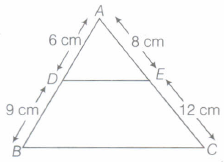
and \(\frac { AE }{ EC } =\frac { 8 }{ 12 } =\frac { 2 }{ 3 } \)
So, \(\frac { AD }{ DB } =\frac { AE }{ EC } \)
Hence, \(DE\parallel BC\)
[ by converse of basic proportionallity theorem]
25.
Given, AB = 6.5 cm and PQ = 10.4 cm
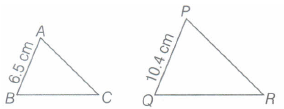
Since, \(\triangle ABC\sim \triangle PQR\)
\(\frac { AB }{ PQ } =\frac { BC }{ QR } =\frac { AC }{ PR } =\frac { 6.5 }{ 10.4 } =\frac { 65 }{ 104 } \)
[ \(\because \) Corresponding sides of similar triangles are proportional]
i.e. \(AB=\frac { 65 }{ 104 } PQ,BC=\frac { 65 }{ 104 } QR,AC=\frac { 65 }{ 104 } PR\)
Also given, perimeter of \(\triangle ABC\) = 60
\(\therefore AB+BC+AC=60\)
\(\Rightarrow \frac { 65 }{ 104 } \left( PQ+QR+PR \right) =60\)
\(PQ+QR+PR=\frac { 60\times 104 }{ 65 } \) = 96 cm
Hence, periemeter of \(\triangle PQR\) is 96 cm.
26.
\(\frac { \sqrt { 2 } -1 }{ \sqrt { 2 } } \)

10th Standard CBSE Syllabus & Materials
10th Standard CBSE
CBSE 10th Social Science PS - Federalism - New Model Questions Papers Study Material - QB365 Set A
NEW10th Standard CBSE
CBSE 10th Social Science PS - Power Sharing - New Model Questions Papers Study Material - QB365 Set A
NEW10th Standard CBSE
CBSE 10th Social Science GEO - Manufacturing Industries - New Model Questions Papers Study Material - QB365 Set A
NEW10th Standard CBSE
CBSE 10th Social Science GEO - Minerals and Energy Resources - New Model Questions Papers Study Material - QB365 Set A



CBSE 10th Standard CBSE Subjects
CBSE Standards





