
 100% FREE ACCESS
10th Standard CBSE Syllabus & Materials
10th Standard CBSE
CBSE 10th Social Science ECO - Globalisation and the Indian Economy - New Model Questions Papers Study Material - QB365 Set A
NEW10th Standard CBSE
CBSE 10th Social Science ECO - Money and Credit - New Model Questions Papers Study Material - QB365 Set A
NEW10th Standard CBSE
CBSE 10th Social Science ECO - Sectors of the Indian Economy - New Model Questions Papers Study Material - QB365 Set A
NEW10th Standard CBSE
CBSE 10th Social Science ECO - Development - New Model Questions Papers Study Material - QB365 Set A
NEW10th Standard CBSE
CBSE 10th Social Science PS - Outcomes of Democracy - New Model Questions Papers Study Material - QB365 Set A
NEW10th Standard CBSE
CBSE 10th Social Science PS - Gender, Religion and Caste - New Model Questions Papers Study Material - QB365 Set A

Published on: 26/09/2019
Triangles
Download CBSE Class 10th Standard CBSE Maths question papers, sample papers, important questions, and previous year solved papers in PDF format. Get free study materials, NCERT solutions, and exam preparation resources for Class 10th Standard CBSE Maths
Questions + Answers key
Take MCQ Maths Test
1.
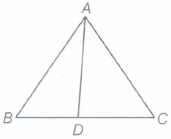
In the figure, \(\triangle ABC\) is drawn such that \(AD\bot BC\), then show that AC 2 = AB2 + BC2 - 2BC.BD.
2.
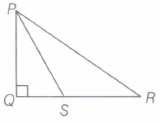
In the given figure, \(\triangle PQR\) is a right angled triangle in which \(\angle Q\) = 90°. If QS = SR, show that PR2 = 4 PS2 - 3PQ2.
3.
In \(\triangle PQR,PS\bot QR\) and PS2 = QS x RS. Prove that \(\triangle PQR\) is a right angled triangle.
4.
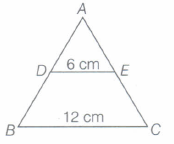
In the given figure, if \(DE\parallel BC\), find the ratio of ar \(\left( \triangle ADE \right) \) and ar \(\left( \triangle DECB \right) \)
5.
If \(\triangle ABC\sim \triangle QRP\), \(\frac { ar\left( \triangle ABC \right) }{ ar\left( \triangle QRP \right) } =\frac { 9 }{ 4 } \), AB = 18 cm and BC = 15 cm, then find PR.
6.
A girl of height 90 cm is walking away from the base of a lamp-post at a speed of 1.2 m/s. If the lamp is 3.6 m above the ground, find the length of her shadow after 4 seconds.
7.
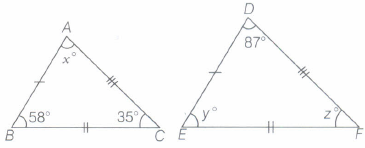
Find the value of each of the pronumerals in the given pair of triangles. Give reason for your answer.
8.
In the given figure, \(\triangle ABC\) and \(\triangle DBC\) have same base BC and lie on the same side of BC. If \(PQ\parallel BA\) and \(PR\parallel BD\), then prove that \(QR\parallel AD\) .

9.
In \(\triangle ABC\) , D and E are points on the sides AB and AC respectively, such that \(DE\parallel BC\) . If AD = 4x - 3, AE = 8x - 7, BD = 3x - 1 and CE = 5x - 3, find the value of x.
10.
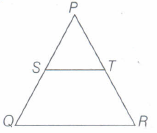
In \(\triangle PQR,ST\parallel QR,\frac { PS }{ SQ } =\frac { 3 }{ 5 } \) and PR = 28 cm, find PT.
11.
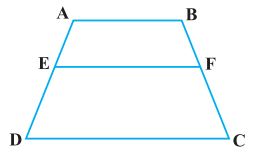
ABCD is a trapezium with AB || DC. E and F are points on non-parallel sides AD and BC respectively such that EF is parallel to AB. Show that \(\frac{AE}{ED}=\frac{BF}{FC}\).
12.
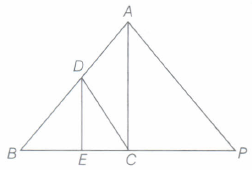
In the given figure of \(\triangle ABC\), \(DE\parallel AC\). If \(DC\parallel AP\), where point P lies on BC produced, then prove that \(\frac { BE }{ EC } =\frac { BC }{ CP } \).
13.
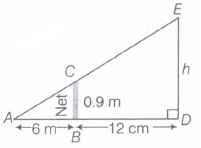
Find the value of the height 'h' in the adjoining figure. at which the tennis ball must be hit, so that it will just pass over the net and land 6 m away from the base of the net.
14.
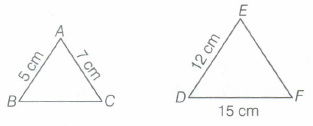
It is given that \(\triangle ABC\sim \triangle EDF\) such that AB = 5 cm, AC = 7 cm, DF = 15 cm and DE = 12 cm. Find the lengths of the remaining sides of the triangles.
15.
If \(\triangle ABC\sim \triangle PQR\), AB = 6.5 cm, PQ = 10.4 cm and perimeter of \(\triangle ABC\) = 60 cm, find the perimeter of \(\triangle PQR\).
1.
Given ABC is a triangle in which \(AD\bot BC\) .
To show AC 2 = AB2 + BC2 - 2BC.BD.
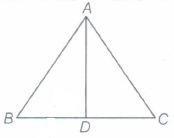
proof In \(\triangle ADC\),
As, \(AD\bot BC\)
AC2 = AD2 + DC2 [by Pythagoras theorem]
AD2 = AC2 - DC2... (i)
In \(\triangle ABD\)
AB2 = BD2 + AD2 [by Pythagoras theorem]
AD2 = AB2 - BD2 ... (ii)
From Eq.(i) and Eq.(ii),
AC2 - DC2 = AB2 - BD2
AC2 = AB2 + DC2 - BD2
AC2 = AB2 + (BC - BD)2
- BD2 [aS, DC = BC - BD]
= AB2 + BC2 + BD2 - 2 . BC. BD - BD2
AC2 = AB2 + BC2 - 2BC.BD.
2.
Given \(\triangle PQR\) is a right angled triangle \(\angle Q\) = 90°, QS = SR.
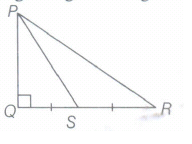
To show PR2 = 4 PS2 - 3 PQ2
Proof \(\triangle PQR\),
PR2 = PQ2 + OR2 [by Pythagoras theorem] ... (i)
Now, QS = SR [given]
QR = SR = \(\frac{1}{2}\) QR
QR = 2QS ... (ii)
Put QR = 2QS in Eq.(i),
then, PR2 = PQ2 + (2QS)2 = PQ2 + 4QS2
In \(\triangle PQS\),
PS2 = PQ2 + QS2
\(\Rightarrow \) QS2 = PS2 - PQ2 ... (iii)
\(\Rightarrow \) PR2 = PQ2 + 4 (PS2 - PQ2) [from Eq.(iii)]
= PQ2 + 4 PS2 - 4 PQ2
\(\therefore \) PR2 = 4 PS2 - 3 PQ2
3.
In right angled \(\triangle PSQ\) and \(\triangle PSR\) ,
PQ2 = PS2 + QS2... (i)
and PR2 = PS2 + SR2... (ii)
On adding Eqs.(i) and (ii), we get
PQ2 + PR2 = 2 PS2 + QS2 + SR2
= 2 (QS x SR) + QS2 + SR2
[\(\because \) PS2 = QS x RS, given]
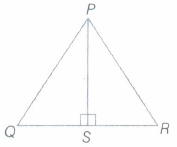
= (QS + SR)2 = QR2
[\(\because \) a2 + b2 + 2ab = (a + b)2]
\(\Rightarrow \) PQ2 + PR2 = QR2
Hence, \(\triangle PQR\) is a right angled triangle right angled at P.
4.
Given, \(DE\parallel BC\) , DE = 6 cm and BC = 12 cm
In \(\triangle ABC\) and \(\triangle ADE\),
\(\angle ABC=\angle ADE\) [corresponding angles]
\(\angle ACB=\angle AED\) [corresponding angles]
and \(\angle A=\angle A\) [common angle]
\(\therefore \triangle ABC\sim \triangle ADE\) [by AAA similarity criterion]
We know that, the ratio of areas of two similar triangles is equal to the ratio of squares of their corresponding sides.
\(\therefore \frac { ar\left( \triangle ADE \right) }{ ar\left( \triangle ABC \right) } =\frac { { \left( DE \right) }^{ 2 } }{ { \left( BC \right) }^{ 2 } } =\frac { { \left( 6 \right) }^{ 2 } }{ { \left( 12 \right) }^{ 2 } } =\left( \frac { 1 }{ 2 } \right) ^{ 2 }\)
\(\Rightarrow \frac { ar\left( \triangle ADE \right) }{ ar\left( \triangle ABC \right) } =\left( \frac { 1 }{ 2 } \right) ^{ 2 }=\frac { 1 }{ 4 } \)
Let \(ar\left( \triangle ADE \right) =k\) , then \(ar\left( \triangle ABC \right) =4k\)
Now, \(ar\left( \triangle DECB \right) =ar\left( \triangle ADC \right) - ar\left( \triangle ADE \right) \)
= 4k - k = 3k
\(\therefore \) Required ratio = \(ar\left( \triangle ADE \right) : ar\left( \triangle DECB \right) \)
= k : 3k = 1 : 3
5.
Given, \(\triangle ABC\sim \triangle QRP\), AB = 18 cm, BC = 15 cm
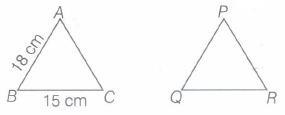
We know that, the ratio of areas of two similar triangles is equal to the ratio of squares of their corresponding sides.
\(\therefore \frac { ar\left( \triangle ABC \right) }{ ar\left( \triangle QRP \right) } =\frac { { \left( BC \right) }^{ 2 } }{ { \left( RP \right) }^{ 2 } } \)
But \(\frac { ar\left( \triangle ABC \right) }{ ar\left( \triangle QRP \right) } =\frac { 9 }{ 4 } \) given]
\(\Rightarrow \frac { { \left( 15 \right) }^{ 2 } }{ { \left( RP \right) }^{ 2 } } =\frac { 9 }{ 4 } \) [\(\because \) BC = 15 cm]
\(\Rightarrow { \left( RP \right) }^{ 2 }=\frac { 225\times 4 }{ 9 } =100\)
\(\therefore \) RP = 10 cm
[taking positive square root]
6.
Let AB denote the lamp-post and CD the girl after walking for 4 seconds away from the lamp-post.
From the figure, you can see that DE is the shadow of the girl. Let DE be x metres.
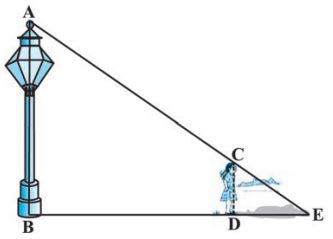
Now, BD = 1.2 m \(\times\) 4 = 4.8 m.
Note that in \(\Delta\) ABE and \(\Delta\) CDE,
\(\angle\)B and \(\angle\)D (Each is of 90° because lamp-post as well as the girl are standing vertical to the ground)
and \(\angle\)E = \(\angle\)E (Same angle)
So, \(\Delta \mathrm{ABE} \sim \Delta \mathrm{CDE}\) (AA similarity criterion)
Therefore, \(\frac{\mathrm{BE}}{\mathrm{DE}}=\frac{\mathrm{AB}}{\mathrm{CD}}\)
i.e., \(\frac{4.8+x}{x}=\frac{3.6}{0.9} \quad\left(90 \mathrm{~cm}=\frac{90}{100} \mathrm{~m}=0.9 \mathrm{~m}\right)\)
i.e., 4.8 + x = 4x
i.e., 3x = 4.8
i.e., x = 1.6
So the shadow of the girl after walking for 4 seconds is 1.6 m long.
7.
Given, AB = DE, BC = EF and AC = DF
\(\therefore \triangle ABC\sim \triangle DEF\) [by SSS similarity criterion]
So, x = 87°, y = 58° and z = 35°
[since, corresponding angles of similar triangles are equal]
8.
Given \(\triangle ABC\) and \(\triangle DBC\) have same base BC and lie on the same side of BC.
To prove \(QR\parallel AD\)
Construction Join QR and AD.
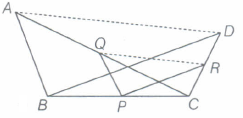
Proof Since, \(PQ\parallel AB\)
So, \(\frac { CP }{ PB } =\frac { CQ }{ QA } \) [by basic proportionality theorem] ... (i)
\(\because PR\parallel BD\)
So, \(\frac { CP }{ PB } =\frac { CR }{ RD } \) [by basic proportionality theorem] ... (ii)
From Eqs. (i) and (ii), \(\frac { CQ }{ QA } =\frac { CR }{ RD } \)
Hence, \(QR\parallel AD\)
[by converse of basic proportionality theorem]
9.
Given, in \(\triangle ABC\), \(DE\parallel BC\)
By Thales theorem, we get
\(\frac { AD }{ DB } =\frac { AE }{ EC } \)
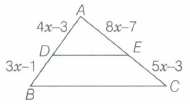
\(\Rightarrow \frac { 4x-3 }{ 3x-1 } =\frac { 8x-7 }{ 5x-3 } \)
[\(\because \) AD = 4x - 3, DB = 3x - 1, AE = 8x - 7, EC = 5x - 3]
\(\Rightarrow \) (4x - 3)(5x - 3) = (8x - 7)(3x - 1)
\(\Rightarrow \) 20x2 - 12x + 9 - 15x = 24x2 - 21x - 8x + 7
\(\Rightarrow \) 4x2 - 2x - 2 = 0
\(\Rightarrow \) 2x2 - x - 1 = 0 [dividing both sides by 2]
\(\Rightarrow \) 2x2 - 2x + x - 1 = 0 [by splitting the middle term]
\(\Rightarrow \) 2x(x - 1) + 1 (x - 1) = 0
\(\Rightarrow \) (2x + 1) (x - 1) = 0 \(\therefore x=-\frac { 1 }{ 2 } \) or x = 1
If \(x=-\frac { 1 }{ 2 } \), then AD = \(4\times -\frac { 1 }{ 2 } -3=-5<0\) [not possible]
Hence, x = 1 is the required value.
10.
Given \(ST\parallel QR\), PS/SQ = 3/5 and PR = 28 cm
By using basic proportionality theorem, we get
\(\frac { PS }{ SQ } =\frac { PT }{ TR } \Rightarrow \frac { PS }{ SQ } =\frac { PT }{ PR-PT } \)
\(\Rightarrow \frac { 3 }{ 5 } =\frac { PT }{ 28-PT } \)
\(\Rightarrow 3\left( 28-PT \right) =5PT\)
\(\Rightarrow 84=5PT+3PT\Rightarrow PT=\frac { 84 }{ 8 } \)
\(\Rightarrow PT=\) 10.5 cm
Hence, the length of PT is 10.5 cm.
11.
Let us join AC to intersect EF at G
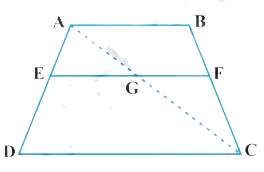
AB || DC and EF || AB (Given)
So, EF || DC (Lines parallel to the same line are parallel to each other)
Now, in \(\Delta\) ADC,
EG || DC (As EF || DC)
So, \(\frac{AE}{ED}=\frac{AG}{GC}\)
Similarly, from \(\Delta\)CAB,
\(\begin{aligned} & \frac{C G}{A G}=\frac{C F}{B F} \\ \end{aligned}\)
\(\begin{aligned} & \frac{A G}{G C}=\frac{B F}{F C} \end{aligned}\)
Therefore, from (1) and (2),
\(\frac{\mathrm{AE}}{\mathrm{ED}}=\frac{\mathrm{BF}}{\mathrm{FC}}\)
12.
Given, in \(\triangle ABC\), \(DE\parallel AC\) [given]
So, \(\frac { BE }{ EC } =\frac { BD }{ DA } \) ... (i)
[ by basic proportionality theorem]
Also, \(DC\parallel AP\) [given]
So, \(\frac { BC }{ CP } =\frac { BD }{ DA } \) ... (ii)
[ by basic proportionality theorem]
From Eqs. (i) and (ii), we get
\(\frac { BE }{ EC } =\frac { BC }{ CP } \)
13.
Since, the height h is measured vertically, so \(\angle EDA\) is a right angle. We assume that the net (i.e. CB) is vertical.
Here, \(\triangle ADE\) and \(\triangle ABC\) are similar as they are equiangular.
\(\therefore \frac { DE }{ BC } =\frac { AD }{ AB } \) [ Corresponding sides of similar triangles are proportional]
\(\Rightarrow \frac { h }{ 0.9 } =\frac { 18 }{ 6 } \Rightarrow \frac { h }{ 0.9 } =3\)
h = 0.9 x 3 = 2.7 m
Hence, the height at which the ball should be hit, is 2.7 m.
14.
Given, \(\triangle ABC\sim \triangle EDF\)
Also, AB = 5 cm, AC = 7 cm, DF = 15 cm
and DE = 12 cm .... (i)
Since, \(\triangle ABC\sim \triangle EDF\)
\(\therefore \frac { AB }{ ED } =\frac { AC }{ EF } =\frac { BC }{ DF } \)
[ ∵ Corresponding sides of similar triangles are proportions]
\(\Rightarrow \frac { 5 }{ 12 } =\frac { 7 }{ EF } =\frac { BC }{ 15 } \) [from Eq. (i)]
On taking first and second terms, we get
\(\frac { 5 }{ 12 } =\frac { 7 }{ EF } \Rightarrow EF=\frac { 7\times 12 }{ 5 } \) = 16.8 cm
On taking first and third terms, we get
\(\frac { 5 }{ 12 } =\frac { BC }{ 15 } \Rightarrow BC=\frac { 5\times 15 }{ 12 } \) = 6.25 cm
Hence, lengths of the remaining sides of the triangles are EF = 16.8 cm and BC = 6.25 cm.
15.
Given, AB = 6.5 cm and PQ = 10.4 cm
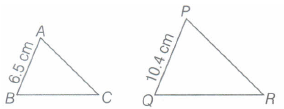
Since, \(\triangle ABC\sim \triangle PQR\)
\(\frac { AB }{ PQ } =\frac { BC }{ QR } =\frac { AC }{ PR } =\frac { 6.5 }{ 10.4 } =\frac { 65 }{ 104 } \)
[ \(\because \) Corresponding sides of similar triangles are proportional]
i.e. \(AB=\frac { 65 }{ 104 } PQ,BC=\frac { 65 }{ 104 } QR,AC=\frac { 65 }{ 104 } PR\)
Also given, perimeter of \(\triangle ABC\) = 60
\(\therefore AB+BC+AC=60\)
\(\Rightarrow \frac { 65 }{ 104 } \left( PQ+QR+PR \right) =60\)
\(PQ+QR+PR=\frac { 60\times 104 }{ 65 } \) = 96 cm
Hence, periemeter of \(\triangle PQR\) is 96 cm.

10th Standard CBSE Syllabus & Materials
10th Standard CBSE
CBSE 10th Social Science PS - Federalism - New Model Questions Papers Study Material - QB365 Set A
NEW10th Standard CBSE
CBSE 10th Social Science PS - Power Sharing - New Model Questions Papers Study Material - QB365 Set A
NEW10th Standard CBSE
CBSE 10th Social Science GEO - Manufacturing Industries - New Model Questions Papers Study Material - QB365 Set A
NEW10th Standard CBSE
CBSE 10th Social Science GEO - Minerals and Energy Resources - New Model Questions Papers Study Material - QB365 Set A



CBSE 10th Standard CBSE Subjects
CBSE Standards





