
 100% FREE ACCESS
10th Standard CBSE Syllabus & Materials
10th Standard CBSE
CBSE 10th Social Science ECO - Globalisation and the Indian Economy - New Model Questions Papers Study Material - QB365 Set A
NEW10th Standard CBSE
CBSE 10th Social Science ECO - Money and Credit - New Model Questions Papers Study Material - QB365 Set A
NEW10th Standard CBSE
CBSE 10th Social Science ECO - Sectors of the Indian Economy - New Model Questions Papers Study Material - QB365 Set A
NEW10th Standard CBSE
CBSE 10th Social Science ECO - Development - New Model Questions Papers Study Material - QB365 Set A
NEW10th Standard CBSE
CBSE 10th Social Science PS - Outcomes of Democracy - New Model Questions Papers Study Material - QB365 Set A
NEW10th Standard CBSE
CBSE 10th Social Science PS - Gender, Religion and Caste - New Model Questions Papers Study Material - QB365 Set A

Published on: 14/08/2019
Real Number
Download CBSE Class 10th Standard CBSE Maths question papers, sample papers, important questions, and previous year solved papers in PDF format. Get free study materials, NCERT solutions, and exam preparation resources for Class 10th Standard CBSE Maths
Questions + Answers key
Take MCQ Maths Test
1.
Use Euclid division lemma to show that the square of any positive integer cannot be of the form 5m + 2 or 5m + 3 for some integer m.
2.
Find the greatest number which on dividing 1657 and 2037 leaves remainders 6 and 5, respectively.
3.
If HCF of two numbers is 2 and their product is 120, find their LCM.
4.
Explain, why (3 x 5 x 7) + 7 is a composite number?
5.
Find the HCF of 960 and 432.
6.
For any positive integer n, prove that n3 - n is divisible by 6.
7.
Write the missing numbers is the following factorisation.
(i) -q.png) (ii)
(ii) -q.png)
8.
The traffic lights at three different roads crossings change after 48, 72 and 108 s, respectively. If they change simultaneously at 7 am, then at what time will they change simultaneously again?
9.
If the HCF of 657 and 963 is expressible in the form of 657x + 963 (-15), find x.
10.
Explain why 7 × 11 × 13 + 13 and 7 × 6 × 5 × 4 × 3 × 2 × 1 + 5 are composite numbers.
11.
Use Euclid's division lemma to show that the square of any positive integer is either of the form 3m or 3m + 1, for some integer m.
12.
The HCF of two numbers is 113 and their LCM is 56952. If one number is 904, find the other number.
13.
If two positive integers p and q can be expressed as p = ab2 and q = a3b; where a,b being prime numbers, find the LCM (p,q)
14.
Show that the square of an odd positive integer is of the form 8m + 1, where m is some whole number.
15.
The product of two consecutive positive integers is divisible by 2. Is this statement true or false? Give reason.
16.
Calculate \(\frac { 3 }{ 8 } \) in the decimal form.
17.
What is the condition for the decimal expansion of a rational number to terminate? Explain with the help of an example.
18.
Show that 7n cannot end with the digit zero, for any natural number II.
19.
Show that any positive even integer can be written in the from 6q, 6q + 2 or 6q + 4, where q is an integer
20.
Explain whether \(3\times 12\times 101+4\) is a prime number or a composite number
21.
Find the missing numbers a, b, c and d in the given factor tree
22.
Calculate the HCF of 33 x 5 and 32 x 52.
23.
What is the HCF of the smallest composite number and the smallest prime number?
24.
Explain why 13233343563715 is a composite number?
25.
Find the least number that is divisible by all the numbers from 1 to 5 (both inclusive).
26.
Find the LCM of x and y, if xy = 180 and HCF of (x, y) = 5
27.
Write the HCF and LCM of the smallest odd composite number and the smallest odd prime number. If an odd number p divides q2, then will it divide q3 also? Explain.
1.
Let n be any positive integer.
By Eucild's division lemma, 11= 5q + r, \(0\le r<5\)
n = Sq, Sq + 1, Sq + 2,5q + 3 or 5q + 4, where \(q\epsilon w\) q is a whole number
now n2 = (5q)2 = 25q2 = 5(5q2) = 5m
n2= (5q + 1)2= 25q2 + 10q + 1= 5m + 1
n2 = (5q + 2)2= 25q2 + 20q + 4 = 5m+ 4
Similarly n2= (5q + 3)2 = 5m + 4
and n2 =(5q + 4)2 = 5m + 1
Thus square of any positive integer cannot be of the form 5m + 2 or 5m + 3.
2.
Required number
= HCF of (1657 - 6) and (2037 - 5)
= HCF of (1651 and 2032
By using Euclid's division lemma, we get
2032 = (1651 x 1) + 381
Here, divisor is 1651 and remainder is 381
Again, by using Euclid's division lemma, we get
1651 = (381 x 4) + 127
Here, divisor is 381 and remainder is 127.
Again, by using Euclid's division lemma, we get
381 = (127 x 3) + 0
Here, the remainder is zero.
So, HCF of 1651 and 2032 is 127.
Hence, the required number is 127 which on dividing 1657 and 2037 leaves remainders 6 and 5, respectively.
3.
Let the two number are a and b.
Given, HCF(a, b) = 2
and product (a x b) = 120
We know that,
HCF (a, b) x LCM (a, b) = Product of a and b
\(\therefore \) 2 x LCM (a, b) = 120
\(\Rightarrow \) LCM (a, b) = \(\frac{120}{2}\) = 6
Hence, the required LCM is 60.
4.
We have, (3 x 5 x 7) + 7 = 105 + 7 = 112
\(\therefore \) Prime factors of 112 = 2 x 2 x 2 x 2 x 7 = 24 x 7
So, it is the product of prime factors 2 and 7.
Hence, it is a composite number.
5.
On applying Euclid's division lemma for 960 and 432, we get
960 = (432 x 2) + 96
Here, remainder = 96 \(\neq \) 0,
so take new dividend as 432 and divisor as 96.
Then, we get 432 = (96 x 4) + 48
Here, remainder = 48 \(\neq \) 0,
so take new dividend as 96 and divisor as 48.
Then. we get 96 = (48 x 2) + 0
Here, the remainder is 0 (zero) and last divisor is 48.
Hence, HCF of 960 and 432 is 48.
6.
n3-n = n n2-1)
= n (n+1)(n-1)
=( n-1) n(n+1)
= product of threeconsecutive positive integers
Now, we ave to show that the product of three consecutive positive integers is divisible by 6.
We know that any positive integer a is of the form 3q, 3q + 1 or 3q + 2 for some integer q.
Let a, a + 1, a + 2 be any three consecutive integers.
Case I: if a=3q
a(a + l)(a + 2) = 3q(3q + 1)(3q + 2)
= 3q (2r)
= 6qr, which is divisible by 6.
(∵ Product of two consecutive integers (3q + 1) and (3q + 2) is an even integer, say 2r)
Case II: If a=3q + 1
∴ a(a + l)(a + 2) = (3q + 1)(3q + 2)(3q + 3)
= (2r) (3)(q + 1)
= 6r(q + 1),
which is divisible by 6
Case III: If a=3q + 2
ஃ a(a + l)(a + 2) = (3q + 2)(3q + 3)(3q + 4)
= multiple of 6 for ever
= 6r (say),
which is divisible by 6.
Hence, the product of three consecutive integers is divisible by 6.
7.
(i) 36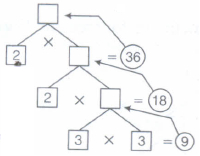
(ii) 42
8.
Hint LCM of 48. 72 and 108 = 2 x 2 x 2 x 2 x 3 × 3 x 3 = 432
Therefore, after 432 s, they will change simultaneously. We know that 60 s = 1min
⇒ 1s = 1/60 min
⇒ 432 s = 432/60 min =7min 12 s
Hence, the lights change simultaneously at 7 : 07 : 12 am.
9.
Given, HCF of 657 and 963 = 657 x + 963 (- 15) .... (i)
By using Euclid's division lemma, we get
963 = (657 x 1) + 306
Here, divisor is 657 and remainder is 306.
so, again applying Euclid's division lemma, we get
657 = (306 x 2) + 45
Here, divisor is 306 and remainder is 45.
So, again applying Euclid's division lemma, we get
306 = (45 x 6) + 36
Here, divisor is 45 and remainder is 36.
So, again applying Euclid's division lemma, we get
45 = (36 x 1) + 9
Here, divisor is 36 and remainder is 9.
So, again applying Euclid's division lemma, we get
36 = (9 x 4) + 0
Here, remainder is zero and last divisor is 9.
\(\therefore \) HCF of 657 and 963 = 9 ... (ii)
From Eqs.(i) and Eqs. (ii),
9 = 657 x + 963 (- 15)
\(\Rightarrow \) 657x = 9 + 963 x 15 = 9 + 14445
\(\Rightarrow \) 657x = 14454 \(\Rightarrow \) \(x=\frac { 14454 }{ 657 } =22\)
10.
We have, (7 x 11 x 13) + 13 = 1001 + 13 = 1014
\(\Rightarrow \) 1014 = 2 x 3 x 13 x 13
We know that, a number is called composite number, if it has atleast one factor other than 1 and the number itself. Here, 1014 is the product of more than two prime numbers, i.e. 2, 3 and 13.
So, it is a composite number.
Now, (7 x 6 x 5 x 4 x 3 x 2 x 1) + 5 = 5045
\(\Rightarrow \) 5045 = 5 x 1009
Thus, it is the product of prime factors 5 and 1009.
Hence, it is also a composite number.
11.
Consider an arbitrary positive integer y. Then, by taking y as dividend and 3 as divisor, we can write y as
y = 3q + r, where \(0\le r<3\)
[by Euclid's division lemma]
i.e. r = 0, 1, 2
Now, if r = 0, then y = 3q
if r = 1, then y = 3q + 1
and if r = 2, then y = 3q + 2
Thus, the positive integer y is of the form 3q, 3q + 1 or 3q + 2.
Consider, y = 3q and squaring on both sides, we get
y2 = (3q)2 \(\Rightarrow \) y2 + 9q2 = 3(3q)2 = 3m .... (i)
[taking 3q2 = m, where m is some integer]
Consider, y = 3q + 1 and squaring on both sides, we get
y2 = (3q + 1)2
\(\Rightarrow \) y2 = 9q2 + 6q + 1 = 3(3q2 + 2q) + 1 = 3m + 1 .... (ii)
[taking 3q2 + 2q = m, where m is some integer]
Consider, y = 3q + 2 and squaring on both sides, we get
y2 = (3q + 2)2 \(\Rightarrow \) y2 = 9q2 + 12q + 4
\(\Rightarrow \) y2 = (9q2 + 12q + 3) + 1 = 3(3q2 + 4q + 1) + 1
\(\Rightarrow \) y2 = 3m + 1 .... (iii)
From Eqs. (i), (ii) and (iii), we get y2 = 3m or 3m + 1
Thus, the square of any positive integer can be either of the form 3m or 3m + 1, for some integer m.
12.
Given, HCF = 113, LCM = 56952 and one number = 904
Let another number = x
\(\therefore \quad HCF=\frac { x\times 904 }{ LCM } \)
\(\Rightarrow \quad 113=\frac { x\times 904 }{ 56952 } \)
\(\Rightarrow \quad x=\frac { 113\times 56952 }{ 904 } =7119\)
13.
P = ab2 = a x b x b and q = a3b = a x a x a x b
LCM (p, q) = a3 b2
14.
Let a be any positive integer.
We know that, any odd positive integer is of the form 2q + 1, where q is a whole number.
\(\therefore \) a = 2q + 1
\(\Rightarrow \) a2 = (2q + 1)2 [squaring both sides]
\(\Rightarrow \) a2 = 4q(q + 1) + 1 ...(i)
Note that q(q + 1) is either '0' or even, for any whole number q.
So, let q(q + 1) = 2m where m is a whole number.
From Eq.(i), we get a2 = 4(2m) + 1 = 8m + 1
15.
True, because the product of any two consecutive numbers, say n(n + 1) will always be even as one out of n or (n+1) must be even.
16.
\(\frac { 3 }{ 8 } =\frac { 3 }{ { 2 }^{ 3 } } \)
\(=\frac { { 3\times 5 }^{ 3 } }{ { 2 }^{ 3 }\times { 5 }^{ 3 } } \)
\(=\frac { 375 }{ 10^{ 3 } } =\frac { 375 }{ 1000 } \)
\(=0.375\)
17.
The decimal expansion of a rational number terminates, if the denominator of rational no p/q, when p and q are co-primes and q can be expressed as 2m5n where In and n are non-negative integers.
e.g. \(\frac { 3 }{ 10 } =\frac { 3 }{ 2^{ 1 }\times 5^{ 1 } } =0.3\)
18.
\({ 7 }^{ n }=(1\times 7)^{ n }={ 1 }^{ n }\times { 7 }^{ n }\)
So the only prime in the factorization of 7n is 7, 1 not 2 or 5.
∴ 7n cannot end with the digit zero.
19.
Let a be any positive integer Yz
By division algorithm
a=6q + r, where \(0\le r<6\)
∴ a = 6q,6q + 1,6q + 2,6q + 3,6q + 4,6q + 5
But a is an even integer
∴ a = 6q,6q + 2, 6q+ 4
20.
\(3\times 12\times 101+4=4(3\times 3\times 101+1)\)
= 4(909+1)
= 4(910)
= a composite number
[∵ Product of more than two factors]
21.
\(a=\frac { 9,009 }{ 3,003 } =3\)
\(b=\frac { 1,001 }{ 143 } =7\)
Since 143 = 11 x 13, so c=11 or 13
and d=13 or 11.
22.
HCF of 33 x 5 and 32 x 52
= 32 x 5
= 9 x 5
= 45
23.
The smallest prime number is 2 and the smallest composite number is 22 Hence, required HCF (22,2) = 2.
24.
The given number ends in 5. Hence it is a multiple of 5. Therefore it is a composite number
25.
Required number=LCM (1, 2, 3, 4, 5)
60
26.
36
27.
\(\because \) smallest odd composite number = 9
and smallest odd prime number = 3.
\(\therefore \) HCF of 9 and 3 = 3
and LCM of 9 and 3 = 9
Now, if an odd number p divides q2, then p is one of the factors of q2, i.e. q2 = pm, for some integer m. .... (i)
Now, q3 = q2 . q \(\Rightarrow \) q3 = pm . q [from Eq.(i)]
\(\Rightarrow \) q3 = p (mq)
\(\Rightarrow \) p is a factor of q3 also \(\Rightarrow \) p divides q3

10th Standard CBSE Syllabus & Materials
10th Standard CBSE
CBSE 10th Social Science PS - Federalism - New Model Questions Papers Study Material - QB365 Set A
NEW10th Standard CBSE
CBSE 10th Social Science PS - Power Sharing - New Model Questions Papers Study Material - QB365 Set A
NEW10th Standard CBSE
CBSE 10th Social Science GEO - Manufacturing Industries - New Model Questions Papers Study Material - QB365 Set A
NEW10th Standard CBSE
CBSE 10th Social Science GEO - Minerals and Energy Resources - New Model Questions Papers Study Material - QB365 Set A



CBSE 10th Standard CBSE Subjects
CBSE Standards





