
 100% FREE ACCESS
10th Standard CBSE Syllabus & Materials
10th Standard CBSE
CBSE 10th Social Science ECO - Globalisation and the Indian Economy - New Model Questions Papers Study Material - QB365 Set A
NEW10th Standard CBSE
CBSE 10th Social Science ECO - Money and Credit - New Model Questions Papers Study Material - QB365 Set A
NEW10th Standard CBSE
CBSE 10th Social Science ECO - Sectors of the Indian Economy - New Model Questions Papers Study Material - QB365 Set A
NEW10th Standard CBSE
CBSE 10th Social Science ECO - Development - New Model Questions Papers Study Material - QB365 Set A
NEW10th Standard CBSE
CBSE 10th Social Science PS - Outcomes of Democracy - New Model Questions Papers Study Material - QB365 Set A
NEW10th Standard CBSE
CBSE 10th Social Science PS - Gender, Religion and Caste - New Model Questions Papers Study Material - QB365 Set A

Published on: 04/09/2019
Probability
Download CBSE Class 10th Standard CBSE Maths question papers, sample papers, important questions, and previous year solved papers in PDF format. Get free study materials, NCERT solutions, and exam preparation resources for Class 10th Standard CBSE Maths
Questions + Answers key
Take MCQ Maths Test
1.
Probability of getting a prime number in single throw of a die is.....
2.
Probability of getting 6 with single die is.........
3.
Sum of the probabilities of each outcome in an experiment is...........
4.
The probability of an event is greater than or equal to __________ and less than or equal to____________
5.
Probability of an event E + Probability of the event 'not E' = --------------
6.
The probability of getting a bad egg in a lot of 800 eggs is 0.125. Find the number of bad eggs in the lot.
7.
A card is drawn at random from a pack of 52 playing cards. Find the probability that the card drawn is neither an ace nor a king.
8.
A die is thrown once. Find the probability of getting a number less than 3.
9.
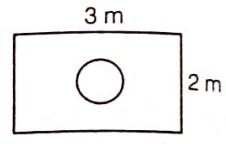
Suppose you drop a die at random on the rectangular region shown in Figure. What is the probability that it will land inside the circle of diameter 1m?
10.
A bag contains lemon flavoured candies only. Malini takes out one candy without looking into the bag. What is the probability that she takes out
(i) an orange flavoured candy?
(ii) a lemon flavoured candy?
11.
The king, queen and jack of clubs are removed from a deck of 52 playing cards and then well-shuffled. One card is selected from the remaining cards. Find the probability of getting
(i) a heart (ii) a king (iii) a club (iv) the '10' of hearts
12.
From a well-shuffled pack of playing cards, black jacks, black kings and black aces are removed. A card is then drawn at random from the pack. Find the probability of getting
(a) a red card. (b) not a diamond card.
13.
From a pack of 52 playing cards, jacks queens, kings and aces of red colour are removed. From the remaining a card is drawn at random. Find the probability that the card known is
(i) a black queen (ii) a red card
(iii) a black jack (iv) a picture card (jacks, queens and kings are picture cards)
14.
A box contains 19 balls bearing numbers 1, 2, 3, ..., 19. A ball is drawn at random from the box. What is the probability that the number on the ball is
(i) a prime number (ii) divisible by 3 or 5
(iii) neither divisible by 5 nor by 10 (iv) an even number
15.
A die is thrown twice. What is the probability that
(i) 5 will not come up either time?
(ii) 5 will come up at least once?
[Hint : Throwing a die twice and throwing two dice simultaneously are treated as the same experiment]
16.
A die is thrown once. Find the probability of getting
(i) a prime number.
(ii) a number lying between 2 and 6.
(iii) an odd number
17.
A box contains 5 red marbles, 8 white marbles and 4 green marbles. One marble is taken out of the box at random. What is the probability that the marble taken out will be (i) red? (ii) white? (iii) not green?
18.
On the basis of a throw of a pair of dice.
(i)Complete the following table:
| Event: 'Sum on 2 dice' |
Probability |
| 2 | \(1\over36\) |
| 3 | |
| 4 | |
| 5 | |
| 6 | |
| 7 | |
| 8 | \(5\over36\) |
| 9 | |
| 10 | |
| 11 | |
| 12 | \(1\over36\) |
(ii)A student argues that there are 111 possible outcomes 2,3,4,5,6,7,8,19,10,11 and 12.Therefore, each of them has a probability\(1\over11\).Do you agree with this argument? Justify your answer.
19.
In a game, the entry fee is Rs. 5. The game consists of tossing a coin 3 times. If one or two heads show, then Sweta gets her entry fee back. If she tosses 3 heads, then she receives double the entry fees. Otherwise she will lose. For tossing a coin three times, find the probability that she
(i) loses the entry fee
(ii) gets double entry fee
(iii) just gets her entry fee
20.
If P(E)=0.7, then the probability of 'not E' is
21.
Two coins are tossed simultaneously.
22.
In a class of 15 students, 8 are boys and rest are girls.The probability that a student selected will be girl is
23.
If a Random experiment is performed, then each of its outcome is known as favourable event.
24.
For an event \(E,\ P(\overset { - }{ E } )=1-P(E)\) .
25.
The sum of probabilities of all the outcomes of an experiment is greater than one.
1.
()
1/2
2.
()
1/6
3.
()
1
4.
()
0, 1, since, the probability of each event lies between 0 and 1.
5.
()
1, because the Sum of probabilities of complementary events is equal to one.
6.
Let number of bad eggs=x
Probability of getting a bad egg=\(x\over800\)
A.T.Q. \({x\over800}=0.125\)
x=0.125 x 800=100
7.
Total number of cards = 52
Number of aces and kings = 4 + 4 = 8
Number of cards which are neither ace nor king = 44
Probability that the card drawn is neither an ace nor a king = \(\frac{44}{52}=\frac{11}{13}\)
8.
Total number of ways = 6
Number of ways to get a number less than 3 = 2
\(\therefore\) Required probability = \(\frac{2}{6}=\frac{1}{3}\)
9.
Area of restangle = 3 \(\times\) 2 = 6 m2
and area of circle of radius \(\frac{1}{2} \mathrm{~m}=\pi\left(\frac{1}{2}\right)^2=\frac{\pi}{4} \mathrm{~m}^2\)
\(\left[\because \text { diameter }=1 \mathrm{~m} \Rightarrow \text { radius }=\frac{1}{2} \mathrm{~m}\right]\)
Now, probanility that the die land inside the circle
\(=\frac{\text { Area of circle }}{\text { Area of rectangle }}=\frac{\pi / 4}{6}=\frac{\pi}{24}\)
10.
(i) Let E be an event of getting an orange flavoured candy. All possible outcomes are against the event E because in a bag, all candies are lemon flavoured. So, P(E) = 0
(ii) Let F be an event of getting a lemon flavoured candy. All possible outcomes are favourable to event F because all the candies in the bag are lemon flavoured.
So. P(F) =1
11.
Card removed = king, queen and jack of clubs = 3
Cards left = 52- 3 = 49
(i) Number. of hearts = 13
Probability of drawing a heart = \(\frac {13}{49}\)
(ii) Number of king = 4
Number of kings left = 4 - 1 = 3
Probability of drawing a king = \(\frac {3}{49}\)
(iii) 3 clubs are removed
Number of clubs left=13-3=10
Probability of drawing a club = \(\frac {10}{49}\)
(iv) There is only one '10' of hearts.
\(\therefore\)Probability of drawing a '10' of hearts =\(\frac {1}{49}\)
12.
As black jacks, black kings and black aces are removed
Then remaining cards are 52 - 6 = 46.
\(\therefore \) Total outcomes of drawing the card are 46.
(a) Favourable outcomes of a red card are 26.
\(\therefore \) Probability of a red card = \(\frac { 26 }{ 46 } =\frac { 13 }{ 23 } \)
(b) Favourable outcomes for not a diamond are 46-13 = 33
\(\therefore \) Probability of not a diamond card = \(\frac { 33 }{ 46 } \).
13.
From the total playing 52 cards. red coloured jacks, queen. kings and aces are removed (i.e.. 2 jacks. 2 queens, 2 kings, 2 aces) \(\therefore\) Remaining cards = 52-8 = 44
(i) Favourable cases for a black queen are 2 (i.e., queen club or spade)
\(\therefore\)Probability of drawing a black queen
=\(\frac { \ Favourable \ cases \ for \ black \ queen } {Total \ possible \ cases}\) =\(\frac {2}{44}=\frac {1}{22}\)
(ii) Favourable cases for red cards are 26 -8 = 18 (as 8 cards have been removed) (i.e. 9 diamonds + 9 hearts)
\(\therefore\)Probability of drawing a red card = \(\frac { \ Favourable \ cases \ for \ \ a red \ card } {Total \ possible \ cases}\) =\(\frac {18}{44}=\frac {9}{22}\)
(iii) Favourable cases for a black jack are 2 (i.e. jacks of club or spade)
\(\therefore\)Probability of drawing a black jack =\(\frac { \ Favourable \ cases \ for \ a \ black \ jack } {Total \ possible \ cases}\)=\(\frac {2}{44}=\frac {1}{22}\)
(iv)Favourable cases for a picture card 6 (i.e. 2 black jacks, queens and kings each)
\(\therefore\)Probability of drawing a picture card
=\(\frac { \ Favourable \ cases \ for \ a \ picture \ card } {Total \ possible \ cases}\)=\(\frac {6}{44}=\frac {3}{22}\)
14.
Total number of balls = 19
(i) Prime numbers from 1 to 19 are 2, 3, 5, 7, 9, 11, 13, 17, 19 = Total 8 prime numbers
\(\therefore\) Probability of drawing a prime number = \(\frac{8}{19}\)
(ii) Numbers divisible by 3 or 5 are 3, 6, 9, 15, 18, 10, 5, 12 = Total 8 numbers
\(\therefore\) Probability of drawing a number divisible by 3 or 5 = \(\frac{8}{19}\)
(iii) Number divisible by 5 and 10 are 5, 10, 15 = Total 3
\(\therefore\) Numbers which are neither divisible by 5 nor 10 are 19 - 3 = 16
\(\therefore\) Probability of drawing a number which is neither divisible by 5 nor by 10 = \(\frac{16}{19}\)
(iv) Even numbers from 1- 19 are 2, 4, 6, 8, 10, 12, 14, 16, 18 [Total 9 even numbers]
\(\therefore\) Probability of drawing an even number = \(\frac{9} {19}\)
15.
Total number of outcomes = 36
(i) Let E = Event of getting 5 on atleast one die
Then, E would consist of 11 outcomes, namely (1,5), (2, 5), (3, 5), (4, 5), (5, 5), (6, 6), (5, 1), (5, 2), (5, 3), (5, 4) and (5, 6).
\(\therefore\) Number of outcomes favourable to E = 11
Hence, probability that 5 will come up atleast once,
\(P(E)=\frac{11}{36}\)
(ii) Probability that 5 will not come up either time,
\(P(\bar{E})=1-P(E)=1-\frac{11}{36}=\frac{25}{36}\)
16.
On a die, there are six numbers 1, 2, 3, 4, 5 and 6.
\(\therefore\) Total number of possible outcomes =6
(i) Let E1 = Event of getting a prime number
Then, E1 would consist of three outcomes namely 2, 3 and 5.
\(\therefore\)Number of outcomes favourable to E1 = 3
Probability of getting a prime number,
\(P\left(E_1\right)=\frac{3}{6}=\frac{1}{2}\)
(ii) Let E2 = Event of getting a number lying between 2 and 6
Then, E2 would consist of three outcomes, namely 3, 4 and 5.
\(\therefore\) Number of outcomes favourable to E2 = 3
Probability of getting a number lying between 2 and 6,
\(P\left(E_2\right)=\frac{3}{6}=\frac{1}{2}\)
(iii) Odd numbers = 1, 3, 5
\(\therefore\) P(an odd number) = \(\frac{3}{6}=\frac{1}{2}\)
17.
Total number of marbles = 5 + 8 + 4 = 17
(i) P(red marble) = \(\frac{5}{17}\)
(ii) P(white marble) = \(\frac{8}{17}\)
(iii) Let E3 = Event of drawing a marble which is not green = Event of drawing either red or white marble
\(\therefore\) Number of outcomes favourable to E3 = 5 + 8 = 13
So, probability of taken out not a green marble,
P(E3)=\(\frac{13}{17}\)
18.
Number of outcomes in a throw of a pair of dice 6 X 6 = 36
(i) Number of cases getting the sum 3 = 2 i.e., [(1, 2), (2,1)]
\(\therefore\)Probability of getting sum 3 =\(\frac {2}{36}=\frac {1}{18}\)
Number of cases getting the sum 4 = 3 i.e., [(1,3)(2,2)(3,1)]
\(\therefore\) Probability of getting sum 4= \(\frac {3}{36}=\frac {1}{12}\)
Number of cases of getting the sum 5 = 4 i.e., [(1,4),(2,3),(3,2),(4,1)]
\(\therefore\)Probability of getting sum 5= 36 9 Number of cases of getting the sum 6 = 5 i.e.,[(1,5),(2,4),(3,3),(4,2),(5,1)]
\(\therefore\)Probability of getting sum 6 = \(\frac{5}{36}\)
Number of cases of getting the sum 7 = 6 i.e.,[ (1,6), (2, 5), (3, 4), (4, 3), (5, 2), (6, 1)]
\(\therefore\) Probability of getting sum 7=\(\frac{6}{36}=\frac{1}{6}\)
Number of cases of getting the sum 9 = 4 i.e., [(3,6),(4,5),(5,4),(6,3)]
\(\therefore\)Probability of getting sum 9 = \(\frac{4}{36}=\frac{1}{9}\)
Number of cases of getting the sum 10= 3 i.e., [(5,5),(4,6),(6,4)]
\(\therefore\)Probability of getting sum 10 =\(\frac{3}{36}=\frac{1}{12}\)
Number of cases of getting the sum 11 = 2 i.e.,[(5,6),(6,5)]
\(\therefore\)Probability of getting sum 11 = \(\frac{2}{36}=\frac{1}{18}\)
| Event: 'Sum on 2 dice' | probability |
| 2 | \(\frac{1}{36}\) |
| 3 | \(\frac{2}{36} or \frac{1}{18}\) |
| 4 | \(\frac{3}{36} or \frac{1}{12}\) |
| 5 | \(\frac{4}{36} or \frac{1}{9}\) |
| 6 | \(\frac{5}{36}\) |
| 7 | \(\frac{6}{36} or \frac{1}{6}\) |
| 8 | \(\frac{5}{36}\) |
| 9 | \(\frac{4}{36} or \frac{1}{9}\) |
| 10 | \(\frac{3}{36} or \frac{1}{12}\) |
| 11 | \(\frac{2}{36} or \frac{1}{18}\) |
| 12 | \(\frac{1}{36}\) |
(ii) No, the outcomes as 11 different sum are not equally likely.
19.
Possible outcomes on tossing a coin 3 times, are HHH, HHT, HTH, THH, HTT, THT, TTH, TTT
\(\therefore\) Total number of outcomes = 8
(i) Let E1 be the event that Sweta losses the entry fee
i.e. shen tosses tail three times i.e. TTT.
\(\therefore\) Number of outcomes favourable to E1 = 1
Hence, required probability = P(E1) = \(\frac{1}{8}\)
(ii) Let E2, be the event that Sweta gets double entry fee
i.e. she tosses heads three times
i.e. HHH
\(\therefore\) Number of outcomes favourable to E2 = 1
Hence, required probability \(=P\left(E_2\right)=\frac{1}{8}\)
(iii) Let E3 be the event that Sweta gets her entry fee back
i.e. Sweta gets heads one or two times
i.e. event of getting
HTT, THT, TTH, HHT, HTH or THH
\(\therefore\) Number of outcomes favourable to E3 = 6
Hence, required probability = P(E3) = \(\frac{6}{8}=\frac{3}{4}\)
20.
()
\(3\over10\)
21.
()
\(1\over4\)
22.
()
\(7\over15\)
23.
(b)
24.
(a)
25.
(b)

10th Standard CBSE Syllabus & Materials
10th Standard CBSE
CBSE 10th Social Science PS - Federalism - New Model Questions Papers Study Material - QB365 Set A
NEW10th Standard CBSE
CBSE 10th Social Science PS - Power Sharing - New Model Questions Papers Study Material - QB365 Set A
NEW10th Standard CBSE
CBSE 10th Social Science GEO - Manufacturing Industries - New Model Questions Papers Study Material - QB365 Set A
NEW10th Standard CBSE
CBSE 10th Social Science GEO - Minerals and Energy Resources - New Model Questions Papers Study Material - QB365 Set A



CBSE 10th Standard CBSE Subjects
CBSE Standards





