
 100% FREE ACCESS
10th Standard CBSE Syllabus & Materials
10th Standard CBSE
CBSE 10th Social Science ECO - Globalisation and the Indian Economy - New Model Questions Papers Study Material - QB365 Set A
NEW10th Standard CBSE
CBSE 10th Social Science ECO - Money and Credit - New Model Questions Papers Study Material - QB365 Set A
NEW10th Standard CBSE
CBSE 10th Social Science ECO - Sectors of the Indian Economy - New Model Questions Papers Study Material - QB365 Set A
NEW10th Standard CBSE
CBSE 10th Social Science ECO - Development - New Model Questions Papers Study Material - QB365 Set A
NEW10th Standard CBSE
CBSE 10th Social Science PS - Outcomes of Democracy - New Model Questions Papers Study Material - QB365 Set A
NEW10th Standard CBSE
CBSE 10th Social Science PS - Gender, Religion and Caste - New Model Questions Papers Study Material - QB365 Set A

Published on: 12/08/2019
Areas Related to Circles
Download CBSE Class 10th Standard CBSE Maths question papers, sample papers, important questions, and previous year solved papers in PDF format. Get free study materials, NCERT solutions, and exam preparation resources for Class 10th Standard CBSE Maths
Questions + Answers key
Take MCQ Maths Test
1.
If the circumference of a circle increases from 4\(\pi\) to 8\(\pi\), then what about its area?
2.
A thin wire is in the shape of a circle of radius 77 cm. It is bent into a square. Find the side of the square \(\left( Taking,\pi =\frac { 22 }{ 7 } \right) \)
3.
What is the name of a line which intersects a circle at two distinct points?
4.
Two coins of diameter 2 cm and 4 cm respectively are kept one over the other as shown in the figure, find the area of the shaded ring shaped region in square cm.
5.
The area of a circle is 2464 cm 2 . Find the diameter of circle.
6.
The sum of circumference and the radius of a circle is 51 cm. Find the radius of circle.
7.
For a race of 1540 m, find the number of rounds one have to take on a circular track of radius 3.5 m.
8.
If the ratio of the circumferences of two circles is 3 : 1, then find the ratio of their areas.
9.
A chord of a circle of radius 28 cm subtends an angle 45° at centre of the circle, find the area of the minor segment.
10.
If area of circle is 301.84 cm2, then find the radius of circle.
11.
The circumference of a circular field and perimeter of a square field are equal.If the area of the square field is 484m2, then find the length of the diameter of the circular field.
12.
The circumference of the wheel of an engine of a train is \(4{2\over7}m\). If it makes seven revolutions in 4 seconds then find the speed of the train. \([use \ \pi={22\over 7}]\)
13.
The diameter of a wheel of a bus is 90 cm which makes 315 revolutions per minute. Determine its speed in km/h. \([Use\ \pi = {22\over 7}]\)
14.
A horse is placed for grazing inside are rectangular field 70 m by 52 m and is tethered to one corner by a rope 21 m long. On how much area can it graze?
15.
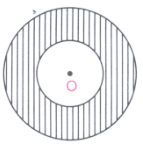
In the given figure, the area of the shaded region between two concentric circle is \(286 cm^2.\) If the difference of the radii of the two circles is 7 cm, find the sum of their radii. [Use \(\pi ={22\over 7}\)]
16.
A bicycle wheel makes 5000 revolutions in moving 11 km. Find the diameter of the wheel. (use \(\pi ={22\over 7}\))
17.
Tick the correct answer in the following: Area of a sector of angle \( \theta\) (in degree) of a circle with radius R is
(a) \({\theta \over 180^o}\times 2\pi R\)
(b) \({\theta \over 180^o}\times \pi R^2\)
(c) \({\theta \over 360^o}\times 2\pi R\)
(d) \({\theta \over 720^o}\times 2\pi R^2\)
18.
How long will Onkar take to run \(12{1\over2}\) rounds at the rate of 3.3km/h, around a circular track of area 5544m2?
19.
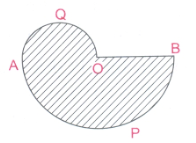
In fig., APB and AQO are semicircle, and AO = OB. If the perimeter of the figure is 40 cm, find the area of the shaded region. [ Use \(\pi\) = 22 / 7]
20.
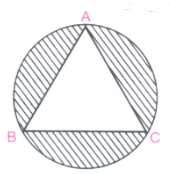
In given figure, an equilateral triangle has been inscribed in a circle of radius 6 cm. Find the area of the shaded region. \([Use\ \pi=3.14]\)
21.
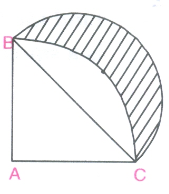
In the fig., ABC is a quadrant of a circle of radius 14 cm and a semicircle is drawn with BC as diameter. Find the area of the shaded region.
22.
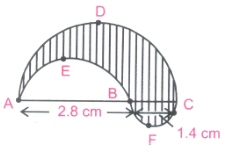
In the fig., find the perimeter of shaded region where ADC, AEB and BFC are semicircles on diameters AC, AB and BC respectively.
23.
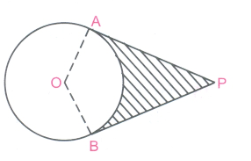
An elastic belt is placed round the rim of a pulley of radius 5 cm. One point on the belt is pulled directly away from the centre O of the pulley until it is at P, 10 cm away from O. Find the length of the belt that is in contact with the rim of the pulley. Also find the shaded area . ( Use \(\pi =3.14,\sqrt { 3 } =1.73)\)
24.
Area of sector with angle q° and radius r is ...............
25.
The boundary of a circle is called its .................
26.
Area of a major segment is always more than area of minor segment.
27.
OAB is a quadrant of a circle. Then, perimeter of OAB is 25 cm
28.
The diameter of a circle whose area is equal to the sum of the areas of the two circles of radill 24 cm and 7 cm is 31 cm.
29.
The perimeter of a semicircle is \(\pi r+2r\).
30.
Area of a circle is the portion enclosed under perimeter.
31.
If r is radius of inner circle and R is radius of outer circle. Area (a) enclosed between them is given by
32.
If r is radius of a circle, where r = 20 cm, area of circle is given by (use \(\pi=3.14\)) area of circle is given by (use \(\pi=3.14\))
33.
If 'a' represents area of circle of radius 'r' and C is circumference, then relation is given by
34.
Perimeter of Santro's wheel whose diameter is 35 cm.
35.
Perimeter of a sector of a circle of radius 'r' and length of the arc 'l'.
1.
Circumference of the circle = 4\(\pi\) cm \(\Rightarrow\) r = 2 cm.
Increase circumference = 8\(\pi\) cm. \(\Rightarrow\) r = 4 cm.
Area of the 1st circle = \(\pi\) \(\times\) (2)2= 4\(\pi\) cm2
Area of the new circle = \(\pi\) (4)2= 16\(\pi\) = 4 \(\times\) 4\(\pi\)
\(\therefore\) Area of the new circle = 4 times the area of first circle.
2.
Perimeter of the circle = Perimeter of square
Let side of square be x cm.
\(\begin{aligned} & 2 \pi \mathrm{r}=4 \mathrm{x} \\ \end{aligned}\)
\(\begin{aligned} & \Rightarrow \quad 2 \times \frac{22}{7} \times 77=4 x \\ \end{aligned}\)
\(\begin{aligned} & \therefore \quad x=\frac{2 \times 22 \times 11}{4}=121 \end{aligned}\)
Side of the square = 121 cm.
3.
A line intersecting the circle at two distinct points is called a secant.
4.
\(\because\) Area of circle = \(\pi { r }^{ 2 }\)
\(\therefore\) Area of the shaded region = \(\pi \)(2)2 - \(\pi \)(1)2
4\(\pi \) - \(\pi \) = 3\(\pi \) sq units.
5.
56 cm
6.
Because Sum of circumference of a circle and radius = 51 cm
\(\Rightarrow \ 2\pi r+r=51\\ \Rightarrow \ r(2\pi +1)=51\\ \Rightarrow \ r\left( 2\times \frac { 22 }{ 7 } +1 \right) =51\\ \Rightarrow\ r\times \frac { 51 }{ 7 } =51\Rightarrow r=7cm\)
Hence, the radius of the circle is 7 cm.
7.
n \(\times\) Circumference of circular track = Length of race
\(\Rightarrow n\times (2\pi r)=1540\)
where, n = number of rounds taken on a circular track
\(\Rightarrow n\times 2\times \frac { 22 }{ 7 } \times 3.5=1540\quad \quad [\because r=3.5cm]\\ \Rightarrow n=\frac { 1540 }{ 2\times \frac { 22 }{ 7 } \times 3.5 } =\frac { 1540 }{ 22\times 2\times 3.5 } \times 7=70\)
Hence, the number of rounds is 70.
8.
\(\frac { Circumference\ of\ one\ circle({ C }_{ 1 }) }{ Circumference\ of\ other\ circle({ C }_{ 2 }) } =\frac { 3 }{ 1 } \\ \Rightarrow \frac { { 2\pi r }_{ 1 } }{ { 2\pi r }_{ 2 } } =\frac { 3 }{ 1 } \Rightarrow \frac { { r }_{ 1 } }{ { r }_{ 2 } } =\frac { 3 }{ 1 } \)
Now, ratio of their areas \(=\frac { { \pi r }_{ 1 }^{ 2 } }{ { \pi r }_{ 2 }^{ 2 } } =\frac { { r }_{ 1 }^{ 2 } }{ { r }_{ 2 }^{ 2 } } =\left( \frac { { r }_{ 1 } }{ { r }_{ 2 } } \right) ^{ 2 }=\left( \frac { 3 }{ 1 } \right) ^{ 2 }=\frac { 9 }{ 1 } \)
9.
30.77 cm2
10.
9.8 cm
11.
Area of square field = 484 m2
∴ Side x Side = 22 x 22
⇒ Side = 22 m
∴ Perimeter of square field = 4 X 22 = 88 m
Since circumference of circular field = Perimeter of square field
\(\Rightarrow \pi d=88\Rightarrow \frac { 22 }{ 7 } d=88\)
\(\Rightarrow d=88\times \frac { 7 }{ 22 } =28m\)
Hence, the length of the diameter of the circular field is 28 m.
12.
Distance covered by train in 1 revolution
= Circumference of the wheel
= 4\(2\over7\) m = \(30\over7\)3
ஃ Distance covered in 4 seconds
= 7 x \(30\over7\)=30 m
ஃ Distance covered in 1 second
= \(30\over4\) = 7.5 m
ஃ Speed = 7.5 m/s.
13.
d = 90 cm, circumference = \(\pi\)d = 90\(\pi\) cm = Distance covered in 1 revolution
Number of revolutions per minute = 315
ஃ Number of revolution per hour = 315 x 60 cm
Distance covered in 1 hour = 90\(\pi\) x 315 x 60 cm
= 90 x \({22\over7}\times{315\times60\over100000}km={9\times22\times45\times6\over1000}km\)
∴ Speed of the bus = 53.46 Km/h
14.
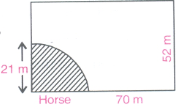
Area of portion that horse can graze area of the shaded portion.
Shaded portion is a sector of radius 21 m = length of the rope
Angle of this sector = angle of the corners of the rectangle = 90°
Area the shaded portion that horse can graze
= \(\frac { \theta }{ 360° } \times { \pi r }^{ 2 }=\frac { 90° }{ 360° } \times \frac { 22 }{ 7 } \times { (21) }^{ 2 }{ m }^{ 2 }\)
= \(\frac { 1 }{ 4 } \times \frac { 22 }{ 7 } \times 21\times 21 \ { m }^{ 2 } \ = \ \frac { 11 }{ 2 } \times 3\times 21 \ { m }^{ 2 }=346.5 \ \ { m }^{ 2 }\)
15.
Let radius of outer circle = \(R_1\) and radius of Inner circle = \(R_2\)
A.T.Q. \(\pi R_1^2-\pi R^2_2=286\)
\(\Rightarrow\) \(\pi (R^2_1-R^2_2)=286 \Rightarrow {22\over 7}\times (R_1-R_2)(R_1+R_2)=286\)
\(\Rightarrow\) \({22\over 7}\times 7\times (R_1+R_2)=286 \Rightarrow R_1+R_2=13 cm\)
16.
Distance covered in 5000 revolutions = 11 km.
Distance covered in 1 revolution
Distance covered in 1 revolution \(={11000\over 5000}m={11\over 5}m\)
Distance covered in 1 revolution = circumference of the wheel
\(\Rightarrow\)\(2\ \pi r ={11\over 5} \Rightarrow 2\times {22\over 7}\times r = {11\over 5}\)
\(\Rightarrow\) \(r \Rightarrow {11\over 5}\times 7\times {1\over 2\times 22}={7\over 20}m\)
\(\therefore\) Diameter \(=2\times r=2\times {7\over 20}={7\over 10}\times 100 cm=70cm\)
17.
\({\theta \over 720^o}\times 2\pi R^2\)
18.
Let r be the radius of the circular track.
Now, area of the circular track = 5544 m2 [given]
⇒ \(\pi\)r2 = 5544
⇒ r2 = \(5544\over \pi\) ⇒ r2 = \(5544 \times7 \over22\)
⇒ r2 = 1764 ⇒ r = \(\sqrt{1764}\) = 42 m
Circumference of the circular track = 2\(\pi\)r
= 2 x \(22\over7\)x42
= 264 m
ஃ Distance covered in 12\(1\over2\) rounds = 264 x \(25\over2\)
= 3300 m
= 3.3 km
Time taken to cover 3.3 km = 1 hour [given] Hence, time taken to cover 3300 m (12\(1\over2\) rounds) around the circular track is 1 hour.
19.
Let AO = OB = r
Then perimeter of semicircle APB
= \(2\pi r \over 2\) = \(\pi\)r
Perimeter of semicircle AQO
= \(\frac { 2\pi \frac { r }{ 2 } }{ 2 } =\frac { \pi r }{ 2 } \)
(∵ radius of semicircle AQO = \(r\over2\))
∴ Perimeter of shaded region
\(=\ \pi r+\frac { \pi r }{ 2 } +r=\frac { 2\pi r+\pi r+2r }{ 2 } \)
But perimeter of shaded region
ஃ \(\frac { 2\pi r+\pi r+2r }{ 2 } =40\)
⇒ r(2\(\pi\) + \(\pi\) + 2) = 80
⇒ r(3\(\pi\) + 2) = 80
⇒ \(r\left( 3\times \frac { 22 }{ 7 } +2 \right) =80\)
⇒ \(r\left( \frac { 66 }{ 7 } +2 \right) =80\)
⇒ \(r\left( \frac { 80 }{ 7 } \right) =80\)
ஃ \(r=\frac { 80\times 7 }{ 80 } =7cm\)
Now, Area of APB = \(\frac { \pi { r }^{ 2 } }{ 2 } =\frac { 22\times 7\times 7 }{ 7\times 2 } \)
= 77 cm2
Area of AQO = \(\frac { \pi { r }^{ 2 } }{ 2 } \)
\(=\frac { 22 }{ 7 } \times \frac { 7 }{ 2 } \times \frac { 7 }{ 2 } \times \frac { 1 }{ 2 } \)
= \(77\over4\) cm2
ஃ Area of shaded region
= 77 + \(\frac { 77 }{ 4 } =\frac { 308+77 }{ 4 } \)
= \(\frac { 385 }{ 4 } \) = 96.25 cm2
20.
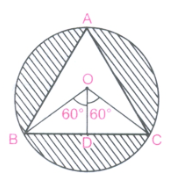
In OBD
cos 60°=\(OD \over OB\)and sin 60°=\(BD\over OB\)
⇒ \(1\over2\)= \(OD\over6\) and \(\frac { \sqrt { 3 } }{ 2 } \) = \(BD\over6\)
⇒ \(6\over2\)=OD and \(\frac { \sqrt { 3 } }{ 2 } \)x6 = BD
⇒ OD = 3 and BD = 3\(\sqrt3\)
BC = 2BD = 2 x 3\(\sqrt3\)=6\(\sqrt3\)
Area of the shaded region = area of circle - area of \(\triangle\)ABC
= \(2\pi { (6) }^{ 2 }-\frac { \sqrt { 3 } }{ 2 } { \left( 6\sqrt { 3 } \right) }^{ 2 }\)
= 3.14 x 6 x - \(\frac { \sqrt { 3 } }{ 4 } \) x 6\(\sqrt3\) x 6 \(\sqrt3\)
= 113.04 - 27 x 1.732 = 113.04 - 46.76 = 66.28 cm2
21.
In right-angled ΔABC, right angled at A
AB2 + BC2=BC2
(14)2 + (14)2 = BC2
392 = BC2
BC=14√2cm
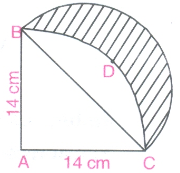
Area of shaded region = Area of ΔABC, + Area of semicircle on BC - area of quadrant ABDC
Area of ΔABC=\({1\over 2}\times AC\times AB={1\over 2}\times14\times14=98cm^2\)
Area of semicircle on BC\(={\pi r^2\over 2}\)
\(={22\over 7}\times7\sqrt2\times7\sqrt2\times{1\over 2}=154cm^2\)
Area of quadrant ABDC=\({\pi r^2\over 4}={22\over 7}\times14\times14\times{1\over 4}=154cm^2\)
∴ Area of shaded region=(98+154-154)cm2=98cm2
22.
Length of semicircle ADC = \(\pi\times{4.2\over 2}cm=2.1\pi cm\)
Length of semicircle AEB\(=\pi\times{2.8\over2}cm=1.4\pi cm\)
Length of semicircle BFC=\(\pi\times{1.4\over2}cm=0.7\pi cm\)
∴ Perimeter of shaded region = 2.1π+1.4π+0.7π=4.2π cm=13.2cm
23.
In right-angled triangle OAP,
\({OA\over OP}=cos\angle AOP\)
-s.png)
\(⇒\ \ {5\over 10}= cosㄥAOP\)
⇒ ㄥAOP=600
Similarly, ㄥAOP=600
ㄥAOB=600+600=1200
Length of arc (AB)=\({\theta\over 360^0}\times2\pi r\)
\(={120^0\over 360^0}\times2\times\pi\times5\)
\(={10\pi\over 3}cm\)
Length of the belt that is in the contact with the rim of pulley
= circumference of circle - length of arc AB
\(=2\pi\times5-{10\pi\over 3}={20\pi\over 3}cm\)
Area of sector
OAQB=\(={\theta\over 360^0}\times\pi r^2\)
\(={120^0\over 360^0}\times\pi5\times\times5cm^2={25\over 3}\pi cm^2\)
Area of quadrilateral OAPB
= 2 x area of triangle OAP
\(2\times{1\over 2}\times OA\times AP\)
\(=5\times5\sqrt3cm=25\sqrt3cm^2\)
Area of shaded region
\(=\left(25\sqrt3-{25\pi\over 3}\right)cm^2\)
24.
()
\(\frac { \pi { r }^{ 2 }{ q }^{ ° } }{ { 360 }^{ ° } } \)
25.
()
circumference
26.
(a)
27.
(a)
28.
(b)
29.
(a)
30.
(a)
31.
()
\(\pi \left( { R }^{ 2 }-{ r }^{ 2 } \right) \)
32.
()
1256 cm2
33.
()
rC = 2a
34.
()
110 cm [\(\because\) \(2\pi r\) = Perimeter
\(\Rightarrow \ 2\times \frac { 22 }{ 7 } \times \frac { 35 }{ 2 } \) = Perimeter as d = 2r \(\Rightarrow \ r=\frac { 35 }{ 2 } \)
\(\Rightarrow \) Perimeter = 110 cm]
35.
()
2r + 1

10th Standard CBSE Syllabus & Materials
10th Standard CBSE
CBSE 10th Social Science PS - Federalism - New Model Questions Papers Study Material - QB365 Set A
NEW10th Standard CBSE
CBSE 10th Social Science PS - Power Sharing - New Model Questions Papers Study Material - QB365 Set A
NEW10th Standard CBSE
CBSE 10th Social Science GEO - Manufacturing Industries - New Model Questions Papers Study Material - QB365 Set A
NEW10th Standard CBSE
CBSE 10th Social Science GEO - Minerals and Energy Resources - New Model Questions Papers Study Material - QB365 Set A



CBSE 10th Standard CBSE Subjects
CBSE Standards





