
 100% FREE ACCESS
10th Standard CBSE Syllabus & Materials
10th Standard CBSE
CBSE 10th Social Science ECO - Globalisation and the Indian Economy - New Model Questions Papers Study Material - QB365 Set A
NEW10th Standard CBSE
CBSE 10th Social Science ECO - Money and Credit - New Model Questions Papers Study Material - QB365 Set A
NEW10th Standard CBSE
CBSE 10th Social Science ECO - Sectors of the Indian Economy - New Model Questions Papers Study Material - QB365 Set A
NEW10th Standard CBSE
CBSE 10th Social Science ECO - Development - New Model Questions Papers Study Material - QB365 Set A
NEW10th Standard CBSE
CBSE 10th Social Science PS - Outcomes of Democracy - New Model Questions Papers Study Material - QB365 Set A
NEW10th Standard CBSE
CBSE 10th Social Science PS - Gender, Religion and Caste - New Model Questions Papers Study Material - QB365 Set A

Published on: 29/12/2018
CLASS 10 FULL TEST
Download CBSE Class 10th Standard CBSE Maths question papers, sample papers, important questions, and previous year solved papers in PDF format. Get free study materials, NCERT solutions, and exam preparation resources for Class 10th Standard CBSE Maths
Questions + Answers key
Take MCQ Maths Test
1.
If \(\alpha\) and \(\beta\) are the zeroes of the polynomial 2x2 - 4x + 5, find the value of :
(i) \({ \alpha }^{ 2 }+{ \beta }^{ 2 }\)
(ii) \(\frac{1}{\alpha}+\frac{1}{\beta}\)
(iii) \(\left( \alpha -\beta \right) ^{ 2 }\)
(iv) \(\frac { 1 }{ { \alpha }^{ 2 } } +\frac { 1 }{ { \beta }^{ 2 } } \)
(v) \({ \alpha }^{ 3 }+{ \beta }^{ 3 }\)
2.
Evaluate \(\frac { \cot { ({ 90 }^{ 0 }-\theta ) } \sin { ({ 90 }^{ 0 }-\theta ) } }{ \sin { \theta } } +\frac { \cot { { 40 }^{ 0 } } }{ \tan { { 50 }^{ 0 } } } -(\cos ^{ 2 }{ { 20 }^{ 0 } } +\cos ^{ 2 }{ { 70 }^{ 0 } } )\)
3.
Find the distance between the points P( cos \(\alpha\),-sin \(\alpha\) ) and Q(-cos\(\alpha\),sin\(\alpha\) ).
4.
If a point P is 17 cm from the centre of a circle of radius 8 cm, then find the length of the tangent drawn to the circle from point P.
5.
A card is selected at random from a well shuffled deck of 52 playing cards.Find the probability of getting a face card.
6.
In the given figure, two circles with centres A and B of radius 5 cm and 3 cm touching each other internally. If the perpendicular bisector of segment AB, meets the bigger circle at P and Q, find the length of PQ.
7.
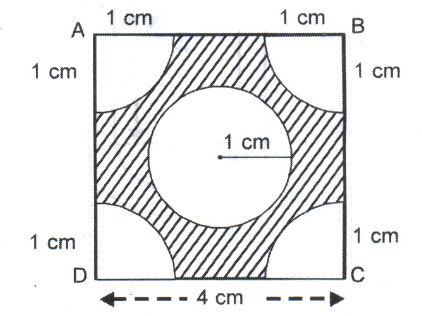
In the given figure, from each corner of a square ABCD, of side 4 cm, quadrant of a circle of radius 1 cm each is cut and a circle of radius 1 cm is cut from the centre. Find the area of the shaded region.
8.
State whether the points (0,5), (0,9) and (3,6) are collinear, is true or false. Justify.
9.
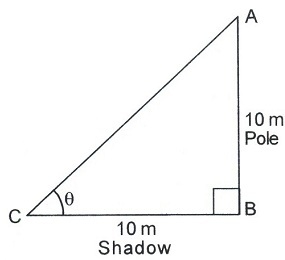
A pole 10m high cast a shadow 10m long on the ground, then find the sun,s elevation.
10.
The line segment joining the points P(3,3) and Q(6,-6) is trisected at the points A and B such that A is nearer to P. If A also lies on the line given by 2x+y+k=0, find the value of k.
11.
One card is drawn from a pack of 52 cards, each of the 52 cards being equally likely to be drawn. Find the probability that the card is red and a king.
12.
The radius of a circle is 50cm. If the radius is decreased by 50% then find the percentage decrease in its area.
13.
If 11th term of A.P. is 110 and 110th term is 11 and its nth term is zero, then find the value of n.
14.
A sphere of maximum volume is cut out from a solid hemisphere of radius 7cm.What is the ratio of the volume of the hemisphere to that of the cut out sphere?
15.
Find the solution of the quadratic equation \(x^{2}-b^{2}=a (2x-a)\) .
16.
Solve the following equation for x : \({1\over x+1}+{2\over x+2}={5\over x+4}, \ x\ne -1,-2,-4\)
17.
The sum of deviations of a set of values x, x, x, ..........., x, measured from 50 is - 10 and the sum of deviations1, x2, x3, ..........., xn, measured from 50 is - 10 and the sum of deviations of the values from 46 is 70. Find the value of 11and the mean.
18.
Evaluate : \(\frac { 5\cos ^{ 2 }{ { 60 }^{ ° }+4 } \cos ^{ 2 }{ { 30 }^{ ° }-\tan ^{ 2 }{ { 45 }^{ ° } } } }{ \sin ^{ 2 }{ { 30 }^{ ° }+\cos ^{ 2 }{ { 60 }^{ ° } } } } \)
19.
Solve for x, y:
(a) \(\frac { x+y-8 }{ 2 } =\frac { x+2y-14 }{ 3 } =\frac { 3x+y-12 }{ 11 } \)
(b) 7(y+3) - 2(x+2) = 14, 4(y-2) + 3(x-3) = 2
20.
Show that any positive odd integer is of the form 6q + 1,6q + 3 or 6q + 5, where q is some integer.
21.
Prove that the area of the equilateral triangle described on the side of an isosceles right angled triangle is half the area of the equilateral triangle described on its hypotenuse.
22.
If sum of first 6 terms of an AP is 36 and that of the first 16 terms is 256, then find the sum of first 10 terms.
23.
Find the area of the shaded region in the given figure, if PR = 24 cm, PQ = 7 cm and O is the centre of the circle. [Take, \(\pi =22/7\)].
24.
Find the values of k for which the given equations ha real and equal roots
(i) \(x^{ 2 }+k(4x+k-1)+2=0\)
(ii) \(x^{ 2 }-2x(1+3k)+7(2+2k)=0\)
25.
Two dice are thrown simultaneously. Find the probability that the sum of the two numbers appearing on the top is less than or equal to 10.
26.
A bucket made up of a metal sheet is in the form of a frustum of a cone. Its depth is 24 cm and the diameters of the top and bottom are 30 cm and 10 cm respectively. Find the cost of milk which can completely fill the bucket at the rate of Rs. 20 per litre and the cost of the metal sheet used, if it costs Rs. 10 per 100 cm2 . \(\left[ Use\quad \pi =3.14 \right] \)
27.
Show that the points (7,10), (-2,5) and (3,-4) are the vertices of an isosceles right triangle.
28.
The shadow of a flagstaff is three times as long as the shadow of the flagstaff when the sunrays meet the ground at an angle of 60o . Find the angle between the sunrays and the ground at the time of longer shadow.
29.
ABC is an isosceles triangle, in which AB=AC, circumscribed about a circle.Show that BC is bisected at the point of contact.
30.
Polynomial x4 + 7x3 + 7x2 + px + q is exactly divisible by x2 + 7x + 12, then find the value of p and q.
31.
If the LCM of 26 and 91 is 182. find their HCF.
32.
An agriculture field is the form of a rectangle of length 20 m, width 14 m. A 10 m deep well of diameter 7 m is dug in a corner of the field and the soil taken out of the well is spread evenly over the remaining part of the field. Find the rise in its level.
33.
If the height and length of the shadow of a man are the same, then find the angle of elevation of the sun.
34.
Which of the following are APs? If they form an AP, then find the common difference d and write three more terms.
\(-\frac { 1 }{ 2 } ,-\frac { 1 }{ 2 } ,-\frac { 1 }{ 2 } -\frac { 1 }{ 2 } ,...\)
35.
Check whether the following quadratic equations.
\(x^{ 3 }-4x^{ 2 }-x+1=(x-2)^{ 2 }\)
36.
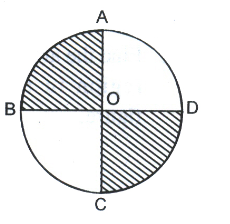
AC and BD are two perpendicular diameters of circle ABCD. Given that, the area of the shaded portion is 308 cm2, calculate :
(i) the length of AC and
(ii) the circumference of the circle.
37.
PQR is a right angled triangle right angled at Q.PQ=5cm, QR=12cm.A circle with centre O is inscribed in \(\Delta\)PQR, touching its ll sides.Find the radius of the circle.
1.
Given \(\alpha\) and \(\beta\) are the zeroes of 2x2 - 4x + 5
\(\Rightarrow \quad \alpha +\beta =\frac { -\left( -4 \right) }{ 2 } =2\)
and \(\alpha\beta=\frac{5}{2}\)
Now,
(i) \(\left( { \alpha }^{ 2 }+{ \beta }^{ 2 } \right) =\left( \alpha +\beta \right) ^{ 2 }-2\alpha \beta ={ 2 }^{ 2 }-2\times \frac { 5 }{ 2 } =4-5\)
= - 1
(ii) \(\frac { 1 }{ { \alpha } } +\frac { 1 }{ { \beta } } =\frac { \alpha +\beta }{ \alpha \beta } =\frac { 2 }{ \frac { 5 }{ 2 } } =\frac { 4 }{ 5 } \)
(iii) \(\left( \alpha -\beta \right) ^{ 2 }=\left( \alpha +\beta \right) ^{ 2 }-4\alpha \beta ={ 2 }^{ 2 }-\frac { 4\times 5 }{ 2 } \)
= 4 - 10 = - 6
(iv) \(\frac { 1 }{ { { \alpha }^{ 2 } } } +\frac { 1 }{ { { \beta }^{ 2 } } } =\frac { { \alpha }^{ 2 }+{ \beta }^{ 2 } }{ \left( \alpha \beta \right) ^{ 2 } } =\frac { -1 }{ \left( \frac { 5 }{ 2 } \right) ^{ 2 } } =\frac { -4 }{ 5 } \)
(v) \(\left( { \alpha }^{ 3 }+{ \beta }^{ 3 } \right) =\left( \alpha +\beta \right) ^{ 3 }-3\alpha \beta \left( \alpha +\beta \right) \)
\(={ 2 }^{ 3 }-3\times \frac { 5 }{ 2 } \times 2=8-15=-7\)
2.
1
3.
2 units
\(=\sqrt { { (-cos\alpha -cos\alpha ) }^{ 2 }+{ (sin\alpha +sin\alpha ) }^{ 2 } } \)
\(=\sqrt { (-2cos\alpha )^{ 2 }+(2sin\alpha )^{ 2 } } \)
\(=\sqrt { 4cos^{ 2 }\alpha +4{ sin }^{ 2 }\alpha } =2\sqrt { cos^{ 2 }\alpha +{ sin }^{ 2 }\alpha } \)
4.
We know that, radius is perpendicular to the tangent at the point of contact.
\(\therefore \ \ \ OA\ \bot \ PA\\ \Rightarrow \ \angle OAP={ 90 }^{ \circ }\)

In , \(\triangle OAP\)
PO2 = PA2 + AO2 [by Pythagoras theorem]
\(\Rightarrow \) (17)2 = (PA)2 + (8)2
\(\Rightarrow \) (PA)2 = 289 - 64 = 225
\(\Rightarrow \) PA = \(\sqrt { 225 } \) = 15 cm
Hence, the length of the tangent from point P is 15 cm.
5.
\(3\over13\)
6.
Here, A and B are the centres of two circle having radii 5 cm and 3 cm respectively touch each other internally.
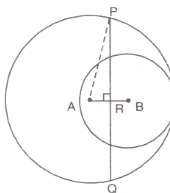
ஃ AB = 5 cm - 3 cm
= 2 cm
Since PQ is perpendicular bisector of the segment AB.
ஃ \(\angle \)ARP = \(\angle \)ARQ = 90° and PR = RQ
AR = RB = 1 cm
Now, in rt. \(\angle \) ed \(\triangle\)ARP, by using Pythagoras theorem, we have
PR2 = AP2 - AR2
= 52 - 12 = 25 - 1 = 24
ஃ PR = \(\sqrt{24}\)=2\(\sqrt6\) cm
PQ = 2PR
= 2 x 2\(\sqrt6\) = 4\(\sqrt6\) cm
7.
9.72 cm2
8.
False.
Since two points lie on y-axis and third point lies in first quadrant.
9.
In art. \(\triangle\)ABC, \(\angle\)B = 90°
\(\therefore\) AB = BC = 10 m, let \(\angle\)ACB = \(\theta\)
\(\therefore\) tan \(\theta={{AB}\over{BC}}={{10}\over{10}}=1\)
tan \(\theta\) = 1
\(\Rightarrow\) \(\theta\) = 45°
10.
k=-8
11.
Total number of cards = 52
Card drawn is red and a king = 2(as there are 2 red kings)
\(\therefore\) probability of drawing a card which is red and a king = \(\frac{2}{52}=\frac{1}{26}\)
12.
Area of circle = \(\pi\) x 502 = 2500\(\pi\) cm2
New radius = 50 - \(50\over100\) x 50 = 25 cm
Area of new circle = 625\(\pi\) cm2
Decrease in area = 2500\(\pi\) - 625\(\pi\)
= 1875\(\pi\) cm2
%decrease in area = \(1875\pi\over2500\pi\) x 100 = 75%
13.
121
14.
Radius of the sphere cut = \(\frac{1}{2}\)radius of the hemisphere = \(\frac{7}{2}\)cm
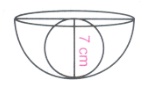
Voulme of hemisphere: volume of sphere \(=\frac{2}{3} \pi(7)^{3}: \frac{4}{3} \times \pi \times\left(\frac{7}{2}\right)^{3}\)
\(=1: 2 \times \frac{1}{8}=1: \frac{1}{4}=4: 1\)
15.
a + b , a - b
16.
\({1\over x+1}+{2\over x+2}={5\over x+4}\)
\({x+2+2(x+1)\over (x+1)(x+2)}={5\over x+4}\)
\({x+2+2x+2\over x^2+3x+2}={5\over x+4}\)
(3x+4)(x+4)=5(x2+3x+2)
3x2+12x+4x+16=5x2+15x+10
3x2+16x+16=5x2+15x+10
2x2-x-6=0
2x2-4x+3x-6=0
2x(x-2)+3(x-2)=0
(2x+3)(x-2)=0
x=2 or \(x={-3\over 2}\)
17.
We have,
\(\sum _{ i=1 }^{ n }{ \left( { x }_{ i }-50 \right) } =-10\) and \( \sum _{ i=1 }^{ n }{ \left( { x }_{ i }-46 \right) } =70\)
\(\sum _{ i=1 }^{ n }{ { x }_{ i }-50n } =-10\)
and \(\sum _{ i=1 }^{ n }{ { x }_{ i }-46n } =70\)
Subtracting (ii) from (i),
- 4n = - 80
\(\Rightarrow \) n = 20
\(\sum _{ i=1 }^{ n }{ { x }_{ i }-50\times 20 } =-10\)
\(\Rightarrow \ \ \ \ \ \ \ \sum _{ i=1 }^{ n }{ { x }_{ i } } =990\)
\(\therefore\) Mean = \(\frac { 1 }{ n } \left( \sum _{ i=1 }^{ n }{ { x }_{ i } } \right) =\frac { 990 }{ 20 } =49.5\)
Hence, n = 20 and mean = 49.5
18.
\(\frac { 5\cos ^{ 2 }{ { 60 }^{ ° }+4 } \cos ^{ 2 }{ { 30 }^{ ° }-\tan ^{ 2 }{ { 45 }^{ ° } } } }{ \sin ^{ 2 }{ { 30 }^{ ° }+\cos ^{ 2 }{ { 60 }^{ ° } } } } \)
\(=\frac { 5{ \left( \frac { 1 }{ 2 } \right) }^{ 2 }+4{ \left( \frac { \sqrt { 3 } }{ 2 } \right) }^{ 2 }.{ \left( 1 \right) }^{ 2 } }{ { \left( \frac { 1 }{ 2 } \right) }^{ 2 }+{ \left( \frac { 1 }{ 2 } \right) }^{ 2 } } \)
\(=\frac { \frac { 5 }{ 4 } +3-1 }{ \frac { 1 }{ 4 } +\frac { 1 }{ 4 } } \)
\(=\frac { \frac { 5 }{ 4 } +2 }{ \frac { 1 }{ 2 } } =\frac { \frac { 13 }{ 4 } }{ \frac { 1 }{ 2 } } \)
\(=\frac{26}{4}=\frac{13}{2}\)
19.
(a) \(\frac { x+y-8 }{ 2 } =\frac { x+2y-14 }{ 3 } \)
\(\Rightarrow \quad 3x+3y-24=2x+4y-28\)
\(\Rightarrow \quad x-y+4=0\) ......(i)
and \(\frac { x+2y-14 }{ 3 } =\frac { 3x+y-12 }{ 11 } \)
\(\Rightarrow \quad 11x+22y-154=9x+3y-36\)
\(\Rightarrow \quad 2x+19y-118=0\) .....(ii)
Multiply eqn. (i) by 2 and subtract eqn. (ii) from (iii)
2x - 2y + 8 = 0 .....(iii)
\(\Rightarrow\) 2x + 19y - 118 = 0
\(\underline { -\quad -\quad + } \)
\(-21y+126=0\Rightarrow y=\frac { 126 }{ 21 } \)
\(\therefore\) y = 6
\(\therefore\) from (i), x + 6 - 8 = 0
\(\therefore\) x = 2
\(\therefore\) x = 2 and y = 6
(b) 7(y + 3) - 2(x + 2) =14,
\(\Rightarrow\) 7y + 21 - 2x - 4 = 14
\(\Rightarrow\) 2x - 7y - 3 = 0 .....(i)
and 4(y - 2)+ 3(x - 3) = 2
\(\Rightarrow\) 4y - 8 + 3x - 9 = 2
\(\Rightarrow\) 3x + 4y - 19 = 0 .....(ii)
Multiply equation (i) by 3 and (ii) by 2,
6x - 21y - 9 = 0
6x + 8y - 38 = 0
\(\underline { -\quad -\quad + } \)
- 29y + 29 = 0
\(\Rightarrow\) y = 1
From (i), 2x -7(1) - 3 = 0
\(\Rightarrow\) 2x = 10
\(\therefore\) x = 5
\(\therefore\) x = 5 and y = 1.
20.
By Euclid's division algorithm, for two positive integers a and b, we have
a =bq + r,
Let b=6,
r = 0, 1, 2, 3,4,5
So a = 6q, 6q + 1, 6q + 2, 6q + 3, 6q + 4,6q + 5
Clearly, a = 6q, 6q + 2,6q + 4 are even, as they are divisible by 2.
But 6q + 1, 6q + 3, 6q + 5 are odd, as they are not divisible by 2. 1
∴ Any positive odd integer is of the form 6q + 1, 6q + 3 or 6q + 5
21.
Given A \(\triangle ABC\) in which \(\angle ABC=\) 90° and AB = BC.\(\triangle ABD\) and \(\triangle ACE\) are equilateral triangles.
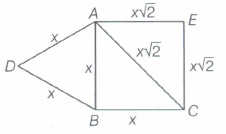
To Prove \(ar\left( \triangle ABD \right) =\frac { 1 }{ 2 } ar\left( \triangle CAE \right) \)
Proof Let AB = BC = x units
Now, \(CA=\sqrt { { AB }^{ 2 }+{ AC }^{ 2 } } =\sqrt { { x }^{ 2 }+{ x }^{ 2 } } =x\sqrt { 2 } \) units.
In \(\triangle ABD\) and \(\triangle CAE\), each angle is 60° as they are equilateral triangle.
\(\therefore \triangle ABD\sim \triangle CAE\)
Since, the ratio of the area of two similar triangles is equal to the ratio of the squares of their corresponding sides.
\(\therefore \frac { ar\left( \triangle ABD \right) }{ ar\left( \triangle CAE \right) } =\frac { { AB }^{ 2 } }{ { CE }^{ 2 } } =\frac { { x }^{ 2 } }{ { \left( x\sqrt { 2 } \right) }^{ 2 } } =\frac { { x }^{ 2 } }{ 2{ x }^{ 2 } } =\frac { 1 }{ 2 } \)
Hence, \(ar\left( \triangle ABD \right) =\frac { 1 }{ 2 } ar\left( \triangle CAE \right) \)
22.
100
23.
161.5 cm2
24.
(i) \(\frac { 2 }{ 3 } or-1\)
(ii) \(2or\frac { -10 }{ 9 } \)
25.
\(\frac { 11 }{ 2 } \)
26.
Rs.163.28, Rs.171.13
27.
AB2=(-2-7)2+(5-10)2 = (-9)2+(-5)2 =81+25 =106
BC2=(3-(-2))2+(-4-5)2=(5)2+(-9)2=25+81=106
AC2=(3-7)2+(-4-10)2=(4)2+(14)2=16+196=212
Since AB2+BC2=AC2
∴ ABC is a right triangle.
AB = \(\sqrt { 106 } \) and BC = \(\sqrt { 106 } \)
∵ AB = BC
∴ ABC is an isosceles right triangle.
28.
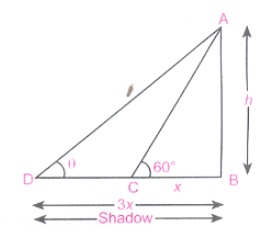
In rt. ΔABC, tan60o = \(\frac { AB }{ BC } =\frac { h }{ x } \)
⇒ \(\sqrt { 3 } =\frac { h }{ x } \Rightarrow h=\sqrt { 3 } x\)
In rt. ∆ABD, tanፀ = \(\frac { AB }{ BD } \)
⇒ tanፀ = \(\frac { h }{ 3x } \)
⇒ tanፀ = \(\frac { \sqrt { 3 } x }{ 3x } =\frac { 1 }{ \sqrt { 3 } } \)⇒ ፀ = 30o
29.
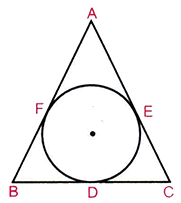
Here, AB = AC (Given) .......(i)
AF = AE (Tangent from A) ......(ii)
AB - AF = AC - AE
⇒ BF = CE
Now, BF = BD (Tangent from B)
Also, CE = CD (Tangent from C)
⇒ BD = CD
30.
Factors of x2 + 7x + 12 :
x2 + 7x + 12 = 0
\(\Rightarrow\) x2 + 4x + 3x + 12 = 0
\(\Rightarrow\) x(x + 4) + 3 (x + 4) = 0
\(\Rightarrow\) (x + 4) (x + 3) = 0
\(\Rightarrow\) x = - 4, - 3 .... (i)
Let p'(x) = x4 + 7x3 + 7x2 + px + q
If p(x) is exactly divisible by x2 + 7x + 12, then x = - 4 and x = - 3 are zeroes of p(x) [from eq (i)]
p(x) = x4 + 7x3 + 7x2 + px + q
p(- 4) = (-4)4 + 7(-4)3 + 7(-4)2 + p(-4) + q
but p(-4) = 0
\(\therefore\) 0 = 256 - 448 + 112 - 4p + q
\(\Rightarrow\) 0 = - 4p + q - 80
\(\Rightarrow\) 4p - q = 80 ... (ii)
and p(-3) = (-3)4 + 7 (-3)3 + 7(-3)2 + p(-3) + q
but p(-3) = 0
\(\therefore\) 0 = 81 - 189 + 63 - 3p + q
\(\Rightarrow\) 0 = -3 p+ q - 45
\(\Rightarrow\) 3p - q = - 45
On solving eq.(ii) and eq. (iii) by elimination method, we get
4p - q = - 80
3p - q = - 45
p = - 35
On putting the value of p in eq. (i),
4(- 35) - q = - 80
\(\Rightarrow\) - 140 - q = - 80
\(\Rightarrow\) - q = 140 - 80
\(\Rightarrow\) - q = 60
\(\Rightarrow\) q = - 60
Hence, p = - 35, q = - 60
31.
Given, LCM (26, 91) = 182
\(\therefore \quad HCF(26,91)=\frac { 26\times 91 }{ LCM(26,91) } =\frac { 26\times 91 }{ 182 } =13\)
32.
1.594 m
33.
Let SQ be the height and PQ be the shadow of a man.
According to the question, SQ = PQ
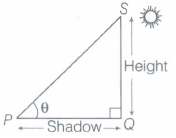
Again, let the angle of elevation of the sun be \(\theta \)
In right angled \(\\ \Delta PQS\)
\(tan\theta =\frac { perpendicular }{ Base } =\frac { QS }{ PQ }\)
\( \Rightarrow tan\theta =\frac { QS }{ QS } \left[ \because PQ = QS \right]\)
\( \\ \Rightarrow tan\theta =1=tan 45° \left[ \because tan 45°=1 \right] \)
\( \therefore \theta =45°\)
Hence, the angle of elevation of the sun is 45\(°\)
34.
Here, \({ a }_{ 1 }=-\frac { 1 }{ 2 } ,{ a }_{ 2 }=-\frac { 1 }{ 2 } ,{ a }_{ 3 }=-\frac { 1 }{ 2 } ,{ a }_{ 4 }=-\frac { 1 }{ 2 } \)
Now, \({ a }_{ 2 }-{ a }_{ 1 }=-\frac { 1 }{ 2 } -\left( -\frac { 1 }{ 2 } \right) =-\frac { 1 }{ 2 } +\frac { 1 }{ 2 } =0\)
\({ a }_{ 3 }-{ a }_{ 2 }=-\frac { 1 }{ 2 } -\left( \frac { 1 }{ 2 } \right) =-\frac { 1 }{ 2 } +\frac { 1 }{ 2 } =0\)
\({ a }_{ 4 }-{ a }_{ 3 }=-\frac { 1 }{ 2 } -\left( \frac { 1 }{ 2 } \right) =-\frac { 1 }{ 2 } +\frac { 1 }{ 2 } =0\)
Clearly, the difference of successive terms is same. Therefore, the given list of numbers forms an AP and its common difference,(d) is 0.
Now, next three terms of this AP are
\({ a }_{ 5 }={ a }_{ 4 }+d=-\frac { 1 }{ 2 } +0=-\frac { 1 }{ 2 } \)
\({ a }_{ 6 }={ a }_{ 5 }+d=-\frac { 1 }{ 2 } +0=-\frac { 1 }{ 2 } \)
\({ a }_{ 7 }={ a }_{ 6 }+d=-\frac { 1 }{ 2 } +0=-\frac { 1 }{ 2 } \)
35.
Given equation is
\(x^{ 3 }-4x^{ 2 }-x+1=(x-2)^{ 3 }\)
\(\Rightarrow x^{ 3 }-4x^{ 2 }-x+1=x^{ 3 }-3(x^{ 2 })2+3x(2)^{ 2 }-(2)^{ 3 }\)
\(\left[ \because (a-b) \right] ^{ 3 }=a^{ 3 }-3a^{ 2 }b+3ab^{ 2 }-b^{ 3 }]\)
\(\Rightarrow x^{ 3 }-4x^{ 2 }-x+1=x^{ 3 }-6x^{ 2 }-12x+8=0\)
\(\Rightarrow 2x^{ 2 }-13x+9=0\)
Which is of the form \(ax^{ 2 }+bx+x=0\) Hence, it is a quadratic equation. where \(a\neq 0\) and b,c are any real numbers.
36.
(i) 28 cm
(ii) 88 cm
37.
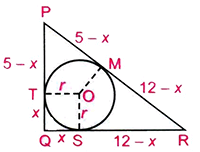
Let QS = x; SR = 12 - x
∴ PT = 5 - x; PM = PT
ஃ PM = 5 - x
Also SR = MR ⇒ MR = 12 - x
Also PQ2 + QR2 = PR2
⇒ PR = 13 ⇒ PM + MR = 13
⇒ 5 - x + 12 - x 13 ⇒ 2x - 4 ⇒ x = 2
Also OSQT is a square
ஃ OS = QS ⇒ OS = 2 cm
ஃ Radius of incircle = 2 cm.

10th Standard CBSE Syllabus & Materials
10th Standard CBSE
CBSE 10th Social Science PS - Federalism - New Model Questions Papers Study Material - QB365 Set A
NEW10th Standard CBSE
CBSE 10th Social Science PS - Power Sharing - New Model Questions Papers Study Material - QB365 Set A
NEW10th Standard CBSE
CBSE 10th Social Science GEO - Manufacturing Industries - New Model Questions Papers Study Material - QB365 Set A
NEW10th Standard CBSE
CBSE 10th Social Science GEO - Minerals and Energy Resources - New Model Questions Papers Study Material - QB365 Set A



CBSE 10th Standard CBSE Subjects
CBSE Standards





