
 100% FREE ACCESS
10th Standard CBSE Syllabus & Materials
10th Standard CBSE
CBSE 10th Social Science ECO - Globalisation and the Indian Economy - New Model Questions Papers Study Material - QB365 Set A
NEW10th Standard CBSE
CBSE 10th Social Science ECO - Money and Credit - New Model Questions Papers Study Material - QB365 Set A
NEW10th Standard CBSE
CBSE 10th Social Science ECO - Sectors of the Indian Economy - New Model Questions Papers Study Material - QB365 Set A
NEW10th Standard CBSE
CBSE 10th Social Science ECO - Development - New Model Questions Papers Study Material - QB365 Set A
NEW10th Standard CBSE
CBSE 10th Social Science PS - Outcomes of Democracy - New Model Questions Papers Study Material - QB365 Set A
NEW10th Standard CBSE
CBSE 10th Social Science PS - Gender, Religion and Caste - New Model Questions Papers Study Material - QB365 Set A

Published on: 01/08/2018
Some of the important questions are prepared from this chapter Coordinate Geometry. In this question paper, questions are prepared from the book back and previous year questions.
Download CBSE Class 10th Standard CBSE Maths question papers, sample papers, important questions, and previous year solved papers in PDF format. Get free study materials, NCERT solutions, and exam preparation resources for Class 10th Standard CBSE Maths
Questions + Answers key
Take MCQ Maths Test
1.
Find the coordinates of the point which divide the line segment joining A(2, -3) and B(-4, -6) into three equal parts.
2.
If P(9 a -2, -b) divides line segment joining A (3a + 1, -3) and B(8a,5) in the ratio 3:1, then find the values of a and b. Also, determine the value of a2 + b2 .
3.
Determine if the points (1,5),(2,3) and (-2,-11) are collinear.
4.
Find the distance between the following pairs of points: (-5,7),(-1,3)
5.
If the point (0, 0), (1, 2) and (x, y) are collinear, then find x.
6.
Find the area of the triangle with vertices (0, 0), (6, 0) and (0, 5)
7.
Prove that the point (3,0), (6,4) and (-1,3) are the vertices of a right angled isosceles triangle.
8.
Find the distance of the point (-4, -7) from the y-axis.
9.
The ordinate of a point A on y-axis is 5 and B has co-ordinates (-3, 1). Find the length of AB.
10.
Show that the points A (-6, 10), B(-4, 6) and C(3, -8) are collinear, such that \(AB=\frac { 2 }{ 9 } AC\) .
11.
Check, whether the points (-4, 0), (4, 0) and (0, 3) are the vertices of an isosceles triangle or equilateral triangle.
12.
Name the type of triangle formed by the points A(-5, 6), B(-4, 2) and C(7, 5).
13.
If A(4,-8), B(3,6) and C(5,-4) are the vertices of \(\Delta ABC\), D is the mid point of BC and P is a point on AD joined such that \({AP\over PD}=2\), find the coordinates of P.
14.
Use distance formula to show that the points A(-2,3), B(1,2) and (7,0) are collinear.
15.
The bisector of angles of triangle are ...........................
16.
The distance between the point (2,5) and (7,5) is ...........
17.
In the fourth quadrant for a point, the abscissa is ....... and the ordinate is ........
18.
Area of triangle formed by the vertices (x1,y1), (x2,y2) and (x3,y3) is the numerical value of ................
19.
The centroid of triangle divides the median in the ratio ...........
20.
(1, -1), (0,4) and (- 5, 3) are vertices of a triangle. Check whether it is a scalene triangle, isosceles triangle or an equilateral triangle. Also, find the length of its median joining the vertex (1, - 1) the mid-point of the opposite side.
21.
If A(4, -1), B(5, 3), C(2, y) and D(1, 1) are the vertices a parallelogram ABCD, find y.
22.
If P(9a-2, -b) divides line segment joining A(3a+1, -3) and B(8a, 5) in the ratio 3: 1, then find the value of a and b.Also, determine the value of \({ a }^{ 2 }+{ b }^{ 2 }\) .
1.
Let P(x1 , y1) and Q(x2 , y2) are two points which divide AB in three equal parts.
By section formula
\(P\left( { x }_{ 1 }{ y }_{ 1 } \right) =\left( \frac { 1\times \left( -4 \right) +2\times \left( 2 \right) }{ 1+2 } ,\frac { 1\times \left( -6 \right) +2\times \left( -3 \right) }{ 1+2 } \right) \)
\(=\left( \frac { -4+4 }{ 3 } ,\frac { -6+(-6) }{ 3 } \right) \)
= (0, -4)
\(Q\left( { x }_{ 2 }{ y }_{ 2 } \right) =\left( \frac { 2\times \left( -4 \right) +1\times \left( 2 \right) }{ 2+1 } ,\frac { 2\times \left( -6 \right) +1\times \left( -3 \right) }{ 2+1 } \right) \)
\(=\left( \frac { -8+2 }{ 3 } ,\frac { -12+(-3) }{ 3 } \right) \)
= (- 2, - 5)
2.
a = 1 and b = -3, a2 + b2 = 10
3.
Let points be A(1,5), B(2,3) and C(-2,-11)
\(AB=\sqrt { \left( 2-1 \right) ^{ 2 }+\left( 3-5 \right) ^{ 2 } } =\sqrt { 1+4 } =\sqrt { 5 } units\)
\(BC=\sqrt { \left( -2-2 \right) ^{ 2 }+\left( -11-3 \right) ^{ 2 } } =\sqrt { 16+196 } =\sqrt { 212 } =2\sqrt { 53 } units.\)
\(AC=\sqrt { \left( -2-1 \right) ^{ 2 }+\left( -11-5 \right) ^{ 2 } } =\sqrt { 9+256 } =\sqrt { 265 } =\sqrt { 5\times 53 } units \)
AB+BC≠ AC
Hence, the given points are not collinear.
4.
Let A(-5,7) and B(-1,3)
\(AB=\sqrt{(-1+5)^2+(3-7)^2}\)=\(\sqrt{16+16}\)=\(\sqrt{32}\)
=\(\sqrt{16X2}=4\sqrt2 units\)
5.
\(\therefore \quad \frac { 1 }{ 2 } \left[ { { x }_{ 1 }\left( { y }_{ 2 }-{ y }_{ 3 } \right) +{ x }_{ 2 }\left( { y }_{ 3 }-{ y }_{ 1 } \right) +{ x }_{ 3 }\left( { y }_{ 1 }-{ y }_{ 2 } \right) } \right] =0\)
\(\Rightarrow \quad \frac{1}{2}[0(2-y)+1(y-0)+x(0-2)]=0\)
\(\Rightarrow \quad \frac { 1 }{ 2 }[y-2x]=0\)
\(\Rightarrow \quad 2x-y=0\)
6.
Area of triangle
\(=\frac { 1 }{ 2 } \left[ { x }_{ 1 }\left( { y }_{ 2 }-{ y }_{ 3 } \right) +{ x }_{ 2 }\left( { y }_{ 3 }-{ y }_{ 1 } \right) +{ x }_{ 3 }\left( { y }_{ 1 }-{ y }_{ 2 } \right) \right] \)
\(=\frac { 1 }{ 2 } [ 0(0-5)+6(5-0)+0(0+0)]\)
\(=\frac { 1 }{ 2 }[6\times5]\) = 15 sq. units
7.
Given A(3,0), B(6,4) and C(-1,3)
\(\therefore\) AB2 = (3-6)2 + (0-4)2 = 9 + 16 = 25
BC2 = (6+1)2 + (4-3)2 = 49 + 1 = 50
CA2 = (-1-3)2 + (3-0)2 = 16 + 9 = 25
AB2 = CA2 \(\Rightarrow\) AB = CA
\(\therefore\) Triangle is isosceles
Also, 25 + 50 = 50
\(\Rightarrow\) AB2 + CA2 = BC2
Since pythagoras theorem is verified, therefore triangle is a right angled triangle.
8.
Points are (-4, -7) and (0, -7)
Distance = \(=\sqrt { { \left( 0+4 \right) }^{ 2 }+{ \left( -7+7 \right) }^{ 2 } } =\sqrt { { 4 }^{ 2 }+0 } =\sqrt { 16 } \) = 4 units
9.
Here, \(A\rightarrow \left( 0,5 \right) \) and \(B\rightarrow \left( -3,1 \right) \)
\(AB=\sqrt { { { { \left( { { x }_{ 2 }-{ x }_{ 1 } } \right) ^{ 2 }+\left( { { y }_{ 2 }-{ y }_{ 1 } } \right) ^{ 2 } } } } } \)
\(AB=\sqrt { { { { \left( { -3-0 } \right) ^{ 2 }+\left( { 1-5 } \right) ^{ 2 } } } } } \)
\(AB=\sqrt { { { { 9+16 } } } } =\sqrt { 25 } =\) 5 units
10.
Here, coordinates of \(A\equiv ({ x }_{ 1 },{ y }_{ 2 })\) = (-6, 10),
Coordinates of B \(\equiv \) (x2, y2) = (-4, 6) and
Coordinates of C \(\equiv \) (x3, y3) = (3, -8).
We know that,
Area of triangle = \(\frac { 1 }{ 2 } \left| { x }_{ 1 }({ y }_{ 2 }-{ y }_{ 3 })+{ x }_{ 2 }({ y }_{ 3 }-{ y }_{ 1 })+{ x }_{ 3 }({ y }_{ 1 }-{ y }_{ 2 }) \right| \)
\(\therefore\) Area of \(\Delta ABC\) = \(\frac { 1 }{ 2 } \left| -6\{ 6-(-8)\} +(-4)(-8-10)+3(10-6) \right| \)
\(=\frac { 1 }{ 2 } \left| -6(14)+(-4)(-18)+2(4) \right| \)
\(=\frac { 1 }{ 2 } \left| -84+72+12 \right| =0\)
Since, area of \(\Delta ABC\) is zero. So, points A, B and C are collinear.
Now, \(AB=\sqrt { { (-4+6) }^{ 2 }+{ (6-10) }^{ 2 } } \)
[ using distance formula ]
\(=\sqrt { { 2 }^{ 2 }+{ (-4) }^{ 2 } } =\sqrt { 4+16 } =\sqrt { 20 } \)
\(=2\sqrt { 5 } units\)
\(AC=\sqrt { ({ 3+6) }^{ 2 }+(-8-10)^{ 2 } } \)
\(=\sqrt { { 9 }^{ 2 }+({ -18 })^{ 2 } } =\sqrt { 81+324 } \)
\(=\sqrt { 405 } =\sqrt { 81\times 5 } =9\sqrt { 5 } units\)
\(\therefore \quad AB=2\sqrt { 5 } \times \frac { 9 }{ 9 } =\frac { 2 }{ 9 } AC\)
Hence proved.
11.
Let A = (x1,y1) = (-4, 0), B = (x2,y2) = (4, 0) and C = (x3, y3) = (0, 3)
Now, AB = \(\sqrt { { [4-(-4)] }^{ 2 }+{ (0-0) }^{ 2 } } \) [ using distance formula ]
\(=\sqrt { { (4+4) }^{ 2 } } =\sqrt { { 8 }^{ 2 } } =8\quad units\)
\(BC=\sqrt { (0-4{ ) }^{ 2 }+{ (3-0) }^{ 2 } } =\sqrt { { (-4) }^{ 2 }+{ (3) }^{ 2 } } \)
\(=\sqrt { 16+9 } =\sqrt { 25 } =5\quad units\)
and AC \(=\sqrt { [0-(-4){ ] }^{ 2 }+(3-0{ ) }^{ 2 } } \)
\(=\sqrt { 16+9 } =\sqrt { 25 } =5\quad units\)
\(\because BC = AC\)
So, \(\triangle \) ABC is an isosceles triangle.
12.
scalene triangle
13.
A(4, -8), B(3, 6) and C(5, -4) are vertices of AABC and D is the mid-point of BC
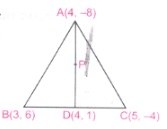
Coordinates of D are [Given]
\(\left( \frac { 3+5 }{ 2 } ,\frac { 6+(-4) }{ 2 } \right) =\left( \frac { 8 }{ 2 } ,\frac { 8 }{ 2 } \right) =\left( 4,1 \right) \)
\(\frac { AP }{ PD } =2\quad \) [Given]
\(\Rightarrow \ AP:PD\ =\ 2:1\)
⇒ Coordinates of P are \(\left( \frac { 2\times 4+1\times 3 }{ 2+1 } ,\frac { 2\times 1+1\times 6 }{ 2+1 } \right) =\left( \frac { 8+3 }{ 3 } ,\frac { 2+6 }{ 3 } \right) =\left( \frac { 11 }{ 3 } ,\frac { 8 }{ 3 } \right) \)
14.
\(AB=\sqrt { ({ 1+2) }^{ 2 }+({ 2-3) }^{ 2 } } =\sqrt { 9+1 } =\sqrt { 10 } \)
\(BC=\sqrt { ({ 7-1) }^{ 2 }+({ 0-2) }^{ 2 } } =\sqrt { 36+4 } =\sqrt { 40 } =2\sqrt { 10 } \)
\(AC=\sqrt { ({ 7+2) }^{ 2 }+({ 0-3) }^{ 2 } } =\sqrt { 81+9 } =\sqrt { 90 } =3\sqrt { 10 } \)
Since \(AB+BC=\sqrt { 10 } +2\sqrt { 10 } =(1+2)\sqrt { 10 } =3\sqrt { 10 } =AC\)
Hence, the points A, B and C are collinear.
15.
()
concurrent
16.
()
5 units
17.
()
positive, negative
18.
()
\({1\over2}[x_1(y_2-y_3)+x_2(y_3-y_1)+x_3(y_1-y_2)]\)
19.
()
2:1
20.
Let the vertices of \(\triangle ABC\) be A(1, -1), B(0, 4) and C(-5,3)
Using distance formula,
\(AB=\sqrt { { \left( 1-0 \right) }^{ 2 }+{ \left( -1-4 \right) }^{ 2 } } \)
\(=\sqrt { 1+{ 5 }^{ 2 } } =\sqrt { 26 } \)
\(BC=\sqrt { { \left( -5-0 \right) }^{ 2 }+{ \left( 3-4 \right) }^{ 2 } } \)
\(=\sqrt { 25+1 } =\sqrt { 26 } \)
\(AC=\sqrt { { \left( -5-1 \right) }^{ 2 }+{ \left( 3+1 \right) }^{ 2 } } \)
\(=\sqrt { 36+16 } =\sqrt { 52 } =2\sqrt { 13 } \)
\(\Rightarrow \quad AB=BC\neq AC\)
\(\Rightarrow \quad \triangle ABC\) is isosceles.
Now, using mid-section formula, the co-ordinates of mid-point of BC are
\(x=\frac { -5+0 }{ 2 } =-\frac { 5 }{ 2 } \)
\(y=\frac { 3+4 }{ 2 } =\frac { 7 }{ 2 } \)
\(\Rightarrow \quad D\left( x,y \right) =\left( -\frac { 5 }{ 2 } ,\frac { 7 }{ 2 } \right) \)
Length of median AD
\(=\sqrt { { \left( \frac { -5 }{ 2 } -1 \right) }^{ 2 }+{ \left( \frac { 7 }{ 2 } +1 \right) }^{ 2 } } \)
\(=\sqrt { { \left( \frac { -7 }{ 2 } \right) }^{ 2 }+{ \left( \frac { 9 }{ 2 } \right) }^{ 2 } } \)
\(=\sqrt { \frac { 130 }{ 4 } } =\sqrt { \frac { 130 }{ 2 } } \)
Length of median AD is \(\frac { \sqrt { 130 } }{ 2 } \) units.
21.
Diagonals of a parallelogram bisect each other.
Mid-points of AC and BD are same
\(\Rightarrow \quad \left( 3,\frac { -1+y }{ 2 } \right) =\left( 3,2 \right) \)
\(\frac { -1+y }{ 2 } =2\quad \Rightarrow \quad y=5\)
22.
Let P(9a-2, -b) divides AB internally in the ratio 3: 1.
\(\therefore \) By section formula, we get 9a-2 = \(\frac { 3(8a)+1(3a+1) }{ 3+1 } \) and -b = \(\frac { 3(5)+1(-3) }{ 3+1 } \) [\(\because \) for internally ratio, coordinates are \(\left( \frac { { m }_{ 1 }{ x }_{ 2 }+{ m }_{ 2 }{ x }_{ 1 } }{ { m }_{ 1 }+{ m }_{ 2 } } ,\frac { { m }_{ 1 }{ y }_{ 2 }+{ m }_{ 2 }{ y }_{ 1 } }{ { m }_{ 1 }+{ m }_{ 2 } } \right) \)]
\(\Rightarrow 9a-2=\frac { 24a+3a+1 }{ 4 } \) and \(-b=\frac { 15-3 }{ 4 } \)
\(\Rightarrow 9a-2=\frac { 27a+1 }{ 4 }\) and \(-b=\frac { 12 }{ 4 } \)
\(\Rightarrow \) 36a-8 = 27a+1 and b = -3
\(\Rightarrow \) 9a-9 =0 and b=-3
\(\Rightarrow \) a=1 and b=-3
Now,\({ a }^{ 2 }+{ b }^{ 2 }={ (1) }^{ 2 }+{ (-3) }^{ 2 }\) = 1+9 = 10 units.

10th Standard CBSE Syllabus & Materials
10th Standard CBSE
CBSE 10th Social Science PS - Federalism - New Model Questions Papers Study Material - QB365 Set A
NEW10th Standard CBSE
CBSE 10th Social Science PS - Power Sharing - New Model Questions Papers Study Material - QB365 Set A
NEW10th Standard CBSE
CBSE 10th Social Science GEO - Manufacturing Industries - New Model Questions Papers Study Material - QB365 Set A
NEW10th Standard CBSE
CBSE 10th Social Science GEO - Minerals and Energy Resources - New Model Questions Papers Study Material - QB365 Set A



CBSE 10th Standard CBSE Subjects
CBSE Standards





