
 100% FREE ACCESS
10th Standard CBSE Syllabus & Materials
10th Standard CBSE
CBSE 10th Social Science ECO - Globalisation and the Indian Economy - New Model Questions Papers Study Material - QB365 Set A
NEW10th Standard CBSE
CBSE 10th Social Science ECO - Money and Credit - New Model Questions Papers Study Material - QB365 Set A
NEW10th Standard CBSE
CBSE 10th Social Science ECO - Sectors of the Indian Economy - New Model Questions Papers Study Material - QB365 Set A
NEW10th Standard CBSE
CBSE 10th Social Science ECO - Development - New Model Questions Papers Study Material - QB365 Set A
NEW10th Standard CBSE
CBSE 10th Social Science PS - Outcomes of Democracy - New Model Questions Papers Study Material - QB365 Set A
NEW10th Standard CBSE
CBSE 10th Social Science PS - Gender, Religion and Caste - New Model Questions Papers Study Material - QB365 Set A

Published on: 03/10/2019
Real Number
Download CBSE Class 10th Standard CBSE Maths question papers, sample papers, important questions, and previous year solved papers in PDF format. Get free study materials, NCERT solutions, and exam preparation resources for Class 10th Standard CBSE Maths
Questions + Answers key
Take MCQ Maths Test
1.
Prove that n2-n is divisible by 2 for every positive integer n.
2.
Write the missing numbers is the following factorisation.
(i) -q.png) (ii)
(ii) -q.png)
3.
Use Euclid's division lemma to show that the square of any positive integer is either of the form 3m or 3m + 1, for some integer m.
4.
Show that \(\left( \sqrt { 3 } +\sqrt { 5 } \right) ^{ 2 }\) is an irrational number.
5.
Find the HCF and LCM of 60, 84 and 108 by using the prime factorisation method.
6.
If two positive integers p and q can be expressed as p = ab2 and q = a3b; where a,b being prime numbers, find the LCM (p,q)
7.
Use the Euclid's division algorithm to find the HCF of
(i) 650 and 1170
(ii) 870 and 225
8.
The product of two consecutive positive integers is divisible by 2. Is this statement true or false? Give reason.
9.
A number when divided by 53 gives 34 as quotient and 21 as remainder. Find the number.
10.
Prove that \(3+2\sqrt { 5 } \) is irrational.
1.
Any positive integer is of the form 2q or 2q + 1, for some integer q.
∴ When n=2q
n2-n = 2q(2q-1)
= 2m, where m=q(2q-1)
which is divisible by 2.
When n = 2q+1
n2-n = (2q+1)(2q+1-1)
= 2q (2q+1)
= 2m, when m = q(2q+1)
which is divisible by 2.
Hence, n2-n is divisible by 2 for every positive integer n.
2.
(i) 36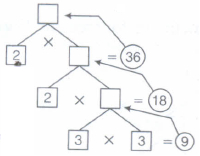
(ii) 42
3.
Consider an arbitrary positive integer y. Then, by taking y as dividend and 3 as divisor, we can write y as
y = 3q + r, where \(0\le r<3\)
[by Euclid's division lemma]
i.e. r = 0, 1, 2
Now, if r = 0, then y = 3q
if r = 1, then y = 3q + 1
and if r = 2, then y = 3q + 2
Thus, the positive integer y is of the form 3q, 3q + 1 or 3q + 2.
Consider, y = 3q and squaring on both sides, we get
y2 = (3q)2 \(\Rightarrow \) y2 + 9q2 = 3(3q)2 = 3m .... (i)
[taking 3q2 = m, where m is some integer]
Consider, y = 3q + 1 and squaring on both sides, we get
y2 = (3q + 1)2
\(\Rightarrow \) y2 = 9q2 + 6q + 1 = 3(3q2 + 2q) + 1 = 3m + 1 .... (ii)
[taking 3q2 + 2q = m, where m is some integer]
Consider, y = 3q + 2 and squaring on both sides, we get
y2 = (3q + 2)2 \(\Rightarrow \) y2 = 9q2 + 12q + 4
\(\Rightarrow \) y2 = (9q2 + 12q + 3) + 1 = 3(3q2 + 4q + 1) + 1
\(\Rightarrow \) y2 = 3m + 1 .... (iii)
From Eqs. (i), (ii) and (iii), we get y2 = 3m or 3m + 1
Thus, the square of any positive integer can be either of the form 3m or 3m + 1, for some integer m.
4.
Irrational
5.
| 2 | 60 |
| 2 | 30 |
| 3 | 15 |
| 5 | 5 |
| 1 |
| 2 | 84 |
| 2 | 42 |
| 3 | 21 |
| 7 | 7 |
| 1 |
| 2 | 108 |
| 2 | 54 |
| 3 | 27 |
| 3 | 9 |
| 3 | 3 |
| 1 |
HCF (60, 84, 108) = 12 and LCM = 3780
6.
P = ab2 = a x b x b and q = a3b = a x a x a x b
LCM (p, q) = a3 b2
7.
Consider the greater number as a and smaller as b and then apply Euclid's division algorithm to get the required HCF.
(i) 130 (ii) 15
8.
True, because the product of any two consecutive numbers, say n(n + 1) will always be even as one out of n or (n+1) must be even.
9.
Use, dividend = divisor x quotient + remainder
= 53 x 34 + 21
= 1823
10.
Let us assume to the contrary that \(3+2\sqrt { 5 } \) is a rational number. Then, it can be expressed in the form \(\frac{a}{b}\), where a, b are coprime integers and \(b\neq 0\)
Now, \(3+2\sqrt { 5 } \) = a/b, where a,b are integers and \(b\neq 0\)
On rearranging, we get
\(2\sqrt { 5 } =\frac { a }{ b } -3\quad or\quad \sqrt { 5 } =\frac { a }{ 2b } -\frac { 3 }{ 2 } \)
Since, a, b are integers and \(b\neq 0\) , therefore \(\frac{a}{2b}\) is rational number and so \(\frac{a}{2b}\) - \(\frac{3}{2}\) is a rational number.
[since, difference of two rational numbers is also a rational number]
\(\Rightarrow \sqrt { 5 } \) is a rational number. But \(\sqrt { 5 } \) is an irrational number.
This shows that our assumption is incorrect.
So, \(3+2\sqrt { 5 } \) is irrational.

10th Standard CBSE Syllabus & Materials
10th Standard CBSE
CBSE 10th Social Science PS - Federalism - New Model Questions Papers Study Material - QB365 Set A
NEW10th Standard CBSE
CBSE 10th Social Science PS - Power Sharing - New Model Questions Papers Study Material - QB365 Set A
NEW10th Standard CBSE
CBSE 10th Social Science GEO - Manufacturing Industries - New Model Questions Papers Study Material - QB365 Set A
NEW10th Standard CBSE
CBSE 10th Social Science GEO - Minerals and Energy Resources - New Model Questions Papers Study Material - QB365 Set A



CBSE 10th Standard CBSE Subjects
CBSE Standards





