
 100% FREE ACCESS
10th Standard CBSE Syllabus & Materials
10th Standard CBSE
CBSE 10th Social Science ECO - Globalisation and the Indian Economy - New Model Questions Papers Study Material - QB365 Set A
NEW10th Standard CBSE
CBSE 10th Social Science ECO - Money and Credit - New Model Questions Papers Study Material - QB365 Set A
NEW10th Standard CBSE
CBSE 10th Social Science ECO - Sectors of the Indian Economy - New Model Questions Papers Study Material - QB365 Set A
NEW10th Standard CBSE
CBSE 10th Social Science ECO - Development - New Model Questions Papers Study Material - QB365 Set A
NEW10th Standard CBSE
CBSE 10th Social Science PS - Outcomes of Democracy - New Model Questions Papers Study Material - QB365 Set A
NEW10th Standard CBSE
CBSE 10th Social Science PS - Gender, Religion and Caste - New Model Questions Papers Study Material - QB365 Set A

Published on: 14/02/2020
10th Standard CBSE Science Board Exam Model Question paper I 2019-2020
Download CBSE Class 10th Standard CBSE Science question papers, sample papers, important questions, and previous year solved papers in PDF format. Get free study materials, NCERT solutions, and exam preparation resources for Class 10th Standard CBSE Science
Questions + Answers key
Take MCQ Science Test
1.
The preparation of water from hydrogen and oxygen gas is accompanied by:
Evolution of coloured gas
Formation of precipitate
Formation of ashes
Change in state
2.
Element X forms a chloride with the formula XCl2 , which is a solid a high melting point. X would most likely be in the same group of the Periodic Table as :
Na
Mg
Al
Si
3.
Pentane has the molecular formula C5H12 . It has
5 covalent bonds
12 covalent bonds
16 covalent bonds
17 covalent bonds
4.
Which one of the following will decide whether something is alive:
Body structure
Movement
Cellular organization
Both (a) and (b)
5.
Commercial electric motors do not use
An electromagnet to rotate the armature
Effectively large number of turns of conducting wire in the current carrying coil
A permanent magnet to rotate the armature
A soft iron core on which the coil is wound
6.
Acid rain happen because
Sun leads to heating of upper layer of atmosphere
Burning of fossil fuels release oxides of carbon, nitrogen and sulphur in the atmosphere.
Electrical charges a produced due to friction among clouds
Earth's atmosphere contains acids.
7.
Which of the following properly is generally not shown by metals?
Electrical conduction
Sonorous in nature
Dullness
Ductility
8.
Junction between two neurons is called
Cell junction
Neuro muscular junction
Neural joint
Synapse
9.
1 kilowatt hour (kWh) is equal to
3.6 \(\times\)106J
3.6 \(\times\)108J
3.6 \(\times\)102J
3.6 \(\times\)105J
10.
Identify the correct representation of reaction occurring during chlor-alkali process
\(2NaCl(l)+2H_2O(l)\rightarrow2NaOH(l)+Cl_2(g)+H_2(g)\)
\(2NaCl(aq)+2H_2O(aq)\rightarrow2NaOH(aq)+Cl_2(g)+H_2(g)\)
\(2NaCl(aq)+2H_2O(l)\rightarrow2NaOH(aq)+Cl_2(aq)+H_2(aq)\)
\(2NaCl(aq)+2H_2O(l)\rightarrow2NaOH(aq)+Cl_2(g)+H_2(g)\)
11.
Arun took a pale green substance X in a test tube, and heated it over a flame. He observed a color change along with evolution of two gases with the smell of burning sulphur
(a) Identify X.
(b) Identify the product formed.
(c) Write the equation.
(d) Identify the type of chemical reaction.
12.
What is the difference between two consecutive members in a homologous series in alkanes in terms of:
(i) Molecular mass,
(ii) Number of atoms of elements.
13.
Write the name and molecular formula of the first member of the homologous series of alkynes
14.
Which gas is usually liberated when an acid reacts with a metal?
15.
A wire of resistance 10 ohm is bent in the form of a closed circle. What is the effective resistance between the two points at the ends of any diameter of the circle?
16.
Should the heating element of an electric iron be made of iron, silver or nichrome wire?
17.
Name the functional group present in each of the following organic compounds:
(i) C2H5Cl
(ii) C2H5OH
18.
In electron dot structure, the valence shell electrons are represented by crosses or dots.
a) The atomic number of chlorine is 17. Write its electronic configuration
b) Draw the electron dot structure of chlorine molecule
19.
Who discovered that mechanical motion can produce current?
20.
Name the rule used to determine the direction of induced current.
21.
What is lymph?
22.
Which pancreatic enzyme is effective in digesting proteins?
23.
What kind of quantity is magnetic field?
24.
Name the catalyst used in the manufacture of ammonia by Haber's Process.
25.
What are two types of reducing agents used to reduce metal oxide?
26.
What is the purpose of quenching steel?
27.
Name the term for transport of food from leaves other parts of the plant.
28.
What is geothermal energy?
29.
Give two examples each of the metals that are good conductors and poor conductors of heat respectively.
30.
What health disorder may occur if the following hormones are not secreted properly?
(a) Growth hormone
(b) Insulin
(c) Thyroxine
(d) Testosterone
31.
What are gustatory receptors?
32.
Name the hormone secreted by thyroid gland.
33.
Name the part of brain in which hypothalamus is located.
34.
Give the S.I. unit of electric current?
35.
Will current flow more easily through a thick wire or a thin wire of the same material, when connected to the same source? Why?
36.
What is the role of a catalyst in a chemical
37.
Balance the following chemical equation:
Fe(s) + H2O(g) \(\rightarrow\) Fe3O4(s) + H2(g)
38.
A magnesium ribbon is burnt in oxygen to give a white compound X accompanied by emission of light. If the burning ribbon is now placed in an atmosphere of nitrogen, it continues to burn and forms a compound Y.
(a) Write the chemical formulae of X and Y.
(b) Write a balanced chemical equation, when X is dissolved in water.
39.
Esters are sweet-smelling substances and are used in making perfumes. Suggest some activity and the reaction involved for the preparation of an ester with well labeled diagram.
40.
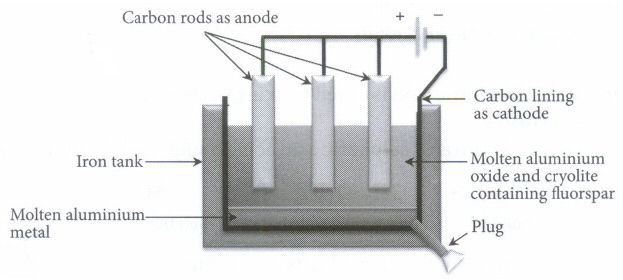
(a) Write chemical equations for the reactions involved in obtaining pure alumina from the mineral bauxite which has impurities of iron oxide and silica.
(b) Draw a labelled diagram of the electrolytic tank cell used for the extraction of aluminium from alumina.
41.
How do carbohydrates, proteins and fats get digested in human beings?
42.
How will you conclude that the same potential difference exist across three resistors connected in a parallel arrangement to a battery?
43.
Nervous and hormonal system together perform the function of control and coordination in human beings. Justify the statement with the help of an example.
44.
(a) Why is sulphuric acid called 'King of Chemicals'?
(b) Describe the three chemical reactions that take place during the conversion of sulphur dioxide to sulphuric acid in the 'Contact Process'.
(c) Why should water be never added drop wise to concentrated sulphuric acid?
45.
Mention the products produced when an acid reacts with a base. Give equation of an example of the reaction involved. What is this kind of reaction known as?
46.
Write the steps for balancing the chemical equation for the formation of ammonia by the combination of nitrogen and hydrogen.
47.
Define water of crystallisation with two examples. How will you prove their existence in the examples given by you?
48.
Distinguish between permanent magnet and electromagnet.
49.
Distinguish between an electric motor and generator?
50.
Name the constituents of blood.Why white blood corpuscles are called 'soldiers of the body'?
51.
How are oxygen and carbon dioxide transported in human beings? How are lungs designed to maximize the area for exchange of gases?
52.
From amongst the metals sodium, calcium, aluminium, copper and magnesium, name the metal.
(i) which reacts with water only on boiling and
(ii) another which does not react even with steam.
53.
(a) Why is the Solar Cooker box covered with a plane glass plate?
(b) Why is energy of water flowering in a river considered to be an indirect form of solar energy?
(c) How is the fission of nucleus brought about?
54.
(a) What is a 'solar cell'?
(b) Why is biogas considered an ideal fuel for domestic use?
(c) Name a device in which controlled chain reaction is used.
55.
Distinguish between voluntary and involuntary actions of our body.
56.
Describe the central nervous system in human being under the following heads:
(i) Regions included
(ii) Three functions of any one region
57.
(a) Distinguish between the terms "overloading and short circuiting" as used in domestic circuits.
(b) Why are the coils of electric toasters made of an alloy rather than a pure metal?
58.
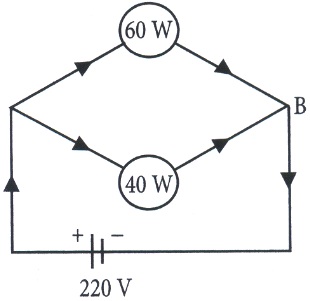
Two lamps, one related 60W at 220 W at 220V and the other 40 W at 220 V, are connected in parallel to the electric supply at 220V.
(a) Draw a circuit diagram to show the connections.
(b) Calculate the current drawn from the electric supply.
(c) Calculate the total energy consumed by the two lamps together when they operate for one hour.
59.
The Position of three elements A,B and C in the Periodic Table is shown below:
| Group\(\rightarrow \) | I | II | III | IV | V | VI | VII |
| Period\(\downarrow \) | |||||||
| 1 | B | ||||||
| 2 | A | ||||||
| 3 | C |
Giving reasons, explain the following :
(a)Element A is a non-metal.
(b)Element B has a larger atomic size than element C.
(c) Element C has a Valency of 1
60.
Which is the process used to harness nuclear energy these days? Explain it briefly.
61.
State modern periodic law of classification of elements.
62.
Why was the system of classification of elements into triads not found suitable?
63.
Chlorine, bromine and iodine form a Dobereiner's triad. The atomic masses of chlorine and iodine are 35.5 and 126.9 respectively. Predict the atomic mass of bromine.
64.
What are fossil fuels?
65.
Name the gas which is the major constituent of bio gas?
1.
(d)
Change in state
2.
(b)
Mg
3.
(c)
16 covalent bonds
4.
(b)
Movement
5.
(a)
An electromagnet to rotate the armature
6.
(b)
Burning of fossil fuels release oxides of carbon, nitrogen and sulphur in the atmosphere.
7.
(c)
Dullness
8.
(d)
Synapse
9.
(d)
3.6 \(\times\)105J
10.
(d)
\(2NaCl(aq)+2H_2O(l)\rightarrow2NaOH(aq)+Cl_2(g)+H_2(g)\)
11.
Galvanisation
12.
Difference in :
(i) Molecular mass = 14 a.m.u.
(ii) Number of atoms of elements = CH2
13.
Ethyne, C2H2
14.
Reaction of an acid with a metal:
When an acid reacts with a metal, it forms a salt.
Hydrogen which is in all the acids gets displaced and liberated as hydrogen gas.
Acids + Metals \(\rightarrow\) Salt + Hydrogen gas
15.
As the wire is bent in the form of a closed circle, it will be have like two resistors of 5\(\Omega \) each, connected in parallel. Therefore, the equivalent resistance can be calculated as:
\(\frac { 1 }{ R_{ eq } } =\frac { 1 }{ { R }_{ 1 } } +\frac { 1 }{ { R }_{ 2 } } \)
\(\frac { 1 }{ R_{ eq } } =\frac { 1 }{ 5 } +\frac { 1 }{ 5 } \)=\(\frac { 1 }{ R_{ eq } } =\frac { 2 }{ 5 } \)
\(\frac { 1 }{ R_{ eq } } =\frac { 5 }{ 2 } =2.5\Omega \)
The effective resistance between the two points at the ends of an diameter of the circle is 2.5 \(\Omega \).
16.
Nichrome should be used as a heating element in an electric iron because its melting point is higher than iron and silver.
17.
(i) (-Cl) Halogen (Chloro)
(ii) -OH) Alcohol
18.
a) The electronic configuration of chlorine with atomic number 17 is
K L M
2 8 7
b) Electron dot structure of chlorine molecule Cl2 is

19.
Michael Faraday in 1831 discovered that mechanical motion can produce current.
20.
Direction of induced current is given by Fleming's right hand rule according to this rule, stretch the thumb, fore-finger and the middle finger of the right hand such that they are mutually perpendicular.
If the fore-finger points in the direction of magnetic field the thumb shows the direction of motion and middle finger points in the direction of induced current.
21.
It is an extracellular fluid used in transportation.
22.
Pancreatic trypsin
23.
It is a vector quantity as it has both magnitude and direction.
24.
Heated iron acts as a catalyst in the synthesis of ammonia. It accelerates the rate of reaction and hence acts as a promoter .
25.
Carbon and highly reactive metals such as sodium, calcium, aluminium are used as reducing agents to reduce metal into metal.
26.
Quenching makes steel very hard and brittle.
27.
Translocation
28.
The heat energy obtained in the form of steam from under the earth's crust is called geothermal energy.
29.
(a) Good conductor : Silver Ag and Copper Cu
(b) Poor conductor : Lead Pb and Mercury Hg
30.
(a) Dwarfism if less hormone; Gigantism if secreted more.
(b) Diabetes
(c) Goitre
(d) Masculine characters will not develop properly in male.
31.
The receptors present in our tongue which detect the taste are called gustatory receptors.
32.
Thyroxine is the hormone secreted by the thyroid gland. This hormone regulates the metabolism of carbohydrates, fats and proteins. By regulating the metabolism it helps in optimum growth and development of the body.
33.
Hind brain
34.
Ampere (A)
35.
Resistance is inversely proportional to the area of cross-section of the wire. Since, thìck wire has a large area of cross-section, its resistance will be less. Thus, current will flow more easily through the thick wire.
36.
A catalyst changes the rate of reaction without taking part in the reaction itself.
37.
3Fe(s) + 4H2O(g) →→ Fe3O4(s) + 4H2(g)
38.
(a) The chemical formula of X is MgO (magnesium oxide).The chemical formula of 'Y' is Mg3N2 (magnesium nitride).
(b) When 'X, magnesium oxide dissolves ip water, it gives magnesium hydroxide.
The chemical reaction involved in it, is as follows: •
MgO + H2O\(\rightarrow\) Mg(OH)2
39.
Carboxylic acid reacts with alcohols to form ester. For example, when ethanoic acid is warmed with ethanol in presence of a few drops of concentrated sulphuric acid as catalyst, an ester (ethyl ethanoate, commonly called ethyl acetate) and water are formed.
\(\underset{Acetic\ or\ ethanoic\ acid}{CH_COOH}+\underset{Ethanol}{C_2H_5OH}\xrightarrow{Conc. H_2SO_4}\underset{Ethyl\ ethanoate}{CH_3COOC_2H_5}+\underset{Water}{H_2O)}\)
Ester are sweet -smelling substances. So they are widely used in making perfumes and flavoring agents. Further, the reaction between a carboxylic acid and an alcohol to form a sweet ester is used as a test for alcohols as well as carboxylic acids.
40.
(a) The reaction involved in obtaining pure alumina from the mineral bauxite having impurities of iron oxide and silica is:
(i) \(\underset { Aluminiumoxide\\ (frombauxiteore) }{ { AI }_{ 2 }{ O }_{ 3 }(s) } +\underset { Sodiumhydroxide\\ \quad (hot) }{ 2NaOH(aq) } \rightarrow \underset { Sodiumaluminate\\ \quad (Soluble) }{ { 2NaAIO }_{ 2 }(aq) } +\underset { Water }{ { H }_{ 2 }O(I) } \)
The iron oxide and silica (sand) present in the bauxite ore do not dissolve in sodium hydroxide solution. Therefore, they are separated by filtration.
(ii) \(\underset { Sodiumaluminate }{ { NaAIO }_{ 2 }(aq) } +\underset { Water }{ { 2H }_{ 2 }O(I) } \rightarrow \underset { Aluminiumhydroxide\\ \quad (Whiteppt) }{ { AI(OH) }_{ 3 }(s) } +\underset { Sodiumhydroxide }{ NaOH(aq) } \)
(iii) \(\underset { Aluminiumhydroxide }{ { 2AI(OH) }_{ 3 }(s) } \underrightarrow { heat } \underset { Aluminiumoxide\\ \quad (Pure) }{ { AI }_{ 2 }{ O }_{ 3 }(s) } +\underset { Steam }{ { 3H }_{ 2 }O(g) } \)
(b)
41.
The salivary glands secrete saliva. The saliva contains water, salts, mucus and an enzyme ptyalin. The enzyme ptyalin, also glycogen and convert them into maltose. The mucus and water makes the food soft and slippery for the formation of bolus and also protects soft lining of alimentary canal. Thus the digestion of starch i.e., carbohydrate begins in the mouth. Since,the food remains in the mouth only for a short time and so, the digestion of food remains incomplete.
\(Starch(Carbohydrates)+Glycogen\overset { Ptyalin }{ \longrightarrow } Maltose\)
The partially digested food is further digested in the stomach. The food is broken down into smaller pieces and churned to form a semi-solid paste. The wall of the stomach contains three tubular glands. These glands secrete gastric juice. The gastric juice contains hydrochloric acid, mucus, pepsin, gastric lipase and rennin.
Hydrochloric acid:
It softens the food
It makes food acidic for the function of pepsin
It stops the action of salivary amylase
It kills germs and bacteria to disinfect the food
It converts inactive pepsinogen and prorennin into active pepsin and rennin.
\(InactivePepsinogen\overset { HCI }{ \longrightarrow } ActivePepsin\\ InactivePro-rennin\overset { HCI }{ \longrightarrow } Activerenin\)
Pepsin: It hydrolyses proteins into soluble proteoses and peptones only in presence of hydrochloric acid.
\(Protein\overset { Pepsin }{ \longrightarrow } Peptones+Proteoses\)
Rennin: It is active only in infants. The main function of rennin is that it converts soluble milk protein casein into insoluble protein called paracasein. Due to this, milk stays in stomach for longer duration.
\(\underset { (solublemilkprotein) }{ Casein } \overset { Rennin }{ \longrightarrow } \underset { (Insoluble) }{ Paracasein } \)
Mucus: The main function of mucus is to protect the inner lining of stomach from corroding action of hydrochloric acid as well as from pepsin enzyme.
Small Intestine: It is the seat of major digestion and absorption. Small intestine receives the secretion of two glands namely,
(i) Liver, (ii) Pancreas
Liver: It is the largest gland of the body. It is reddish brown in colour. It has soft pear - shaped sac called gall bladder. The gall bladder secretes bile juice. Bile is alkaline containing bile pigment. Thus, bile is stored in the gall bladder. It helps to emulsify or break the fats or lipids present in the food.
The bile performs the following functions:
(i) It breaks the larger globules of fat into small globules to make the enzyme to act and digest them.
(ii) It prevents putrefaction of food.
(iii) The bile creates a medium for the pancreatic juice to act on food by neutralizing the acidity in the food.
Pancreas: Pancreas secretes a digestive fluid called pancreatic juice. This juice contains digestive enzymes such as trypsin, nucleases, pancreatic lipase and pancreatic amylase. The enzyme trypsin digests the proteins, the enzyme pancreatic amylase breaks down the starch and the enzyme lipase breaks down the emulsified
facts. Pancreas produces two important hormones namely,
(i) Insulin, (ii) Glucagon
Insulin is essential for using glucose and storing it into glycogen. Glucagon is essential for conversion of glycogen into glucose. The alkaline medium is favourable
for the action of pancreatic enzymes.
\(Starch\xrightarrow [ ]{ Pancreaticamylase } Maltose\\ Fat\xrightarrow [ ]{ Lipase } Fattyacids+Glycerol\\ Proteins\xrightarrow [ ]{ Trypsin } Peptides\)
Secretion of intestinal juice by liver and pancreatic glands
The intestinal juice contains a number of enzymes which complete the digestion process. Here, the complex carbohydrates are converted into glucose, proteins are converted into amino acids and fats are converted into fatty acids and glycerol. All these end products i.e., amino acids, glucose, fatty acids and glycerol are small
and water soluble molecules. This complete digestion of food takes place by biological catalysts called enzymes. The intestinal juice includes - maltase, invertase, lactase etc.
\(Peptides\xrightarrow [ ]{ Trypsin } Aminoacids\\ Sucrose\xrightarrow [ ]{ Invertase } Glucose+Fructose\\ Maltose\xrightarrow [ ]{ Maltose } Glucose+Glucose\\ Lactose\xrightarrow [ ]{ lactose } Glucose+Galactose\)
42.
A number of resistors are said to be connected in parallel if one end of each is connected to one point and the other end is connected to another point so that the potantial difference across each resistor is the same and is equal to the applied potential difference between the two points. If we connect a voltmeter first across R1, then across R2 ad lastly across R3, it will show same voltage.
43.
The endocrine and neural system both works together for the normal functioning of our body. The synthesis and release of certain hormones is regulated by the neural system. Also, the release of certain hormones influences the activity of nerves.
For example, hypothalamus receives neural signals from brain and releases hormones.
In case of deficiency of iodine, body produces less thyroxine hormone. Hypothalamus releases hormones to stimulate pituitary gland which further stimulates thyroid gland to secrete thyoxine.
44.
(a) Concentrated sulphuric acid is called the king of chemicals as it is a very strong acid and is highly corrosive.
(b) The three chemical reactions that take place during the conversion of sulfur dioxide to sulphuric acid in the 'Contact Process' are given below.
Step I: Sulphur dioxide is mixed with air and passed over vanadiumpent (V) oxide catalyst heated to \(450^oC\) to form sulphur trioxide.
\(\underset{Sulphur\ dioxide}{2SO_{2(g)}}+\underset{Oxygen}{O_{2(g)}}\underset{\rightleftharpoons }{V_2O_5}\underset{Sulphur\ trioxide}{2SO_{3(g)}}+Heat\)
Step II : Sulphur trioxide is dissolved in concentrated sulphuric acid to form a thick fuming liquid called oleum.
\(\underset{Sulphuric\ acid}{H_2SO_4(l)}+\underset{Sulphur\ trioxide}{SO_{3(g)}}\begin{matrix} V_2O_5 \\ \rightleftharpoons \\ \end{matrix}\underset{Oleum}{H_2S_2O_{7(l)}}\)
Step III: Oleum is diluted with a calculated quantity of water to obtain sulphuric acid.
\(H_2S_2O_{7(l)}+\underset{Water}{H_2O_{(l)}}\rightarrow\underset{Sulphuric\ acid}{2H_2SO_{4(aq)}}\)
(c) If water is added to sulphuric acid then a large amount of heat is evolved. This changes water to steam, which can splash the acid. Hence, it is dangerous.
45.
The reaction between an acid and a base that gives a salt and water is known as a neutralisation reaction.
Base + Acid ➝ Salt + Water
NaOH(aq) + HCI(aq) ➝ NaCl(aq) + H2O(I)
46.
N2 + H2 \(\rightarrow \) NH3 (Unbalanced equation).
(i) Examine the number of atoms of different elements present in the unbalanced equation.
(ii) In the above reaction, left hand N2 and H2 of both the sides are unbalanced.
(iii) To balance hydrogen, H2 is multiplied by 3 on side. It makes 6H-atoms on the left hand side.
(iv) Now to balance hydrogen atoms on the right hand side, NH3 should be multiplied by 2. It makes 6H-atoms on this side.
(v) Now to balance nitrogen atoms, they are counted separately for both the sides and we will find that, nitrogen atoms are 2 on both the sides.
(vi) Balanced chemical equation will be :
N2 + H2 \(\rightarrow \) NH3.
47.
Water of crystallisation is a fixed number of water molecules present in one formula unit of a salt. One formula unit of copper sulphate contains five water molecules (SH2O). The water molecules which form
part of the structure of a crystal are called water of crystallisation.
\(\underset{(Hydrated\ copper\ sulphate)\\(Blue)}{CuSO_4.5H_2O}\xrightarrow{Heat}\underset{(Anhydrous\ copper\ sulphate)\\(White)}{CuSO_4}+\underset{Water\\(Goes\ away)}{5H_2O}\)
Due to loss of water of crystallisation.
\(\underset{Anhydrous\ copper\ sulphate\\(White)}{CUSO_4}+\underset{Water}{5H_2O}\longrightarrow\underset{Hydrated\ sulphate\\(blue)}{CUSO_4.5H_2O}\)
By adding water
48.
| Electromagnet | Permanent Magnet |
| 1. It is temporary magnet and can be demagnetized | 1. It is a permanent magnet and cannot be demagnetized |
| 2. Magnetic strength can be changed. | 2. its strength is fixed. |
| 3. Its polarity can also be changed. | 3. Its polarity is fixed. |
| 4. It is prepared from soft iron. | 4. It is prepared from hard steel. |
49.
The major differences between an electric motor and generator are stated below:
Electric Motor:
1. It converts electrical energy into mechanical energy.
2. It needs electrical energy for its works.
3. They are used as water pumps, marble grinders etc.
Generator:
1. It converts mechanical energy into electrical energy
2. It needs mechanical energy for its working.
3. They are used as water pumps, marble grinders etc.
4. diesel generator, hydro-electric generator are the examples of it.
50.
The different constituents of blood are plasma (the fluid part of the bloo(d) and blood corpuscles consisting of RBCs, WBCs, and platelets)
WBCs are known as the soldiers of the body because they fight against the pathogenes that invade our body, thus preventing the occurence of diseases.
51.
(i) Oxygen enters the human body through the nasal passage and reaches the lungs.
(ii) Numerous alveoli are present in the lungs. These alveoli are surrounded by many blood capillaries. From the alveoli, 02 is taken up by the red blood cells present in the blood capillaries.
(iii) Similarly, the CO2 from the various tissues is transported to the alveoli.
(iv) This CO2 is then released through the nasal passage during exhalation. Alveoli are the sites of exchange of gases. Each lung contains 300- 350 million alveoli.
These alveoli increase the surface area for gaseous exchange, making the process of respiration more efficient.
52.
(i) Magnesium reacts with water only on boiling.
(ii) Copper metal does not react even with steam.
53.
(a) The solar cooker box is covered with a plane glass plate so as to prevent heat from escaping.
(b) Sun is said to be the ultimate and the original source for most of the energy present on the earth. When sun rays fall on oceans and other water bodies, the water present in the water bodies gets evaporated and rises up in the atmosphere. In the upper part of the atmosphere, this water vapour gets condensed and forms douds, which give rain on the high lands. Therefore, the rain water runs over the Sand surface towards the large water bodies. This running water over the land surfaces is called river. Therefore, the energy of running water actually originates from the solar energy. This is why solar energy of water flowing in a river is considered to be an indirect form of solar energy.
(c) The fission of nucleus is brought about by splitting the nucleus of heavy atoms, such as uranium or plutonium, with low-energy neutron bombardment.
54.
(a) A solar cell is a device which converts solar energy into electricity. It is a sandwich of a silicon-boron layer and a silicon-arsenic layer.
(b) Biogas is an ideal fuel for domestic use because it is a cheap and clean fuel, which does not leave behind any residue.
(c) A nuclear power plant is a device in which controlled chain reaction is used.
55.
Voluntary actions are under the control of our will, it needs thinking. e.g. talking, walking. Involuntary actions are not under the control of our will, they are automatic. eg. salivation, heart beat.
56.
(i) Regions included in central nervous system are the brain and the spinal cord. The brain and the spinal cord. The brain is further divided into three parts - forebrain, midbrain, and hindbrain.
(ii) Three of the functions of the brain are:
Forebrain controls intelligence, learning, memory, thinking, speech, etc.
Midbrain is associated with the sense of sight and hearing.
Hindbrain controls all involuntary actions such as breathing, peristalsis, etc.
57.
(a) Short circuiting is the term used for defining the situation in which the neutral and live wires of an electric circuit come in direct contact. When too many electrical appliances are connected to a single socket, the appliances drawn much more current or power that the permissible limit from the main supply. This situation is termed as overloading.
(b) Resistivity of an alloy is much higher than its constituent metals Moreover, alloys do not oxidise as easily as the constituent metals at high temperature. Because of these reasons, coils of electric testers are made of an alloy rather than a pure meta.
58.
(a)
(b) Electric current flowing through a bulb = \(\frac { Power\quad of\quad the\quad bulb }{ Voltage\quad across\quad the\quad bulb } \)
\(i.e.,\quad I=\frac { P }{ V } \)
Therefore, \({ I }_{ 60 }=\frac { 60W }{ 220V } =\frac { 3 }{ 11 } A\quad and\quad { I }_{ 40 }=\frac { 40W }{ 220V } =\frac { 2 }{ 11 } A\)
Therefore, total current flowing through the circuit \(={ I }_{ 60 }+{ I }_{ 40 }=\frac { 3 }{ 11 } +\frac { 2 }{ 11 } =\frac { 5 }{ 11 } A=0.45A\)
(c) Total energy consumed = Power \(\times \) Time
That is, E = P \(\times \) T
= (40W+60W)\(\times \)1h
= 100 Wh
= 0.1 kWh
59.
(a) Element 'A' is non-metal because it belongs to Group VII therefore it has 7 electrons in its outermost shell. It needs one electron to acquire nearest inert gas configuration and form a monovalent -ve ion.
(b) Atom of element C has a larger size than that of element A because C belongs to the 3rd period therefore it has three shells whereas A belongs to the 2nd period thus it has two shells.
(c) Element B has a valency of 1 because it belongs to Group I and has one valence electron. To complete its outermost shell or to acquire nearest noble gas configuration it loses one electron and forms a monovalent +ve ion.
60.
In a process called nuclear fission, the nucleus of a heavy atom (such as uranium, plutonium or thorium), when bombarded with low-energy neutrons, can be split into lighter nuclei with a release of tremendous amount of energy if the mass of the original nucleus is just a little more than the sum of the masses of the individual products.
The released energy can be used to produce steam and further generate electricity. The major hazard of nuclear power generation is the storage and disposal of spent or used fuels. Improper nuclear-waste storage and disposal result in environmental contamination. Further, there is a risk of accidental leakage of nuclear radiation. The high cost of installation of a nuclear power plant, high risk of environmental contamination and limited availability of uranium makes large-scale use of nuclear energy prohibitive. The only viable way to dispose off radioactive waste is to bury it deep underground. "The nuclear waste also should be guarded against any misuse.
61.
()
Modern periodic law states "that the properties of elements are a period function of the atomic numbers"
62.
()
It is because all the elements discovered at that time could not be classified into triads.
63.
()
Atomic mass of Br = 35.5 + 126.9 / 2
= 162.4 / 2 = 81.2
64.
()
Fuels which are formed from the fossil remains of plants and animals and are obtained from under the earth's crust are called fossil fuels. Example coal, petroleum and natural gas.
65.
()
Methane(75%)

10th Standard CBSE Syllabus & Materials
10th Standard CBSE
CBSE 10th Social Science PS - Federalism - New Model Questions Papers Study Material - QB365 Set A
NEW10th Standard CBSE
CBSE 10th Social Science PS - Power Sharing - New Model Questions Papers Study Material - QB365 Set A
NEW10th Standard CBSE
CBSE 10th Social Science GEO - Manufacturing Industries - New Model Questions Papers Study Material - QB365 Set A
NEW10th Standard CBSE
CBSE 10th Social Science GEO - Minerals and Energy Resources - New Model Questions Papers Study Material - QB365 Set A



CBSE 10th Standard CBSE Subjects
CBSE Standards





