100% FREE ACCESS
10th Standard CBSE Syllabus & Materials
10th Standard CBSE
CBSE 10th Social Science ECO - Globalisation and the Indian Economy - New Model Questions Papers Study Material - QB365 Set A
NEW10th Standard CBSE
CBSE 10th Social Science ECO - Money and Credit - New Model Questions Papers Study Material - QB365 Set A
NEW10th Standard CBSE
CBSE 10th Social Science ECO - Sectors of the Indian Economy - New Model Questions Papers Study Material - QB365 Set A
NEW10th Standard CBSE
CBSE 10th Social Science ECO - Development - New Model Questions Papers Study Material - QB365 Set A
NEW10th Standard CBSE
CBSE 10th Social Science PS - Outcomes of Democracy - New Model Questions Papers Study Material - QB365 Set A
NEW10th Standard CBSE
CBSE 10th Social Science PS - Gender, Religion and Caste - New Model Questions Papers Study Material - QB365 Set A

Published on: 14/02/2020
10th Standard CBSE Science Board Exam Model Question paper II 2019-2020
Download CBSE Class 10th Standard CBSE Science question papers, sample papers, important questions, and previous year solved papers in PDF format. Get free study materials, NCERT solutions, and exam preparation resources for Class 10th Standard CBSE Science
Questions + Answers key
Take MCQ Science Test
1.
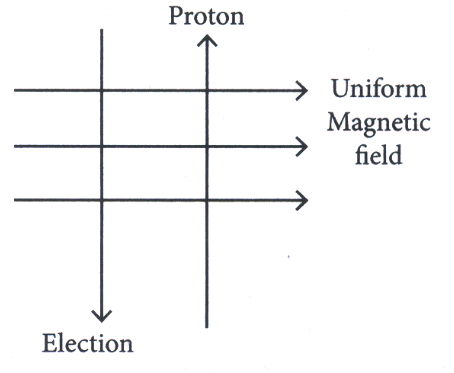
A uniform magnetic field exists in the plane of paper pointing from left to right as shown in Figure. In the field an electron and a proton move as shown in the figure. The electron and the proton experience
Forces both pointing into the plane of paper
Forces both pointing out of the plane of paper
Forces pointing into the plane of paper and out of the plane of paper, respectively.
Force pointing opposite and along the direction of the uniform magnetic field respectively.
2.
Which of the following statements about the Modern Periodic Table is correct:
It has 18 horizontal rows known as Periods
It has 7 vertical columns known as Periods
It has 18 vertical columns known as Groups
It has 7 horizontal rows known as Groups.
3.
The first member of alkyne homologous series is
Ethyne
Ethane
Propyne
Methane
4.
Which one of the following forms of energy leads to least environment pollution in the process of its harnessing and utilization?
Nuclear energy
Thermal energy
Solar energy
Geothermal energy
5.
Which of the following non-metals is a liquid?
Carbon
Bromine
Phosphorus
Sulphur
6.
In an electrical circuit two resistors of 2\(\Omega \) and 4\(\Omega \) respectively are connected in series to a 6 V battery. The heat dissipated by the 4\(\Omega \) resistor in 5s will be
5 J
10 J
20 J
30 J
7.
Which part of alimentary canal receives bile from the liver?
Stomach
Small intestine
Large intestine
Oesophagus
8.
Which of the following is not associated with growth of plant?
Auxin
Gibberellins
Cytokinins
Abscissic acid
9.
Sodium hydrogen carbonate when added to acetic acid evolves a gas. Which of the following statements are true about the gas evolved?
(i) It turns lime water milky
(ii) It extinguishes a burning splinter
(iii) It dissolves in a solution of sodium hydroxide
(iv) It has a pungent odour
(i) and (ii)
(i), (ii) and (iii)
(ii), (iii) and (iv)
(i) and (iv)
10.
Three beakers labelled as A, B and C each containing 25 mL of water was taken. A small amount of NaOH, anhydrous CuSO4 and NaCl were added to the beakers A, B and C respectively. It was observed that there was an increase in the temperature of the solutions contained in beakers A and B, whereas in case of beaker C, the temperature of the solution falls. Which one of the following statement(s) is (are) correct?
(i) In beakers A and B, exothermic process has occurred.
(ii) In beakers A and B, endothermic process has occurred.
(iii) In beaker C exothermic process has occurred.
(iv) In beaker C endothermic process has occured.
(i) only
(ii) only
(i) and (iv)
(ii) and (iii)
11.
Explain isomerism. State any four characteristics of isomers. Draw the structures of possible isomers of butane, C4H10
12.
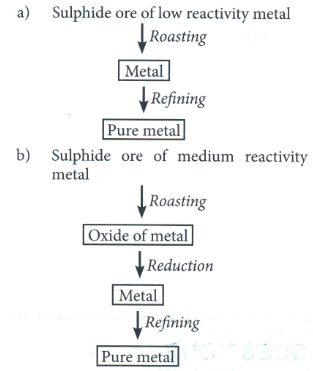
Give the steps involved in the extraction of metals of low and medium reactivity from their respective sulphide ores.
13.
Describe the process of urine formation in kidneys.
14.
State Ohm's law? How can it be verified experimentally? Does it hold good under all conditions? Comment
15.
Nervous and hormonal system together perform the function of control and coordination in human beings. Justify the statement with the help of an example.
16.
A sulphate salt of Group 2 element of the Periodic Table is a white, soft substance. Which can be moulded into different shapes by making its dough. When this compound is left in open for sometime, it becomes a solid mass and cannot be used for moulding purposes. Identify the sulphate salt and why does it show such a behaviour? Give the reaction involved.
17.
What happens when a piece of
(a) Zinc metal is added to copper sulphate solution?
(b) Aluminium metal is added to dilute hydrochloric acid?
(c) Silver metal is added to copper sulphate solution? Write the balanced chemical equation if the reaction occurs.
18.
Name the process by which unsaturated fats are changed to saturated fats.
19.
Write next two members of the homologous series
20.
Explain why an aqueous solution of sodium sulphate IS neutral while an aqueous of sodium carbonate is basic in nature.
21.
Which gas is usually liberated when an acid reacts with a metal?
22.
Define homologous series of organic compounds. List its two characteristics. Write the name and formula of the first member of the series of alkanes.
23.
How many covalent bonds are there in a molecule of ethane (C2H6)?
24.
What is the difference between AC generator and DC generator?
25.
What is the impact of leakage or loss of blood upon the pressure?
26.
What is the site in cells where glucose is converted into 3 carbon molecule of pyruvate?
27.
What constitutes the field of a magnet?
28.
Name a reducing agent that may be used to obtain manganese from manganese dioxide.
29.
Name two metals both of which are very ductile as well as very malleable.
30.
What are two types of reducing agents used to reduce metal oxide?
31.
Why is respiration considered an exothermic process?
32.
What is geothermal energy?
33.
What are the adaptations of leaf for photosynthesis?
34.
(a) Why is there a need to harness non-conventional source of energy?
(b) Give two main examples.
35.
What are photoreceptors?
36.
What part of the brain is responsible for precision of voluntary action?
37.
Why is pituitary gland called master gland?
38.
What is the advantage of the third wire of earth connection in domestic electric appliances?
39.
Give the unit of electric resistance
40.
What is a voltmeter?
41.
Name the reaction which forms insoluble salts.
42.
What type of reaction is this:
Na2SO4 + BaCl2 \(\rightarrow\) BaSO4 + 2NaCl
43.
Dry ammonia gas has no action on litmus paper, but a solution of a ammonia in water turns red litmus paper blue, why is it so?
44.
(a) Give Arrhenius definition of an acid and a base.
(b) Choose strong acid and strong base from the following:
\(CH_3COOH,\ NH_4OH,\ KOH,\ HCl\)
45.
(a) In the following reactions, name the reactants, which undergoes oxidation and reduction:
(i) CuO(s) + H2(g) \(\longrightarrow \) Cu(s) + H2O(g)
(ii)CuO(s) + Zn(s) \(\longrightarrow \) ZnO(s) + Cu(s)
(b) State one industrial application of reduction.
46.
Name the three products of 'chlor-alkali' process. Write one commercially or industrially important material each that can be prepared from each of these products
47.
(a) Arrange the following metals in the order of their decreasing activities: Aluminium, Gold, Sodium, Copper
(b) Give chemical equation for the reaction of aluminium powder with manganese dioxide on heating.
48.
Distinguish between an electric motor and generator?
49.
What is 'translocation'? Why is it essential for plants?Where in plants are the following synthesized:
(i)Sugar (ii)Hormones
50.
Give reasons for the following:
(i)The glottis is guarded by epiglottis
(ii)The lung alveoli are covered with blood capillaries.
(iii)The wall of trachea is supported by cartilage rings.
51.
(a) Name the chief ore of iron. Write its formula.
(b) How is an iron ore concentrated? Describe it briefly.
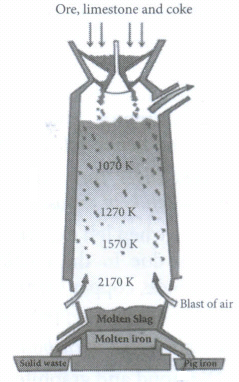
(c) Draw a labelled diagram of the blast furnace used in the extraction of iron from its concentrated ore.
52.
(a) Why is the Solar Cooker box covered with a plane glass plate?
(b) Why is energy of water flowering in a river considered to be an indirect form of solar energy?
(c) How is the fission of nucleus brought about?
53.
(a) What is a 'solar cell'?
(b) Why is biogas considered an ideal fuel for domestic use?
(c) Name a device in which controlled chain reaction is used.
54.
Imagine that you are sitting in a chamber with your back to one wall. An electron beam, moving horizontally from back wall towards the front wall, is deflected by a strong magnetic field to your right side. What is the direction of magnetic field?
55.
Give difference between nervous system and endocrine system.
56.
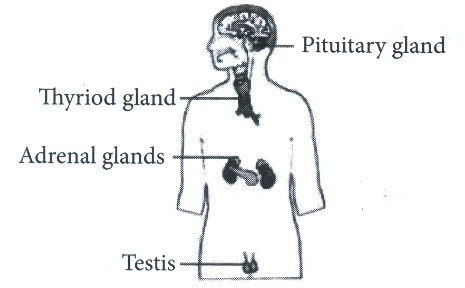
Draw a diagram showing endocrine glands in a male body. Label the following glands on it:
(i) Pituitary
(ii) Thyroid
(iii) Adrenal
(iv) Testes
57.
Give the differences between series and parallel connections of resistors.
58.
(a) Distinguish between the terms "overloading and short circuiting" as used in domestic circuits.
(b) Why are the coils of electric toasters made of an alloy rather than a pure metal?
59.
What are the uses of washing soda?
60.
(a) Did Mendeleev have gaps in his periodic table?
(b) Any three Limitations of Mendeleev's classification.
(c) Does electronic configurations of atoms change in a period with increase in atomic number?
61.
Which is the process used to harness nuclear energy these days? Explain it briefly.
62.
State modern periodic law of classification of elements.
63.
Chlorine, bromine and iodine form a Dobereiner's triad. The atomic masses of chlorine and iodine are 35.5 and 126.9 respectively. Predict the atomic mass of bromine.
64.
Lithium, sodium and potassium form a Dobereiner's triad. The atomic masses of lithium and potassium are 7 and 39 respectively. Predict the atomic mass of sodium.
65.
What is energy?
66.
What is meant by the 'calorific value' of a fuel? How is it determined? Arrange the following fuels in a decreasing order of their calorific values: Kerosene, Coal, LPG.
1.
(c)
Forces pointing into the plane of paper and out of the plane of paper, respectively.
2.
(c)
It has 18 vertical columns known as Groups
3.
(a)
Ethyne
4.
(c)
Solar energy
5.
(b)
Bromine
6.
(c)
20 J
7.
(b)
Small intestine
8.
(d)
Abscissic acid
9.
(a)
(i) and (ii)
10.
(c)
(i) and (iv)
11.
Isomerism is a phenomenon due to which some compounds have same molecular formula but different structural formulae .
Characteristics:
(i) They differ in structural formula
(ii) They differ in melting point
(iii) They differ in boiling point
(iv) They differ in solubility in same solven.
12.
13.
The mechanism of urine formation includes three steps namely,
(i) Glomerular ultra-filtration
(ii) Tubular reabsorption
(iii) Tubular secretion
(i)Glomerular Ultrafiltration:
Ultrafiltration of blood takes place inthe Malphighian body which acts as a biological filter. A Malphighian body comprises of Bowman's capsule and glomeruli.
The blood from the kidney flows through the capillaries of glomerulus where the blood pressure, is comparatively high and so brings about effective filtration. The hydrostatic pressure of the blood is always greater than the opposing pressures existing in the plasma protein and renal capillaries. Thus, the available net filtering force is chiefly responsible for glomerular filtration. The fluid in the capsule which is obtained by this process is termed glomerular filtrate. In man it is about 125ml/min. In 24 hours, the total volume of glomerular filtrate is 170 to 180 litres.
(ii) Tubular Reabsorption: Reabsorption takes place in the 'uriniferous tubules. Reabsorption of useful substances is a differential or selective process. The glomerular filtrate contains many useful substances such as glucose, amino acids, mineral salts and vitamins dissolved in large amount of water. Substances such as glucose, sodium and calcium, are actively reabsorbed in large quantities. Substances like urea and uric acid etc are reabsorbed in small quantities by a simple diffusion process or passive reabsorption. Substances like creatinine are not reabsorbed. They are completely eliminated.
Proximal convoluted tubule is responsible for the reabsorption of water, glucose, sodium phosphate and bicarbonates. On entering the distal convoluted tubule, the urine becomes nearly isotonic to the surrounding tissue fluid due to the active transport of sodium and passive transport of water. As urine (isotonic) passes into the collecting tubule it becomes once again hypertonic by the osmotic reabsorption of water under the influence of the hormone ADH. Thus the urine formed contains 96% of water, 2% urea and 2% of the metabolic products.
(iii) Tubular Secretion: This is the final step in the formation of urine during which the walls of tubule actively remove additional waste substances which are harmful to the body from the blood that have escaped filtration.
14.
At constant temperature, the current flowing through a conductor is directly proportional to the potential difference across its ends.
Onh's law does not hold good under all conditions as it is not a fundamental law of nature like Newton's laws. It is obeyed by metallic conductors only when physical condition like temperature etc., are kept unchanged. It is not obeyed by a lamp filament.
15.
The endocrine and neural system both works together for the normal functioning of our body. The synthesis and release of certain hormones is regulated by the neural system. Also, the release of certain hormones influences the activity of nerves.
For example, hypothalamus receives neural signals from brain and releases hormones.
In case of deficiency of iodine, body produces less thyroxine hormone. Hypothalamus releases hormones to stimulate pituitary gland which further stimulates thyroid gland to secrete thyoxine.
16.
The Substance which is used for making different shapes is Plaster of Paris. Its chemical name is calcium sulphate hemihydrate \([CaSO_4.1/2H_2O].\) The two formula unit of \(CaSO_4\) share one molecule of water. As a result, it is soft. When it is left open for some time, it absorbs moisture from the atmosphere and forms gypsum, which is a hard solid mass.
\(\underset{Plaster\ of\ Paris}{CaSO_4.{1\over 2}H_2O}+1{1\over2}{H_2O}\rightarrow \underset{Gypsum}{CaSO_4.2H_2O}\)
17.
(a) Zinc sulphate and copper is formed when zinc reacts with copper sulphate,
\(\underset{Zinc}{Zn( s)} + \underset{Copper\ sulphate}{CuSO_4} (aq) \rightarrow \underset{Zinc\ sulphate}{ZnSO_4(aq)} + \underset{Copper}{Cu}\)
(b) Hydrochloric acid forms aluminium chloride and hydrogen gas when reacts with aluminium metal.
\(2AI + 6HCI\rightarrow 2AlCl_3 + 3H_2\)
(c) When silver metal is added to copper sulphate solution, no reaction takes place because silver is less reactive than copper
18.
Hydrogenation.
19.
C2H6C3H6
20.
Sodium sulphate is a neutral salt because it is made from strong acid and strong base.
Sodium carbonate is a basic salt because it is made from strong base and a weak acid.
21.
Reaction of an acid with a metal:
When an acid reacts with a metal, it forms a salt.
Hydrogen which is in all the acids gets displaced and liberated as hydrogen gas.
Acids + Metals \(\rightarrow\) Salt + Hydrogen gas
22.
The series of organic compounds have same functional group and similar chemical properties is called homologous series.
(a) Each member differs from successive member by -CH2- group.
(b) The difference in molecular weight between two successive members is 14 u.
Characteristics:
(i) It has same general formula, from which, all members can be derived.
(ii) They have similar chemical properties.
C2H4CH2 = CH2. Ethene is first member of alkene series.
23.
There are 7 covalent bonds in a molecule of ethane.
24.
AC generator produces current which changes its direction after equal intervals of time and DC generator produces current which is unidirectional.
25.
Blood flow will increase upon the pressure of blood in the blood vessels. The oxygenated blood flowing through the artery doesnot have any impact as the arteries are thick walled, highly elastic blood vessels having narrow lumen and no valves.
26.
Glycolysis is the process of breaking down one glucose molecule into two pyruvic acid molecules (also called pyruvate). Glycolysis is a multi-step metabolic process that takes place in the cytoplasm of animal cells, plant cells, and microorganism cells.
27.
Magnetic field of a magnet contains magnetic field lines in it.
28.
Aluminium.
29.
Aluminium and copper.
30.
Carbon and highly reactive metals such as sodium, calcium, aluminium are used as reducing agents to reduce metal into metal.
31.
Respiration involves the breaking down of digested food using oxygen.As respiration produces a lot of energy in the form of ATP, this process is exothermic in nature.
32.
The heat energy obtained in the form of steam from under the earth's crust is called geothermal energy.
33.
(i)Leaves provide large surface area for maximum light absorption
(ii)Leaves are arranged at right angles to the light source in a way that causes overlapping
(iii)The extensive network of veins enables quick transport of substances to and from the mesophyll cells.
(iv)Presence of numerous stomata for gaseous exchange.
(v)The chloroplasts are more in number on the upper surface of leaves.
34.
(a) The energy demands are increasing rapidly due to population explosion and our efforts to improve quality of life by adopting faster means of transport and travel, rapid industrialization and extensive use of energy-fed home appliances.
(b) Fossil fuels are fast depleting.
35.
The receptors present in our eyes are called photoreceptors, as they are light sensitive.
36.
Cerebellum.
37.
It is because pituitary gland controls and coordinates the secretions of all the other endocrine glands.
38.
Earth wire is used to provide a low resistance conducting path to any charge that gets leaked into the body of the appliance.
39.
Ohm (1Ω)
40.
A measuring instrument used to measure potential difference between two points in an electric circuit.
41.
Precipitation reaction
42.
It is a double displacement reaction.
43.
A solution of ammonia in water results in the formation of ammonium hydroxide (NH4OH). Ammonium hydroxide is basic in nature and turns red litmus blue.
44.
(a) According to Arrhenius theory, acids are substances that produce H+ ions when mixed with water. On the other hand, based are substances that produce OH- ions when mixed with water.
(b) NH4OH is a weak base and HCl is a strong acid.
45.
(a) (i) The reactants are copper oxide and hydrogen. Copper oxide undergoes reaction and hydrogen (H2) undergoe oxidation.
(ii) The reactants are copper oxide and zinc. Zinc undergoes oxidation and copper oxide undergoes reduction.
(b) Calcium carbonate is reduced in industries to get CaO and CO2.
46.
The three products are:
Sodium hydroxide (NaOH), Chlorine (CI2) and Hydrogen (H2).
NaOH - for soaps and detergents and paper making or artificial fibers.
Cl2- PVC, pesticides, CFCs.
H2- fuels, margarine, NH3 for fertilizers.
47.
(a) Sodium (Na) > Aluminium (A1)> Copper (Cu) > Gold (Au).
(b) 3MnO2(s) + 4A1(s) \(\overset { \Delta }{ \longrightarrow } \) 3Mn(l) + 2A12O3(s)+ Heat.
48.
The major differences between an electric motor and generator are stated below:
Electric Motor:
1. It converts electrical energy into mechanical energy.
2. It needs electrical energy for its works.
3. They are used as water pumps, marble grinders etc.
Generator:
1. It converts mechanical energy into electrical energy
2. It needs mechanical energy for its working.
3. They are used as water pumps, marble grinders etc.
4. diesel generator, hydro-electric generator are the examples of it.
49.
The transport of soluble products of photosynthesis is known as translocation. Translocation in plants occurs by means of the vascular tissue known as phloem. Translocation is necessary because without it, the food prepared by the leaves cannot reach other parts of the plant.
(i)In plants, the synthesis of sugars takes place in the leaves by the process of photosynthesis.
(ii)Hormones are synthesised away from their targrt site.
50.
(i)The glottis is gaurded by epiglottis because it prevents the entry of food in wind pipe. If the food enters wind pipe, then it chokes it, leading to the death of the person.
(ii)The lung alveoli are covered with blood vessels because the oxygen that we inhale dissolves in the blood, present in these blood capillaries only, as it reaches the lungs.
(iii)The wall of trachea is supported by cartilage rings because these rings prevent the air passage from collapsing.
51.
Haematite (Fe2O3) is an important ore of iron.
In the upper part of the blast furnace, carbon monoxide reduces iron (III) oxide to iron metal.
\(\underset { Iron(III)oxide }{ { Fe }_{ 2 }{ O }_{ 3 } } +\underset { Carbonmonoxide }{ 3CO(g) } \rightarrow \underset { Ironmetal }{ 2Fe(I) } +\underset { Carbondioxide }{ { 3CO }_{ 2 }(g) } \)
Following reactions are involved in the blast furnace:
(i) Formation of carbon monoxide
\(\underset { Carbon }{ C(s) } +\underset { Oxygen }{ { O }_{ 2 }(g) } \rightarrow \underset { Carbondioxide }{ { CO }_{ 2 }(g) } +Heat\\ \underset { Carbondioxide }{ { CO }_{ 2 }(g) } +\underset { Coke }{ C(s) } \rightarrow \underset { Carbonmonoxide }{ 2CO(g) } \)
(ii) Reduction of iron (III) oxide or haematite to iron
\(\underset { Iron(III)oxide }{ { Fe }_{ 2 }{ O }_{ 3 } } +\underset { Carbonmonoxide }{ 3CO(g) } \rightarrow \underset { Ironmetal }{ 2Fe(I) } +\underset { Carbondioxide }{ { 3CO }_{ 2 }(g) } \)
52.
(a) The solar cooker box is covered with a plane glass plate so as to prevent heat from escaping.
(b) Sun is said to be the ultimate and the original source for most of the energy present on the earth. When sun rays fall on oceans and other water bodies, the water present in the water bodies gets evaporated and rises up in the atmosphere. In the upper part of the atmosphere, this water vapour gets condensed and forms douds, which give rain on the high lands. Therefore, the rain water runs over the Sand surface towards the large water bodies. This running water over the land surfaces is called river. Therefore, the energy of running water actually originates from the solar energy. This is why solar energy of water flowing in a river is considered to be an indirect form of solar energy.
(c) The fission of nucleus is brought about by splitting the nucleus of heavy atoms, such as uranium or plutonium, with low-energy neutron bombardment.
53.
(a) A solar cell is a device which converts solar energy into electricity. It is a sandwich of a silicon-boron layer and a silicon-arsenic layer.
(b) Biogas is an ideal fuel for domestic use because it is a cheap and clean fuel, which does not leave behind any residue.
(c) A nuclear power plant is a device in which controlled chain reaction is used.
54.
According to Fleming's left hand rule, the direction of magnetic field is vertically downward.
55.
| Endocrine System | Nervous System |
| 1. This system does not have direct connection with the organs or tissues controlled by it. |
This system has direct connection and control over the tissues or organs. |
| 2. The information of coordination is transmitted slowly. | The information is transmitted very fast. |
| 3. The effect is long lasting. | The effect is short lived. |
56.
57.
| Series connection | Parallel connection |
| 1. The potential difference (V) across the combination of resistors connected in series is equal to the sum of all the individual potential differnece. | The potential difference across all resistors in parallel connection remains constant. |
|
2. Current (I) remains the same. |
Current (I) will be different for different resistor.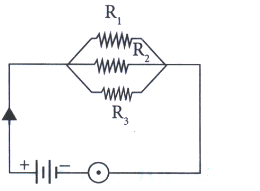 |
| 3. The resistance will be the sum of all the resistors in the circuit. Rs = R1 + R2 + R3. |
Total resistance will be given as \(\frac { 1 }{ { R }_{ p } } =\frac { 1 }{ { R }_{ 1 } } +\frac { 1 }{ { R }_{ 2 } } +\frac { 1 }{ { R }_{ 3 } } \) |
| 4. Equivalent resistance is high. | Equivalent resistance is less than each resistor. |
58.
(a) Short circuiting is the term used for defining the situation in which the neutral and live wires of an electric circuit come in direct contact. When too many electrical appliances are connected to a single socket, the appliances drawn much more current or power that the permissible limit from the main supply. This situation is termed as overloading.
(b) Resistivity of an alloy is much higher than its constituent metals Moreover, alloys do not oxidise as easily as the constituent metals at high temperature. Because of these reasons, coils of electric testers are made of an alloy rather than a pure meta.
59.
(i) Sodium carbonate (washing soda) is used in glass, soap and paper industries.
(ii) It is used in the manufacture of sodium compounds such as borax.
(iii) Sodium carbonate can be used as a cleaning agent for domestic purposes.
(iv) It is used for removing permanent hardness of water.
60.
(a) Gaps were left for undiscovered elements in the Mendeleevs Periodic Table.
(b) (i) Position of hydrogen was not justified.
(ii) Increasing order of atomic mass could not be maintained.
(iii) Isotopes have similar chemical properties but different atomic masses, they cannot be given separate places.
(c) Number of shells remains the same, number of valence electrons goes on increasing from left to right in a period till octet is complete.
| Li | Be | B | C | N | O | F | Ne |
| 2,1 | 2,2 | 2.3 | 2,4 | 2,5 | 2,6 | 2,7 | 2,8 |
61.
In a process called nuclear fission, the nucleus of a heavy atom (such as uranium, plutonium or thorium), when bombarded with low-energy neutrons, can be split into lighter nuclei with a release of tremendous amount of energy if the mass of the original nucleus is just a little more than the sum of the masses of the individual products.
The released energy can be used to produce steam and further generate electricity. The major hazard of nuclear power generation is the storage and disposal of spent or used fuels. Improper nuclear-waste storage and disposal result in environmental contamination. Further, there is a risk of accidental leakage of nuclear radiation. The high cost of installation of a nuclear power plant, high risk of environmental contamination and limited availability of uranium makes large-scale use of nuclear energy prohibitive. The only viable way to dispose off radioactive waste is to bury it deep underground. "The nuclear waste also should be guarded against any misuse.
62.
()
Modern periodic law states "that the properties of elements are a period function of the atomic numbers"
63.
()
Atomic mass of Br = 35.5 + 126.9 / 2
= 162.4 / 2 = 81.2
64.
()
Atomic mass of Na = 7+39 / 2 = 46 / 2 = 23
65.
()
Energy is the capability to do work.
66.
()
The amount of heat produced in burning the unit mass of a fuel completely is known as the calorific value of that fuel. It is determined with the help of Bomb Calorimeter.
Arrangement of the fuels in a decreasing order of their calorific values.
LPG > Kerosene > Coal

10th Standard CBSE Syllabus & Materials
10th Standard CBSE
CBSE 10th Social Science PS - Federalism - New Model Questions Papers Study Material - QB365 Set A
NEW10th Standard CBSE
CBSE 10th Social Science PS - Power Sharing - New Model Questions Papers Study Material - QB365 Set A
NEW10th Standard CBSE
CBSE 10th Social Science GEO - Manufacturing Industries - New Model Questions Papers Study Material - QB365 Set A
NEW10th Standard CBSE
CBSE 10th Social Science GEO - Minerals and Energy Resources - New Model Questions Papers Study Material - QB365 Set A



CBSE 10th Standard CBSE Subjects
CBSE Standards