
 100% FREE ACCESS
10th Standard CBSE Syllabus & Materials
10th Standard CBSE
CBSE 10th Social Science ECO - Globalisation and the Indian Economy - New Model Questions Papers Study Material - QB365 Set A
NEW10th Standard CBSE
CBSE 10th Social Science ECO - Money and Credit - New Model Questions Papers Study Material - QB365 Set A
NEW10th Standard CBSE
CBSE 10th Social Science ECO - Sectors of the Indian Economy - New Model Questions Papers Study Material - QB365 Set A
NEW10th Standard CBSE
CBSE 10th Social Science ECO - Development - New Model Questions Papers Study Material - QB365 Set A
NEW10th Standard CBSE
CBSE 10th Social Science PS - Outcomes of Democracy - New Model Questions Papers Study Material - QB365 Set A
NEW10th Standard CBSE
CBSE 10th Social Science PS - Gender, Religion and Caste - New Model Questions Papers Study Material - QB365 Set A

Published on: 14/02/2020
10th Standard CBSE Science Board Exam Model Question paper II 2020
Download CBSE Class 10th Standard CBSE Science question papers, sample papers, important questions, and previous year solved papers in PDF format. Get free study materials, NCERT solutions, and exam preparation resources for Class 10th Standard CBSE Science
Questions + Answers key
Take MCQ Science Test
1.
A compound ‘X’ is an important ingredient of an antacid. It is also used in fire extinguisher. Identify ‘X’.
2.
Write next two members of the homologous series
3.
A milkman added a small amount of baking soda to fresh milk:
(i)Why does he shift the pH of fresh milk to slightly alkaline?
(ii)Why does this milk take longer time to set as a curd?
4.
Write a balanced chemical equation:
\({ FeSO }_{ 4 }\overset { Heat }{ \rightarrow } { Fe }_{ 2 }{ O }_{ 3 }(s)+S{ O }_{ 2 }(g)+{ SO }_{ 3 }(g)\)
5.
Why do silver articles become black after sometime when exposed to air?
6.
An electric heater of resistance 8 \(\Omega\) draws 15 A from the service mains 2 hours. Calculate the rate at which heat is developed in the heater.
7.
Identify the elements with the following property and arrange them in increasing order of their reactivity
(a) An element which is a soft and reactive metal
(b) The metal which is an important constituent of limestone
(c) The metal which exists in liquid state at room temperature
8.
Name the functional group present in each of the following compounds:
(i) HCOOH
(ii) C2H5CHO
9.
Name the functional group present in each of the following organic compounds:
(i) C2H5Cl
(ii) C2H5OH
10.
What are life processes?
11.
Define electromagnetic induction.
12.
Distinguish between DC and AC.
13.
What is meant by overloading.
14.
What is solder?
15.
Name three common types of ores where metal exists in nature.
16.
Name the type of blood vessels which carry blood from organs to the heart.
17.
What is breathing?
18.
What is geothermal energy?
19.
Explain the cause of shoots of the plant bending towards light.
20.
Which part of the brain is concerned with memory?
21.
Name one endocrine gland which performs dual function.
22.
Name the part of brain in which hypothalamus is located.
23.
What is the S.I. unit of charge?
24.
Give the unit of power.
25.
Why is the series arrangement not used for connecting domestic electric appliances in a circuit?
26.
How are the alveoli designed to maximise the exchange of gases?
27.
Which metals do not corrode easily?
28.
Name the reaction which forms insoluble salts.
29.
Name the different forms of energy required for breaking down the reactants in decomposition reaction.
30.
Dry ammonia gas has no action on litmus paper, but a solution of a ammonia in water turns red litmus paper blue, why is it so?
31.
The pH value of three solutions A, B, and C having equal molar concentration are respectively 2.0, 7.0, and 13.0 at 298 K. Which of the three solutions represents an acid solution?
32.
Why does the colour of copper sulphate solution change when an iron nail is dipped in it?
33.
In an attempt to demonstrate electrical conductivity through an electrolyte, the following apparatus shown below was set up.
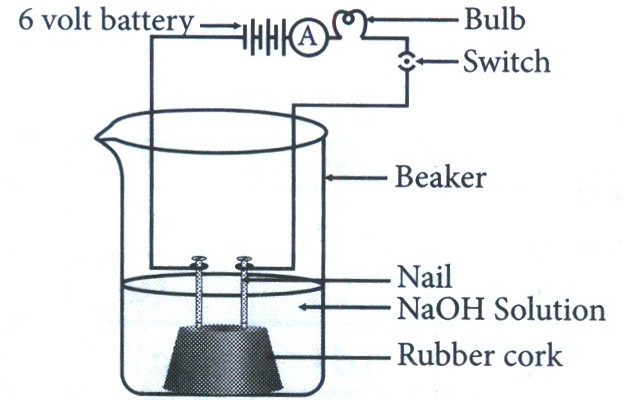
which among the following statement(s) is (are) correct?
(i) Bulb will not glow because electrolyte is not acidic
(ii) Bulb will glow because NaOH is a strong base and furnishes ions for conduction.
(iii) Bulb will not glow because circuit is incomplete.
(iv) Bulb will not glow because it depends upon the type of electrolytic solution.
(i) and (iii)
(ii) and (iv)
(ii) only
(iv) only
34.
Which of the following statements is not a correct statement about the trends when going from left to right across the periods of periodic Table?
The elements become less metallic in nature.
The number of valence electrons increases.
The atoms lose their electrons more easily.
The oxides become more acidic.
35.
The name of the compound CH3 - CH2 - CHO is
Propanal
Propanone
Ethanol
Ethanal
36.
Fuel used in thermal power plant is
Water
Uranium
Biomass
Fossil fuels
37.
2 ml each of concentrated HCl, HNO3 and a mixture of concentrated HCl and concentrated HNO3 in the ratio of 3 : 1 were taken in test tubes labelled as A, B and C. A small piece of metal was put in each test tube. No change occured in test tubes A and B but the metal got dissolved in test tube C respectively. The metal could be
Al
Au
Cu
Zn
38.
A few drops of iodine solution were added to rice water. The solution turned blue-black in colour. This indicates that rice water contains
Complex proteins
simple proteins
fats
Starch
39.
Which of the following statements about transmission of nerve impulse is incorrect?
Nerve impulse travels from dendritic end towards axonal end.
At the dendritic end electrical impulses bring about the release of some chemicals which generate an electrical impulse at the axonal end of another neutron.
The chemicals released from the axonal end of one neuron cross the synapse and generate a similar electrical impulse in a dendrite of another neuron.
A neuron transmits electrical impulses not only to another neuron but also to muscle and gland cells.
40.
If I is the current through a wire and 1 is the charge of electron, then no. of electrons in t seconds will be
1/It
It/1
\(\frac { 11 }{ t } \)
It1
41.
Three beakers labelled as A, B and C each containing 25 mL of water was taken. A small amount of NaOH, anhydrous CuSO4 and NaCl were added to the beakers A, B and C respectively. It was observed that there was an increase in the temperature of the solutions contained in beakers A and B, whereas in case of beaker C, the temperature of the solution falls. Which one of the following statement(s) is (are) correct?
(i) In beakers A and B, exothermic process has occurred.
(ii) In beakers A and B, endothermic process has occurred.
(iii) In beaker C exothermic process has occurred.
(iv) In beaker C endothermic process has occured.
(i) only
(ii) only
(i) and (iv)
(ii) and (iii)
42.
An organic compound A on heating with concentrated H2SO4 forms a compound B which on addition of one mole of hydrogen in presence of Ni forms a compound C. One mole of compound C on combustion forms two moles of CO2 and 3 moles of H2O. Identify the compounds A, B and C and write the chemical equations of the reactions involved.
43.
What is an alloy? How is an alloy made? List two purpose of making alloys. Mention the constituents and two properties of each of the following alloys.
(i) Stainless steel
(ii) Brass
44.
Explain the mechanism of photosymthesis.
45.
A sulphate salt of Group 2 element of the Periodic Table is a white, soft substance. Which can be moulded into different shapes by making its dough. When this compound is left in open for sometime, it becomes a solid mass and cannot be used for moulding purposes. Identify the sulphate salt and why does it show such a behaviour? Give the reaction involved.
46.
Give the characteristic tests for the following gases:
(a) CO2
(b) SO2
(c) O2
(d) H2
47.
2g ferrous sulphate crystals are heated in a dry boiling tube.
(i) List any two observations.
(ii) Name the type of chemical reaction taking place.
(iii) Write the chemical equation of the reaction.
48.
Draw a neat and labeled diagram to show the following activity:
The action of dilute sulphuric acid on zinc granules.
(i) Name the gas evolved.
(ii) How will you test for the gas?
49.
(i) A non-metal X exists in two different forms Y and Z. Y is the hardest natural substance whereas Z is a good conductor of electricity. Identity X, Y, Z.
(ii) A element, X, on reaction with oxygen forms an oxide XO2. The oxide when dissolved in water turns blue litmus red. State whether element X is a metal or a non-metal.
(iii) Name the metal which is alloyed with copper to make bronze.
50.
Write one example of each of the following:
(i) Most malleable metal and most ductile metal.
(ii) The best conductor of heat and the poorest conductor of heat.
(iii) A metal with highest melting point and a metal with lowest melting point.
51.
(i) Write the name given to bases that are highly soluble in water. Give an example.
(ii) How is tooth decay related to pH? How can it be prevented?
(iii) Why does bee-sting cause pain and irritation? Rubbing of baking soda on the sting area gives relief. How?
52.
Distinguish between an electric motor and generator?
53.
How 'respiration' different from 'breathing'? Explain the processes of 'aerobic' respiration and 'anaerobic' respiration.
54.
Write the functions of the following in the digestive process:
(i)Bile
(ii)Bicarbonate secreted by the duodenum
(iii)Pancreatic amylase
55.
(a) Why is the Solar Cooker box covered with a plane glass plate?
(b) Why is energy of water flowering in a river considered to be an indirect form of solar energy?
(c) How is the fission of nucleus brought about?
56.
(a) What is a 'solar cell'?
(b) Why is biogas considered an ideal fuel for domestic use?
(c) Name a device in which controlled chain reaction is used.
57.
Give difference between nervous system and endocrine system.
58.
How do neurons transmit information?
59.
Give differences between conductors and insulators.
60.
A touch bulb is rated 2.5 V and 750 mA. Calculate (i) its power, (ii) its resistance and (iii) the energy consumed if this bulb is lighted for four hours.
61.
Atoms of eight elements A, B, C, D, E, F, G and H have the same number of electronic shells but different number of electrons in their outermost shells. It was found that elements A and G combine to form an ionic compound which can also be extracted from sea water. Oxides of the elements A and B are basic in nature while those of E and F are acidic. The oxide of element D is almost neutral. Answer the following questions based on the information given herein:
(i) To which group period of the Periodic table do the listed elements belong?
(ii) Which one of the eight elements is likely to be a noble gas?
(iii) Which one of the eight elements would have the largest atomic radius?
(iv) Which two elements amongst these are likely to be non-metals?
(v) Which one of these eight elements is likely to be a semi-metal or metalloid?
62.
a) How can solar energy be harnessed?
b) Mention any two limitations in using solar energy.
c) How are these limitations overcome?
63.
State modern periodic law of classification of elements.
64.
Why was the system of classification of elements into triads not found suitable?
65.
Chlorine, bromine and iodine form a Dobereiner's triad. The atomic masses of chlorine and iodine are 35.5 and 126.9 respectively. Predict the atomic mass of bromine.
66.
What is meant by fusion?
67.
Which one of the following is a renewable resource?
Natural gas, Petrroleum, Ground water, Coal
1.
X. Sodium bicarbonate (NaHCO3)
2.
C2H6C3H6
3.
(i) Fresh milk is acidic and can spoil easily. In presence of baking soda, milk becomes alkaline and can be stored for a longer time.
(ii) When milk is set to curd, its pH decreases. The alkali does not allow it to become more acidic easily. So it will take more time
4.
Balanced Equation
\(2{ FeSO }_{ 4 }\overset { Heat }{ \rightarrow } { Fe }_{ 2 }{ O }_{ 3 }(s)+S{ O }_{ 2 }(g)+{ SO }_{ 3 }(g)\)
5.
They get tarnished by reacting with atmospheric air to form silver sulphide.
6.
Given, Resistance, R = 8 \(\Omega\) , Current, J = 15 A
Time, t = 2 h = 7200 s
\(\therefore\) Heat developed. H = J2Rr
=15 \(\times\)15 \(\times\) 8 \(\times\) 7200 J
\(\therefore\) Rate of heat developed.
\(P=\frac{H}{t}=\frac{15\times 15\times 8 \times 7200}{7200}\)
= 1800 W or 1800J/s
Thus, the rate at which heat is developed in the heater is 1800 joule per second.
7.
(a) Alkali metals are soft and reactive. For example Na, K etc.,
(b) Limestone is calcium carbonate, therefore, the important constituent of limestone is calcium.
(c) Metals which exist in the liquid state at room temperature are mercury (Hg) and francium (Fr)
8.
(i) -COOH (Carboxylic acid)
(ii) -CHO (Aldehyde)
9.
(i) (-Cl) Halogen (Chloro)
(ii) -OH) Alcohol
10.
The processes that together perform the maintenance functions of living organisms are called life processes.
11.
The phenomenon in which an electric current is induced in a circuit because of a changing magnetic field is called electromagnetic induction.
12.
| DC | AC |
| 1. Unidirectional flow of current. | Current changes its direction in a cycle. |
| 2. Cells and batteries produce DC. | Dynamo produces AC. |
13.
When the total current drawn by all the appliances at a particular time exceeds the bearing capacity of that wire, the wires of the domestic wiring gets heated. This is called overloading.
14.
Solder is an alloy of lead and tin.
15.
Oxides ores, carbonate and sulphide ore.
16.
The blood vessels which carry blood from organs to the heart are veins.
17.
Breathing is the process of taking in oxygen (inhalation) and giving out carbon dioxide (exhalation)
18.
The heat energy obtained in the form of steam from under the earth's crust is called geothermal energy.
19.
Shoot of the plant bends towards light due to phototropism. The stimulus is light and the movements of shoot is towards light.
20.
Fore brain
21.
Pancreas. It secretes hormones and digestive enzymes.
22.
Hind brain
23.
Coulomb
24.
Watt
25.
In a domestic circuit, parallel connection of devices is preferable for several reasons:
a. In series connection, if one of the devices is defective, if one of the devices is defective, then the current of the entire circuit is cut off. As a result, all the devices stop working. In parallel connection, even if one device is defective, the others continue working.
b. In series connection, selective operation of devices is not possible, but this is not so in the case of parallel connection.
c. In series connection, the same current passes through all the devices, regardless of the fact that different devices require different values of current to operate. In parallel connection, different values of current can be obtained for different devices according to their requirements.
26.
The bronchi, within the lungs divide into smaller tubes called bronchioles and finally terminate in balloon-like structures called 'alveoli'. The alveoli are made up of thin moist membranes which are richly supplied with blood and provide a very large surface area for the gaseous exchange.
27.
Metals present at the bottom of the reactivity series do not corrode easily, e.g. gold, silver, platinum etc.
28.
Precipitation reaction
29.
Heat, light and electricity.
30.
A solution of ammonia in water results in the formation of ammonium hydroxide (NH4OH). Ammonium hydroxide is basic in nature and turns red litmus blue.
31.
A represents an acid solution. This is because the pH value of A is 2.0 and the pH value of an acids lies between 1 and 6.
32.
The colour of copper sulphate solution changes when an iron nail is dipped in it because iron being more reactive than copper, displaces copper metal from aqueous copper sulphate solution. Thus, blue colour of copper sulphate fades away to give green colour solution of ferrous sulphate.
Fe (s) + CuSO4(aq) \(\rightarrow\) FeSO4(aq) + Cu(s)
Grey Blue Green Brown
33.
(c)
(ii) only
34.
(c)
The atoms lose their electrons more easily.
35.
(a)
Propanal
36.
(d)
Fossil fuels
37.
(b)
Au
38.
(d)
Starch
39.
(b)
At the dendritic end electrical impulses bring about the release of some chemicals which generate an electrical impulse at the axonal end of another neutron.
40.
(b)
It/1
41.
(c)
(i) and (iv)
42.
i) Since compound C on combustion forms two moles of CO2 and 3 moles of H2 O, therefore compound C must contain two carbon atoms and six hydrogen atmos. Thus compound C must be C2H6 (ethane)
\(\underset{Ethene(C)}{2C_2H_6}+\underset{Oxygen}{7O_2}\xrightarrow{Heat}\underset{Carbon\ dioxide}{4CO_2}+\underset{Water}{6H_2O}\)
ii) Since compound (C) is obtained by addition of 1 mole of H2 in presence of Ni to compound (B), therefore (B) must be ethane.
\(\underset{Ethene(B)}{CH2}=CH_2+H_2\xrightarrow{Ni/Heat}\underset{Ethene(C)}{CH_3-CH_3}\)
iii) Since compound (B) is formed by heating compound (A) with cone. H2SO4 therefore compound (A) must be ethanol.
\(\underset{Ethanol(A)}{CH_3CH_2OH}\xrightarrow{Conc. H_2SO_4,443K}CH_2=CH_2+\underset{Ethene(B)}{H_2O}\)
43.
(i) An alloy is a homogenous mixture of two or more metals. It sometimes contains a non -metal component also.
(ii) It is made by heating the components in a definite proportion and then uniformly mixing them in the molten state and then cooling.
(iii) Two purposes of making alloys are:
(a) To make a substance resistant to corrosion
(b) To make a substance strong and hard
(iv) Constituents of Stainless steel:
Iron, nickel, and chromium
(v) Two properties of stainless steel are:
(a) It is resistant to corrosion.
(b) It is more durable.
(vi) Constituents of Brass:
Copper and Zinc
(vii) Two properties of brass are:
(a) It is resistant to corrosion.
(b) It is more malleable.
44.
Food is prepared in the green leaves of the plant by combining carbon dioxide and water in presence of sunlight and chlorophyll. The carbon dioxide required for photosynthesis is taken by the plants from air. The carbon dioxide enters the leaves through tiny pores called stomata. The water required is taken from soil. The sunlight provides the energy required to carry out the preparation of food. The green pigment called chlorophyll present in green leaves help to absorb energy from sunlight. The oxygen produced as a by-product goes into the air.
The food prepared by the green leaves is in the form of glucose. This glucose is sent to different parts of the plant. The excess glucose is changed into starch and is stored in the leaves of the plant. The food prepared by photosynthesis provides all the energy to a plant which it needs to grow. Thus, it is clear that the green plants convert sunlight energy into chemical energy. by making food. When we eat plant foods such as fruits, vegetables, food grains etc., the chemical energy stored in them is released in our body during respiration.
During the process of photosynthesis, the following three steps take place:
(i) Absorption of sunlight energy by chlorophyll.
(ii) Conversion of sunlight energy into chemical energy and splitting of water into hydrogen and oxygen using sunlight energy.
(iii) Reduction of carbon dioxide to form carbohydrates using the chemical energy.
45.
The Substance which is used for making different shapes is Plaster of Paris. Its chemical name is calcium sulphate hemihydrate \([CaSO_4.1/2H_2O].\) The two formula unit of \(CaSO_4\) share one molecule of water. As a result, it is soft. When it is left open for some time, it absorbs moisture from the atmosphere and forms gypsum, which is a hard solid mass.
\(\underset{Plaster\ of\ Paris}{CaSO_4.{1\over 2}H_2O}+1{1\over2}{H_2O}\rightarrow \underset{Gypsum}{CaSO_4.2H_2O}\)
46.
(a) Carbon dioxide turns lime water milky as it forms calcium carbonate with lime water. This is the characteristics test for carbon dioxide.
Ca(OH)2 + CO2 --> CaCO3 + H2O
(b) The smell of sulphur dioxide gas is like burning of sulphur, which is the characteristics test for sulphur dioxide. Sulphur dioxide turns moist litmus paper from blue to red.
(c) When a burnt candle or match stick is brought near the oxygen gas, it starts burning brightly. This is the characteristic test for oxygen gas.
(d) When a burnt candle or match stick is brought near the hydrogen gas, it burns with pop sound, which is the characteristic test for hydrogen gas.
47.
(i) Before heating, it is pale green.
After heating, it is brown or reddish brown.
Two observations are:
(a) Change in state and colour
(b) Evolution of gas
(ii) Decomposition reaction
2FeSO4(s) \(\overset { Heat }{ \rightarrow } \) Fe2O3(s) + S02(g) + SO3(g)
48.
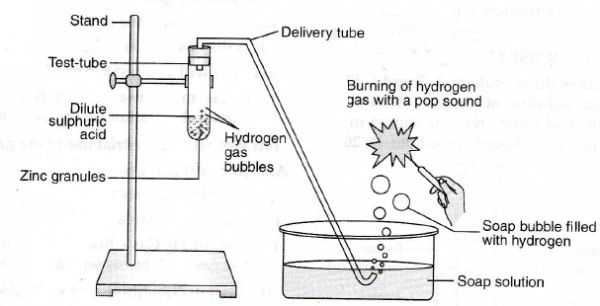
(i) The gas evolved is hydrogen.
(ii) Zn(s)+H2SO4(aq)\(\rightarrow\)ZnSO4(aq)+H2\(\uparrow\)
Test for H2 gas: The presence of H2 gas can be tested by passing the gas through soap solution and then bringing a burning splinter near the soap bubbles filled with the gas. If the gas burns with a pop sound, it is hydrogen.
49.
(i) X - Carbon, Y - Diamond, Z - Graphite
(ii) Non-metal
(iii) Tin.
50.
(i) Gold and silver are most malleable metal and most ductile metal,
(ii) Silver is the best conductor of heat and lead is the poorest conductor of heat.
(iii) Metal with highest melting point - Tungsten, iron. Metal with lowest melting point - Gallium, Cesium.
51.
(i) Alkali. e.g., NaOH (Sodium hydroxide).
(ii) Tooth decay starts when the pH of the mouth is lower than 5·5.It can be prevented by using tooth pastes which are generally basic.
(iii) Bee-sting has acid that causes pain and irritation. Baking soda is alkaline, neutralises the acid and gives relief.
52.
The major differences between an electric motor and generator are stated below:
Electric Motor:
1. It converts electrical energy into mechanical energy.
2. It needs electrical energy for its works.
3. They are used as water pumps, marble grinders etc.
Generator:
1. It converts mechanical energy into electrical energy
2. It needs mechanical energy for its working.
3. They are used as water pumps, marble grinders etc.
4. diesel generator, hydro-electric generator are the examples of it.
53.
Breathing is the process by which oxygen is taken in (inhalation) and carbon dioxide is released out (exhalation). Respiration involves the oxidation of the food we eat to release energy. Carbon dioxide produced as a result of this is released out during exhalation.
Aerobic respiration: During aerobic respiration, the oxidation of food takes place in the presence of oxygen. Aerobic respiration can be summarised by the given equation:
\({ C }_{ 6 }{ H }_{ 12 }{ O }_{ 6 }+{ 6O }_{ 2 }\longrightarrow { 6CO }_{ 2 }+{ 6H }_{ 2 }O+Energy\)
Anaerobic respiration: During anaerobic respiration, food is broken down in the absence of oxygen. It is also known as fermentation and is more common in microorganisms such as yeast.
Sometimes pyruvate gets converted into lactic acid in muscles by the process of anaerobic respiration.
\({ C }_{ 6 }{ H }_{ 12 }{ O }_{ 6 }\xrightarrow [ ]{ Absenceofoxygen } Alcohol+{ CO }_{ 2 }+{ H }_{ 2 }O+Energy\)
54.
(i)Bile is helpful in the emulsification of fats i.e., the breaking down of large fat droplets into smaller fat globules, which the pancreatic enzymes can act upon.
(ii)The pancreatic juice contains enzymes that require an alkaline medium to act. The bicarbonate secreted by the duodenum provides this alkaline medium.
(iii)The function of pancreatic amylase is to convert complex carbohydrates into glucose, which is absorbed in the blood.
55.
(a) The solar cooker box is covered with a plane glass plate so as to prevent heat from escaping.
(b) Sun is said to be the ultimate and the original source for most of the energy present on the earth. When sun rays fall on oceans and other water bodies, the water present in the water bodies gets evaporated and rises up in the atmosphere. In the upper part of the atmosphere, this water vapour gets condensed and forms douds, which give rain on the high lands. Therefore, the rain water runs over the Sand surface towards the large water bodies. This running water over the land surfaces is called river. Therefore, the energy of running water actually originates from the solar energy. This is why solar energy of water flowing in a river is considered to be an indirect form of solar energy.
(c) The fission of nucleus is brought about by splitting the nucleus of heavy atoms, such as uranium or plutonium, with low-energy neutron bombardment.
56.
(a) A solar cell is a device which converts solar energy into electricity. It is a sandwich of a silicon-boron layer and a silicon-arsenic layer.
(b) Biogas is an ideal fuel for domestic use because it is a cheap and clean fuel, which does not leave behind any residue.
(c) A nuclear power plant is a device in which controlled chain reaction is used.
57.
| Endocrine System | Nervous System |
| 1. This system does not have direct connection with the organs or tissues controlled by it. |
This system has direct connection and control over the tissues or organs. |
| 2. The information of coordination is transmitted slowly. | The information is transmitted very fast. |
| 3. The effect is long lasting. | The effect is short lived. |
58.
Information passes through neuron in the form of electro-chemical signals. These signals are called impulse.
When an impulse reaches the end of the axon it sets off the release of some chemicals. These chemicals cross the gap or the synapse and start a similar electrical impulse in a dendrite of the next neuron. A similar synapse allows the delivery of impulses from the neurons to other cells, like muscle cells or glands.
59.
| Conductors | Insulators |
| 1. Materials that allow electricity to pass through them. | Materials that do not allow electricity to pass through them. |
| 2. These materials have loosely bounded free electrons. |
These materials do not have loosely bounded free electrons. |
| 3. Eg., metals and graphite. | E.g., non-metals, rubber, plastic etc. |
60.
It is given that: Voltage (V) = 2.50 V
Current (I) = 750 mA = 0.75 A
The bulb is lighted for 4 hours.
Thus,
(i) Power generated (P) = VI = 2.50\(\times\) 0.75 = 1.87 W
(ii) Resistance (R) = \(\frac { V }{ I } =\frac { 2.5 }{ 0.75 } =3.33\Omega \)
(iii) Energy consumed in 4 hours = Power\(\times\)Time = P\(\times\)t =1.87\(\times\)4 = 7.48 Wh
61.
(i) A and B belong to group 1 and 2 because they form basic oxides. C belongs to group 13 as it has 3 valence electrons. D belongs to group 14 as it forms almost neutral oxide. E and F belong to group 15 and 16 as they form acidic oxides. G belongs to group 17 as it has 7 valence electrons and H belongs to group 18. They belong to 3rd period of Periodic Table because sodium belongs to 3rd period and AG is NaCl, ionic compound of sodium which can be obtained from sea water and A(Na) and G( Cl) belong to 3rd period.
(ii) H belong to noble gas.
(iii) A has the largest atomic radius.
(iv) E and F are likely to be non-metals.
(v) D is likely to be metalloid or semi-metal.
62.
a) Solar energy can be harnessed by using solar energy devices. These devices either use solar energy directly as heat or convert it into solar energy directly as heat or convert it into electricity. One of the devices is solar cooker.
b) Limitations of solar energy:
i) It is not evenly distributed on the Earth.
ii) It requires costly equipment and infrastructure.
c) Using of solar cells.
63.
()
Modern periodic law states "that the properties of elements are a period function of the atomic numbers"
64.
()
It is because all the elements discovered at that time could not be classified into triads.
65.
()
Atomic mass of Br = 35.5 + 126.9 / 2
= 162.4 / 2 = 81.2
66.
()
Fusion means joining lighter nuclei to make a heavier nucleus, most commonly hydrogen or hydrogen isotopes to create helium.
67.
()
Among natural gas, petroleum, ground water and coal, only ground water is a renewable resource. It returns in the water cycle.

10th Standard CBSE Syllabus & Materials
10th Standard CBSE
CBSE 10th Social Science PS - Federalism - New Model Questions Papers Study Material - QB365 Set A
NEW10th Standard CBSE
CBSE 10th Social Science PS - Power Sharing - New Model Questions Papers Study Material - QB365 Set A
NEW10th Standard CBSE
CBSE 10th Social Science GEO - Manufacturing Industries - New Model Questions Papers Study Material - QB365 Set A
NEW10th Standard CBSE
CBSE 10th Social Science GEO - Minerals and Energy Resources - New Model Questions Papers Study Material - QB365 Set A



CBSE 10th Standard CBSE Subjects
CBSE Standards





