
 100% FREE ACCESS
10th Standard CBSE Syllabus & Materials
10th Standard CBSE
CBSE 10th Social Science ECO - Globalisation and the Indian Economy - New Model Questions Papers Study Material - QB365 Set A
NEW10th Standard CBSE
CBSE 10th Social Science ECO - Money and Credit - New Model Questions Papers Study Material - QB365 Set A
NEW10th Standard CBSE
CBSE 10th Social Science ECO - Sectors of the Indian Economy - New Model Questions Papers Study Material - QB365 Set A
NEW10th Standard CBSE
CBSE 10th Social Science ECO - Development - New Model Questions Papers Study Material - QB365 Set A
NEW10th Standard CBSE
CBSE 10th Social Science PS - Outcomes of Democracy - New Model Questions Papers Study Material - QB365 Set A
NEW10th Standard CBSE
CBSE 10th Social Science PS - Gender, Religion and Caste - New Model Questions Papers Study Material - QB365 Set A

Published on: 14/02/2020
10th Standard CBSE Science Board Exam Model Question paper III 2020
Download CBSE Class 10th Standard CBSE Science question papers, sample papers, important questions, and previous year solved papers in PDF format. Get free study materials, NCERT solutions, and exam preparation resources for Class 10th Standard CBSE Science
Questions + Answers key
Take MCQ Science Test
1.
State the reason why carbon can neither form C4+ cations for C4- anions, but forms covalent compounds. Also state reasons to explain why covalent compounds:
(a) are bad conductors of electricity?
(b) have low melting and boiling points
2.
Define the terms 'nutrients' and 'nutrients'.List two differences between 'Holozoic nutrition' and 'Saprophytic nutrition'.Give two examples of each of these two types of nutrition.
3.
Describe the activity that shows that a current-carrying conductor experiences a force perpendicular to its length and the external magnetic field. How does Fleming's left-hand rule help us to find the direction of the force acting on the current carrying conductor?
4.
Of the three metals X, Y and Z, X reacts with cold water, Y with hot water and Z with steam only. Identify X, Y and Z and also arrange them in order of increasing reactivity.
5.
How will you infer with the help of an experiment that the same current flows through every part of the circuit containing three resistances in series connected to a battery?
6.
Mention one function for each of these hormones:
(a) Thyroxin
(b) Insulin
(c) Adrenaline
(d) Growth hormone
(e) Testosterone
7.
A sulphate salt of Group 2 element of the Periodic Table is a white, soft substance. Which can be moulded into different shapes by making its dough. When this compound is left in open for sometime, it becomes a solid mass and cannot be used for moulding purposes. Identify the sulphate salt and why does it show such a behaviour? Give the reaction involved.
8.
What happens when a piece of
(a) Zinc metal is added to copper sulphate solution?
(b) Aluminium metal is added to dilute hydrochloric acid?
(c) Silver metal is added to copper sulphate solution? Write the balanced chemical equation if the reaction occurs.
9.
A metal nitrate solution ‘A’ is added to reddish brown metal ‘B’. The metal present in ‘A’ is used for making jewellery and turns black in air, very thin foils of metal are used to decorate sweets. The compound ‘C’ formed on chemical reaction is blue in color and metal present in ‘A’ is formed. Identify A’ ‘B’ and ‘C’ and write chemical reactions involved.
10.
A compound ‘X’ is used for drinking has pH=7. Its acidified solution in presence of electricity undergoes decomposition to produce gases ‘Y’ and ’Z’. The volume of ‘Y’ is double than ‘Z’.’Y’ is highly combustible whereas ‘Z’ is a supporter of combustion. Identify ‘X,’Y, ’Z’ and write the chemical reactions involved.
11.
Write the name and structure of an alcohol with four carbon atoms in its molecule.
12.
What happens when ZnCO3 is heated in the absence of air? Give the relevant equation.
13.
Name two metals that start floating after sometime when immersed in water and explain why they do so.
14.
Give an example of a metal which is the best conductor of heat.
15.
Which gas is usually liberated when an acid reacts with a metal?
16.
A wire of resistance 10 ohm is bent in the form of a closed circle. What is the effective resistance between the two points at the ends of any diameter of the circle?
17.
What physical and chemical properties of elements were used by Mendeleev in creating his periodic table? List two observations which posed a challenge to Mendeleev's Periodic Law.
18.
Name the functional group present in each of the following organic compounds:
(i) C2H5Cl
(ii) C2H5OH
19.
Draw the structure of CH3COOH molecule.
20.
Name the rule used to determine the direction of induced current.
21.
Where do we connect a fuse with the live wire or with neutral wire?
22.
What kind of quantity is magnetic field?
23.
Name three common types of ores where metal exists in nature.
24.
What seems to happen when a piece of sodium metal is dropped into water?
25.
What is breathing?
26.
What is meant by 'translocation' with respect to transport in plants?
27.
Why is respiration considered an exothermic process?
28.
What are photoreceptors?
29.
Write the components of central nervous system.
30.
What are olfactory receptors?
31.
Give the unit of power.
32.
What is meant by the statement, "Potential difference between points A and B in an electric field is 1 volt"?
33.
Two solutions A and B have pH values of 5 and 8 respectively. Which solution will be basic in nature?
34.
Dry ammonia gas has no action on litmus paper, but a solution of a ammonia in water turns red litmus paper blue, why is it so?
35.
Give an example of a decomposition reaction. Describe an activity to illustrate such a reaction by heating.
36.
Write the chemical equation of the reaction with an example each in which the following change has taken place:
(i) Change in colour
(ii)Change in temperature
(iii) Formation of precipitate.
37.
What happens when:
(i) Dilute hydrochloric acid is added to solid sodium carbonate.
(ii) Quicklime is treated with water.
(iii) Sodium chloride solution is added to lead nitrate solution.
Also write the chemical equation in each case.
38.
Mention the products produced when an acid reacts with a base. Give equation of an example of the reaction involved. What is this kind of reaction known as?
39.
What happens when the solution of baking soda is heated? Write the chemical equation for the same. Name the product which is responsible for making the bread or cake spongy and fluffy.
40.
You are given samples of three metals: Sodium, magnesium and copper. Suggest any two activities to arrange them in order to their decreasing reactivity
41.
(i) A non-metal X exists in two different forms Y and Z. Y is the hardest natural substance whereas Z is a good conductor of electricity. Identity X, Y, Z.
(ii) A element, X, on reaction with oxygen forms an oxide XO2. The oxide when dissolved in water turns blue litmus red. State whether element X is a metal or a non-metal.
(iii) Name the metal which is alloyed with copper to make bronze.
42.
Distinguish between an electric motor and generator?
43.
Give reasons for the following:
(i)The glottis is guarded by epiglottis
(ii)The lung alveoli are covered with blood capillaries.
(iii)The wall of trachea is supported by cartilage rings.
44.
How are oxygen and carbon dioxide transported in human beings? How are lungs designed to maximize the area for exchange of gases?
45.
(a) State one limitation of solar energy available from solar cells.
(b) What is the minimum wind velocity required to obtain useful energy with a windmill?
(c) Define the term 'nuclear fission'.
46.
(a) Why is the Solar Cooker box covered with a plane glass plate?
(b) Why is energy of water flowering in a river considered to be an indirect form of solar energy?
(c) How is the fission of nucleus brought about?
47.
Distinguish between voluntary and involuntary actions of our body.
48.
Draw a diagram of human brain and label on it the following of its parts:
(i) Cerebrum
(ii) Meninges
(iii) Medulla Oblongata
(iv) Cerebellum
49.
Give differences between conductors and insulators.
50.
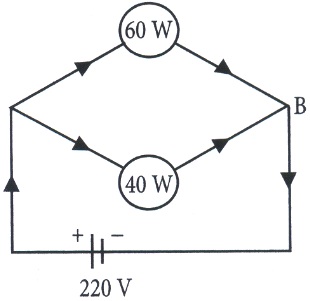
Two lamps, one related 60W at 220 W at 220V and the other 40 W at 220 V, are connected in parallel to the electric supply at 220V.
(a) Draw a circuit diagram to show the connections.
(b) Calculate the current drawn from the electric supply.
(c) Calculate the total energy consumed by the two lamps together when they operate for one hour.
51.
How is the small intestine designed to absorb digested food?
52.
Which of the following salts has no water of crystallization?
Blue vitriol
Washing soda
Baking soda
Gypsum
53.
During an exothermic reaction
Heat is absorbed
There is no heat transfer
Heat can either be absorbed or evolved
Heat is evolved.
54.
On moving from left to right in a period in the periodic table, the size of the atom.
increases
decreases
does not change appreciably
first decreases and then increases
55.
A molecule of ammonia (NH3) has
only single bonds
only double bonds
only triple bonds
two double bonds and one single bond
56.
The major problem in harnessing nuclear energy is how to?
Split nuclei
Sustain the reaction
Dispose off spent safely
Convert nuclear energy into electrical energy
57.
The magnetic field inside a long straight current carrying solenoid
is zero
decrease as we move towards its end
increases as we move towards its end
is the same at all points.
58.
A cylindrical conductor of length l and uniform area of cross section A has resistance R, another conductor of length 2l and resistance R of the same material has area of cross section?
A/2
3A/2
2A
3A
59.
If copper is kept open in air, it slowly loses its shining brown surface and gains a green coating. It is due to the formation of
CuSO4
CuCO3
Cu(NO3)2
CuO
60.
Which statement is not true about thyroxin?
Iron is essential for the synthesis of thyroxin
It regulates carbohydrates, protein and fat metabolism in the body
Thyroid gland require iodine to synthesise thyroxin
Thyroxin is also called thyroid hormone
61.
The kidneys in human beings are a part of the system for
Nutrition
Respiration
Excretion
Transportation
62.
How many vertical columns are there in the modern periodic table and what are they called?
63.
Why was the system of classification of elements into triads not found suitable?
64.
Lithium, sodium and potassium form a Dobereiner's triad. The atomic masses of lithium and potassium are 7 and 39 respectively. Predict the atomic mass of sodium.
65.
What are fossil fuels?
66.
What is energy?
67.
What is a nuclear reactor?
68.
Atomic number of a few elements are given below 10, 20, 7, 14
(a) Identify the elements.
(b) Identify the Group number of these elements in the Periodic Table.
(c) Identify the Periods of these elements in the Periodic Table.
(d) What would be the electronic configuration for each of these elements?
(e) Determine the valency of these elements.
69.
(i) Write the value of solar constant of Sun.
(ii) What type of mirror is used in Box Type Solar Cooker?
(iii) Why it is difficult to use hydrogen as a source of energy?
(iv) Fossil fuels are classified as non-renewable source of energy. Explain why.
1.
Carbon atoms have 4 electrons in their outcomes shell. So need to gain or lose electrons to attain noble gas configuration.
(i) It could gain four electrons forming c4- anion. But it would be difficult for the nucleus with six protons to hold on to ten electrons.
(ii) It could lose four electrons forming C4+ cations. But it would require a large amount energy to remove four electrons from its outermost shell.
Because of these reasons, carbon shares its valence electrons to complete its octet with other atoms to form covalent bonds.
(a) Covalent compounds are bad conductors of electricity because they do not contain ions.
(b) Covalent compounds have usually low melting and boiling because they are made up of electronically neutral molecule. So the force of attraction between the molecules of a covalent compound is very weak. Only a small amount of heat energy is required to break these weak molecular forces, due to which covalent compounds have low melting and boiling points.
2.
Nutrition can be defined as the process of acquiring source of energy from the outside to the inside of the body. Nutrients are the different sources of energy acquired by living organisms by the process of nutrition.
| Holozoic nutrition | Saprophytic nutrition |
|---|---|
| 1.It is the process in which living organisms take up complex. |
1.In this type of nutrition, the organisms obtain their nutrients by digesting dead and decaying organic matter. |
| 2.A specialised digestive system is involved. Examples: human beings, cow |
2.The organisms lack specialised digestive system and produce enzymes, which digest the organic matter outside the cell and the digested nutrients are then absorbed into the cell. Examples : Some bacteria and fungi. |
3.
Activity:
To show the effect of magnetic field on current -carrying conductor
Materials Required:
A small aluminium rod, a horse-shoe magnet, battery, plug key, wires and a stand.
Procedure:
The aluminium rod is suspended horizontally from the stand and tied to two wires at its ends. The wires are attached to rheostat, battery and a plug key to make the circuit.
The horse-shoe magnet is positioned in a way that the aluminium rod lies between the two poles of the magnet. If the South Pole is above the aluminium rod and the North Pole is below it. The plug key is inserted to initiate current supply to the rod.
It is observed that the aluminium rod deflects towards left.
When the direction of the current is reversed the aluminium rod deflects towards right.
Conclusion:
When a current carrying conductor is placed within a magnetic field, the conductor experiences deflection. Fleming's Left Hand Rule explains the direction of displacement in this case. Let us assume that the current is moving in anti-clockwise direction in the loop. In that case, the magnetic field would be in clockwise direction; at the top of the loop. Moreover, it would be in anticlockwise direction at the bottom of the loop.
4.
Since the metal X react with cold water, it must be high in the reactivity series i.e., sodium or potassium.
X is alkali metal, Na or K.
Since the metal Y reacts with hot water, it must be middle in the reactivity series i.e., magnesium or calcium.
Y is alkaline earth metal, Mg or Ca.
Since the metal X reacts with steam only, it must be low in the reactivity series i.e., iron Z is Fe.
Increasing reactivity series : Na > Mg > Fe.
5.
A number of resistors are said to be connected in series, if these are joined end to end and the same, current flows through each one of them when a potential difference is applied across the combination. If we connect ammeter first between the point A and R1, then between R1 and R2:R2 and R3 and lastly between R3 and the point B; it is same as current.
6.
(a) General metabolism.
(b) Controls blood sugar level.
(c) Prepare the body for 'fight or flight' response.
(d) Promotes growth and development.
(e) Triggers sperm production and is responsible for the development of secondary sexual characters in males.
7.
The Substance which is used for making different shapes is Plaster of Paris. Its chemical name is calcium sulphate hemihydrate \([CaSO_4.1/2H_2O].\) The two formula unit of \(CaSO_4\) share one molecule of water. As a result, it is soft. When it is left open for some time, it absorbs moisture from the atmosphere and forms gypsum, which is a hard solid mass.
\(\underset{Plaster\ of\ Paris}{CaSO_4.{1\over 2}H_2O}+1{1\over2}{H_2O}\rightarrow \underset{Gypsum}{CaSO_4.2H_2O}\)
8.
(a) Zinc sulphate and copper is formed when zinc reacts with copper sulphate,
\(\underset{Zinc}{Zn( s)} + \underset{Copper\ sulphate}{CuSO_4} (aq) \rightarrow \underset{Zinc\ sulphate}{ZnSO_4(aq)} + \underset{Copper}{Cu}\)
(b) Hydrochloric acid forms aluminium chloride and hydrogen gas when reacts with aluminium metal.
\(2AI + 6HCI\rightarrow 2AlCl_3 + 3H_2\)
(c) When silver metal is added to copper sulphate solution, no reaction takes place because silver is less reactive than copper
9.
A. Silver nitrate
B. Copper
C. Copper nitrate
Displacement reaction
10.
Electrolysis
X = water, Y = hydrogen, Z = oxygen
11.
Butanol
12.
ZnO(s) and CO2(g) are formed.
Chemical Equation:
ZnCO3 → ZnO + CO2
13.
The two metals are:
(i) Calcium (Ca)
(ii) Magnesium (Mg)
They start floating because the bubbles of hydrogen gas which are formed during the reaction stick to the surface of the metal.
14.
Silver or Copper.
15.
Reaction of an acid with a metal:
When an acid reacts with a metal, it forms a salt.
Hydrogen which is in all the acids gets displaced and liberated as hydrogen gas.
Acids + Metals \(\rightarrow\) Salt + Hydrogen gas
16.
As the wire is bent in the form of a closed circle, it will be have like two resistors of 5\(\Omega \) each, connected in parallel. Therefore, the equivalent resistance can be calculated as:
\(\frac { 1 }{ R_{ eq } } =\frac { 1 }{ { R }_{ 1 } } +\frac { 1 }{ { R }_{ 2 } } \)
\(\frac { 1 }{ R_{ eq } } =\frac { 1 }{ 5 } +\frac { 1 }{ 5 } \)=\(\frac { 1 }{ R_{ eq } } =\frac { 2 }{ 5 } \)
\(\frac { 1 }{ R_{ eq } } =\frac { 5 }{ 2 } =2.5\Omega \)
The effective resistance between the two points at the ends of an diameter of the circle is 2.5 \(\Omega \).
17.
Atomic mass as a physical property and nature and formulae of oxide and hydride formed, and chemical property was used by Mendeleev.
Observations :
(i) Increasing order of atomic weights could not be maintained while matching chemical properties. Chemical properties do not depend atomic mass.
(ii) Isotopes have different atomic mass but same chemical properties.
18.
(i) (-Cl) Halogen (Chloro)
(ii) -OH) Alcohol
19.

20.
Direction of induced current is given by Fleming's right hand rule according to this rule, stretch the thumb, fore-finger and the middle finger of the right hand such that they are mutually perpendicular.
If the fore-finger points in the direction of magnetic field the thumb shows the direction of motion and middle finger points in the direction of induced current.
21.
It should be connected with live wire.
22.
It is a vector quantity as it has both magnitude and direction.
23.
Oxides ores, carbonate and sulphide ore.
24.
As soon as a piece of sodium metal is dropped into water, bubbles will come out showing the evolution of a gas is hydrogen. The reaction that takes place between sodium metal and cold water is given below :
2Na + 2H2O → 2NaOH + H2
Sodium Water(cold) Sodium hydroxide Hydrogen
25.
Breathing is the process of taking in oxygen (inhalation) and giving out carbon dioxide (exhalation)
26.
The transport of food from the leaves to the different parts of the plant is called translocation.
27.
Respiration involves the breaking down of digested food using oxygen.As respiration produces a lot of energy in the form of ATP, this process is exothermic in nature.
28.
The receptors present in our eyes are called photoreceptors, as they are light sensitive.
29.
Brain and spinal cord.
30.
The receptors present in our nose and helps in detecting smell are called olfactory receptors.
31.
Watt
32.
It means that 1 joule of work will be done in order to move 1 coulomb of charge from point A to B.
33.
B will be basic nature, with pH = 8.
34.
A solution of ammonia in water results in the formation of ammonium hydroxide (NH4OH). Ammonium hydroxide is basic in nature and turns red litmus blue.
35.
Example of a decomposition reaction:
\(\underset { limestone }{ { CaCO }_{ 3 }(s) } \overset { heat }{ \rightarrow } \underset { quick\quad lime }{ CaO(s) } +C{ O }_{ 2 }(g)\)
Here, when limestone (calcium carbonate) is heated, it decomposes into quick lime (calcium oxide) and carbon di oxide (gas).
36.
(i) Change in colour: Reaction between lead nitrate solution and potassium iodide solution.
Pb(NO3)2(aq) + 2KI \(\longrightarrow \) PbI2(s) + 2KNO3(aq)
In this reaction, colour changes from colourless to yellow.
(ii) Change in temperature: Action of dilute sulphuric acid on zinc.
Zn(s) + H2SO4(aq) \(\longrightarrow \) ZnSO4(aq) + H2
In this reaction, heat is evolved
(iii) Formation of precipitate : Action of barium chloride on sodium sulphate.
BaCl2(aq)+ Na2SO4(aq) \(\longrightarrow \) BaSO4(s) + 2NaCl(aq)
37.
(i) Na2CO3(s) + 2HCl(aq) \(\longrightarrow \) 2NaCI(aq) + H2O(I) + CO2(g)
(ii) CaO(s) + H2O(I) \(\longrightarrow \)Ca(OH)2(aq) + Heat
(iii) Pb(NO3)2(aq) + NaCl(aq) \(\longrightarrow \) PbCI2(s) + 2NaNO3(aq)
38.
The reaction between an acid and a base that gives a salt and water is known as a neutralisation reaction.
Base + Acid ➝ Salt + Water
NaOH(aq) + HCI(aq) ➝ NaCl(aq) + H2O(I)
39.
When baking soda is heated, it decomposes to produce sodium carbonate, water and CO2 gas.
\(2NaHCO_3 \xrightarrow{\Delta} Na_2CO_3 + H_2O+ CO_2\)
CO2 gas produced during the reaction makes the cake or bread spongy and fluffy.
40.
Different metals react with oxygen at different rates. e.g., Sodium (Na) and potassium (K) catch fire, if left in open. Hence, these are the most reactive metals. To prevent accidental fires, these metals are kept immersed in kerosene oil. Magnesium burns in air only by heating. So, it is less reactive than sodium and potassium. Copper (Cu) does not burn on heating but blister copper burns. Hence the order of reactivity of these metals with oxygen is :
Na >Mg> Cu.
Metals react with water to produce a metal oxide and hydrogen gas. Sodium (Na) and potassium (K) react violently with cold water. So the reaction is violent and exothermic. Magnesium (Mg) does not react with cold water. It reacts with hot water. Metals like lead, copper, silver do not react with water at all. The reactivity series of metals towards water is:
Na > Mg > Cu.
41.
(i) X - Carbon, Y - Diamond, Z - Graphite
(ii) Non-metal
(iii) Tin.
42.
The major differences between an electric motor and generator are stated below:
Electric Motor:
1. It converts electrical energy into mechanical energy.
2. It needs electrical energy for its works.
3. They are used as water pumps, marble grinders etc.
Generator:
1. It converts mechanical energy into electrical energy
2. It needs mechanical energy for its working.
3. They are used as water pumps, marble grinders etc.
4. diesel generator, hydro-electric generator are the examples of it.
43.
(i)The glottis is gaurded by epiglottis because it prevents the entry of food in wind pipe. If the food enters wind pipe, then it chokes it, leading to the death of the person.
(ii)The lung alveoli are covered with blood vessels because the oxygen that we inhale dissolves in the blood, present in these blood capillaries only, as it reaches the lungs.
(iii)The wall of trachea is supported by cartilage rings because these rings prevent the air passage from collapsing.
44.
(i) Oxygen enters the human body through the nasal passage and reaches the lungs.
(ii) Numerous alveoli are present in the lungs. These alveoli are surrounded by many blood capillaries. From the alveoli, 02 is taken up by the red blood cells present in the blood capillaries.
(iii) Similarly, the CO2 from the various tissues is transported to the alveoli.
(iv) This CO2 is then released through the nasal passage during exhalation. Alveoli are the sites of exchange of gases. Each lung contains 300- 350 million alveoli.
These alveoli increase the surface area for gaseous exchange, making the process of respiration more efficient.
45.
(a) The solar cells are costly and hence the energy available from them expensive.
(b) 15 km/h is the minimum wind velocity required to obtain useful energy with a windmill.
(c) Nuclear fission is the process in which a radioactive atom splits up into smaller nuclei when struck with low energy neutrons.
46.
(a) The solar cooker box is covered with a plane glass plate so as to prevent heat from escaping.
(b) Sun is said to be the ultimate and the original source for most of the energy present on the earth. When sun rays fall on oceans and other water bodies, the water present in the water bodies gets evaporated and rises up in the atmosphere. In the upper part of the atmosphere, this water vapour gets condensed and forms douds, which give rain on the high lands. Therefore, the rain water runs over the Sand surface towards the large water bodies. This running water over the land surfaces is called river. Therefore, the energy of running water actually originates from the solar energy. This is why solar energy of water flowing in a river is considered to be an indirect form of solar energy.
(c) The fission of nucleus is brought about by splitting the nucleus of heavy atoms, such as uranium or plutonium, with low-energy neutron bombardment.
47.
Voluntary actions are under the control of our will, it needs thinking. e.g. talking, walking. Involuntary actions are not under the control of our will, they are automatic. eg. salivation, heart beat.
48.
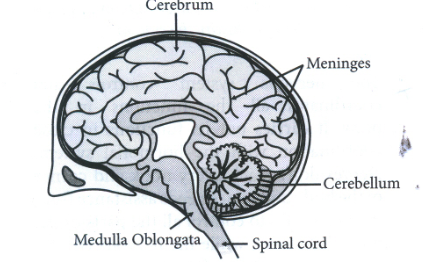
49.
| Conductors | Insulators |
| 1. Materials that allow electricity to pass through them. | Materials that do not allow electricity to pass through them. |
| 2. These materials have loosely bounded free electrons. |
These materials do not have loosely bounded free electrons. |
| 3. Eg., metals and graphite. | E.g., non-metals, rubber, plastic etc. |
50.
(a)
(b) Electric current flowing through a bulb = \(\frac { Power\quad of\quad the\quad bulb }{ Voltage\quad across\quad the\quad bulb } \)
\(i.e.,\quad I=\frac { P }{ V } \)
Therefore, \({ I }_{ 60 }=\frac { 60W }{ 220V } =\frac { 3 }{ 11 } A\quad and\quad { I }_{ 40 }=\frac { 40W }{ 220V } =\frac { 2 }{ 11 } A\)
Therefore, total current flowing through the circuit \(={ I }_{ 60 }+{ I }_{ 40 }=\frac { 3 }{ 11 } +\frac { 2 }{ 11 } =\frac { 5 }{ 11 } A=0.45A\)
(c) Total energy consumed = Power \(\times \) Time
That is, E = P \(\times \) T
= (40W+60W)\(\times \)1h
= 100 Wh
= 0.1 kWh
51.
The small intestine is the main region for the absorption of digested food. The inner lining of the small intestine is covered by millions of tiny finger-like projections called villi. The presence of villi gives the inner walls of the small intestine a very large surface area for the absorption of digestad food.
52.
(c)
Baking soda
53.
(d)
Heat is evolved.
54.
(b)
decreases
55.
(a)
only single bonds
56.
(c)
Dispose off spent safely
57.
(d)
is the same at all points.
58.
(c)
2A
59.
(b)
CuCO3
60.
(a)
Iron is essential for the synthesis of thyroxin
61.
(c)
Excretion
62.
()
There are 18 vertical columns in the modern periodic table and they are called groups.
63.
()
It is because all the elements discovered at that time could not be classified into triads.
64.
()
Atomic mass of Na = 7+39 / 2 = 46 / 2 = 23
65.
()
Fuels which are formed from the fossil remains of plants and animals and are obtained from under the earth's crust are called fossil fuels. Example coal, petroleum and natural gas.
66.
()
Energy is the capability to do work.
67.
()
Nuclear reactor is a device which is used as an energy source. They get their energy from controlling nuclear fission reaction and the energy released from the reaction is primarily used to generate electricity.
68.
| Atomic No. | Electronic Configuration | Group No. | Period No. | Valency | Element |
| 10 | 2,8 | 18 | 2nd | Zero | Neon |
| 20 | 2,8,8,2 | 2 | 4th | 2 | Calcium |
| 7 | 2,54 | 15 | 2nd | 3 | Nitrogen |
| 14 | 2,8,4 | 14 | 3rd | 4 | Silicon |
69.
(i) Solar constant of sun is 1.4 kW/m2.
(ii) Concave mirrors are used in box type solar cookers.
(iii) It is difficult to use hydrogen as a source of energy because it has not been possible to control nuclear fusion reaction. Thus, it has not yet been possible to use energy generated from fusion reaction for anything constructive.
(iv) Fossil fuels are classified as non-renewable sources of energy because it takes a long time for them to replenish naturally. It takes millions of years for fossil fuels to replenish. With the rate at which humans are using them, they will get exhausted in the next hundred years. Thus, fossil fuels are termed as non-renewable source of energy.

10th Standard CBSE Syllabus & Materials
10th Standard CBSE
CBSE 10th Social Science PS - Federalism - New Model Questions Papers Study Material - QB365 Set A
NEW10th Standard CBSE
CBSE 10th Social Science PS - Power Sharing - New Model Questions Papers Study Material - QB365 Set A
NEW10th Standard CBSE
CBSE 10th Social Science GEO - Manufacturing Industries - New Model Questions Papers Study Material - QB365 Set A
NEW10th Standard CBSE
CBSE 10th Social Science GEO - Minerals and Energy Resources - New Model Questions Papers Study Material - QB365 Set A



CBSE 10th Standard CBSE Subjects
CBSE Standards





