
 100% FREE ACCESS
10th Standard CBSE Syllabus & Materials
10th Standard CBSE
CBSE 10th Social Science ECO - Globalisation and the Indian Economy - New Model Questions Papers Study Material - QB365 Set A
NEW10th Standard CBSE
CBSE 10th Social Science ECO - Money and Credit - New Model Questions Papers Study Material - QB365 Set A
NEW10th Standard CBSE
CBSE 10th Social Science ECO - Sectors of the Indian Economy - New Model Questions Papers Study Material - QB365 Set A
NEW10th Standard CBSE
CBSE 10th Social Science ECO - Development - New Model Questions Papers Study Material - QB365 Set A
NEW10th Standard CBSE
CBSE 10th Social Science PS - Outcomes of Democracy - New Model Questions Papers Study Material - QB365 Set A
NEW10th Standard CBSE
CBSE 10th Social Science PS - Gender, Religion and Caste - New Model Questions Papers Study Material - QB365 Set A

Published on: 14/02/2020
10th Standard CBSE Science Board Exam Model Question paper IV 2020
Download CBSE Class 10th Standard CBSE Science question papers, sample papers, important questions, and previous year solved papers in PDF format. Get free study materials, NCERT solutions, and exam preparation resources for Class 10th Standard CBSE Science
Questions + Answers key
Take MCQ Science Test
1.
If the key in the arrangement (below figure) is taken out (the circuit is made open) and magnetic field lines are drawn over the horizontal plane ABCD, the lines are
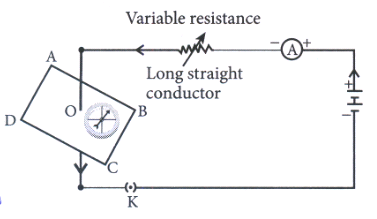
Concentric circles
Elliptical in shape
Straight lines parallel to each other
Concentric circles near the point O but of elliptical shapes as we go away from it.
2.
Which one of the following does not increase while moving down the group of the periodic table?
Atomic radius
Metallic character
Valence
Number of shells in an element
3.
In the soap micelles
the ionic end of soap is on the surface of the cluster while the carbon chain is in the interior of the cluster.
ionic end of soap is in the interior of the cluster and the carbon chain is out of the cluster.
both ionic end and carbon chain are in the interior of the cluster
both ionic end and carbon chain are on the exterior of the cluster
4.
Acid rain happen because
Sun leads to heating of upper layer of atmosphere
Burning of fossil fuels release oxides of carbon, nitrogen and sulphur in the atmosphere.
Electrical charges a produced due to friction among clouds
Earth's atmosphere contains acids.
5.
Generally, non-metals are not lustrous. Which of the following nonmetal is lustrous?
Sulphur
Oxygen
Nitrogen
Iodine
6.
Which of the following statement is correct about receptors?
Gustatory receptors detect taste while olfactory receptors detect smell
Both gustatory and olfactory receptors detect smell
Auditory receptors detect smell and olfactory receptors detect taste
Olfactory receptors detect taste and gustatory receptors smell
7.
The commonly used safety fuse wire is made of
Lead
Copper
Nickel
An alloy of tin and lead
8.
The kidneys in human beings are a part of the system for
Nutrition
Respiration
Excretion
Transportation
9.
Which among the following is /are double displacement reaction(s) ?
(i) Pb + CuCl2 \(\rightarrow\) PbCl2 + Cu
(ii) Na2SO4 + BaCl2 \(\rightarrow\) BaSO4 + 2NaCl
(iii) C + O2 \(\rightarrow\) CO2
(iv) CH4 + 2O2 \(\rightarrow\) CO2 + 2H2O
(i) and (iv)
(ii) only
(i) and (ii)
(iii) and (iv)
10.
During the preparation of hydrogen chloride gas on a humid day, the gas is usually passed through the guard tube containing calcium chloride. The role of calcium chloride taken in the guard tube is to
absorb the evolved gas
moisten the gas
absorb moisture from the gas
absorb Cl- ions from the evolved gas
11.
Ashok wanted his house to white washed. He bought 10kg quick lime from market and dissolved it in 30 liters of water. On adding lime to water he noticed that bubbles were produced and the solution becomes hot. Give reason and name the product formed.
12.
Which term is used to indicate the development of unpleasant smell and taste in butter and oil containing food?
13.
Write the formula of functional group:
(i) aldehyde, (ii) alcohol
14.
Name the functional group present in CH3COCH3 and state the name of this compound
15.
What is the difference between two consecutive members in a homologous series in alkanes in terms of:
(i) Molecular mass,
(ii) Number of atoms of elements.
16.
Which gas is liberated when a metal reacts with an acid? How will you test the presence of this gas?
17.
Name the metal which has very low melting point and can melt with heat of your palm?
18.
Which gas is usually liberated when an acid reacts with a metal?
19.
Should the heating element of an electric iron be made of iron, silver or nichrome wire?
20.
An element 'M' with electronic configuration (2,8,2) combines separately with (NO3)-, (SO4)2 and (PO4)3 radicals.Write the formula of the three compounds so formed.To which group and period of the Modern Periodic Table does the elements 'M' belong?Will 'M' form covalent or ionic compounds?GIve reasn to justify your answer.
21.
What is the use of electric fuse?
22.
Who discovered that mechanical motion can produce current?
23.
What is lymph?
24.
What kind of quantity is magnetic field?
25.
Name the ores of mercury.
26.
What are enzymes?
27.
Why is respiration considered an exothermic process?
28.
A magnetic compass shows a deflection when placed near a current carrying wire. How will the deflection of the compass get affected if the current in the wire is increased? Support your answer with a reason.
29.
Define a 'nuclear fusion reaction'. Describe the conditions for the occurrence of a nuclear fusion reaction.
30.
What are photoreceptors?
31.
Write the components of central nervous system.
32.
What is a neuron?
33.
What is a voltmeter?
34.
Give the formula for quicklime.
35.
Dry ammonia gas has no action on litmus paper, but a solution of a ammonia in water turns red litmus paper blue, why is it so?
36.
What are the differences between autotrophic nutrition and heterotrophic nutrition?
37.
How would you distinguish between baking powder and washing soda by heating?
38.
Write the chemical equation of the reaction with an example each in which the following change has taken place:
(i) Change in colour
(ii)Change in temperature
(iii) Formation of precipitate.
39.
(a) Mention the four informations given by an equation.
(b) State the law of conservation of mass as applicable in a chemical reaction.
40.
List three properties of sodium in which it differs from the general physical properties of most metals.
41.
(i)Two solutions X and Y are tested with universal indicator. Solution X turns orange whereas solution Y turns red. Which of the solutions is a stronger acid?
(ii) State the meaning of strong acids and weak acids. Give one example of each.
42.
Distinguish between permanent magnet and electromagnet.
43.
What is 'translocation'? Why is it essential for plants?Where in plants are the following synthesized:
(i)Sugar (ii)Hormones
44.
Give reasons for the following:
(i)The glottis is guarded by epiglottis
(ii)The lung alveoli are covered with blood capillaries.
(iii)The wall of trachea is supported by cartilage rings.
45.
On adding dilute HCl acid to copper oxide powder, the solution formed is blue-green. Predict the new compound formed which imparts a blue-green colour to the solution.
46.
What is an homologous series? Explain with an example.
47.
(a) State one limitation of solar energy available from solar cells.
(b) What is the minimum wind velocity required to obtain useful energy with a windmill?
(c) Define the term 'nuclear fission'.
48.
(a) What is a 'solar cell'?
(b) Why is biogas considered an ideal fuel for domestic use?
(c) Name a device in which controlled chain reaction is used.
49.
Distinguish between voluntary and involuntary actions of our body.
50.
(i) Draw a schematic diagram of a circuit consisting of a battery of five 2 V cells, a 5 Ohm resistor, a 10 Ohm resistor and a 15 Ohm resistor, and a plug key, all connected in series.
(ii) Calculate the electric current passing through the above circuit when the key is closed.
51.
(a) What is meant by 'Electric Resistance' of a conductor?
(b) A wire of length 'L' and resistance 'R' is stretched so that its length is doubled and the area of cross-section is halved. How will its:
(i) resistance change
(ii) resistivity change
52.
A man went door to door posing to be a goldsmith. He promised to bring back the glitter of old and dull gold ornaments. An unsuspecting lady gave a set of gold bangles to him which he dipped in a particular solution. The bangles sparkled like new but their weight was reduced drastically. The lady was upset but after a futile argument, the man beat a hasty retreat.
(i) Can you play the detective to find out the nature of the solution he had used?
(ii) What is 24 carat gold?
53.
What are the hydrocarbons? Write the name and general formula of
(i) saturated hydrocarbons,
(ii) unsaturated hydrocarbons and draw the structure of one hydrocarbon of each type. How can an unsaturated hydrocarbon be made saturated?
54.
Draw an appropriate schematic diagram showing common domestic circuits and discuss the importance of fuse. Why is it that a burnt out fuse should be replaced by another fuse of identical rating?
55.
How will you conclude that the same potential difference exist across three resistors connected in a parallel arrangement to a battery?
56.
An element A which is a yellow solid at room temperature shows catenation and allotropy. A forms two oxides which are also formed during the thermal decomposition of ferrous sulphate crystals and are the major air pollutants.
(a) Identify the element A
(b) Write the electronic configuration of A
(c) Write the balanced chemical equation for the thermal decomposition of ferrous sulphate crystals?
(d) What would be the nature (acidic/ basic ) of oxides formed?
(e) Locate the Position of the element in the Modern Periodic Table.
57.
Energy from various sources is considered to have been derived from the sun. do you agree? Justify your answer.
58.
How many vertical columns are there in the modern periodic table and what are they called?
59.
State modern periodic law of classification of elements.
60.
Why was the system of classification of elements into triads not found suitable?
61.
What is renewable source of energy?
62.
Which is the ultimate source of energy?
63.
What is a non-renewable source of energy?
1.
(a)
Concentric circles
2.
(c)
Valence
3.
(a)
the ionic end of soap is on the surface of the cluster while the carbon chain is in the interior of the cluster.
4.
(b)
Burning of fossil fuels release oxides of carbon, nitrogen and sulphur in the atmosphere.
5.
(d)
Iodine
6.
(a)
Gustatory receptors detect taste while olfactory receptors detect smell
7.
(a)
Lead
8.
(c)
Excretion
9.
(b)
(ii) only
10.
(c)
absorb moisture from the gas
11.
It happen because when we react quick lime with water it releases heat energy and due to this it produces bubbles in water.
Product is
CaO + H2O → Ca(OH)2 + heat
12.
Oxidation
13.
(i) Aldehyde : \(\underset{\\\\ \ -\mathrm{C}-\mathrm{H}}{\overset{\mathrm{O}}{||}}\)
(ii) Alcohol: -OH
14.
Functional group: Ketone, name of the compound: Propanone.
15.
Difference in :
(i) Molecular mass = 14 a.m.u.
(ii) Number of atoms of elements = CH2
16.
Hydrogen gas is formed. Bring a burning matchstick near to it, H2 will burn explosively with 'pop' sound.
17.
Gallium.
18.
Reaction of an acid with a metal:
When an acid reacts with a metal, it forms a salt.
Hydrogen which is in all the acids gets displaced and liberated as hydrogen gas.
Acids + Metals \(\rightarrow\) Salt + Hydrogen gas
19.
Nichrome should be used as a heating element in an electric iron because its melting point is higher than iron and silver.
20.
(i) Tthe electronic configuration (2, 8, 2) of the element 'M' suggests that it belongs to group 2 and period 3 of the Modern Periodic Table and its valency is 2.
(ii) The chemical formulae of the compounds formed are:
(a) M(NO3)2
(b) MSO4
(c) M3(PO4)2
(iii) 'M' will form ionic compounds by losing two valence electrons to achieve a noble gas configuration that is a stable octet in the valence shell.
21.
Electric fuse is used for protecting the circuits due to short circuiting or overloading of the circuits.
22.
Michael Faraday in 1831 discovered that mechanical motion can produce current.
23.
It is an extracellular fluid used in transportation.
24.
It is a vector quantity as it has both magnitude and direction.
25.
Cinnabar, Hgs
26.
Enzymes are bio-catalyst which help in faster biochemical processes.
27.
Respiration involves the breaking down of digested food using oxygen.As respiration produces a lot of energy in the form of ATP, this process is exothermic in nature.
28.
The strength of magnetic field varies directly as the magnitude of the electric current. So, in case of an increase in current the magnetic field would increase.
29.
Nuclear fusion is a nuclear reaction in which two light nuclei of a heavy atom combine to form a nuclear of a heavier atom.
The conditions required for the occurrence of a fusion are:
(a) High temperature
(b) Hogh pressure
30.
The receptors present in our eyes are called photoreceptors, as they are light sensitive.
31.
Brain and spinal cord.
32.
Neurons are the functional units of the nervous system. They carry the information from the brain and the spinal cord to the different parts of the body and form the different parts of the body to the brain or the spinal cord.
33.
A measuring instrument used to measure potential difference between two points in an electric circuit.
34.
Calcium oxide (CaO), commonly known as quicklime
35.
A solution of ammonia in water results in the formation of ammonium hydroxide (NH4OH). Ammonium hydroxide is basic in nature and turns red litmus blue.
36.
The differences between autotrophic and heterotrophic nutrition are as follows
| Features | Autotrophic Nutrition | Heterotrophic Nutrition |
| Food | In this mode of nutrition, food is prepared by organism itself. | In this mode of nutrition food is obtained from other organisms (autotrophs). |
| Inorganic substances | The raw materials are required by autotrophs. | The raw materials are not required by heterotrophs. |
| Digestion | This process is absent. | This process is required for the conversion of complex molecules into simpler and more soluble ones. |
| Chlorophyll | It is present in autotrophs for trapping light. | It is absent |
| Status | They are known as producers. | They are known as Consumers |
37.
The chemical formula of baking powder is sodium hydrogen carbonate \((NaHCO_3).\) while, that of washing soda is sodium carbonate carbonate on heating gives \(CO_2\) gas which will turn lime water milky whereas no such gas is obtained from sodium carbonate.
\(2NaHCO_3\xrightarrow {Heat}Na_2CO_3+H_2O+CO_2\)
\(NA_2CO_3.10H_2O\xrightarrow {Heat}Na_2CO_3+10H_2O\)
38.
(i) Change in colour: Reaction between lead nitrate solution and potassium iodide solution.
Pb(NO3)2(aq) + 2KI \(\longrightarrow \) PbI2(s) + 2KNO3(aq)
In this reaction, colour changes from colourless to yellow.
(ii) Change in temperature: Action of dilute sulphuric acid on zinc.
Zn(s) + H2SO4(aq) \(\longrightarrow \) ZnSO4(aq) + H2
In this reaction, heat is evolved
(iii) Formation of precipitate : Action of barium chloride on sodium sulphate.
BaCl2(aq)+ Na2SO4(aq) \(\longrightarrow \) BaSO4(s) + 2NaCl(aq)
39.
(a) (i) Physical state of reactants and products.
(ii) Conditions such as temperature, pressure, heat etc.
(iii) Catalyst involved.
(iv) Change in state.
(b) Total mass of the elements present in the products in a chemical reaction has to be equal to the total mass of elements present in the reactants or Mass can neither be created nor. destroyed in a chemical reaction.
40.
Three properties of sodium are:
(i) Sodium is so soft that it can be cut with a knife.
(ii) It has low density.
(iii) It has low melting point.
41.
(i) Solution Y is a stronger acid.
(ii) Strong acid: An acid which dissociates completely in water and produces a large amount of hydrogen ions. e.g., HCI
Weak acid: An acid which dissociates partially in water and produces a small amount of hydrogen ions. CH3COOH.
42.
| Electromagnet | Permanent Magnet |
| 1. It is temporary magnet and can be demagnetized | 1. It is a permanent magnet and cannot be demagnetized |
| 2. Magnetic strength can be changed. | 2. its strength is fixed. |
| 3. Its polarity can also be changed. | 3. Its polarity is fixed. |
| 4. It is prepared from soft iron. | 4. It is prepared from hard steel. |
43.
The transport of soluble products of photosynthesis is known as translocation. Translocation in plants occurs by means of the vascular tissue known as phloem. Translocation is necessary because without it, the food prepared by the leaves cannot reach other parts of the plant.
(i)In plants, the synthesis of sugars takes place in the leaves by the process of photosynthesis.
(ii)Hormones are synthesised away from their targrt site.
44.
(i)The glottis is gaurded by epiglottis because it prevents the entry of food in wind pipe. If the food enters wind pipe, then it chokes it, leading to the death of the person.
(ii)The lung alveoli are covered with blood vessels because the oxygen that we inhale dissolves in the blood, present in these blood capillaries only, as it reaches the lungs.
(iii)The wall of trachea is supported by cartilage rings because these rings prevent the air passage from collapsing.
45.
The name of the compound is cupric chloride which gives blue-green colour to the solution.
\(CuO+2HCI\rightarrow { CuCI }_{ 2 }+{ H }_{ 2 }O\)
46.
A series of similarly constituted compounds in which the members present have the same functional group and similar chemical properties and any two successive members in a particular series differ in their molecular formula by ( - CH2) unit, is called a homologous series.
e.g. alkane series CnH2n+2
| CH4 C3H8 C5H12 |
Methane Propane Pentane |
C2H6 C4H10 |
Ethane Butane |
47.
(a) The solar cells are costly and hence the energy available from them expensive.
(b) 15 km/h is the minimum wind velocity required to obtain useful energy with a windmill.
(c) Nuclear fission is the process in which a radioactive atom splits up into smaller nuclei when struck with low energy neutrons.
48.
(a) A solar cell is a device which converts solar energy into electricity. It is a sandwich of a silicon-boron layer and a silicon-arsenic layer.
(b) Biogas is an ideal fuel for domestic use because it is a cheap and clean fuel, which does not leave behind any residue.
(c) A nuclear power plant is a device in which controlled chain reaction is used.
49.
Voluntary actions are under the control of our will, it needs thinking. e.g. talking, walking. Involuntary actions are not under the control of our will, they are automatic. eg. salivation, heart beat.
50.
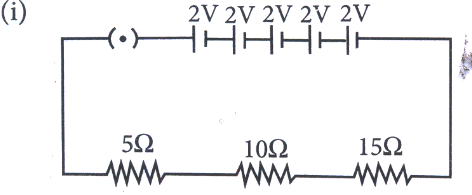
(ii) When the key is closed, total voltage applied across the circuit will be = 2 ✕ 5V = 10 V
Total resistance (R) applied across the circuit in Ohms = 5+10+15= \(30\Omega \)
By Ohm's Law,
Current (I) = \(\frac { V }{ R } \)
\(I=\frac { 10 }{ 30 } =0.33A\)
51.
(a) Resistance is defined as the property of a conductor due to which it opposes the flow of current through it. The S.I. unit of resistance is Ohm \(\left( \Omega \right) \).
(b) (i) The resistance (R) of a conductor is related to its length (l) and area of cross section (A) as
\(R=\frac { p\times l }{ A } \) Where \(\rho \) is the resistivity of the conducting material.
Let R1= Resistance of the original wire
R2= Resistance of the wire when its length is doubled
I1= Length of original wire
l2= Length of original wire when doubled
A1= Area of the original wire
A2= Area when it is halved
Therefore,
\({ R }_{ 1 }=\frac { P\times { l }_{ 1 } }{ { A }_{ 1 } } \quad \quad ---\quad (1)\\ { R }_{ 2 }=\frac { P\times { l }_{ 2 } }{ { A }_{ 2 } } \quad \quad ---\quad (2)\)
Dividing equation (1) and (2) by equation (1), we obtain
\(\frac { { R }_{ 1 } }{ { R }_{ 2 } } =\frac { { l }_{ 1 } }{ { l }_{ 2 } } \times \frac { { A }_{ 1 } }{ { A }_{ 2 } } \quad ---\quad (3)\)
It is given that:
\({ l }_{ 1 }=2l_{ 1 }\quad and\quad { A }_{ 2 }=\frac { 1 }{ 2 } { A }_{ 1 }\\ \)
Putting these values in equation (3), we obtain
R2=4R1
Hence, the resistance of the wire will be 4 times of the original value.
(ii) The resistivity will not change on stretching the wire. Resistivity is the property of the conducting material. It does not depend on the dimension of the wire. As materials of both the wires are the same, the resistivity will not change.
52.
(i) The nature of the solution is acidic. It is a mixture of conc. HNO3, and conc. HCI in the ratio of 1 : 3. It can dissolve gold as it is an oxidising agent.
(ii) Pure gold is 24 carat gold which is very soft.
53.
-s.jpg)
-s.jpg)
54.
Importance of Fuse: The electric fuse is an important device in household wiring and also in many electrical appliances. By melting, the fuse wire breaks the circuit and thus helps in saving the wiring or the appliance from damage. A fuse wire works because of its lower melting point which is possible because of its respective rating. If a fuse with larger rating is used with an appliance, the fuse wire shall not melt and hence would fail to serve the required purpose. Due to this, a fuse with defined rating should not be replaced by one with a larger rating.
55.
A number of resistors are said to be connected in parallel if one end of each is connected to one point and the other end is connected to another point so that the potantial difference across each resistor is the same and is equal to the applied potential difference between the two points. If we connect a voltmeter first across R1, then across R2 ad lastly across R3, it will show same voltage.
56.
(a) The element A which is a yellow solid at room temperature and shows catenation and allotropy is sulphur (S).
(b) The atomic number of sulphur is 16. Therefore, its electronic configuration is 2, 8, 6.
(c) \(\underset { Ferroussulphate }{ { 2FeSO }_{ 4 } } \underrightarrow { Heat } \underset { Ferricoxide }{ { Fe }_{ 2 }{ O }_{ 3 } } +\underset { Sulphurdioxide }{ { SO }_{ 2 } } +\underset { Sulphurtrioxide }{ { SO }_{ 3 } } \)
Both SO2 and SO3 are major air pollutions.
(d) Since sulphur is a non-metal, therefore both S02 and S03 are acidic oxide since they dissolve in water to form the corresponding acids.
\(\underset { Sulphurdioxide }{ { SO }_{ 2 } } +\underset { Water }{ { H }_{ 2 }O } \rightarrow \underset { Sulphurousacid }{ { H }_{ 2 }{ SO }_{ 3 } } \\ \underset { Ferroustrioxide }{ { SO }_{ 3 } } +\underset { Water }{ { H }_{ 2 }O } \rightarrow \underset { Sulphuricacid }{ { H }_{ 2 }{ SO }_{ 4 } } \)
(e) Since sulphur contains six valence electrons, therefore it lies in group 6 + 10 = 16.Further, since atomic number of sulphur (S) is 16. It lies in the 3rd period.
57.
i) All fossil are the remains of the prehistoric plants and animals. Th energy of the fossil fuels is in fact that solar energy which was trapped by natural processes a long time ago.
ii) Solar energy also appears in the form of energy of water flowing in rivers as is obvious from the water cycle in nature. It is this energy which generates in hydroelectric power plants.
iii) Biomass energy is also the solar energy absorbed by the plans which convert it into chemical energy through photosynthesis.
iv) Human and animals use bioenergy to carry out their life activities.
v) Solar energy is one of the main factors responsible for the movement of air in the atmosphere leading to wind energy.
vi) Solar energy is used directly in solar.
58.
()
There are 18 vertical columns in the modern periodic table and they are called groups.
59.
()
Modern periodic law states "that the properties of elements are a period function of the atomic numbers"
60.
()
It is because all the elements discovered at that time could not be classified into triads.
61.
()
A source of energy that can be obtained on a regular basis even after using it continuously is called renewable source of energy like solar, wind and water energy.
62.
()
Sun is the ultimate source of energy.
63.
()
A source of energy which is present in a fixed form and takes millions of years to get replenished is called a non-renewable source of energy like fossil fuels, coal and petroleum.

10th Standard CBSE Syllabus & Materials
10th Standard CBSE
CBSE 10th Social Science PS - Federalism - New Model Questions Papers Study Material - QB365 Set A
NEW10th Standard CBSE
CBSE 10th Social Science PS - Power Sharing - New Model Questions Papers Study Material - QB365 Set A
NEW10th Standard CBSE
CBSE 10th Social Science GEO - Manufacturing Industries - New Model Questions Papers Study Material - QB365 Set A
NEW10th Standard CBSE
CBSE 10th Social Science GEO - Minerals and Energy Resources - New Model Questions Papers Study Material - QB365 Set A



CBSE 10th Standard CBSE Subjects
CBSE Standards





