
 100% FREE ACCESS
10th Standard CBSE Syllabus & Materials
10th Standard CBSE
CBSE 10th Social Science ECO - Globalisation and the Indian Economy - New Model Questions Papers Study Material - QB365 Set A
NEW10th Standard CBSE
CBSE 10th Social Science ECO - Money and Credit - New Model Questions Papers Study Material - QB365 Set A
NEW10th Standard CBSE
CBSE 10th Social Science ECO - Sectors of the Indian Economy - New Model Questions Papers Study Material - QB365 Set A
NEW10th Standard CBSE
CBSE 10th Social Science ECO - Development - New Model Questions Papers Study Material - QB365 Set A
NEW10th Standard CBSE
CBSE 10th Social Science PS - Outcomes of Democracy - New Model Questions Papers Study Material - QB365 Set A
NEW10th Standard CBSE
CBSE 10th Social Science PS - Gender, Religion and Caste - New Model Questions Papers Study Material - QB365 Set A

Published on: 14/02/2020
10th Standard CBSE Science Board Exam Model Question paper V 2020
Download CBSE Class 10th Standard CBSE Science question papers, sample papers, important questions, and previous year solved papers in PDF format. Get free study materials, NCERT solutions, and exam preparation resources for Class 10th Standard CBSE Science
Questions + Answers key
Take MCQ Science Test
1.
Find out the following in the electric circuit given in Figure
(a) Effective resistance of two 8 \(\Omega\) resistors in the combination
(b)Current flowing through 4 \(\Omega\) resistor
(c) Potential difference across 8 \(\Omega\) resistance
(d) Power dissipated in 4 \(\Omega\) resistor
(e) Difference in ammeter readings, if any.
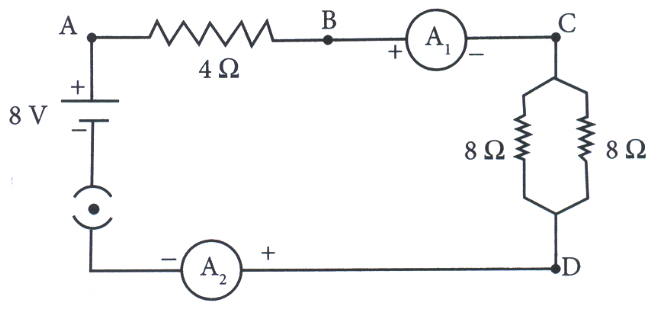
2.
A compound C (molecular formula, C2H4O2) reacts with Na - metal to form a compound R and evolves a gas which burns with a pop sound. Compound C on treatment with an alcohol A in presence of an acid forms a sweet smelling compound S (molecular formula, C3H6O2). On addition of NaOH to C, it also gives R and water. S on treatment with NaOH solution gives back R and A. Identify C, R, A, S and write down the reactions involved.
3.
(a) What is an electromagnet? What does it consist of?
(b) Name one material in each case which is used to make a
(i) Permanent magnet
(ii) Temporary magnet
(c) Describe an activity to show how you can make an electromagnet in your school laboratory.
4.
An element A burns with golden flame in air. It reacts with another element B, atomic number 17 to give a product C. An aqueous solution of product C on electrolysis gives a compound D and liberates hydrogen. Identify A, B, C and D. Also write down the equations for the reactions involved.
5.
Describe the alimentary canal of man.
6.
Name various plant hormones. Also give their physiological effects on plant growth and development.
7.
(a) Why is sulphuric acid called 'King of Chemicals'?
(b) Describe the three chemical reactions that take place during the conversion of sulphur dioxide to sulphuric acid in the 'Contact Process'.
(c) Why should water be never added drop wise to concentrated sulphuric acid?
8.
What happens when a piece of
(a) Zinc metal is added to copper sulphate solution?
(b) Aluminium metal is added to dilute hydrochloric acid?
(c) Silver metal is added to copper sulphate solution? Write the balanced chemical equation if the reaction occurs.
9.
Which gas is usually liberated when an acid reacts with a metal? Illustrate with an example, How will you test for the presence of the gas?
10.
Structural formula of benzene is
-q.jpg)
-q.jpg)
-q.jpg)
-q.jpg)
11.
The proper representation of series combination of cells obtaining maximum potential is
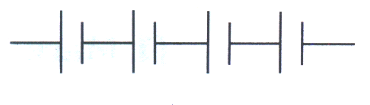
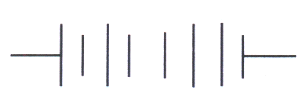

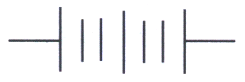
12.
Which of the following gives the correct increasing order of the atomic radii of O, F and N?
O,F,N
N,F,O
O,N,F
F,O,N
13.
Choose the incorrect statement
Fleming's right-hand rule is a simple rule to know the direction of induced current.
The right-hand thumb rule is used to find the direction of magnetic fields due to current carrying conductors.
The difference between the direct and alternating currents is that the direct current always flows in one direction, whereas the alternating current reverses its direction periodically.
In India, the AC changes direction after every 1/50 second.
14.
Which of the first enzyme to mix with food in the digestive tract?
Pepsin
Cellulase
Amylase
Trypsin
15.
Which of the following is not an example of a bio-mass energy source?
Wood
Gobar-gas
Nuclear energy
Coal
16.
Generally, non-metals are not lustrous. Which of the following nonmetal is lustrous?
Sulphur
Oxygen
Nitrogen
Iodine
17.
The substance that triggers the fall of mature leaves and fruits from plants is due to
Auxin
Gibberellin
Abscissic acid
Cytokinin
18.
Calcium phosphate is present in tooth enamel. Its nature is
basic
acidic
neutral
amphoteric
19.
Which of the following are exothermic processes?
(i) Reaction of water with quicklime
(ii) Dilution of an acid
(iii) Evaporation of water
(iv) Sublimation of camphor(crystals)
(i) and (ii)
(ii) and (iii)
(i) and (iv)
(iii) and (iv)
20.
A compound ‘X’ is an important ingredient of an antacid. It is also used in fire extinguisher. Identify ‘X’.
21.
What is the difference between two consecutive members in a homologous series in alkanes in terms of:
(i) Molecular mass,
(ii) Number of atoms of elements.
22.
Write the two succeeding members of the following homologous series:
C2H6'C3H8
23.
Name the metal which reacts with a very dilute HNO3 to evolve hydrogen gas.
24.
Which gas is liberated when a metal reacts with an acid? How will you test the presence of this gas?
25.
State one basic difference between a physical change and a chemical change.
26.
Which gas is usually liberated when an acid reacts with a metal?
27.
The position of three elements A, B and C in the Periodic Table is shown below
| Group Period | 1 | 2 | 13 | 14 | 15 | 16 | 17 |
| 1 | B | ||||||
| 2 | A | A | |||||
| 3 | - | C |
Giving reasons, explain the following:
(a) Element A is a non-metal.
(b) Atom of element C has a larger size than atom of element A.
(c) Element B has a valency of 1.
28.
Write the next homologue of each of the following:
(i) C2H4
(ii) C4H6
29.
Who discovered that mechanical motion can produce current?
30.
What are concentric circles?
31.
Name the tissue which transports water and mineral in a plant
32.
What seems to happen when a piece of sodium metal is dropped into water?
33.
(a) What is the role of fuse, used in series with any electrical appliance?
(b) Why should a fuse with defined rating not be replaced by one with a larger rating?
34.
Name the excretory unit of a kidney
35.
Name the term for transport of food from leaves other parts of the plant.
36.
Why is blood circulation in human heart called double circulation?
37.
Describe the areas where acids are most likely expected?
38.
Give the difference between sensory and motor nerve.
39.
Name the part of hind brain which takes part in regulation of respiration.
40.
Name one endocrine gland which performs dual function.
41.
What is a neuron?
42.
An electric iron has a rating of 750 W, 220 V. Calculate
(i) current passing through it, and
(ii) its resistance, when in use
43.
What is the S.I. unit of charge?
44.
Which has a higher resistance: a 50 W lamp bulb or a 25 W lamp bulb and how many times?
45.
What is the S.I. unit of electric potential?
46.
What is rust?
47.
What happens when:
(i) Dilute hydrochloric acid is added to solid sodium carbonate.
(ii) Quicklime is treated with water.
(iii) Sodium chloride solution is added to lead nitrate solution.
Also write the chemical equation in each case.
48.
While eating food, you happen to spill some curry on your white shirt. You immediately scrub it with soap. What happens to its yellow color on scrubbing with soap? Why? What happens to this stain when the shirt is washed with plenty of water?
49.
Define the term decomposition reaction. Give one example each of thermal decomposition and electrolytic decomposition.
50.
(a) Arrange the following metals in the order of their decreasing activities: Aluminium, Gold, Sodium, Copper
(b) Give chemical equation for the reaction of aluminium powder with manganese dioxide on heating.
51.
A liquid has a pH less than 7 which represent all acidic solution:
(i) State the nature of the solution, if its pH increases from 7 to 14.
(ii) Mention the ion whose concentration increases with the increase in pH value.
(iii) Suggest a method that is generally used for measuring the pH value.
52.
Distinguish between an electric motor and generator?
53.
Name the constituents of blood.Why white blood corpuscles are called 'soldiers of the body'?
54.
What is 'translocation'? Why is it essential for plants?Where in plants are the following synthesized:
(i)Sugar (ii)Hormones
55.
(a) What are amphoteric oxides? Choose the amphoteric oxides from amongst the following oxides?
Na2O, ZnO, Al2O3, CO2, H2O.
(b) Why is it that non-metals do not displace hydrogen from dilute acids?
56.
(a) State one limitation of solar energy available from solar cells.
(b) What is the minimum wind velocity required to obtain useful energy with a windmill?
(c) Define the term 'nuclear fission'.
57.
(a) What is a 'solar cell'?
(b) Why is biogas considered an ideal fuel for domestic use?
(c) Name a device in which controlled chain reaction is used.
58.
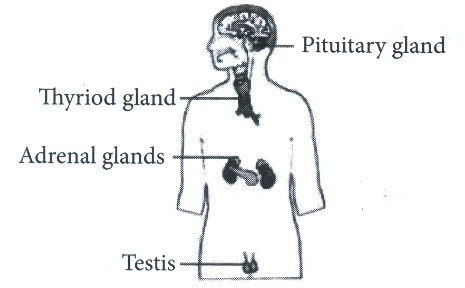
Draw a diagram showing endocrine glands in a male body. Label the following glands on it:
(i) Pituitary
(ii) Thyroid
(iii) Adrenal
(iv) Testes
59.
Describe the central nervous system in human being under the following heads:
(i) Regions included
(ii) Three functions of any one region
60.
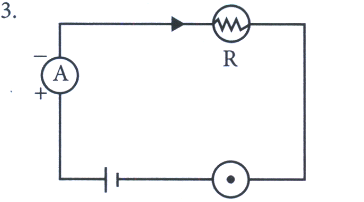
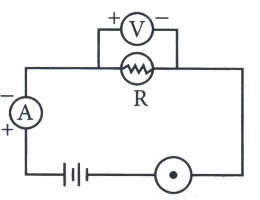
Differentiate between ammeter and voltmeter.
61.
(i) Draw a schematic diagram of a circuit consisting of a battery of five 2 V cells, a 5 Ohm resistor, a 10 Ohm resistor and a 15 Ohm resistor, and a plug key, all connected in series.
(ii) Calculate the electric current passing through the above circuit when the key is closed.
62.
You must have seen tarnished copper vessels being cleaned with lemon or tamarind juice. Explain why these sour substances are effective in cleansing the vessels.
63.
State modern periodic law of classification of elements.
64.
Why was the system of classification of elements into triads not found suitable?
65.
Lithium, sodium and potassium form a Dobereiner's triad. The atomic masses of lithium and potassium are 7 and 39 respectively. Predict the atomic mass of sodium.
66.
Name the gas which is the major constituent of bio gas?
67.
What is the minimum speed of wind required by a wind mill to maintain the necessary speed of turbine in electric generator?
68.
Name the reaction responsible for large energy production in the sun.
69.
Atoms of eight elements A, B, C, D, E, F, G and H have the same number of electronic shells but different number of electrons in their outermost shells. It was found that elements A and G combine to form an ionic compound which can also be extracted from sea water. Oxides of the elements A and B are basic in nature while those of E and F are acidic. The oxide of element D is almost neutral. Answer the following questions based on the information given herein:
(i) To which group period of the Periodic table do the listed elements belong?
(ii) Which one of the eight elements is likely to be a noble gas?
(iii) Which one of the eight elements would have the largest atomic radius?
(iv) Which two elements amongst these are likely to be non-metals?
(v) Which one of these eight elements is likely to be a semi-metal or metalloid?
70.
(i) Distinguish between renewable and non-renewable sources of energy giving one example of each.
(ii) Why is the use of wood as a fuel not advised although forests can be replenished?
1.
(a) Since two \(8\Omega \) resistors are in parallel, their effective resistance (\({ R }_{ P }\)) is given by,
\(\frac { 1 }{ { R }_{ P } } =\frac { 1 }{ 8 } +\frac { 1 }{ 8 } +\frac { 1 }{ 4 } \) or \({ R }_{ P }=4\Omega \)
(b) Total resistance in the circuit
\(R=4\Omega +{ R }_{ P }=4\Omega +4\Omega =84\Omega \)
Current through the electric circuit
\(I=\frac { V }{ R } =\frac { 8V }{ 8\Omega } =1A\)
(c) The potential difference \(4\Omega \) resistor V
I \(=IR=1\times 4=4V\)
(d) Power dissipated in \(4\Omega \) resistor P=\({ (I) }^{ 2 }\)
\(R={ (1) }^{ 2 }(4)=4W\)
(e) There is no difference in the readings of ammeters \({ A }_{ 1 }\) and \({ A }_{ 2 }\) as same current flows through all elements in a series circuit.
2.
Compound with molecular formula C2H4O2 should be Ethanoic acid reacts with Na metal to give sodium ethanoate.
\(\underset{\underset{Ethanoic\ acid}{(C)}}{2CH_3COOH}+2Na\rightarrow\underset{\underset{Sodium\ ethanoate}{(R)}}{2CH_3COONa}+H_2\)
\(\underset{\underset{Ethanoic\ acid}{(C)}}{CH_3COOH}+\underset{\underset{methanol}{(A)}}{CH_3OH}\xrightarrow{conc. H_2SO_4}\underset{\underset{Methyl\ acetate}{(S)}}{CH_3COOCH_3+H_2O}\)
\(CH_3COOH+\underset{Sodium\\ hydroxide}{NAOH}\rightarrow\underset{\underset{Sodium\ ethanoate}{(R)}}{CH_3COONa}+H_2O\)
\(\underset{\underset{Methyl\ acetate}{(s)}}{CH_3COOCH_3}+NaOH\rightarrow\underset{\underset{sodium\ ethanoate}{(R)}}{CH_3COONa}+\underset{\underset{Method}{(A)}}{CH_3OH}\)
3.
(a) When we magnetise a piece of magnetic material such as soft iron by keeping it inside a coil and then passing current through it, the magnet so formed is called electromagnet.
(b) (i) Steel is used to make permanent magnet.
(ii) Soft iron is used to make temporary magnets.
(c) Take a coil of wire having N number of turns and then wound it around a soft iron core. Connect the end of the wire with a battery and plug key and then let current pass through the coil. While current is passing through the coil, bring a compass near the coil. It will be observed that compass needle shows deflection. This shows that the coil will have a magnetic field of its own. The magnet so formed is called an electromagnet.
4.
Since the element B belongs to atomic number 17, it must be chlorine.
The element which burns golden flame in air is sodium. Therefore, the element A must be sodium.
When element sodium and chlorine reacts, it forms sodium chloride, the compound C. The compound C on electrolysis gives sodium hydroxide and hydrogen gas.
Thus, A = Na; B = CI2; C = NaCI; D = NaOH.
Chemical Reactions involved:
\(2Na+{ CI }_{ 2 }\rightarrow 2NaCI\)
\(2NaCI(aq)+{ 2H }_{ 2 }O(I)\rightarrow 2NaOH(aq)+{ CI }_{ 2 }(g)+{ H }_{ 2 }(g)\)
5.
The alimentary canal is nearly 9 m long. It includes -
1. Mouth and Buccal Cavity: It is the upper most opening of human digestive system which gives passage if for ingestion of food. Buccal cavity takes in the food cuts the food into small pieces and chews them to make it soft or easy swallowing. Buccal cavity also has three pairs of salivary glands. These glands secrete saliva
which contains water, salts, mucin and an enzyme ptyalin. Ptyalin is salivary amylase which splits starch and glycogen into maltose.
2. Pharynx: It acts as a passage for the food from buccal cavity to oesophagus.
3. Oesophagus: It is a long and tubular structure which pushes the food rhythmically forward.
4. Stomach: It is a large organ which expands when food enters it. It serves four functions:
(i) Storage of food - Carbohydrates gets digested till the salivary enzyme ptyalin is destroyed by HCI, secreted in the stomach.
(ii) Churning of food - The stomach wall produces muscular contraction, for the food to get churned and to mix it thoroughly with gastric juice.
(iii) Partial digestion - There are three types of gastric juice in stomach namely HCI, protein digesting enzyme (pepsin) and mucus.
(iv) Exit of food - The stomach releases food into the small intestine in a controlled and regulated manner.
Functions of the Gastric Juices
(i) HCI - Makes the tnedium acidic, kills the germs present in the food.
(ii) Pepsin - Acts in acidic medium, breaks proteins into peptone.
(iii) Mucus - Protects the inner lining of the stomach from the action of the acid under normal conditions.
(iv) Gastric juice - Also contains some gastric lipase which partially breaks down lipids.
(v) Regulation of flow of food - Stomach regulates the flow of partially digested food into the small intestine.
5. Small intestine: It is the longest part of digestive system. It is a narrow tube divided into three parts
(i) duodenum
(ii) jejunum and
(iii) ileum. It is the site of the complete digestion of proteins, carbohydrate and fats. Duodenum receives the secretion of bile from bile duct and pancreatic juice from pancreatic duct.
Bile juice
(i) It is secreted by liver and stored temporarily in the gall bladder.
(ii) It has bile pigments and bile salts.
(iii) It has no enzymes and thus has no chemical action on food, but breaks down the fat molecules into small globules.
(iv) This process is called emulsification of fats. Pancreatic juice
(i) It includes pancreatic amylase which breaks down starch, pancreatic lipase which breakdown lipids and trypsin for digesting proteins.
(ii) The secretions of pancreatic duct make the medium alkaline, which is favourable for the action of pancreatic enzymes.
Pancreas secretes hormones insulin and glucagons. The walls of small intestine contains glands which secrete intestinal juice called succus entericus which helps in digesting protein A into amino acids, carbohydrates into glucose, fats into fatty acids and glycerol. The digested food is taken up by the walls of the intestine which has numerous fingers like projection called villi. Villi are richly supplied with blood vessels which the absorbed food to obtain energy. The presence of villi and
blood capillaries increases the capacity of absorption by the wall of intestine
6. Large intestine: It includes three parts namely caecum, colon and rectum. It is shorter but wider than small intestine. It secretes mucus for lubrication. The undigested food is collected as faeces egested out through anus which is regulated by anal sphincter.
6.
Various plant hormones and their effects are as follows:
(i) Auxin : Promotes cell elongation and thus promotes growth of a plant part.
(ii) Gibberellins : Promotes growth.
(iii) Cytokinin : Promotes cell division and thus promotes growth.
(iv) Abscissic acid : Inhibits growth and is responsible for shedding or older parts.
7.
(a) Concentrated sulphuric acid is called the king of chemicals as it is a very strong acid and is highly corrosive.
(b) The three chemical reactions that take place during the conversion of sulfur dioxide to sulphuric acid in the 'Contact Process' are given below.
Step I: Sulphur dioxide is mixed with air and passed over vanadiumpent (V) oxide catalyst heated to \(450^oC\) to form sulphur trioxide.
\(\underset{Sulphur\ dioxide}{2SO_{2(g)}}+\underset{Oxygen}{O_{2(g)}}\underset{\rightleftharpoons }{V_2O_5}\underset{Sulphur\ trioxide}{2SO_{3(g)}}+Heat\)
Step II : Sulphur trioxide is dissolved in concentrated sulphuric acid to form a thick fuming liquid called oleum.
\(\underset{Sulphuric\ acid}{H_2SO_4(l)}+\underset{Sulphur\ trioxide}{SO_{3(g)}}\begin{matrix} V_2O_5 \\ \rightleftharpoons \\ \end{matrix}\underset{Oleum}{H_2S_2O_{7(l)}}\)
Step III: Oleum is diluted with a calculated quantity of water to obtain sulphuric acid.
\(H_2S_2O_{7(l)}+\underset{Water}{H_2O_{(l)}}\rightarrow\underset{Sulphuric\ acid}{2H_2SO_{4(aq)}}\)
(c) If water is added to sulphuric acid then a large amount of heat is evolved. This changes water to steam, which can splash the acid. Hence, it is dangerous.
8.
(a) Zinc sulphate and copper is formed when zinc reacts with copper sulphate,
\(\underset{Zinc}{Zn( s)} + \underset{Copper\ sulphate}{CuSO_4} (aq) \rightarrow \underset{Zinc\ sulphate}{ZnSO_4(aq)} + \underset{Copper}{Cu}\)
(b) Hydrochloric acid forms aluminium chloride and hydrogen gas when reacts with aluminium metal.
\(2AI + 6HCI\rightarrow 2AlCl_3 + 3H_2\)
(c) When silver metal is added to copper sulphate solution, no reaction takes place because silver is less reactive than copper
9.
Hydrogen gas is usually liberated when an acid reacts with metal.
e.g. Zn(s) + H2SO4 (aq) \(\rightarrow\) ZnSO4(aq) + H2 \(\uparrow\)
Test for H2 gas Testing of H2 gas presence can be done by passing the gas through soap solution and then bringing a burning splinter near the soap bubble filled with the gas. If the gas burns with a pop sound, it confirms hydrogen.
10.
(c)
11.
(a)
12.
(d)
F,O,N
13.
(d)
In India, the AC changes direction after every 1/50 second.
14.
(c)
Amylase
15.
(c)
Nuclear energy
16.
(d)
Iodine
17.
(c)
Abscissic acid
18.
(a)
basic
19.
(a)
(i) and (ii)
20.
X. Sodium bicarbonate (NaHCO3)
21.
Difference in :
(i) Molecular mass = 14 a.m.u.
(ii) Number of atoms of elements = CH2
22.
C4H10 and C5H12
23.
Manganese or Magnesium.
24.
Hydrogen gas is formed. Bring a burning matchstick near to it, H2 will burn explosively with 'pop' sound.
25.
In a physical change, no new substance is formed. In a chemical change, new substance is formed.
26.
Reaction of an acid with a metal:
When an acid reacts with a metal, it forms a salt.
Hydrogen which is in all the acids gets displaced and liberated as hydrogen gas.
Acids + Metals \(\rightarrow\) Salt + Hydrogen gas
27.
(a) It is because it has 7 valence electrons. It can gain one electron to form negative ion.So, it is a non-metal.
(b) 'C' has more number of shells than A. So, it is larger in size.
(c) 'B' has one valence electron. It can lose one electron to become stable. So, its valency is equal to 1.
28.
(i) Next homologue of C2H4 is C3H6
(i) Next homologue of C4H6 is C5H8.
29.
Michael Faraday in 1831 discovered that mechanical motion can produce current.
30.
The magnetic field lines around a straight conductor carrying current are concentric circles.
31.
Xylem is the tissue which transports water and minerals in plants.
32.
As soon as a piece of sodium metal is dropped into water, bubbles will come out showing the evolution of a gas is hydrogen. The reaction that takes place between sodium metal and cold water is given below :
2Na + 2H2O → 2NaOH + H2
Sodium Water(cold) Sodium hydroxide Hydrogen
33.
(a) A fuse helps in protecting that appliance from potential damage which may happen due to overload. A fuse wire works because of its lower melting point which is possible because of its respective rating.
(b) If a fuse with larger rating is used with an appliance, the fuse wire shall not melt and hence would fail to serve the required purpose. Due to this, a fuse with defined rating should not be replaced by one with a larger rating.
34.
The uriniferous tubule, or nephron, is the kidney's excretory unit.
Excretion is the process in which an organism's hazardous waste is removed from its body.
The nephron is the fundamental unit of homeostasis, as it is controls the amount of water, ions and other substances in the blood.
Nephron's key tasks include blood filtration, reabsorption, secretion, and urine production.
35.
Translocation
36.
The blood circulation in human heart is called double circulation because the blood passes through the heart twice in one complete cycle of the body-once through the right half in the form of deoxygenated blood and once through the left half in the form of oxygenated blood.
37.
Acid rains are most likely expected in industrial areas where there is emission of oxides of nitrogen and sulphur.
38.
| Sensory nerves | Motor nerves |
| It takes the information from receptors and transmit it to brain. |
It transmits the information for action to be taken from brain to the effector organs i.e. muscles. |
39.
The part of the hindbrain that takes part in the regulation of respiration is medulla oblongata.
40.
Pancreas. It secretes hormones and digestive enzymes.
41.
Neurons are the functional units of the nervous system. They carry the information from the brain and the spinal cord to the different parts of the body and form the different parts of the body to the brain or the spinal cord.
42.
(i) Electric power is related to voltage and electric current as:
Power= Voltage x Current
It is given that the rating of the electric iron is 750W, 220V.
Let the current passing through the bulb be I.
Therefore,
750=220 x I
I=\(\frac{750}{220}\)=3.41A
Therefore, 3.41A current passes through the electric iron.
It is given that the rating of the electric bulb is 750W,220 V
Therefore, P=\(\frac { { V }^{ 2 } }{ P } \)=\(\frac { { 220 }^{ 2 } }{ 750 } \)=64.53\(\Omega \) when in use.
(ii) Electric power is related to voltage and resistance as:
\(\frac { { \left( Voltage \right) }^{ 2 } }{ Resistance } \)
That is,
P=\(\frac { { V }^{ 2 } }{ R } \)
=64.53\(\Omega \)
43.
Coulomb
44.
The resistance of 25 W lamp bulb has a higher value as compound to that of 50 W lamp bulb. Resistance of the 25 W lamp bulb. Resistance of the 25 W lamp bulb will be double of that of the 50 W lamp bulb.
45.
The S.I. unit od electric potential is volt. It is denoted by V.(Volt)
46.
Rust is the hydrated iron (III) oxide, Fe2O3.xH2O.
47.
(i) Na2CO3(s) + 2HCl(aq) \(\longrightarrow \) 2NaCI(aq) + H2O(I) + CO2(g)
(ii) CaO(s) + H2O(I) \(\longrightarrow \)Ca(OH)2(aq) + Heat
(iii) Pb(NO3)2(aq) + NaCl(aq) \(\longrightarrow \) PbCI2(s) + 2NaNO3(aq)
48.
The colour changes from yellow to reddish brown. l Soap is basic in nature and the colour of turmeric changes from yellow to reddish brown in basic medium. The stain turns yellow again.
49.
Reaction in which a single reactant breaks down to give simpler products.
Thermal decomposition-
\(CaCO_{ 2 }\overset { \triangle }{ \longrightarrow } CaO+C{ O }_{ 2 }\)
(Or any other)
Electrolytic decomposition-
2H2O\(\overset { Electric\quad current }{ \rightarrow } \) 2H2+O2
(or)
In a decomposition reaction, a single reactant breaks down into two or more simpler products.
When a decomposition reaction is carried out by heating, it is called thermal decomposition reaction.
\(\underset { (Calucium\quad carbonate) }{ CaCO_{ 3 }(s) } \overset { Heat }{ \rightarrow } \underset { Calcium\quad oxide) }{ CaO(s) } +\underset { (Carbon\quad dioxide) }{ { CO }_{ 2 }(g) } \)
When a decomposition reaction is carried out with the help of electric current, the process is called electrolysis.
\(\underset { Water }{ 2{ H }_{ 2 }O(I) } \overset { Electric\quad current }{ \longrightarrow } \underset { (Hydrogen\quad gas) }{ 2{ H }_{ 2 }(g) } +\underset { (Oxygen\quad gas) }{ { O }_{ 2 }(g) } \)
50.
(a) Sodium (Na) > Aluminium (A1)> Copper (Cu) > Gold (Au).
(b) 3MnO2(s) + 4A1(s) \(\overset { \Delta }{ \longrightarrow } \) 3Mn(l) + 2A12O3(s)+ Heat.
51.
(i) Increase in the strength of alkali. So the nature of solution will be basic.
(ii) Hydroxide ion or hydroxyl ion or OH- ion.
(iii) A paper impregnated with the universal indicator is generally used to measure the pH of a solution.
52.
The major differences between an electric motor and generator are stated below:
Electric Motor:
1. It converts electrical energy into mechanical energy.
2. It needs electrical energy for its works.
3. They are used as water pumps, marble grinders etc.
Generator:
1. It converts mechanical energy into electrical energy
2. It needs mechanical energy for its working.
3. They are used as water pumps, marble grinders etc.
4. diesel generator, hydro-electric generator are the examples of it.
53.
The different constituents of blood are plasma (the fluid part of the bloo(d) and blood corpuscles consisting of RBCs, WBCs, and platelets)
WBCs are known as the soldiers of the body because they fight against the pathogenes that invade our body, thus preventing the occurence of diseases.
54.
The transport of soluble products of photosynthesis is known as translocation. Translocation in plants occurs by means of the vascular tissue known as phloem. Translocation is necessary because without it, the food prepared by the leaves cannot reach other parts of the plant.
(i)In plants, the synthesis of sugars takes place in the leaves by the process of photosynthesis.
(ii)Hormones are synthesised away from their targrt site.
55.
(a) Metal oxides-that react with both acids and bases to produce salt and water are known as amphoteric oxides. For example, zinc reacts with an acid or a base to produce salt and water.
\(ZnO+\underset { (Acid) }{ 2KCI } \rightarrow \underset { (Salt) }{ { ZnCI }_{ 2 } } +\underset { (Water) }{ { H }_{ 2 }O } \\ ZnO+\underset { (Base) }{ 2NaOH } \rightarrow \underset { (Salt) }{ { Na }_{ 2 }{ ZnO }_{ 2 } } +\underset { (Water) }{ { H }_{ 2 }O } \)
Amongst the given oxides, zinc oxide (ZnO) and aluminium oxide (AI2O3) are amphoteric oxides.
(b) Non - metals are electron acceptors. Hence, they cannot donate electrons to H+ ions to form hydrogen gas (H2).
56.
(a) The solar cells are costly and hence the energy available from them expensive.
(b) 15 km/h is the minimum wind velocity required to obtain useful energy with a windmill.
(c) Nuclear fission is the process in which a radioactive atom splits up into smaller nuclei when struck with low energy neutrons.
57.
(a) A solar cell is a device which converts solar energy into electricity. It is a sandwich of a silicon-boron layer and a silicon-arsenic layer.
(b) Biogas is an ideal fuel for domestic use because it is a cheap and clean fuel, which does not leave behind any residue.
(c) A nuclear power plant is a device in which controlled chain reaction is used.
58.
59.
(i) Regions included in central nervous system are the brain and the spinal cord. The brain and the spinal cord. The brain is further divided into three parts - forebrain, midbrain, and hindbrain.
(ii) Three of the functions of the brain are:
Forebrain controls intelligence, learning, memory, thinking, speech, etc.
Midbrain is associated with the sense of sight and hearing.
Hindbrain controls all involuntary actions such as breathing, peristalsis, etc.
60.
| Ammeter | Voltmeter |
| 1. Ammeter is an instrument used to measure current in a circuit. | Voltmeter is used to measure potential difference between two points. |
| 2. It is connected in series in a circuit. | It is connected in parallel in a circuit. |
 |
 |
61.
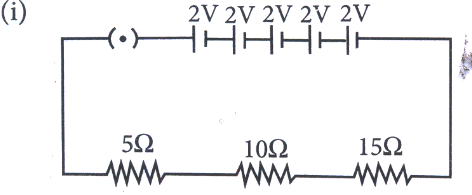
(ii) When the key is closed, total voltage applied across the circuit will be = 2 ✕ 5V = 10 V
Total resistance (R) applied across the circuit in Ohms = 5+10+15= \(30\Omega \)
By Ohm's Law,
Current (I) = \(\frac { V }{ R } \)
\(I=\frac { 10 }{ 30 } =0.33A\)
62.
A layer of basic copper carbonate is formed by the reaction of air on copper metal.
This layer being insoluble in water, cannot be cleaned with water alone. But, it is soluble in acids so lemon containing citric acid, tamarind containing tartaric acid or any other sour substance containing acid can be effective in cleaning the vessels. As these acids neutralises the basic copper carbonate and dissolves the layer. Hence, surface of copper vessels are cleaned with lemon or tamarind juice to give its characteristics lustre.
63.
()
Modern periodic law states "that the properties of elements are a period function of the atomic numbers"
64.
()
It is because all the elements discovered at that time could not be classified into triads.
65.
()
Atomic mass of Na = 7+39 / 2 = 46 / 2 = 23
66.
()
Methane(75%)
67.
()
The minimum speed of wind should be 15 km/h.
68.
()
Nuclear fusion.
69.
(i) A and B belong to group 1 and 2 because they form basic oxides. C belongs to group 13 as it has 3 valence electrons. D belongs to group 14 as it forms almost neutral oxide. E and F belong to group 15 and 16 as they form acidic oxides. G belongs to group 17 as it has 7 valence electrons and H belongs to group 18. They belong to 3rd period of Periodic Table because sodium belongs to 3rd period and AG is NaCl, ionic compound of sodium which can be obtained from sea water and A(Na) and G( Cl) belong to 3rd period.
(ii) H belong to noble gas.
(iii) A has the largest atomic radius.
(iv) E and F are likely to be non-metals.
(v) D is likely to be metalloid or semi-metal.
70.
| Renewable sources of energy | Non-renewable sources of energy | |
| Non-renewable sources of energy of energy that are replenished at a rate faster than the rate at which they are consumed. | Non-renewable sources of energy are the ources of energy that are consumed at a rate faster than the rate at which they are replenished. | |
| Renewable sources of energy are known as inexhaustible sources of energy as they can be easily regenerated at a constant rate. | Non-renewable sources of energy are known as exhaustible sources of energy as they get easily exhausted and the resources of this type are limited in nature. | |
| Examples of renewable sources of energy include sunlight, wind, tides, and geothermal energy. | Examples of non-renewable resources of energy are fossil fuels, which include coal,etroleum, and natural gas. |
ii) Although wood is readily found in nature, it is still not a good source of energy because
- the energy obtained from per mass of Wood is very small.
- it produces a lot of smoke, which is very harmful for the environment and contributes to air pollution.
- using wood as a source of energy further increases the rate of deforestation.

10th Standard CBSE Syllabus & Materials
10th Standard CBSE
CBSE 10th Social Science PS - Federalism - New Model Questions Papers Study Material - QB365 Set A
NEW10th Standard CBSE
CBSE 10th Social Science PS - Power Sharing - New Model Questions Papers Study Material - QB365 Set A
NEW10th Standard CBSE
CBSE 10th Social Science GEO - Manufacturing Industries - New Model Questions Papers Study Material - QB365 Set A
NEW10th Standard CBSE
CBSE 10th Social Science GEO - Minerals and Energy Resources - New Model Questions Papers Study Material - QB365 Set A



CBSE 10th Standard CBSE Subjects
CBSE Standards





