
 100% FREE ACCESS
10th Standard CBSE Syllabus & Materials
10th Standard CBSE
CBSE 10th Social Science ECO - Globalisation and the Indian Economy - New Model Questions Papers Study Material - QB365 Set A
NEW10th Standard CBSE
CBSE 10th Social Science ECO - Money and Credit - New Model Questions Papers Study Material - QB365 Set A
NEW10th Standard CBSE
CBSE 10th Social Science ECO - Sectors of the Indian Economy - New Model Questions Papers Study Material - QB365 Set A
NEW10th Standard CBSE
CBSE 10th Social Science ECO - Development - New Model Questions Papers Study Material - QB365 Set A
NEW10th Standard CBSE
CBSE 10th Social Science PS - Outcomes of Democracy - New Model Questions Papers Study Material - QB365 Set A
NEW10th Standard CBSE
CBSE 10th Social Science PS - Gender, Religion and Caste - New Model Questions Papers Study Material - QB365 Set A

Published on: 14/02/2020
10th Standard CBSE Science Board Model Exam Question paper I 2020
Download CBSE Class 10th Standard CBSE Science question papers, sample papers, important questions, and previous year solved papers in PDF format. Get free study materials, NCERT solutions, and exam preparation resources for Class 10th Standard CBSE Science
Questions + Answers key
Take MCQ Science Test
1.
Silver articles develop black coating and copper articles develop green coating. Which chemical phenomenon is responsible for this coating?
2.
Name a functional group present in
(i) CH3CHO
(ii) C2H5COOH
3.
Write the two succeeding members of the following homologous series:
C2H6'C3H8
4.
Give an example of a metal which is the best conductor of heat.
5.
Name one metal and non-metal which exists in liquid state at room temperature?
6.
What is the effect of an increase in the concentration of H+ ions? 1M HCl or 1M CH3COOH.
7.
Should the heating element of an electric iron be made of iron, silver or nichrome wire?
8.
Draw the structure of ethanol molecule.
9.
On what basis a generator works?
10.
What change will you observe if you test soap with litmus paper (red and blue)?
11.
What is the impact of leakage or loss of blood upon the pressure?
12.
What is electric generator?
13.
What constitutes the field of a magnet?
14.
Name a reducing agent that may be used to obtain manganese from manganese dioxide.
15.
What are the two functions of the kidneys?
16.
What is meant by 'translocation' with respect to transport in plants?
17.
Why is parallel arrangement used in domestic wiring?
18.
Write the components of peripheral nervous system.
19.
Name the hormone secreted by thyroid gland.
20.
Name the part of hind brain which takes part in regulation of respiration.
21.
What is the advantage of the third wire of earth connection in domestic electric appliances?
22.
How is ammeter and voltmeter connected in a circuit?
23.
What is rust?
24.
Name the gas evolved when zinc reacts with dil.HCl.
25.
Which gas is produced when dilute hydrochloric acid is added to a reactive metal? Write the chemical reaction when iron reacts with dilute H2SO4.
26.
Balance the following chemical equations and identify the type of chemical reaction.
(a) Mg(s) + Cl2(g) \(\rightarrow\) MgCl2(s)
(b) HgO(s) \(\overset {Heat}{\rightarrow}\) Hg(l) + O2(g)
(c) Na(s) + S(s) \(\rightarrow\) Na2S(s)
(d) TiCl4(l) + Mg(s) \(\rightarrow\) Ti(s) + MgCl2
(e) CaO(s) + SiO2(s) \(\rightarrow\) CaSiO3(s)
(f) H2O2(l) \(\overset{uv}{\rightarrow}\) H2O(l) + O2(g)
27.
Under what soil condition do you think a farmer would treat the soil of his fields with quicklime (calcium oxide) or slaked lime (calcium hydroxide ) or chalk (calcium carbonate) ?
28.
Which of the following is the correct representation of electron dot structure of nitrogen?
-q.jpg)
-q.jpg)
-q.jpg)
-q.jpg)
29.
A constant current flows in a horizontal wire in the plane of the paper from east to west as shown in the figure. The direction of the magnetic field will be north to south at a point
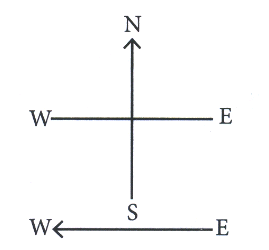
Directly above the wire
directly below the wire
At a point located in the plane of the paper, on the north side of the wire
At a point located in the plane of the paper, on the south side of the wire.
30.
Which of the given elements A, B, C, D and E with atomic number 2,3, 7, 10 and 30 respectively belong to the same period?
A,B,C
B,C,D
A,D,E
B,D,E
31.
Which of the following is not an example of a bio-mass energy source?
Wood
Gobar-gas
Nuclear energy
Coal
32.
The correct sequence of anaerobic reactions in yeast is
Glucose \(\overset { Cytoptasm }{ \longrightarrow } \) Pyruvate \(\overset { mitochondria }{ \longrightarrow } \) Ethanol+Carbon dioxide
Glucose \(\overset { Cytoptasm }{ \longrightarrow } \)Pyruvate \(\overset { Cytoplasm }{ \longrightarrow } \)
Glucose \(\overset { Cytoptasm }{ \longrightarrow } \)Pyruvate \(\overset { mitochondria }{ \longrightarrow } \) Lactic acid
Glucose \(\overset { Cytoptasm }{ \longrightarrow } \) Pyruvate \(\overset { Cytoplasm }{ \longrightarrow } \) Ethanol+ Carbon dioxide
33.
Which one of the following properties is not generally exhibited by ionic compounds?
Solubility in water
Electrical conductivity in solid state
High melting and boiling points
Electrical conductivity in molten state
34.
Involuntary actions in the body are controlled by
Medulla in forebrain
Medulla in midbrain
Medulla in hindbrain
Medulla in spinal cord
35.
Which of the following is not a mineral acid?
Hydrochloric acid
Citric acid
Sulphuric acid
Nitric acid
36.
Solid calcium oxide reacts vigorously with water to form calcium hydroxide accompanied by liberation of heat. This process is called slaking of lime. Calcium hydroxide dissolves in water to form its solution called lime water. Which among the following is (are) true about slaking of lime and the solution formed?
(i) It is an endothermic reaction
(ii) It is an exothermic reaction
(iii) The pH of the resulting solution will be more than seven
((iv) The pH of the resulting solution will be less than seven
(i) and (ii)
(ii) and (iii)
(i) and (iv)
(iii) and (iv)
37.
Account for the following:
(i) State the relation between hydrogen ion concentration of an aqueous solution and its pH.
(ii) An aqueous solution has a pH value of 7.0. Is this solution acidic, basic or neutral?
(iii) Which has a higher pH value, 1MHCl or 1MNaOH solution?
(iv) Tooth enamel is one of the hardest substances in our body. How does it undergo damage due to eating chocolates and sweets? What should we do to prevent it?
(v)How do [H+] ions exist in water?
38.
a) Write the formula and draw electron dot structure of carbon tetrachloride?
b) What is saponification? Write the reaction involved in this process.
39.
(a) What is an electromagnet? What does it consist of?
(b) Name one material in each case which is used to make a
(i) Permanent magnet
(ii) Temporary magnet
(c) Describe an activity to show how you can make an electromagnet in your school laboratory.
40.
Two ores A and B were taken. On heating ore A gives CO2 whereas, ore B gives SO2 .What steps will you take to convert them into metals?
41.
How do carbohydrates, proteins and fats get digested in human beings?
42.
How will you infer with the help of an experiment that the same current flows through every part of the circuit containing three resistances in series connected to a battery?
43.
On heating blue coloured powder of copper (II) nitrate in a boiling tube, copper oxide (black), oxygen gas and a brown gas X is formed.
(a) Write a balanced chemical equation of the reaction.
(b) Identify the brown gas X evolved.
(c) Identify the type of reaction.
(d) What could be the pH range of aqueous solution of the gas X?
44.
(a) Write chemical equations.
(i) When carbon dioxide gas is passed through lime water.
(ii)When excess of carbon dioxide gas is passed through lime water.
(b) List two natural forms of calcium carbonate.
45.
When a copper wire was left in silver nitrate solution for sometime, it was observed that the solution turned bluish green.
(i) Explain the observation.
(ii) Write the balanced chemical equation to represent the change taking place.
46.
(a) Arrange the following metals in the order of their decreasing activities: Aluminium, Gold, Sodium, Copper
(b) Give chemical equation for the reaction of aluminium powder with manganese dioxide on heating.
47.
State reason for the following:
(i) Non-metals cannot displace hydrogen from the acids.
(ii) Hydrogen is not a metal, yet it is placed in the activity series of metals.
(iii) Aluminium is more reactive than iron, yet its corrosion is less than that of iron
48.
Name the acid present in the following:
(i) Tomato, (ii) Vinegar, (iii) Tamarind
49.
Distinguish between an electric motor and generator?
50.
Name the constituents of blood.Why white blood corpuscles are called 'soldiers of the body'?
51.
What is 'translocation'? Why is it essential for plants?Where in plants are the following synthesized:
(i)Sugar (ii)Hormones
52.
(a) Why is the Solar Cooker box covered with a plane glass plate?
(b) Why is energy of water flowering in a river considered to be an indirect form of solar energy?
(c) How is the fission of nucleus brought about?
53.
(a) What is a 'solar cell'?
(b) Why is biogas considered an ideal fuel for domestic use?
(c) Name a device in which controlled chain reaction is used.
54.
Write down three main differences between auxin and cytokinin.
55.
(a) State Ohm's Law.
(b) Draw a schematic diagram of the circuit for studying Ohm's Law.
56.
(a) What is meant by 'Electric Resistance' of a conductor?
(b) A wire of length 'L' and resistance 'R' is stretched so that its length is doubled and the area of cross-section is halved. How will its:
(i) resistance change
(ii) resistivity change
57.
Explain the trends in the modern Periodic Table of various properties like valency, atomic size, metallic and non-metalic properties of the atoms of elements.
58.
Energy from various sources is considered to have been derived from the sun. do you agree? Justify your answer.
59.
How many vertical columns are there in the modern periodic table and what are they called?
60.
Why was the system of classification of elements into triads not found suitable?
61.
Chlorine, bromine and iodine form a Dobereiner's triad. The atomic masses of chlorine and iodine are 35.5 and 126.9 respectively. Predict the atomic mass of bromine.
62.
What is the minimum speed of wind required by a wind mill to maintain the necessary speed of turbine in electric generator?
63.
What is energy?
64.
Which one of the following is a renewable resource?
Natural gas, Petrroleum, Ground water, Coal
1.
Silver coin with atmospheric sulphur and green coating is of copper carbonate which is formed due to the reaction of copper with moist carbon dioxide from the air.
2.
i) Aldehyde, (ii) Carboxylic acid.
3.
C4H10 and C5H12
4.
Silver or Copper.
5.
Metal- mercury, Non-metal- bromine.
6.
1 M HCl has a higher concentration of H+ ions because when HCl dissolves in water it dissociates completely into ions while CH3COOH is a weak acid and does not dissociate into ions completely.
7.
Nichrome should be used as a heating element in an electric iron because its melting point is higher than iron and silver.
8.

9.
A generator works on the basis of electromagnetic induction.
10.
Soap is alkaline in nature. Hence, it turns red litmus paper blue and have no effect on the blue litmus paper.
11.
Blood flow will increase upon the pressure of blood in the blood vessels. The oxygenated blood flowing through the artery doesnot have any impact as the arteries are thick walled, highly elastic blood vessels having narrow lumen and no valves.
12.
It is a device that converts mechanical energy into electrical energy.
13.
Magnetic field of a magnet contains magnetic field lines in it.
14.
Aluminium.
15.
Excretion and osmoregulation.
16.
The transport of food from the leaves to the different parts of the plant is called translocation.
17.
(a) All the appliances work at the same voltage as that of the electric supply.
(b) If one of the other appliances is out of order, all the other appliances keep on working as the circuit is not broken.
18.
Spinal nerves and cranial nerves.
19.
Thyroxine is the hormone secreted by the thyroid gland. This hormone regulates the metabolism of carbohydrates, fats and proteins. By regulating the metabolism it helps in optimum growth and development of the body.
20.
The part of the hindbrain that takes part in the regulation of respiration is medulla oblongata.
21.
Earth wire is used to provide a low resistance conducting path to any charge that gets leaked into the body of the appliance.
22.
Ammeter is connected in series and voltmeter is connected in parallel.
23.
Rust is the hydrated iron (III) oxide, Fe2O3.xH2O.
24.
Hydrogen gas is evolved.
25.
Hydrogen gas is produced when dilute hydrochloric acid is added to a reactive metal.
Fe(s) + H2SO4 (aq) \(\rightarrow\) FeSO4 (aq) + H2(g)
Iron Dil. Sulphuric acid Ferrous sulphate Hydrogen
26.
(a) Mg(s) + Cl2(g) \(\rightarrow\) MgCl2
It is a combination reaction
(b) 2HgO(s) \(\overset {Heat}{\rightarrow}\) 2Hg(l) + O2(g)
It is a thermal decomposition reaction.
(c) 2Na(s) + S(s) \(\rightarrow\) Na2S(s)
It is a combination reaction
(d) TiCl4(l) + 2Mg(s) \(\rightarrow\) Ti(s) + 2MgCl2
It is a displacement reaction
(e) CaO(s) + SiO2(s) \(\rightarrow\) CaSiO3(s)
It is a combination reaction
(f) 2H2O2(l) \(\overset{uv}{\rightarrow}\) 2H2O(l) + O2(g)
It is a decomposition reaction
27.
These fertilisers (CaO, Ca(OH)2, CaCO3] are of basic nature. Therefore, their use will be beneficial, if the soil is acidic. The purpose is to neutralise or decrease the acidity of the soil.
28.
(d)
29.
(b)
directly below the wire
30.
(b)
B,C,D
31.
(c)
Nuclear energy
32.
(d)
Glucose \(\overset { Cytoptasm }{ \longrightarrow } \) Pyruvate \(\overset { Cytoplasm }{ \longrightarrow } \) Ethanol+ Carbon dioxide
33.
(b)
Electrical conductivity in solid state
34.
(c)
Medulla in hindbrain
35.
(b)
Citric acid
36.
(b)
(ii) and (iii)
37.
(i) If H+ ion concentration is more, pH will be less and vice versa or pH of a solution is inversely proportional to H+ ion concentration or pH 52 log (H+).
(ii) This solution is neutral.
(iii) 1MNaOH solution.
(iv) When the pH in the mouth is below 5.5, bacteria present in the mouth produce acids by degradation of sugar and corrode the tooth enamel. It can be prevented by using tooth pastes which are generally basic.
(v) As hydronium [H3O]+ ion.
38.
\(\underset{Carbon}{C}+\underset{Chlorine}{2Cl_2}\xrightarrow{Heat}\underset{Carbon\ tetrachloridse}{CCl_4}\)
Its electron dot structure and structural formulae are:
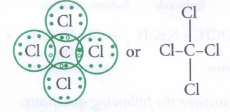
b) Saponification - Alkaline hydrolysis of an ester to give the salt of the corresponding
acid and the alcohol is called saponification. It is reverse of esterification reaction.
For example.
\(\underset{Ester}{CH_3COOC_2H_5}+\underset{sodium\ hydroxide}{NaOH}\xrightarrow{Heat}\underset{Sodium\ acetate}{CH_3COONa}+\underset{Ethanol}{CH_3CH_2OH}\)
Dehydration means removal of a molecule of water. When ethanol is heated with
conc. H2SO4 at 443 K, it undergoes dehydration to form ethene.
\(\underset{Ethanol}{CH_3CH_2OH}\xrightarrow{Conc. H_2SO_4,443K}\underset{Ethene}{CH_2=CH_2+H_2O}\)
39.
(a) When we magnetise a piece of magnetic material such as soft iron by keeping it inside a coil and then passing current through it, the magnet so formed is called electromagnet.
(b) (i) Steel is used to make permanent magnet.
(ii) Soft iron is used to make temporary magnets.
(c) Take a coil of wire having N number of turns and then wound it around a soft iron core. Connect the end of the wire with a battery and plug key and then let current pass through the coil. While current is passing through the coil, bring a compass near the coil. It will be observed that compass needle shows deflection. This shows that the coil will have a magnetic field of its own. The magnet so formed is called an electromagnet.
40.
Ore A gives CO2 and ore B gives SO2 . Therefore, ores are MCO3 and MS.
A can be converted into metal by the following steps :
\({ MCO }_{ 3 }\underrightarrow { Calcination } MO+{ CO }_{ 2 }\\ MO+C\underrightarrow { Reduction } M+CO\)
B can be converted into metal by the following steps :
\(2MS+{ 3O }_{ 2 }\underrightarrow { Roasting } 2MO+{ 2SO }_{ 2 }\\ \quad \quad \quad MO+C\rightarrow M+CO\)
41.
The salivary glands secrete saliva. The saliva contains water, salts, mucus and an enzyme ptyalin. The enzyme ptyalin, also glycogen and convert them into maltose. The mucus and water makes the food soft and slippery for the formation of bolus and also protects soft lining of alimentary canal. Thus the digestion of starch i.e., carbohydrate begins in the mouth. Since,the food remains in the mouth only for a short time and so, the digestion of food remains incomplete.
\(Starch(Carbohydrates)+Glycogen\overset { Ptyalin }{ \longrightarrow } Maltose\)
The partially digested food is further digested in the stomach. The food is broken down into smaller pieces and churned to form a semi-solid paste. The wall of the stomach contains three tubular glands. These glands secrete gastric juice. The gastric juice contains hydrochloric acid, mucus, pepsin, gastric lipase and rennin.
Hydrochloric acid:
It softens the food
It makes food acidic for the function of pepsin
It stops the action of salivary amylase
It kills germs and bacteria to disinfect the food
It converts inactive pepsinogen and prorennin into active pepsin and rennin.
\(InactivePepsinogen\overset { HCI }{ \longrightarrow } ActivePepsin\\ InactivePro-rennin\overset { HCI }{ \longrightarrow } Activerenin\)
Pepsin: It hydrolyses proteins into soluble proteoses and peptones only in presence of hydrochloric acid.
\(Protein\overset { Pepsin }{ \longrightarrow } Peptones+Proteoses\)
Rennin: It is active only in infants. The main function of rennin is that it converts soluble milk protein casein into insoluble protein called paracasein. Due to this, milk stays in stomach for longer duration.
\(\underset { (solublemilkprotein) }{ Casein } \overset { Rennin }{ \longrightarrow } \underset { (Insoluble) }{ Paracasein } \)
Mucus: The main function of mucus is to protect the inner lining of stomach from corroding action of hydrochloric acid as well as from pepsin enzyme.
Small Intestine: It is the seat of major digestion and absorption. Small intestine receives the secretion of two glands namely,
(i) Liver, (ii) Pancreas
Liver: It is the largest gland of the body. It is reddish brown in colour. It has soft pear - shaped sac called gall bladder. The gall bladder secretes bile juice. Bile is alkaline containing bile pigment. Thus, bile is stored in the gall bladder. It helps to emulsify or break the fats or lipids present in the food.
The bile performs the following functions:
(i) It breaks the larger globules of fat into small globules to make the enzyme to act and digest them.
(ii) It prevents putrefaction of food.
(iii) The bile creates a medium for the pancreatic juice to act on food by neutralizing the acidity in the food.
Pancreas: Pancreas secretes a digestive fluid called pancreatic juice. This juice contains digestive enzymes such as trypsin, nucleases, pancreatic lipase and pancreatic amylase. The enzyme trypsin digests the proteins, the enzyme pancreatic amylase breaks down the starch and the enzyme lipase breaks down the emulsified
facts. Pancreas produces two important hormones namely,
(i) Insulin, (ii) Glucagon
Insulin is essential for using glucose and storing it into glycogen. Glucagon is essential for conversion of glycogen into glucose. The alkaline medium is favourable
for the action of pancreatic enzymes.
\(Starch\xrightarrow [ ]{ Pancreaticamylase } Maltose\\ Fat\xrightarrow [ ]{ Lipase } Fattyacids+Glycerol\\ Proteins\xrightarrow [ ]{ Trypsin } Peptides\)
Secretion of intestinal juice by liver and pancreatic glands
The intestinal juice contains a number of enzymes which complete the digestion process. Here, the complex carbohydrates are converted into glucose, proteins are converted into amino acids and fats are converted into fatty acids and glycerol. All these end products i.e., amino acids, glucose, fatty acids and glycerol are small
and water soluble molecules. This complete digestion of food takes place by biological catalysts called enzymes. The intestinal juice includes - maltase, invertase, lactase etc.
\(Peptides\xrightarrow [ ]{ Trypsin } Aminoacids\\ Sucrose\xrightarrow [ ]{ Invertase } Glucose+Fructose\\ Maltose\xrightarrow [ ]{ Maltose } Glucose+Glucose\\ Lactose\xrightarrow [ ]{ lactose } Glucose+Galactose\)
42.
A number of resistors are said to be connected in series, if these are joined end to end and the same, current flows through each one of them when a potential difference is applied across the combination. If we connect ammeter first between the point A and R1, then between R1 and R2:R2 and R3 and lastly between R3 and the point B; it is same as current.
43.
(a) \(2Cu(NO_3)_2\xrightarrow{Heat}2CuO+4NO_2+O_2\)
The brown gas so formed in this reaction is nitrogen dioxide.
(b)Thus, the brown gas 'X' is nitrogen dioxide
(c)This is a Decomposition reaction
(d)Nitrogen dioxide forms nitric acid when reacts with water. The pH value of an acid is less than 7 to 0. Thus the pH range of the aqueous solution of gas 'X' i.e. Nitrogen dioxide may be from 0 to less than 7.
The reaction between nitrogen dioxide and water can be written as follows:-
\(2NO_2 + H_2O\rightarrow HNO_2 + HNO_3\)
44.
(a) (i) Ca(OH)2 + CO2\(\longrightarrow \) CaCO3 + H2O
(ii) Ca(OH)2(aq) + CO2(g)\(\longrightarrow \) CaC03(s) +H2O(I)
CaCO3(s) + H2O(I) + CO2(g) \(\longrightarrow \) Ca(HCO3)2 (aq)
(b) Aragonite and calcite
45.
(i) Copper is more reactive than silver. Hence, when copper wire is dipped in silver nitrate solution, it displaces silver from AgNO3 solution forming copper nitrate which is bluish green in colour.
\((ii)\quad Cu+2AgN{ O }_{ 3 }\longrightarrow \underset { Copperr\quad (II)\quad nitrate\\ bluish\quad green }{ Cu{ (N{ O }_{ 3 }) }_{ 2 } } +\underset { Silver }{ 2Ag } \)
46.
(a) Sodium (Na) > Aluminium (A1)> Copper (Cu) > Gold (Au).
(b) 3MnO2(s) + 4A1(s) \(\overset { \Delta }{ \longrightarrow } \) 3Mn(l) + 2A12O3(s)+ Heat.
47.
(i) Non-metals are electron accepters, they cannot supply electrons so as to convert H+ ion to H2(g).
(ii) Like metals, hydrogen can lose an electron to form positive H+ ion.
(iii) Aluminium is covered with a strong protective layer of oxide which protects the metal from further corrosion.
48.
(i) Tomato - Malic acid and citric acid
(ii) Vinegar - Acetic acid
(iii) Tamarind - Tartaric acid and citric acid.
49.
The major differences between an electric motor and generator are stated below:
Electric Motor:
1. It converts electrical energy into mechanical energy.
2. It needs electrical energy for its works.
3. They are used as water pumps, marble grinders etc.
Generator:
1. It converts mechanical energy into electrical energy
2. It needs mechanical energy for its working.
3. They are used as water pumps, marble grinders etc.
4. diesel generator, hydro-electric generator are the examples of it.
50.
The different constituents of blood are plasma (the fluid part of the bloo(d) and blood corpuscles consisting of RBCs, WBCs, and platelets)
WBCs are known as the soldiers of the body because they fight against the pathogenes that invade our body, thus preventing the occurence of diseases.
51.
The transport of soluble products of photosynthesis is known as translocation. Translocation in plants occurs by means of the vascular tissue known as phloem. Translocation is necessary because without it, the food prepared by the leaves cannot reach other parts of the plant.
(i)In plants, the synthesis of sugars takes place in the leaves by the process of photosynthesis.
(ii)Hormones are synthesised away from their targrt site.
52.
(a) The solar cooker box is covered with a plane glass plate so as to prevent heat from escaping.
(b) Sun is said to be the ultimate and the original source for most of the energy present on the earth. When sun rays fall on oceans and other water bodies, the water present in the water bodies gets evaporated and rises up in the atmosphere. In the upper part of the atmosphere, this water vapour gets condensed and forms douds, which give rain on the high lands. Therefore, the rain water runs over the Sand surface towards the large water bodies. This running water over the land surfaces is called river. Therefore, the energy of running water actually originates from the solar energy. This is why solar energy of water flowing in a river is considered to be an indirect form of solar energy.
(c) The fission of nucleus is brought about by splitting the nucleus of heavy atoms, such as uranium or plutonium, with low-energy neutron bombardment.
53.
(a) A solar cell is a device which converts solar energy into electricity. It is a sandwich of a silicon-boron layer and a silicon-arsenic layer.
(b) Biogas is an ideal fuel for domestic use because it is a cheap and clean fuel, which does not leave behind any residue.
(c) A nuclear power plant is a device in which controlled chain reaction is used.
54.
| Auxin | Cytokinin |
| 1. It promotes cell elongation. | It promotes cell division. |
| 2. It promotes the growth of stem and roots. | It promotes the growth of lateral buds. |
| 3. It can cause formation of seedless fruits. | It can retard ageing of plants. |
55.
(a) Ohm's Law states that at constant temperature, current flowing through a conductor is directly proportional to the potential difference across its ends.
-s.png)
56.
(a) Resistance is defined as the property of a conductor due to which it opposes the flow of current through it. The S.I. unit of resistance is Ohm \(\left( \Omega \right) \).
(b) (i) The resistance (R) of a conductor is related to its length (l) and area of cross section (A) as
\(R=\frac { p\times l }{ A } \) Where \(\rho \) is the resistivity of the conducting material.
Let R1= Resistance of the original wire
R2= Resistance of the wire when its length is doubled
I1= Length of original wire
l2= Length of original wire when doubled
A1= Area of the original wire
A2= Area when it is halved
Therefore,
\({ R }_{ 1 }=\frac { P\times { l }_{ 1 } }{ { A }_{ 1 } } \quad \quad ---\quad (1)\\ { R }_{ 2 }=\frac { P\times { l }_{ 2 } }{ { A }_{ 2 } } \quad \quad ---\quad (2)\)
Dividing equation (1) and (2) by equation (1), we obtain
\(\frac { { R }_{ 1 } }{ { R }_{ 2 } } =\frac { { l }_{ 1 } }{ { l }_{ 2 } } \times \frac { { A }_{ 1 } }{ { A }_{ 2 } } \quad ---\quad (3)\)
It is given that:
\({ l }_{ 1 }=2l_{ 1 }\quad and\quad { A }_{ 2 }=\frac { 1 }{ 2 } { A }_{ 1 }\\ \)
Putting these values in equation (3), we obtain
R2=4R1
Hence, the resistance of the wire will be 4 times of the original value.
(ii) The resistivity will not change on stretching the wire. Resistivity is the property of the conducting material. It does not depend on the dimension of the wire. As materials of both the wires are the same, the resistivity will not change.
57.
(1) Valency. Elements belonging to same group have same number of valence electrons and thus same valency.
Valency in a particular period from left to right first increases as positive valency and then decreases as negative valency.
Example, in elements of 2nd period:
Li has 1+ valency, then Be2+ , C4+ covalency, N3- valeI!cy, then 02- and F(-) valency.
(2) The atomic size or atomic radius increases as we move down in a group and it decreases as we move from left to right in a period. Atomic size increases down a group due to increase in the number of shells. Atomic size decreases along a period due to increase in the nuclear charge which tends to pull the electrons closer to the nucleus and reduces the size of the atom.
(3) Metallic and non -metallic properties. In the modern periodic table metals are on the left size and non-metals are on the right size. A zigzag line of metalloids separates metals from non-metals. Metallic character decreases from left to right in a period and increases while going down in a group. Non-metallic character increases from left to right in a period due to increase in the electron-negativity and this character decreases from topo to bottom in a group due to decrease in the electro-negativity of atoms while going down in a group.
58.
i) All fossil are the remains of the prehistoric plants and animals. Th energy of the fossil fuels is in fact that solar energy which was trapped by natural processes a long time ago.
ii) Solar energy also appears in the form of energy of water flowing in rivers as is obvious from the water cycle in nature. It is this energy which generates in hydroelectric power plants.
iii) Biomass energy is also the solar energy absorbed by the plans which convert it into chemical energy through photosynthesis.
iv) Human and animals use bioenergy to carry out their life activities.
v) Solar energy is one of the main factors responsible for the movement of air in the atmosphere leading to wind energy.
vi) Solar energy is used directly in solar.
59.
()
There are 18 vertical columns in the modern periodic table and they are called groups.
60.
()
It is because all the elements discovered at that time could not be classified into triads.
61.
()
Atomic mass of Br = 35.5 + 126.9 / 2
= 162.4 / 2 = 81.2
62.
()
The minimum speed of wind should be 15 km/h.
63.
()
Energy is the capability to do work.
64.
()
Among natural gas, petroleum, ground water and coal, only ground water is a renewable resource. It returns in the water cycle.

10th Standard CBSE Syllabus & Materials
10th Standard CBSE
CBSE 10th Social Science PS - Federalism - New Model Questions Papers Study Material - QB365 Set A
NEW10th Standard CBSE
CBSE 10th Social Science PS - Power Sharing - New Model Questions Papers Study Material - QB365 Set A
NEW10th Standard CBSE
CBSE 10th Social Science GEO - Manufacturing Industries - New Model Questions Papers Study Material - QB365 Set A
NEW10th Standard CBSE
CBSE 10th Social Science GEO - Minerals and Energy Resources - New Model Questions Papers Study Material - QB365 Set A



CBSE 10th Standard CBSE Subjects
CBSE Standards





