
 100% FREE ACCESS
10th Standard CBSE Syllabus & Materials
10th Standard CBSE
CBSE 10th Social Science ECO - Globalisation and the Indian Economy - New Model Questions Papers Study Material - QB365 Set A
NEW10th Standard CBSE
CBSE 10th Social Science ECO - Money and Credit - New Model Questions Papers Study Material - QB365 Set A
NEW10th Standard CBSE
CBSE 10th Social Science ECO - Sectors of the Indian Economy - New Model Questions Papers Study Material - QB365 Set A
NEW10th Standard CBSE
CBSE 10th Social Science ECO - Development - New Model Questions Papers Study Material - QB365 Set A
NEW10th Standard CBSE
CBSE 10th Social Science PS - Outcomes of Democracy - New Model Questions Papers Study Material - QB365 Set A
NEW10th Standard CBSE
CBSE 10th Social Science PS - Gender, Religion and Caste - New Model Questions Papers Study Material - QB365 Set A

Published on: 14/08/2019
Carbon and Its Compounds
Download CBSE Class 10th Standard CBSE Science question papers, sample papers, important questions, and previous year solved papers in PDF format. Get free study materials, NCERT solutions, and exam preparation resources for Class 10th Standard CBSE Science
Questions + Answers key
Take MCQ Science Test
1.
The correct electron dot structure of a water molecule is
-q.jpg)
-q.jpg)
-q.jpg)
-q.jpg)
2.
The first member of alkyne homologous series is
Ethyne
Ethane
Propyne
Methane
3.
Which of the following represents saponification reaction?
CH3COONa + NaOH \(\xrightarrow [ ]{ CaO } \) CH4 + Na2CO3
CH3COOH + C2H5OH \(\xrightarrow [ ]{ H_2SO_4 } \) CH3COOC2H5 + H2O
2CH3COOH + 2Na \(\rightarrow\) 2CH3COONa + H2
CH3COOC2H5 + NaOH \(\rightarrow\) CH3COONa + C2H5OH
4.
Which of the following does not belong to the same homologous series?
CH4
C2H6
C3H8
C4H8
5.
Pentane has the molecular formula C5H12 . It has
5 covalent bonds
12 covalent bonds
16 covalent bonds
17 covalent bonds
6.
Chlorine reacts with saturated hydrocarbons at room temperature in the
absence of sunlight
presence of sunlight
presence of water
presence of hydrochloric acid
7.
The soap molecule has a
hydrophilic head and a hydrophobic tail
hydrophobic head and a hydrophilic tail
hydrophobic head and a hydrophobic tail
hydrophilic head and a hydrophilic tail
8.
Oils on treating with hydrogen in the presence of palladium or nickel catalyst form fats. This is an example of
Addition reaction
Substitution reaction
Displacement reaction
Oxidation reaction
9.
A molecule of ammonia (NH3) has
only single bonds
only double bonds
only triple bonds
two double bonds and one single bond
10.
While cooking, if the bottom of the vessel is getting blackened on the outside, it means that
the food is not cooked completely.
the fuel is not burning completely.
the fuel is wet.
the fuel is burning completely.
11.
How can ethanol and ethanoic acid can be differentiated on the basis of their physical and chemical properties?
12.
Write the formula of functional group:
(i) aldehyde, (ii) alcohol
13.
Name the process by which unsaturated fats are changed to saturated fats.
14.
Which element exhibits the property of catenation to maximum extent and why?
15.
Write the name and formula of the 2ndmember of homologous series having general formula CnH2n-2
16.
What are isomers? Draw the structures of two isomers of butane, C4H10. Why can't we have isomers of first three members of alkane series?
17.
An organic compound 'A' is an essential constituent of wine and beer. Oxidation of 'A' yields an organic acid 'B' which is present in vinegar. Name the compounds 'A' and 'B' and write their structural formula. What happens when 'A' and 'B' react in the presence of an acid catalyst? Write the chemical equation for the reaction.
18.
Draw the structure of ethanol molecule.
19.
In electron dot structure, the valence shell electrons are represented by crosses or dots.
a) The atomic number of chlorine is 17. Write its electronic configuration
b) Draw the electron dot structure of chlorine molecule
20.
State the reason why carbon can neither form C4+ cations for C4- anions, but forms covalent compounds. Also state reasons to explain why covalent compounds:
(a) are bad conductors of electricity?
(b) have low melting and boiling points
21.
An organic compound A on heating with concentrated H2SO4 forms a compound B which on addition of one mole of hydrogen in presence of Ni forms a compound C. One mole of compound C on combustion forms two moles of CO2 and 3 moles of H2O. Identify the compounds A, B and C and write the chemical equations of the reactions involved.
1.
(c)
2.
(a)
Ethyne
3.
(d)
CH3COOC2H5 + NaOH \(\rightarrow\) CH3COONa + C2H5OH
4.
(d)
C4H8
5.
(c)
16 covalent bonds
6.
(b)
presence of sunlight
7.
(a)
hydrophilic head and a hydrophobic tail
8.
(a)
Addition reaction
9.
(a)
only single bonds
10.
(b)
the fuel is not burning completely.
11.
(i) Distinction based on physical properties:
(a) Smell Ethanoic acid has a pungent smell.
Ethanol has a pleasant smell.
(b) Melting point Ethanol has lower melting point (156 K) than ethanoic acid (290 K).
(c) Physical state Ethanoic acid is solid (glacial acetic acid) in winters but ethanol is always a liquid.
(ii) Distinctions based on chemical properties:
(a) Reaction with sodium hydrogen carbonate On adding a small amount of sodium hydrogen carbonate to ethanoic acid, carbon dioxide gas is evolved with brisk effervescence. However, no such reaction noticed in case of ethanol.
CH3COOH + NaHCO3 \(\rightarrow\) CH3CO\(\bar{O}\)\(\overset{+}{N}\)a + CO2\(\uparrow\) H2O
Ethanoic acid
C2H5OH + NaHCO3 \(\rightarrow\) No reaction
Ethanol
(b) Reaction with caustic alkalies Ethanoic acid reacts with both sodium hydroxide (NaOH) and potassium hydroxide (KOH) to form corresponding salt and water. Ethanol fails to react with either of these.
CH3COOH + NaOH \(\rightarrow\) CH3CO\(\bar{O}\)\(\overset{+}{N}\)a + H2O
CH3COOH + KOH \(\rightarrow\) CH3CO\(\bar{O}\)\(\overset{+}{K}\) + H2O
12.
(i) Aldehyde : \(\underset{\\\\ \ -\mathrm{C}-\mathrm{H}}{\overset{\mathrm{O}}{||}}\)
(ii) Alcohol: -OH
13.
Hydrogenation.
14.
Carbon, due to Strong C-C bond.
15.
Propyne C3H4
16.
Those compounds, which have same molecular formula but different structural formulae are called isomers.
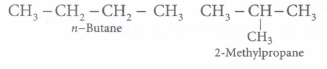
In first three members of alkane series, branching is not possible. Therefore, we cannot have isomers.
17.
A is ethanol (C2H5OH) which is essential constituent of wine and beer and 'B' is acetic acid (CH3COOH) which is present in vinegar.
\(\underset{(Present\ in\ wine\ and\ beer)\\ 'A'}{CH_3CH_2OH}+2[O]\xrightarrow[Oxidation]{Alkaline\ KMnO_4}\underset{Acid\\ (Present\ in\ vinegar)\\ 'B'}{CH_3COOH}+H_2O\)
When 'A' and 'B' react in the presence of an acid catalyst, ethyl ethanoate is formed.
\(\underset{'A'}{CH_3COOH(l)}+\underset{'A'}{C_2H_5OH(l)}\xrightarrow{Conc. H_2SO_4} CH_3COOC_2H_5(l)+H_2O(l)\)
18.

19.
a) The electronic configuration of chlorine with atomic number 17 is
K L M
2 8 7
b) Electron dot structure of chlorine molecule Cl2 is

20.
Carbon atoms have 4 electrons in their outcomes shell. So need to gain or lose electrons to attain noble gas configuration.
(i) It could gain four electrons forming c4- anion. But it would be difficult for the nucleus with six protons to hold on to ten electrons.
(ii) It could lose four electrons forming C4+ cations. But it would require a large amount energy to remove four electrons from its outermost shell.
Because of these reasons, carbon shares its valence electrons to complete its octet with other atoms to form covalent bonds.
(a) Covalent compounds are bad conductors of electricity because they do not contain ions.
(b) Covalent compounds have usually low melting and boiling because they are made up of electronically neutral molecule. So the force of attraction between the molecules of a covalent compound is very weak. Only a small amount of heat energy is required to break these weak molecular forces, due to which covalent compounds have low melting and boiling points.
21.
i) Since compound C on combustion forms two moles of CO2 and 3 moles of H2 O, therefore compound C must contain two carbon atoms and six hydrogen atmos. Thus compound C must be C2H6 (ethane)
\(\underset{Ethene(C)}{2C_2H_6}+\underset{Oxygen}{7O_2}\xrightarrow{Heat}\underset{Carbon\ dioxide}{4CO_2}+\underset{Water}{6H_2O}\)
ii) Since compound (C) is obtained by addition of 1 mole of H2 in presence of Ni to compound (B), therefore (B) must be ethane.
\(\underset{Ethene(B)}{CH2}=CH_2+H_2\xrightarrow{Ni/Heat}\underset{Ethene(C)}{CH_3-CH_3}\)
iii) Since compound (B) is formed by heating compound (A) with cone. H2SO4 therefore compound (A) must be ethanol.
\(\underset{Ethanol(A)}{CH_3CH_2OH}\xrightarrow{Conc. H_2SO_4,443K}CH_2=CH_2+\underset{Ethene(B)}{H_2O}\)

10th Standard CBSE Syllabus & Materials
10th Standard CBSE
CBSE 10th Social Science PS - Federalism - New Model Questions Papers Study Material - QB365 Set A
NEW10th Standard CBSE
CBSE 10th Social Science PS - Power Sharing - New Model Questions Papers Study Material - QB365 Set A
NEW10th Standard CBSE
CBSE 10th Social Science GEO - Manufacturing Industries - New Model Questions Papers Study Material - QB365 Set A
NEW10th Standard CBSE
CBSE 10th Social Science GEO - Minerals and Energy Resources - New Model Questions Papers Study Material - QB365 Set A



CBSE 10th Standard CBSE Subjects
CBSE Standards





