
 100% FREE ACCESS
10th Standard CBSE Syllabus & Materials
10th Standard CBSE
CBSE 10th Social Science ECO - Globalisation and the Indian Economy - New Model Questions Papers Study Material - QB365 Set A
NEW10th Standard CBSE
CBSE 10th Social Science ECO - Money and Credit - New Model Questions Papers Study Material - QB365 Set A
NEW10th Standard CBSE
CBSE 10th Social Science ECO - Sectors of the Indian Economy - New Model Questions Papers Study Material - QB365 Set A
NEW10th Standard CBSE
CBSE 10th Social Science ECO - Development - New Model Questions Papers Study Material - QB365 Set A
NEW10th Standard CBSE
CBSE 10th Social Science PS - Outcomes of Democracy - New Model Questions Papers Study Material - QB365 Set A
NEW10th Standard CBSE
CBSE 10th Social Science PS - Gender, Religion and Caste - New Model Questions Papers Study Material - QB365 Set A

Published on: 26/09/2019
Electricity
Download CBSE Class 10th Standard CBSE Science question papers, sample papers, important questions, and previous year solved papers in PDF format. Get free study materials, NCERT solutions, and exam preparation resources for Class 10th Standard CBSE Science
Questions + Answers key
Take MCQ Science Test
1.
If a 12 V battery is connected to the arrangement of resistances given below, calculate
(i) the total effective resistance of the arrangement and
(ii) the total current flowing in the circuit
2.
(a) State Ohm's Law.
(b) Draw a schematic diagram of the circuit for studying Ohm's Law.
3.
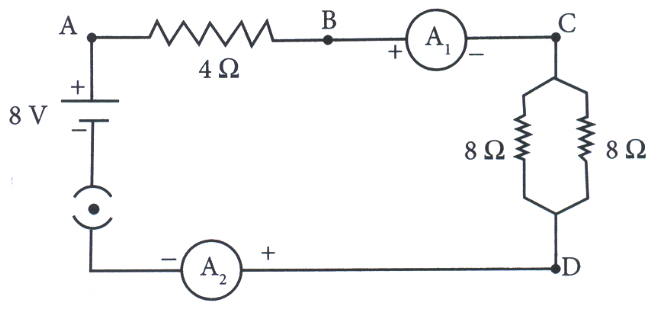
Find out the following in the electric circuit given in Figure
(a) Effective resistance of two 8 \(\Omega\) resistors in the combination
(b)Current flowing through 4 \(\Omega\) resistor
(c) Potential difference across 8 \(\Omega\) resistance
(d) Power dissipated in 4 \(\Omega\) resistor
(e) Difference in ammeter readings, if any.
4.
How will you conclude that the same potential difference exist across three resistors connected in a parallel arrangement to a battery?
5.
How will you infer with the help of an experiment that the same current flows through every part of the circuit containing three resistances in series connected to a battery?
6.
State Ohm's law? How can it be verified experimentally? Does it hold good under all conditions? Comment
1.
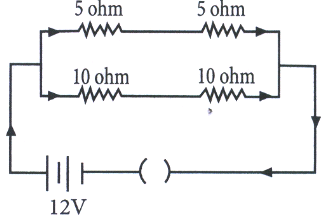
(i) The 5 Ω resistors are connected in series. Therefore, their effective resistance = (5 + 5) = 10 Ω
The 10 Ω resistors are connected in series. Therefore, their effective resistance = (10 + 10) = 20 Ω
Now these 10 Ω equivalent and 20 Ω equivalent are connected in parallel. Therefore, the equivalent resistance (Req) will be:
\(\frac { 1 }{ { R }_{ eq } } =\frac { 1 }{ { R }_{ 1 } } +\frac { 1 }{ { R }_{ 2 } } \)
\(\frac { 1 }{ { R }_{ eq } } =\frac { 1 }{ 10 } +\frac { 1 }{ 20 } \)
\(\frac { 1 }{ { R }_{ eq } } =\frac { 2+1 }{ 20 }
\)
\(\frac { 1 }{ { R }_{ eq } } =\frac { 20 }{ 3 } =6.76\Omega \)
(ii) Total Current = Total voltage / Total equivalent resistor
=12 / 6.67
= 1.8 A.
2.
(a) Ohm's Law states that at constant temperature, current flowing through a conductor is directly proportional to the potential difference across its ends.
-s.png)
3.
(a) Since two \(8\Omega \) resistors are in parallel, their effective resistance (\({ R }_{ P }\)) is given by,
\(\frac { 1 }{ { R }_{ P } } =\frac { 1 }{ 8 } +\frac { 1 }{ 8 } +\frac { 1 }{ 4 } \) or \({ R }_{ P }=4\Omega \)
(b) Total resistance in the circuit
\(R=4\Omega +{ R }_{ P }=4\Omega +4\Omega =84\Omega \)
Current through the electric circuit
\(I=\frac { V }{ R } =\frac { 8V }{ 8\Omega } =1A\)
(c) The potential difference \(4\Omega \) resistor V
I \(=IR=1\times 4=4V\)
(d) Power dissipated in \(4\Omega \) resistor P=\({ (I) }^{ 2 }\)
\(R={ (1) }^{ 2 }(4)=4W\)
(e) There is no difference in the readings of ammeters \({ A }_{ 1 }\) and \({ A }_{ 2 }\) as same current flows through all elements in a series circuit.
4.
A number of resistors are said to be connected in parallel if one end of each is connected to one point and the other end is connected to another point so that the potantial difference across each resistor is the same and is equal to the applied potential difference between the two points. If we connect a voltmeter first across R1, then across R2 ad lastly across R3, it will show same voltage.
5.
A number of resistors are said to be connected in series, if these are joined end to end and the same, current flows through each one of them when a potential difference is applied across the combination. If we connect ammeter first between the point A and R1, then between R1 and R2:R2 and R3 and lastly between R3 and the point B; it is same as current.
6.
At constant temperature, the current flowing through a conductor is directly proportional to the potential difference across its ends.
Onh's law does not hold good under all conditions as it is not a fundamental law of nature like Newton's laws. It is obeyed by metallic conductors only when physical condition like temperature etc., are kept unchanged. It is not obeyed by a lamp filament.

10th Standard CBSE Syllabus & Materials
10th Standard CBSE
CBSE 10th Social Science PS - Federalism - New Model Questions Papers Study Material - QB365 Set A
NEW10th Standard CBSE
CBSE 10th Social Science PS - Power Sharing - New Model Questions Papers Study Material - QB365 Set A
NEW10th Standard CBSE
CBSE 10th Social Science GEO - Manufacturing Industries - New Model Questions Papers Study Material - QB365 Set A
NEW10th Standard CBSE
CBSE 10th Social Science GEO - Minerals and Energy Resources - New Model Questions Papers Study Material - QB365 Set A



CBSE 10th Standard CBSE Subjects
CBSE Standards





