
 100% FREE ACCESS
10th Standard CBSE Syllabus & Materials
10th Standard CBSE
CBSE 10th Social Science ECO - Globalisation and the Indian Economy - New Model Questions Papers Study Material - QB365 Set A
NEW10th Standard CBSE
CBSE 10th Social Science ECO - Money and Credit - New Model Questions Papers Study Material - QB365 Set A
NEW10th Standard CBSE
CBSE 10th Social Science ECO - Sectors of the Indian Economy - New Model Questions Papers Study Material - QB365 Set A
NEW10th Standard CBSE
CBSE 10th Social Science ECO - Development - New Model Questions Papers Study Material - QB365 Set A
NEW10th Standard CBSE
CBSE 10th Social Science PS - Outcomes of Democracy - New Model Questions Papers Study Material - QB365 Set A
NEW10th Standard CBSE
CBSE 10th Social Science PS - Gender, Religion and Caste - New Model Questions Papers Study Material - QB365 Set A

Published on: 03/08/2019
Electricity
Download CBSE Class 10th Standard CBSE Science question papers, sample papers, important questions, and previous year solved papers in PDF format. Get free study materials, NCERT solutions, and exam preparation resources for Class 10th Standard CBSE Science
Questions + Answers key
Take MCQ Science Test
1.
A wire of resistance 10 ohm is bent in the form of a closed circle. What is the effective resistance between the two points at the ends of any diameter of the circle?
2.
Should the heating element of an electric iron be made of iron, silver or nichrome wire?
3.
An electric iron has a rating of 750 W, 220 V. Calculate
(i) current passing through it, and
(ii) its resistance, when in use
4.
A bulb is rated at 5.0 volt, 100 mA. Calculate its
(i) power and
(ii) resistance
5.
What is the S.I. unit of charge?
6.
Which has a higher resistance: a 50 W lamp bulb or a 25 W lamp bulb and how many times?
7.
Give the unit of power.
8.
What is meant by saying that the potential difference between two points is 1 V?
9.
Name a device that helps to maintain a potential difference across a conductor.
10.
Calculate the number of electrons constituting one coulomb of charge.
11.
Define the unit of current.
12.
What does an electric current mean?
13.
Two conducting wires of the same material and of equal lengths and equal diameters are first connected in series and then parallel in a circuit across the same potential difference. The ratio of heat produced in series and parallel combination would be
1:2
2:1
1:4
4:1
14.
Unit of electric power may also be expressed as
volt ampere
kilowatt hour
watt second
joule second
15.
The resistivity does not charge if
the material is charged
the temperature is charged
the shape of the resistor is charge
both material and temperature are changed
16.
Electrical resistivity of a given metallic wire depends upon
its length
its thickness
its shape
nature of the material
17.
If I is the current through a wire and 1 is the charge of electron, then no. of electrons in t seconds will be
1/It
It/1
\(\frac { 11 }{ t } \)
It1
18.
(i) Draw a schematic diagram of a circuit consisting of a battery of five 2 V cells, a 5 Ohm resistor, a 10 Ohm resistor and a 15 Ohm resistor, and a plug key, all connected in series.
(ii) Calculate the electric current passing through the above circuit when the key is closed.
19.
(a) State Ohm's Law.
(b) Draw a schematic diagram of the circuit for studying Ohm's Law.
20.
How will you conclude that the same potential difference exist across three resistors connected in a parallel arrangement to a battery?
1.
As the wire is bent in the form of a closed circle, it will be have like two resistors of 5\(\Omega \) each, connected in parallel. Therefore, the equivalent resistance can be calculated as:
\(\frac { 1 }{ R_{ eq } } =\frac { 1 }{ { R }_{ 1 } } +\frac { 1 }{ { R }_{ 2 } } \)
\(\frac { 1 }{ R_{ eq } } =\frac { 1 }{ 5 } +\frac { 1 }{ 5 } \)=\(\frac { 1 }{ R_{ eq } } =\frac { 2 }{ 5 } \)
\(\frac { 1 }{ R_{ eq } } =\frac { 5 }{ 2 } =2.5\Omega \)
The effective resistance between the two points at the ends of an diameter of the circle is 2.5 \(\Omega \).
2.
Nichrome should be used as a heating element in an electric iron because its melting point is higher than iron and silver.
3.
(i) Electric power is related to voltage and electric current as:
Power= Voltage x Current
It is given that the rating of the electric iron is 750W, 220V.
Let the current passing through the bulb be I.
Therefore,
750=220 x I
I=\(\frac{750}{220}\)=3.41A
Therefore, 3.41A current passes through the electric iron.
It is given that the rating of the electric bulb is 750W,220 V
Therefore, P=\(\frac { { V }^{ 2 } }{ P } \)=\(\frac { { 220 }^{ 2 } }{ 750 } \)=64.53\(\Omega \) when in use.
(ii) Electric power is related to voltage and resistance as:
\(\frac { { \left( Voltage \right) }^{ 2 } }{ Resistance } \)
That is,
P=\(\frac { { V }^{ 2 } }{ R } \)
=64.53\(\Omega \)
4.
Voltage (V) = 5.0 V
Current (I) = 100 mA = 0.1 A
(i) Power = VI = 5\(\times\)0.1= 0.5W
(ii) Resistance = \(\frac { V }{ I } =\frac { 5 }{ 0.1 } =50\Omega \)
5.
Coulomb
6.
The resistance of 25 W lamp bulb has a higher value as compound to that of 50 W lamp bulb. Resistance of the 25 W lamp bulb. Resistance of the 25 W lamp bulb will be double of that of the 50 W lamp bulb.
7.
Watt
8.
The potential difference between two points is said to be 1 V if 1 J of work is done in moving 1 Coulomb of electric charge from one point to other point.
9.
Electric cell or battery is a device that helps to maintain a potential difference across a conductor.
10.
We know that, charge on one electron = 1.6 \(\times\) 10-19C
\(\Rightarrow\) 1.6 \(\times\) 10-19 coulomb charge = 1 electron.
\(\therefore\) 1 coulomb charge=\(\frac{1}{1.6\times 10^{-19}}\simeq 6.25\times 10^{18}\) electrons
11.
The SI unit of electric current is ampere (A).
The current flowing through a conductor is said to be 1A, if a charge of 1coulomb (C) flows through it in 1second (s)
or \(1 A=\frac{1 C}{1 s}\)
12.
The flow of electric charge is known as electric current. Electric current is carried by moving electrons through a conductor. Electric current flows in opposite direction to the movement of electrons.
13.
(c)
1:4
14.
(a)
volt ampere
15.
(c)
the shape of the resistor is charge
16.
(d)
nature of the material
17.
(b)
It/1
18.
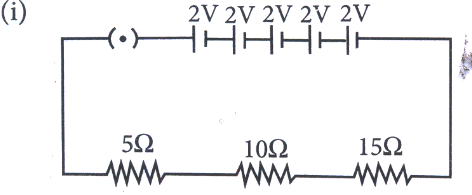
(ii) When the key is closed, total voltage applied across the circuit will be = 2 ✕ 5V = 10 V
Total resistance (R) applied across the circuit in Ohms = 5+10+15= \(30\Omega \)
By Ohm's Law,
Current (I) = \(\frac { V }{ R } \)
\(I=\frac { 10 }{ 30 } =0.33A\)
19.
(a) Ohm's Law states that at constant temperature, current flowing through a conductor is directly proportional to the potential difference across its ends.
-s.png)
20.
A number of resistors are said to be connected in parallel if one end of each is connected to one point and the other end is connected to another point so that the potantial difference across each resistor is the same and is equal to the applied potential difference between the two points. If we connect a voltmeter first across R1, then across R2 ad lastly across R3, it will show same voltage.

10th Standard CBSE Syllabus & Materials
10th Standard CBSE
CBSE 10th Social Science PS - Federalism - New Model Questions Papers Study Material - QB365 Set A
NEW10th Standard CBSE
CBSE 10th Social Science PS - Power Sharing - New Model Questions Papers Study Material - QB365 Set A
NEW10th Standard CBSE
CBSE 10th Social Science GEO - Manufacturing Industries - New Model Questions Papers Study Material - QB365 Set A
NEW10th Standard CBSE
CBSE 10th Social Science GEO - Minerals and Energy Resources - New Model Questions Papers Study Material - QB365 Set A



CBSE 10th Standard CBSE Subjects
CBSE Standards





