
 100% FREE ACCESS
10th Standard CBSE Syllabus & Materials
10th Standard CBSE
CBSE 10th Social Science ECO - Globalisation and the Indian Economy - New Model Questions Papers Study Material - QB365 Set A
NEW10th Standard CBSE
CBSE 10th Social Science ECO - Money and Credit - New Model Questions Papers Study Material - QB365 Set A
NEW10th Standard CBSE
CBSE 10th Social Science ECO - Sectors of the Indian Economy - New Model Questions Papers Study Material - QB365 Set A
NEW10th Standard CBSE
CBSE 10th Social Science ECO - Development - New Model Questions Papers Study Material - QB365 Set A
NEW10th Standard CBSE
CBSE 10th Social Science PS - Outcomes of Democracy - New Model Questions Papers Study Material - QB365 Set A
NEW10th Standard CBSE
CBSE 10th Social Science PS - Gender, Religion and Caste - New Model Questions Papers Study Material - QB365 Set A

Published on: 16/08/2019
How do Organisms Reproduce
Download CBSE Class 10th Standard CBSE Science question papers, sample papers, important questions, and previous year solved papers in PDF format. Get free study materials, NCERT solutions, and exam preparation resources for Class 10th Standard CBSE Science
Questions + Answers key
Take MCQ Science Test
1.
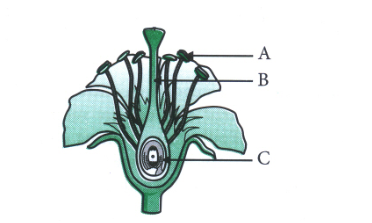
Name the parts A, B and C shown in the following diagram and state one function of each.
2.
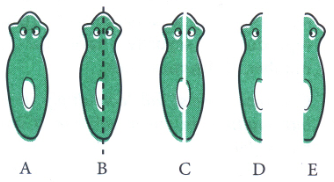
Would a Planaria cut vertically into two halves regenerate into two individuals? Complete Figure 'D' and 'E' by indicating the regenerated regions.
3.
"The chromosomal number of the sexually reproducing parents and their offspring is the same".Justify this statement.
4.
List two advantages of vegetative reproduction practiced in case of an orange plant.
5.
List any four modes of asexual reproduction.
6.
Define the terms unisexual and bisexual giving one example of each.
7.
Name the life process of an organisms that helps in the growth of its population.
8.
List the function of human female reproductive system.
9.
State what type of method is used for growing jasmine plant.
10.
Name the information source of making proteins in the cell. State two basis events in reproduction.
11.
What happen when a mature program filament attains considerable length?
12.
Why cannot fertilisation take place in flowers if pollination does not occur?
13.
Explain how, offspring and parents of organisms reproducing sexually have the same number of chromosomes?
14.
What is the importance of DNA copying in reproduction?
15.
How does reproduction help in providing stability to the population of species?
16.
Why does menstruation occur?
17.
How does binary fission differ from multiple fission?
18.
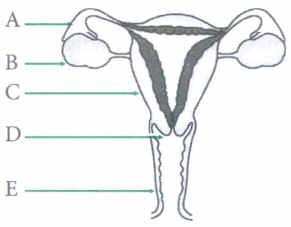
(a)Name the parts labelled A, B, C, D and E.
(b)Where do the following functions occur?
(i) Production of an egg
(ii) Fertilisation
(iii) Implantation of the zygote.
(c) What happens to the lining of uterus:
(i) before release of a fertilised egg?
(ii) if no fertilisation occurs?
19.
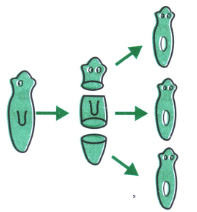
Why are budding, fragmentation and regeneration all considered as asexual types of reproduction? With neat diagrams explain the process of regeneration in Planaria.
20.
List four points of significance of reproductive health in a society. Name any two areas related to reproductive health which have improved over the past 50years in our country.
21.
Write two points of difference between asexual and sexual types of reproduction. Describe why variations are observed in the offspring formed by sexual reproduction.
22.
What are the changes seen in girls at the time of puberty?
23.
InRhizopus, tubular thread-like structures bearing sporangia at their tips are called
filaments
hyphae
rhizoids
roots
24.
The correct sequence of reproductive stages seen in flowering plants is
gametes, zygote, embryo, seedling
zygote, gametes, embryo, seedling
seedling, embryo, zygote, gametes
gametes, embryo, zygote, seedling
25.
Characters transmitted from parents to offspring are present in
cytoplasm
ribosome
golgi bodies
genes
26.
The anther contains
sepals
ovules
carpel
pollen grains
27.
Asexual reproduction takes place through budding in
amoeba
yeast
plasmodium
leishmania
1.
A\(\rightarrow \) Anther. It produces pollen grains which are the male gametes.
B\(\rightarrow \) Style. It provides the path through which the pollen tube grows and reaches the ovary.
C\(\rightarrow \) Ovary. It contains ovules and each ovule has an egg cell / female gamete. It develops into fruit after fertilization.
2.
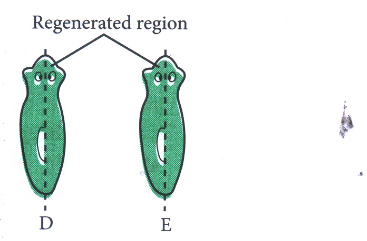
3.
In sexual reproduction, though the genetic material DNA (in the form of chromosomes) from two gametes, male and female gametes, combines together to form a new cell 'zygote' but the amount of DNA (the number of chromosomes) in the zygote does not get doubled because gametes are the special type of cells called reproductive cells which contain only half the amount of DNA (or half the number of chromosomes) as compared to the normal body cells of an organism. So when a male gamete (having half number of chromosomes of the organisms) combines with a female gamete (which also contain half the number of chromosomes) during sexual reproduction, then the new cell zygote will have the normal amount of DNA or normal number of chromosomes in it.
4.
Two advantages of practicing vegetative reproduction in orange plants are:
(i) The oranges produced are similar in size and shape.
(ii) Many oranges do not produce viable seeds and hence, vegetative method is good alternative.
5.
Four modes of asexual reproduction are-Binary fission in Amoeba, Fragmentation in Spirogyra, Regeneration in Planaria and Budding in Hydra.
6.
Unisexual is the plant whose flowers contain their stamens or carpel but not both. Example: Papya, Watermelon
Bisexual is the plant whose flowers contain both stamens and carpels. Explain: Hibiscus, Mustard.
7.
Reproduction is the process that helps in the growth of population of an organism.
8.
Two functions of ovary:
To produce female gamete ovum
To secrete female hormones estrogen and progestrone.
9.
Artificial methods of vegetative propagation like layering is used for growing jasmine plant.
10.
The DNA in the cell nucleus is the information source of making proteins.
The two basic events in reproduction are:
(i) Creation of a DNA copy.
(ii) Additional cellular apparatus by the cell involved in the process.
11.
When a mature spirogyra filament attains considerable length, it breaks up into smaller fragments or pieces, and each fragment grows into a new filament or individual
12.
For fertilization to occur, it is necessary that the male gamete reaches the female gamete. This can only happen when the pollen grains are transferred to the stigma through any means of pollination. So, fertilization cannot take place in flowers if pollination does not occur.
13.
Gamete formation is the first step in sexual reproduction. Number of chromosomes is halved during gamete formation. As a result, the number of chromosomes in gamete is half the number of chromosomes in somatic cells. When male and female gametes fuse during fertilization, the number of chromosomes becomes equal to that in somatic cells. This explains how, offspring and parents of organisms reproducing sexually have the same number of chromosomes.
14.
The importance of DNA copying during reproduction are:
(i) It is responsible for the transmission of parental characteristics to the offsprings.
(ii) During DNA copying in reproduction, the changes occur due to the inheritance of traits from both the parents. This lead to certain genetic variations, which are useful for the evolution of species over a period of time.
15.
A species occupies a well-defined niche in an ecosystem, using is ability to reproduce. During reproduction, copies of DNA pass from one generation to the next. This copying of DNA takes place with consistency in reproducing organisms. As, it is important for the maintenance of body design features (physiological as well as structural) which allows the organism to use that particular niche. Reproduction is therefore, linked to the stability of population of a species.
16.
Menstruation occurs when the egg is not fertilised. Every month, uterus prepares itself to receive a fertilised egg. To nourish the embryo, its lining becomes thick and spongy. In case, egg is not fertilised, this lining breaks and discharges out of the body through the vagina in the form of blood. This is referred to as menstruation.
17.
Differences between binary fission and multiple fission are given below
| Binary Fission | Multiple Fission |
| The parent organism splits to form two new organisms. | The parent organism splits to form many new organisms at the same time. |
| It takes place during favourable environmental conditions. | It takes place during unfavourable environmental Conditions |
| It takes place in organisms like Amoeba, Leishmania, etc. | It takes place in organisms like Plasmodium. |
18.
(a) A\(\rightarrow \) Oviduct or Fallopian tube;
B\(\rightarrow \) Ovary;
C\(\rightarrow \) Uterus;
D\(\rightarrow \) Cervix;
E\(\rightarrow \) Vagina.
(b) (i) Ovaries;
(ii) Fallopian tube;
(iii) Lining of the uterus.
(c) (i) The lining of the uterus becomes
(ii) The lining of the uterus slowly breaks and comes out through the vagina as blood and mucous, if no fertilisation occurs.
19.
Budding, fragmentation and regeneration are considered as asexual types of reproduction because gamete formation does not happen during these modes of reproduction and a single parent carries out the process of reproduction.
The above figures shows regeneration in planaria:
When the body of planaria is cut off into several part, each part regenerates its complementary part to develop into a new individual.
20.
The significance of reproductive health of society are:
1. regular medication and check-ups have led to development of reproductive health. Healthy mothers give birth to healthy children.
2. Reproductive health should be maintain in order to prevent sexually transmitted diseases (STDs).
3. Family planning by using various contraceptives enables a couple to decide on the number of children they want to have and when to have them. If a couple has less number of children they can provide good food, clothes and education to each child. So a small family is a happy family.
4. Having fewer children also keeps the mother in good health. This will reduce the cases of maternal mortality as well as new born mortality.
21.
Two points of difference between asexual and sexual reproduction are as follows:
(a) A single parent is involved in asexual reproduction, while two parents are involved in sexual reproduction.
(b) Meiosis does not happen in asexual reproduction during gamete formation.
reason of variations in offspring produced by sexual reproduction: Two sets of genes are contributed by different parents, which bring different sets of characters in the offspring.
22.
Changes seen in girls at the time of puberty are as follows:
(i) Growth of hairs in armpits and pubic region.
(ii) Mammary glands (breast) develop and hips its broaden.
(iii) Utrerus, vagina, Fallopian tube enlarge and pelvis widens.
(iv) Menstruation and ovulation also start.
23.
(b)
hyphae
24.
(a)
gametes, zygote, embryo, seedling
25.
(d)
genes
26.
(d)
pollen grains
27.
(b)
yeast

10th Standard CBSE Syllabus & Materials
10th Standard CBSE
CBSE 10th Social Science PS - Federalism - New Model Questions Papers Study Material - QB365 Set A
NEW10th Standard CBSE
CBSE 10th Social Science PS - Power Sharing - New Model Questions Papers Study Material - QB365 Set A
NEW10th Standard CBSE
CBSE 10th Social Science GEO - Manufacturing Industries - New Model Questions Papers Study Material - QB365 Set A
NEW10th Standard CBSE
CBSE 10th Social Science GEO - Minerals and Energy Resources - New Model Questions Papers Study Material - QB365 Set A



CBSE 10th Standard CBSE Subjects
CBSE Standards





