
 100% FREE ACCESS
10th Standard CBSE Syllabus & Materials
10th Standard CBSE
CBSE 10th Social Science ECO - Globalisation and the Indian Economy - New Model Questions Papers Study Material - QB365 Set A
NEW10th Standard CBSE
CBSE 10th Social Science ECO - Money and Credit - New Model Questions Papers Study Material - QB365 Set A
NEW10th Standard CBSE
CBSE 10th Social Science ECO - Sectors of the Indian Economy - New Model Questions Papers Study Material - QB365 Set A
NEW10th Standard CBSE
CBSE 10th Social Science ECO - Development - New Model Questions Papers Study Material - QB365 Set A
NEW10th Standard CBSE
CBSE 10th Social Science PS - Outcomes of Democracy - New Model Questions Papers Study Material - QB365 Set A
NEW10th Standard CBSE
CBSE 10th Social Science PS - Gender, Religion and Caste - New Model Questions Papers Study Material - QB365 Set A

Published on: 18/09/2019
How do Organisms Reproduce
Download CBSE Class 10th Standard CBSE Science question papers, sample papers, important questions, and previous year solved papers in PDF format. Get free study materials, NCERT solutions, and exam preparation resources for Class 10th Standard CBSE Science
Questions + Answers key
Take MCQ Science Test
1.
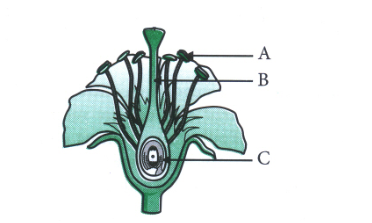
Name the parts A, B and C shown in the following diagram and state one function of each.
2.
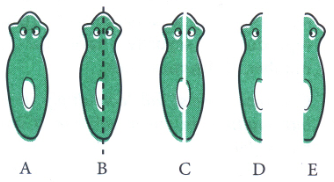
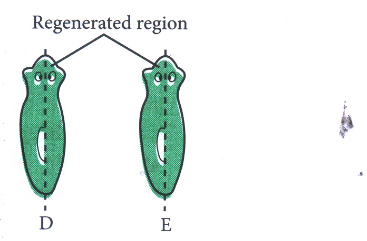
Would a Planaria cut vertically into two halves regenerate into two individuals? Complete Figure 'D' and 'E' by indicating the regenerated regions.
3.
Write two examples each of sexually transmitted disease caused by (i)virus, (ii) bacteria. Explain how the transmission of such diseases be prevented?
4.
What is meant by asexual reproduction? List its any two different forms.
5.
Define the term puberty. List two changes observed in girl at the time of puberty.
6.
"Variation that confer an advantage to an individual organism only will survive in a population". Justify
7.
What is 'reproduction'? Mention the importance of DNA copying in reproduction.
8.
Why does bread mould grow profusely on a moist of bread rather than on a dry slice of bread?
9.
Colonies of yeast fail to multiply in water, but multiple in sugar solution. Give one reason for this.
10.
What could be the reasons for adopting contraceptive methods?
11.
What are the functions performed by the testis in human beings?
12.
If a woman is using a copper-T, will it help in protecting her from sexually transmitted diseases?
13.
Why does menstruation occur?
14.
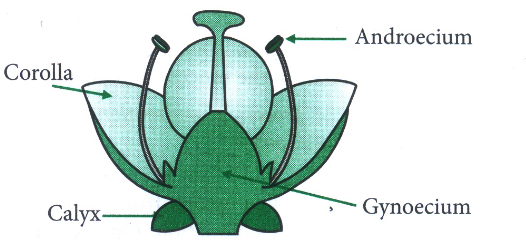
Draw a labelled diagram of the longitudinal section of a flower.
1.
A\(\rightarrow \) Anther. It produces pollen grains which are the male gametes.
B\(\rightarrow \) Style. It provides the path through which the pollen tube grows and reaches the ovary.
C\(\rightarrow \) Ovary. It contains ovules and each ovule has an egg cell / female gamete. It develops into fruit after fertilization.
2.
3.
Sexually transmitted diseases caused by
(i) Virus:
(a) AIDS (Acquired Immune Deficiency Syndrome)
(b) Genital warts
(ii) Bacteria:
(a) Gonorrhoea
(b) Syphilis
Transmission of such diseases can be prevented by the following ways:
a) Screening tests for blood donors
b) Mutually faithful monogamous relationships
c) Educating people in high risk groups
d) Using condoms etc.
4.
Asexual reproduction is the process of producing new organism from a single parent without the involvement of sex cells. Fission and fragmentation are two different forms of a sexual reproduction.
5.
The period when the rate of general body growth begins to slow down and reproductive tissues begin to mature, is called puberty.
Two changes observed in girls at the time of puberty are:
(i) The breast size begin to increase,
(ii) Menstruation starts.
6.
It is because the chances of survival depend on the nature of variations and different individuals have different kinds of advantages.
For example, a bacteria that can withstand heat will survive better in a heat wave, i.e. the organisms that are fit in the competitive environment and with great variations will be able to survive and adapt. Thus, more offsprings and population with genetic variations will survive.
7.
Reproduction is the process of producing new individuals of the same species by existing organisms of a species, i.e. parents. The importance of DNA copying in reproduction are as follows:
(i) DNA copying is called DNA replication. In this process, one copy each of replicated DNA will be passed to daughter cells.
(ii) Variations may be introduced during DNA copying. This inbuilt tendency for variation during reproduction forms the basis of evolution.
8.
Water is necessary for all metabolic activities. On the moist bread the spores of bread mold get the much needed water; which is not available on the dry bread. Hence, bread mould grows profusely on a moist slice of bread rather than on a dry slice of bread.
9.
When the colony of yeast is in water, it does not get nutrition, because water does not have nutrients. Sugar, on the other hand, provides nutrition. Once the yeast gets nutrition, it grows and begins producing buds. That is why, colonies of yeast fail to multiply in water, but multiply in sugar solution.
10.
The reasons for adopting contraceptive methods are:
(i) To avoid frequent pregnancies, which in turn helps in population control.
(ii) To prevent the spread of Sexually Transmitted Diseases (STDs).
11.
Functions of testes in human beings include:
(i) production of male sex cells-sperms.
(ii) production of male sex hormone-testosterone.
12.
No, copper-T does not prevent the transmission of sexually transmitted diseases. Copper-T only prevents implantation. The only safe method that can be used to prevent the transmission of sexually transmitted diseases is condoms.
13.
Menstruation occurs when the egg is not fertilised. Every month, uterus prepares itself to receive a fertilised egg. To nourish the embryo, its lining becomes thick and spongy. In case, egg is not fertilised, this lining breaks and discharges out of the body through the vagina in the form of blood. This is referred to as menstruation.
14.

10th Standard CBSE Syllabus & Materials
10th Standard CBSE
CBSE 10th Social Science PS - Federalism - New Model Questions Papers Study Material - QB365 Set A
NEW10th Standard CBSE
CBSE 10th Social Science PS - Power Sharing - New Model Questions Papers Study Material - QB365 Set A
NEW10th Standard CBSE
CBSE 10th Social Science GEO - Manufacturing Industries - New Model Questions Papers Study Material - QB365 Set A
NEW10th Standard CBSE
CBSE 10th Social Science GEO - Minerals and Energy Resources - New Model Questions Papers Study Material - QB365 Set A



CBSE 10th Standard CBSE Subjects
CBSE Standards





