
 100% FREE ACCESS
10th Standard CBSE Syllabus & Materials
10th Standard CBSE
CBSE 10th Social Science ECO - Globalisation and the Indian Economy - New Model Questions Papers Study Material - QB365 Set A
NEW10th Standard CBSE
CBSE 10th Social Science ECO - Money and Credit - New Model Questions Papers Study Material - QB365 Set A
NEW10th Standard CBSE
CBSE 10th Social Science ECO - Sectors of the Indian Economy - New Model Questions Papers Study Material - QB365 Set A
NEW10th Standard CBSE
CBSE 10th Social Science ECO - Development - New Model Questions Papers Study Material - QB365 Set A
NEW10th Standard CBSE
CBSE 10th Social Science PS - Outcomes of Democracy - New Model Questions Papers Study Material - QB365 Set A
NEW10th Standard CBSE
CBSE 10th Social Science PS - Gender, Religion and Caste - New Model Questions Papers Study Material - QB365 Set A

Published on: 15/09/2018
Test
Download CBSE Class 10th Standard CBSE Science question papers, sample papers, important questions, and previous year solved papers in PDF format. Get free study materials, NCERT solutions, and exam preparation resources for Class 10th Standard CBSE Science
Questions + Answers key
Take MCQ Science Test
1.
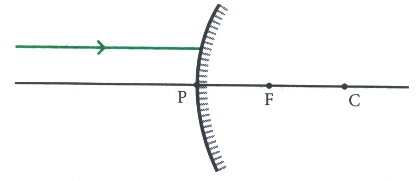
A ray of light is incident on a convex mirror as shown. Redraw the diagram and complete the path of this ray after reflection from the mirror. Mark angle of incidence and angle of reflection on it.
2.
Name the lens which always gives an erect and diminished image?
3.
A ray of light is incident on a concave mirror along its principal axis. What will be the angle of reflection?
4.
What is meant by power of a lens?
5.
List any four characteristics of biogas on account of which it is considered an ideal fuel
6.
What is a good source of energy?
7.
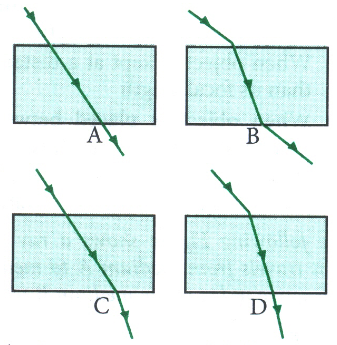
The path of a ray of light coming from air passing through a rectangular glass slab traced by four students are shown as A, B, C and D in Figure. Which one of them is correct?
A
B
C
D
8.
Under which of the following conditions a concave mirror can form an image larger than the actual object?
When the object is kept at a distance equal to its radius of curvature
When object is kept at a distance less than its focal length
When object is placed between the focus and centre of curvature
When object is kept at a distance greater than its radius of curvature
9.
A 10 mm long awl pin is placed vertically in front of a concave mirror. A 5 mm long image of the awl pin is formed at 30 cm in front of the mirror. The focal length of this mirror is.
- 30 cm
- 20 cm
- 40 cm
- 60 cm
10.
Which of the following is not an example of a bio-mass energy source?
Wood
Gobar-gas
Nuclear energy
Coal
11.
A solar water heater cannot be used to get hot water on
A sunny day
A cloudy day
A hot day
A windy day
12.
A concave mirror produces three times magnified (enlarged) real image of object placed at 10 cm in front of it. Where is the image located?
13.
(a) State one limitation of solar energy available from solar cells.
(b) What is the minimum wind velocity required to obtain useful energy with a windmill?
(c) Define the term 'nuclear fission'.
14.
(a) Why is the Solar Cooker box covered with a plane glass plate?
(b) Why is energy of water flowering in a river considered to be an indirect form of solar energy?
(c) How is the fission of nucleus brought about?
15.
(a) What is a 'solar cell'?
(b) Why is biogas considered an ideal fuel for domestic use?
(c) Name a device in which controlled chain reaction is used.
16.
Compare and contrast fossil fuels and the Sun as direct sources of energy.
17.
(i) Distinguish between renewable and non-renewable sources of energy giving one example of each.
(ii) Why is the use of wood as a fuel not advised although forests can be replenished?
18.
(i) Write the value of solar constant of Sun.
(ii) What type of mirror is used in Box Type Solar Cooker?
(iii) Why it is difficult to use hydrogen as a source of energy?
(iv) Fossil fuels are classified as non-renewable source of energy. Explain why.
19.
Energy from various sources is considered to have been derived from the sun. do you agree? Justify your answer.
20.
a) Why is there a need for harnessing non-conventional sources of energy?
b) How can energy be harnessed from the sea in different ways?
21.
What are the limitations of extracting the following energy?
(a) The wind
(b) The waves
(c) The tides
22.
Which one of the following is a renewable resource?
Natural gas, Petrroleum, Ground water, Coal
23.
(a) Define focal length of a divergent lens.
(b) A divergent lens of focal length 30 cm forms the image of an object of size 6 cm on the same side as the object at a distance of 15 cm from its optical centre. Use lens formula to determine the distance of the object from the lens and the size of the image formed.
(c) Draw a ray diagram to show the formation of image in the above situation.
1.

2.
Concave lens.
3.
Angle of reflection = 0
Since, \(n=\frac { c }{ v } \)
we get, \(n=\frac { c }{ 0.6c } =\frac { 1 }{ 0.6 } \approx 1.67\)
4.
It is a measure of the degree of convergence or divergence of light rays falling on it. It can also be defined as the reciprocal of its focal length in metres.
5.
Biogas is considered as an ideal fuel because it
Has a high calorific value
Produces no smoke on burning
Burns smoothly without any explosion
Leaves no residue on combustion
6.
A good source of energy should be renewable and environment friendly.
7.
(b)
B
8.
(c)
When object is placed between the focus and centre of curvature
9.
(b)
- 20 cm
10.
(c)
Nuclear energy
11.
(b)
A cloudy day
12.
Real image is inverted. So, magnification is negative
Thus, m=-3=\(\frac{Image \quad size}{Object \quad size}\)
\(=\frac{h_{i}}{h_{o}}=-\frac{v}{u}\)
[where, v = image distance and u = object distance]
\(\Rightarrow -3=\frac{-(v)}{(-10)}\) [\(\because\) object is placed in front of mirror]
\(\Rightarrow -3=\frac{v}{10}\)
Image distance, v = -30 cm
Negative sign shows that image is real, so it will be formed in front of the mirror.
13.
(a) The solar cells are costly and hence the energy available from them expensive.
(b) 15 km/h is the minimum wind velocity required to obtain useful energy with a windmill.
(c) Nuclear fission is the process in which a radioactive atom splits up into smaller nuclei when struck with low energy neutrons.
14.
(a) The solar cooker box is covered with a plane glass plate so as to prevent heat from escaping.
(b) Sun is said to be the ultimate and the original source for most of the energy present on the earth. When sun rays fall on oceans and other water bodies, the water present in the water bodies gets evaporated and rises up in the atmosphere. In the upper part of the atmosphere, this water vapour gets condensed and forms douds, which give rain on the high lands. Therefore, the rain water runs over the Sand surface towards the large water bodies. This running water over the land surfaces is called river. Therefore, the energy of running water actually originates from the solar energy. This is why solar energy of water flowing in a river is considered to be an indirect form of solar energy.
(c) The fission of nucleus is brought about by splitting the nucleus of heavy atoms, such as uranium or plutonium, with low-energy neutron bombardment.
15.
(a) A solar cell is a device which converts solar energy into electricity. It is a sandwich of a silicon-boron layer and a silicon-arsenic layer.
(b) Biogas is an ideal fuel for domestic use because it is a cheap and clean fuel, which does not leave behind any residue.
(c) A nuclear power plant is a device in which controlled chain reaction is used.
16.
| Sun | Fossil fuels |
| 1. It is renewable source of energy 2. It does not cause pollution 3. It is cheap, easily available for most of the time and at most of the places |
It is non-renewable source of energy It causes pollution in the environment It is expensive, not easily available any time and anywhere. |
17.
| Renewable sources of energy | Non-renewable sources of energy | |
| Non-renewable sources of energy of energy that are replenished at a rate faster than the rate at which they are consumed. | Non-renewable sources of energy are the ources of energy that are consumed at a rate faster than the rate at which they are replenished. | |
| Renewable sources of energy are known as inexhaustible sources of energy as they can be easily regenerated at a constant rate. | Non-renewable sources of energy are known as exhaustible sources of energy as they get easily exhausted and the resources of this type are limited in nature. | |
| Examples of renewable sources of energy include sunlight, wind, tides, and geothermal energy. | Examples of non-renewable resources of energy are fossil fuels, which include coal,etroleum, and natural gas. |
ii) Although wood is readily found in nature, it is still not a good source of energy because
- the energy obtained from per mass of Wood is very small.
- it produces a lot of smoke, which is very harmful for the environment and contributes to air pollution.
- using wood as a source of energy further increases the rate of deforestation.
18.
(i) Solar constant of sun is 1.4 kW/m2.
(ii) Concave mirrors are used in box type solar cookers.
(iii) It is difficult to use hydrogen as a source of energy because it has not been possible to control nuclear fusion reaction. Thus, it has not yet been possible to use energy generated from fusion reaction for anything constructive.
(iv) Fossil fuels are classified as non-renewable sources of energy because it takes a long time for them to replenish naturally. It takes millions of years for fossil fuels to replenish. With the rate at which humans are using them, they will get exhausted in the next hundred years. Thus, fossil fuels are termed as non-renewable source of energy.
19.
i) All fossil are the remains of the prehistoric plants and animals. Th energy of the fossil fuels is in fact that solar energy which was trapped by natural processes a long time ago.
ii) Solar energy also appears in the form of energy of water flowing in rivers as is obvious from the water cycle in nature. It is this energy which generates in hydroelectric power plants.
iii) Biomass energy is also the solar energy absorbed by the plans which convert it into chemical energy through photosynthesis.
iv) Human and animals use bioenergy to carry out their life activities.
v) Solar energy is one of the main factors responsible for the movement of air in the atmosphere leading to wind energy.
vi) Solar energy is used directly in solar.
20.
a) (i) Depletion of fossil fuels. (ii) Increase in population. (iii) Improve the quality of living
b) The energy from the sea or ocean can be obtained in any of the following three forms:
a) Wave energy
b) Tidal energy
c) Ocean thermal energy
a) Wave Energy
The energy from the sea can also b obtained in the form of sea waves When the wind blows on the surface of the sea, the very fast sea waves move on the surface possessing kinetic energy. This energy can be used generate electricity. In order to trap this energy, a wide variety of device need to be installed to turn turbine: and drive generators.
Many experimental ideas wen developed to harness this energy.
These are as follows:
1. Setting up of floating generator: in the sea to trap the sea waves generate electricity.
2. Allowing the sea waves move and down inside large tubes. As the waves move up, the air inside the tubes is compressed and to turn a turbine to generate electricity.
These experimental ideas many years to be installed. Thu: harnessing of sea waves energy would be possible only at those places where sea waves are very strong.
Tidal Energy The tidal waves include low tides and high tides. When the rise of sea water takes place due to gravitational pull of the moon, it is called high tide and when the fall of seawater takes place it is called low tide. The rise and fall of tidal waves takes place twice a During this period, a large movement of water takes place between the high tides and low tides resulting in the production of a very large source o energy.
The tidal energy can be harnessed only by constructing a tidal by constructing a tidal power plant across a narrow opening to the sea. During the high tides, the gates the dam are opened and the sea water is allowed to fall on the turbine t produce electricity. Thus, we can say that kinetic energy of the sea water converted into electrical energy.
During low tides, the gates of the dal are closed due to which the water level in the dam raises possessing potential energy. Now, the gates are opened and the water is allowed to fall back into the sea. This falling water is also used to rotate the turbine to generate electricity.
c) Ocean Thermal Energy
We know that a large area of sea is called ocean. The water at the surface of an ocean gets heated due to the radiation from the sun and reaches a higher temperature than the deeper levels of the ocean. This creates a temperature difference between the water at the surface of the ocean and at deeper levels of the ocean. The solar energy stored in the oceans in the form of heat is called ocean thermal energy. The heat energy produced due to the difference in the temperature Of water On the surface of the ocean and temperature of water deep into ocean. This heat energy produced can be used to produce electricity. Thus, we can define ocean thermal energy as "The heat energy due to the temperature difference between different layers of water in the Ocean' We can convert the ocean thermal energy (OTE) into electricity by ocean thermal energy conversion power plants or OTEC power plants.
The devices which are used to harness the ocean thermal energy are called ocean thermal energy conversion
[OTEC] power plants. To operate ocean thermal energy conversion [OTEC] power plant, the temperature difference between the surface water o ocean and deeper water must be 200( or more. In some ocean thermal energy conversion [OTECI power plants, the warm surface water of the ocean used to boil liquids like ammonia o chlorofluorocarbon (CFC). Then, the high-pressure vapours of the liquid an used to turn the turbine to generate electricity. The colder water from the deeper ocean is pumped up to cool the used up vapours to convert them back into liquid.
21.
(a) Wind energy farms can be located only in vast open areas where the wind is are of 15 km/h.
Cost of wind mill is high.
The location of wind energy farms should not be on the routes of migratory birds.
The whistling and whirling of wind mill is irritating.
(b) Energy from waves can be harnessed only in coastal areas.
Wave energy will be available only where waves are very strong.
(c) Energy from tides can be harnessed only at selected places.
Technologies for harnessing energy from waves and tides are still at experimental stage and hence are less efficient and very costly.
22.
()
Among natural gas, petroleum, ground water and coal, only ground water is a renewable resource. It returns in the water cycle.
23.
(a) (i) The principal focus of a diverging lens is a point on its principal axis from which light rays, originally parallel to the axis appear to diverge after passing through the diverging (concave) lens.
(ii) The distance between pole and principal focus of a diverging lens is called the focal length in the given diagram OF is the focal length.
-S.png)
(b) Divergent lens (Concave lens) Focal length, f = -30 cm
Size of the object, h1 = 6 cm
Image distance, v = -15 cm
Object distance, u = ?
Size of the image, h2 = ?
According to the lens formula,
\(\frac { 1 }{ f } =\frac { 1 }{ v } +\frac { 1 }{ u } \)
\(\frac { 1 }{ -30 } =\frac { -1 }{ -15 } +\frac { 1 }{ u } \)
\(\Rightarrow \frac { 1 }{ u } =\frac { -1 }{ 15 } +\frac { 1 }{ 30 } =\frac { -2+1 }{ 30 } =\frac { -1 }{ 30 } \)
u=-30cm
\(\frac { { h }_{ 2 } }{ { h }_{ 1 } } =\frac { v }{ u } \)
\(\Rightarrow \frac { { h }_{ 2 } }{ 6 } =\frac { -15 }{ -30 } \)
\(\Rightarrow { h }_{ 2 }=\frac { 15 }{ 30 } \times 6=+3cm\)
-S.png)

10th Standard CBSE Syllabus & Materials
10th Standard CBSE
CBSE 10th Social Science PS - Federalism - New Model Questions Papers Study Material - QB365 Set A
NEW10th Standard CBSE
CBSE 10th Social Science PS - Power Sharing - New Model Questions Papers Study Material - QB365 Set A
NEW10th Standard CBSE
CBSE 10th Social Science GEO - Manufacturing Industries - New Model Questions Papers Study Material - QB365 Set A
NEW10th Standard CBSE
CBSE 10th Social Science GEO - Minerals and Energy Resources - New Model Questions Papers Study Material - QB365 Set A



CBSE 10th Standard CBSE Subjects
CBSE Standards





