
 100% FREE ACCESS
10th Standard CBSE Syllabus & Materials
10th Standard CBSE
CBSE 10th Social Science ECO - Globalisation and the Indian Economy - New Model Questions Papers Study Material - QB365 Set A
NEW10th Standard CBSE
CBSE 10th Social Science ECO - Money and Credit - New Model Questions Papers Study Material - QB365 Set A
NEW10th Standard CBSE
CBSE 10th Social Science ECO - Sectors of the Indian Economy - New Model Questions Papers Study Material - QB365 Set A
NEW10th Standard CBSE
CBSE 10th Social Science ECO - Development - New Model Questions Papers Study Material - QB365 Set A
NEW10th Standard CBSE
CBSE 10th Social Science PS - Outcomes of Democracy - New Model Questions Papers Study Material - QB365 Set A
NEW10th Standard CBSE
CBSE 10th Social Science PS - Gender, Religion and Caste - New Model Questions Papers Study Material - QB365 Set A

Published on: 30/09/2019
Light Reflection and Refraction
Download CBSE Class 10th Standard CBSE Science question papers, sample papers, important questions, and previous year solved papers in PDF format. Get free study materials, NCERT solutions, and exam preparation resources for Class 10th Standard CBSE Science
Questions + Answers key
Take MCQ Science Test
1.
(a) Draw a ray diagram to show the formation of image by concave lens when an object is placed in front of it.
(b) In the above diagram mark the object -distance (u) and the image-distance (v) with their proper signs (=ve or -ve as per the new Cartesian sign convention) and state how these distance are related to the focal length (f) of the concave lens in this case.
(c) Find the nature and power of a lens which forms a real and inverted image of magnification -1 at a distance of 40 cm from its optical centre.
2.
(i) " A convex lens can form a magnified erect as well as magnified inverted image of an object placed in front of it. " Draw ray diagram to justify this statement stating the position of the object with respect to the lens in each case.
(ii) As object of height 4 cm is placed at a distance of 20 cm from a concave lens of focal length 10 cm. Use lens formula to determine the position of the image formed.
3.
A student wants to project the image of candle flame on the walls of school laboratory by using a lens:
(a) Which type of lens should he use any why?
(b) At what distance in terms of focal length 'F' of the lens should he place the candle flame so as to get
(i) a magnified, and
(ii) a diminished image respectively on the wall?
(c) Draw ray diagram to show the formation of the image in each case.
4.
(a) State the laws of refraction of light. Give an expression to relate the absolute refractive index of a medium with speed of light in vacuum.
(b) The refractive indices of water and glass with respect to air are 4/3 and 3/2 respectively. If the speed of light in glass is \({ 2\times 10 }^{ 8 }\) ms-1, find the speed of light in (i) air, (ii) water.
5.
(a) One - half of a convex lens is covered with a black paper. Will such a lens produce an image of the complete object? Support your answer with a ray diagram.
(b) An object 5 cm high is held 25 cm away from a converging lens of focal length 10 cm.
(i) Draw the ray diagram and
(ii) Calculate the position and size of the image formed.
(iii) What is the nature of the image?
6.
(a) Define optical centre of a spherical lens.
(b) A divergent lens has a focal length of 20 cm At what distance should an object of height 4 cm from the optical centre of the lens be placed so that its image is formed 10 cm away from the lens. Find the size of the image also.
(c) Draw a ray diagram to show the formation of image in above situation.
7.
(a) Define focal length of a spherical lens.
(b) A divergent lens has a focal length of 30 cm. At what distance should an object of height 5 cm from the optical centre of the lens be placed so that its image is formed 15 cm away from the lens? Find the size of the image also.
(c) Draw a ray diagram to show the formation of image in the above situation.
8.
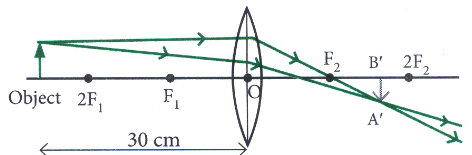
(i) One half of a convex lens of focal length 10 cm is converted with a black paper. Can such a lens produce an image of a complete object placed at a distance of 30 cm from the lens? Draw ray diagram to justify your answer.
(ii) A 4 cm tall object is placed perpendicular to the principal axis of a convex lens of focal length 20 cm. The distance of the object from the lens is 15 cm. Find nature, position and size of the image.
9.
The image of a candle flame formed by a lens is obtained on a screen placed on the other side of the lens. If the image is three times the size of the flame and the distance between lens and image is 80 cm, at what distance should the candle be placed from the lens? What is the nature of the image at a distance of 80 cm and the lens?
10.
Size of image of an object by a mirror having a focal length of 20 cm is observed to be reduced to 1/3 rd of its size. At what distance the object has been placed from the mirror? What is the nature of the image and the mirror?
1.
-S.png)
(b) CB=-uCF = -fCB=-v
The relation between u, v and f is given by the lens formula:
\(\frac { 1 }{ f } =\frac { 1 }{ v } -\frac { 1 }{ u } \)
As both u and v are negative the above equation will change to
\(\frac { 1 }{ f } =\frac { 1 }{ (-v) } -\frac { 1 }{ (-u) } \)
\(\frac { 1 }{ f } =\frac { -1 }{ v } +\frac { 1 }{ u } \)
\(\Rightarrow \frac { 1 }{ f } =\frac { 1 }{ u } -\frac { 1 }{ v } \)
We know that the focal length of a concave lens is negative, so the above equation will be changed to
\(\frac { 1 }{ -f } =\frac { 1 }{ u } -\frac { 1 }{ v } \)
\(\Rightarrow \frac { 1 }{ f } =\frac { 1 }{ v } -\frac { 1 }{ u } \)
(c) Magnification m=-1
v = + 40 cm (real and inverted)
Nature of the lens = ?
Power of the lens, P =?
\(\frac { v }{ u } =m\Rightarrow \frac { +40 }{ u } =-1\)
40=-u ⇒ u = -40 cm
According to the lens formula,
\(\frac { 1 }{ f } =\frac { 1 }{ v } -\frac { 1 }{ u } \)
\(\Rightarrow \frac { 1 }{ f } =\frac { 1 }{ 40 } -\frac { 1 }{ -40 } =\frac { 1 }{ 40 } +\frac { 1 }{ 40 } =\frac { 2 }{ 40 } =\frac { 1 }{ 20 } \)
f = +20 cm
fis +ve thus the lens is convex
\(P=\frac { 1 }{ f(metres) } =\frac { 1\times 100 }{ 20 } =+5D\)
Since power of lens is positive, lens will be converging in nature.
2.
(i) A convex lens can form a magnified erect image when the object is placed between the optical centre and principal focus of the convex lens (i.e. between O and F).
-S.png)
(ii) A convex lens can form a magnified erect image when the object is placed between focus and the centre of curvature (i.e. between F' and 2F).
-S.png)
Object height, h = 4 cm;
Object distance, u = -20 cm
Nature of the lens = concave lens;
Focal length = f = +10 cm
Image distance, v = ?
According to the lens formula,
\(\frac { 1 }{ f } =\frac { 1 }{ v } -\frac { 1 }{ u } \)
\(\Rightarrow \frac { 1 }{ v } =\frac { 1 }{ f } +\frac { 1 }{ u } \)
\(\frac { 1 }{ v } =\frac { 1 }{ +10 } +\frac { 1 }{ -20 } =\frac { 1 }{ 10 } -\frac { 1 }{ 20 } =\frac { 2-1 }{ 20 } =\frac { 1 }{ 20 } \)
∴ v=20cm
The image is formed at a distance of 20 cm from the lens on the opposite side.
3.
(a) A convex lens should be used. This is because it can produce a real image of the candle flame on the wall as it is a converging lens where refracted rays actually meet.
(b)&(c)
(i) A real magnified image is formed when the candle flame is placed between F and 2F from the convex lens on the other side of the wall.
-S.png)
(ii) A real diminished image is formed when the candle flame is placed beyond 2F from the convex lens on the other side of the wall.
-S.png)
4.
(a) Laws of Refraction:
(i) The first law of refraction of light states that the incident ray, the refracted ray and the normal at the point of incidence, all lie in the same plane.
(ii) The second law of refraction of light is the Snell's Law of Refraction. It state that the ratio of sine of the angle of incidence to the sine of angle of refraction is a constant for a given pair of medium.
\(\frac { sin\quad i }{ sin\quad r } =Constant(n)\)
This constant (n) is called refractive index of the medium.
(i) When the light is going from vacuum to another medium, then the value of refractive index is called the absolute refractive index.
(ii) The ratio of speed of light in vacuum to the speed of light in a medium is called the absolute refractive index of that medium,
i.e.
Absolute refractive index (of a medium)
\(=\frac { Speed\quad of\quad light\quad in\quad vacuum(c) }{ Speed\quad of\quad light\quad in\quad medium(v) } \)
(b) \(_{ a }{ { n }_{ w } }=\frac { 4 }{ 3 } ,_{ a }{ { n }_{ g } }=\frac { 3 }{ 2 } \)
Speed of light in glass, vg= 2 x 10⁸ m/s
Speed of light in air, vg= ?
Speed of light in water, vw =?
\(_{ a }{ { n }_{ w } }=\frac { { v }_{ a } }{ { v }_{ w } } \)
\(\Rightarrow \frac { 4 }{ 3 } =\frac { { v }_{ a } }{ { v }_{ w } } \) ...(i)
\(_{ a }{ { n }_{ g } }=\frac { { v }_{ a } }{ { v }_{ g } } \)
\(\Rightarrow \frac { 3 }{ 2 } =\frac { { v }_{ a } }{ 2\times { 10 }^{ 8 } } \)
-S.png)
Putting the value of va in equation (i),
\(\frac { 4 }{ 2 } =\frac { 3\times { 10 }^{ 8 } }{ { v }_{ w } } \)
\(\Rightarrow { v }_{ w }=3\times { 10 }^{ 8 }\times \frac { 3 }{ 4 } =\frac { 9 }{ 4 } \times { 10 }^{ 8 }\)
=2.25x10⁸ m/s.
5.
(a) As we can see in the figure given, when the lower half of the convex lens is covered with a black paper, it still forms lens. However the intensity of the image is reduced when the convex lens is covered with black paper.
-S-1.png)
(b) (i) Converging lens (Convex lens):
Height of the object, h1= 5 cm
Object distance, u = -25 cm
Focal length, f= +10 cm
-S-2.png)
(ii) Image distance, v ?
Image size, h2 = ?
According to lens formula:
\(\frac { 1 }{ v } -\frac { 1 }{ u } =\frac { 1 }{ f } \)
\(\Rightarrow \frac { 1 }{ v } -\frac { 1 }{ -25 } =\frac { 1 }{ 10 } \)
\(\Rightarrow \frac { 1 }{ v } +\frac { 1 }{ 25 } =\frac { 1 }{ 10 } \)
\(\frac { 1 }{ v } =\frac { 1 }{ 10 } -\frac { 1 }{ 25 } \)
\(\Rightarrow \frac { 1 }{ v } =\frac { 5-2 }{ 50 } =\frac { 3 }{ 50 } \)
\(\Rightarrow v=\frac { 50 }{ 3 } =+16.6cm\)
\(\frac { { h }_{ 2 } }{ { h }_{ 1 } } =\frac { v }{ u } \)
\(\Rightarrow \frac { { h }_{ 2 } }{ 5 } =\frac { 50 }{ 3\times -25 } \)
-S.png)
(iii) Nature of the image
(a) The +ve of v shows that image is real.
(b) The -ve sign of h2 shows that image is inverted.
∴ Size of image = 3.3 cm
6.
(a) Optical centre of the lens. It is a point within the lens that lies on the principal axis through which away of light passes undeflected.
= f=-20cm h1 = 4 cm
v = -10 cm u=?
h2=?
\(\frac { 1 }{ f } =\frac { 1 }{ v } -\frac { 1 }{ u } \)
\(\Rightarrow \frac { 1 }{ -20 } -\frac { 1 }{ 10 } -\frac { 1 }{ u } \)
\(\Rightarrow \frac { 1 }{ u } =\frac { 1 }{ 10 } +\frac { 1 }{ 20 } \)
\(\Rightarrow \frac { 1 }{ u } -\frac { 1 }{ 10 } +\frac { 1 }{ 20 } \)
\(\Rightarrow \frac { 1 }{ u } =\frac { -2+1 }{ 20 } \)
\(\Rightarrow \frac { 1 }{ u } =\frac { -1 }{ 20 } \)
Now,
\(\frac { { h }_{ 2 } }{ { h }_{ 1 } } =\frac { v }{ u } \)
\(\Rightarrow \frac { { h }_{ 2 } }{ 4 } =\frac { -10 }{ -20 } \)
\(\Rightarrow { h }_{ 2 }=\frac { 10 }{ 20 } \times 4=2cm\)
h2=2cm
-S.png)
7.
(a) The distance between optical centre and focus of the lens is called focal length of a spherical lens.
(b) Diverging lens: Concave lens Focal -30 cm
Object distance, u =?
Height of the object, h1 = 5 cm
Image distance, v = - 15 cm
Image size, h2 = ?
According to the lens formula,
\(\frac { 1 }{ f } =\frac { 1 }{ v } +\frac { 1 }{ u } \)
\(\frac { 1 }{ -30 } =\frac { -1 }{ -15 } +\frac { 1 }{ u } \)
\(\Rightarrow \frac { 1 }{ u } =\frac { -1 }{ 15 } +\frac { 1 }{ 30 } =\frac { -2+1 }{ 30 } =\frac { -1 }{ 30 } \)
u=-30cm
\(\frac { { h }_{ 2 } }{ { h }_{ 1 } } =\frac { -v }{ u } \)
\(\Rightarrow \frac { { h }_{ 2 } }{ 5 } =\frac { -15 }{ -30 } \)
\(\Rightarrow { h }_{ 2 }=\frac { 5 }{ 2 } =2.5cm\)
8.
(i) Yes.If a convex lens of focal length 10cm is covered one half with a black paper, it can produce an image of the complete object between F2 and 2F2.The rays of light coming from the object get refracted by the upper half of the lens. The image formed will be real, inverted and diminished.
(ii)Object height, h1=4cm
Focal length, f=+20cm
Object distance, u=-15cm
Image distance, v=?
Image height, h2=?
By lens formula,
\({1\over f}={1\over v}-{1\over u}\)
\(\Rightarrow\ {1\over v}={1\over f}+{1\over u}={1\over +20}+{1\over -15}={1\over 20}-{1\over 15}\)
\(\Rightarrow\ {1\over V}={3-4\over 60}={-1\over 60}\)
v=-60cm
Negative sign of v shows that the image is virtual.
9.
Given m = -3, v = 80 cm, u = ?
Using the expression \(m=\frac { -v }{ u } \)
we have \(-3=\frac { 80 }{ u } \) or \(u=\frac { -80 }{ 3 } =-26.67cm\)
The image is real and the lens is a convex lens.
10.
Given m = 1/3, f = 20 cm, u = ?
Using the expression m = -v/u
We have 1/3 = -v/u or u = -3 V
Now using the expression
\(\frac{1}{f}=\frac{1}{u}+\frac{1}{v}\)
We have
\(\frac{1}{20}=\frac{1}{u}+\frac{-3}{u}=\frac{-2}{u}\)
or u = -40 cm

10th Standard CBSE Syllabus & Materials
10th Standard CBSE
CBSE 10th Social Science PS - Federalism - New Model Questions Papers Study Material - QB365 Set A
NEW10th Standard CBSE
CBSE 10th Social Science PS - Power Sharing - New Model Questions Papers Study Material - QB365 Set A
NEW10th Standard CBSE
CBSE 10th Social Science GEO - Manufacturing Industries - New Model Questions Papers Study Material - QB365 Set A
NEW10th Standard CBSE
CBSE 10th Social Science GEO - Minerals and Energy Resources - New Model Questions Papers Study Material - QB365 Set A



CBSE 10th Standard CBSE Subjects
CBSE Standards





