
 100% FREE ACCESS
10th Standard CBSE Syllabus & Materials
10th Standard CBSE
CBSE 10th Social Science ECO - Globalisation and the Indian Economy - New Model Questions Papers Study Material - QB365 Set A
NEW10th Standard CBSE
CBSE 10th Social Science ECO - Money and Credit - New Model Questions Papers Study Material - QB365 Set A
NEW10th Standard CBSE
CBSE 10th Social Science ECO - Sectors of the Indian Economy - New Model Questions Papers Study Material - QB365 Set A
NEW10th Standard CBSE
CBSE 10th Social Science ECO - Development - New Model Questions Papers Study Material - QB365 Set A
NEW10th Standard CBSE
CBSE 10th Social Science PS - Outcomes of Democracy - New Model Questions Papers Study Material - QB365 Set A
NEW10th Standard CBSE
CBSE 10th Social Science PS - Gender, Religion and Caste - New Model Questions Papers Study Material - QB365 Set A

Published on: 05/09/2019
Magnetic Effects of Electric Current
Download CBSE Class 10th Standard CBSE Science question papers, sample papers, important questions, and previous year solved papers in PDF format. Get free study materials, NCERT solutions, and exam preparation resources for Class 10th Standard CBSE Science
Questions + Answers key
Take MCQ Science Test
1.
What is the use of electric fuse?
2.
What is similar between solenoid and bar magnet?
3.
What are concentric circles?
4.
What is the difference between AC generator and DC generator?
5.
Name the rule used to determine the direction of induced current.
6.
What is galvanometer?
7.
Define electromagnetic induction.
8.
Name the device that converts electric energy into mechanical energy.
9.
Distinguish between DC and AC.
10.
What does an electric current carrying wire behaves like?
11.
Two circular coils A and B are placed close to each other. If the current in the coil A is changed, will some current be induced in the coil B? Give reason.
12.
Name two safety measures commonly used in electric circuits and appliances.
13.
Name some sources of direct current.
14.
On what principle does electric motor work?
15.
State Fleming's Left hand Rule.
16.
The magnetic field in a given region is uniform. Draw a diagram to represent it.
17.
Why don’t two magnetic field lines intersect each other?
18.
Why does a compass needle get deflected when brought near a bar magnet?
19.
List the properties of magnetic lines of force.
20.
The most important safety method used for protecting home appliances from short circuiting or overloading is
Earthing
Use of fuse
Use of stabilisers
Use of electric meter.
21.
To convert an AC generator into DC generator
Split-ring type commutator must be used
Slip rings and brushes must be used
A stronger magnetic field has to be used
A rectangular wire has to be used.
22.
The strength of magnetic field inside a long current carrying straight solenoid is
More at the ends than at the centre
Minimum in the middle
Same at all points
Found to increase from one end to the other.
23.
Choose the incorrect statement
Fleming's right-hand rule is a simple rule to know the direction of induced current.
The right-hand thumb rule is used to find the direction of magnetic fields due to current carrying conductors.
The difference between the direct and alternating currents is that the direct current always flows in one direction, whereas the alternating current reverses its direction periodically.
In India, the AC changes direction after every 1/50 second.
24.
Commercial electric motors do not use
An electromagnet to rotate the armature
Effectively large number of turns of conducting wire in the current carrying coil
A permanent magnet to rotate the armature
A soft iron core on which the coil is wound
25.
At the time of short circuit, the current in the circuit
reduces substantially
does not change
increases heavily
vary continuously
26.
The essential difference between an AC generator and a DC generator is that
AC generator has an electromagnet while a DC generator has permanent magnet.
DC generator will generate a higher voltage.
AC generator will generate a higher voltage
AC generator has slip rings while the DC generator has a commutator.
27.
The phenomenon of electromagnetic induction is
the process of charging a body.
the process of generating magnetic field due to a current passing through a coil.
producing induced current in a coil due to relative motion between a magnet and the coil.
the process of rotating a coil of an electric motor.
28.
Which of the following correctly describes the magnetic field near a long straight wire ?
The field consists of straight lines perpendicular to the wire.
The field consists of straight lines Parallel to the wire.
The field consists of radial lines originating from the wire.
The field consists of concentric circles centred on the wire.
29.
The magnetic field inside a long straight current carrying solenoid
is zero
decrease as we move towards its end
increases as we move towards its end
is the same at all points.
30.
Explain with the help of a labelled diagram the distribution of magnetic field due to a current through a circular loop. Why is it that if a current carrying coil has 'n' turns the field produced at any point is n times as large as that produced by a single turn?
31.
With the help of a labelled circuit diagram illustrate the pattern of field lines of the magnetic field around a current carrying straight long conducting wire. How is the right hand thumb rule useful to find direction of magnetic field associated with a current carrying conductor?
1.
Electric fuse is used for protecting the circuits due to short circuiting or overloading of the circuits.
2.
The magnetic field produced by a solenoid is similar to the bar magnet.
3.
The magnetic field lines around a straight conductor carrying current are concentric circles.
4.
AC generator produces current which changes its direction after equal intervals of time and DC generator produces current which is unidirectional.
5.
Direction of induced current is given by Fleming's right hand rule according to this rule, stretch the thumb, fore-finger and the middle finger of the right hand such that they are mutually perpendicular.
If the fore-finger points in the direction of magnetic field the thumb shows the direction of motion and middle finger points in the direction of induced current.
6.
A galvanometer is an instrument that can detect the presence of a current in a circuit.
7.
The phenomenon in which an electric current is induced in a circuit because of a changing magnetic field is called electromagnetic induction.
8.
An electric motor.
9.
| DC | AC |
| 1. Unidirectional flow of current. | Current changes its direction in a cycle. |
| 2. Cells and batteries produce DC. | Dynamo produces AC. |
10.
It behaves like a magnet.
11.
When two circular coils A and B placed close to each other and the current in coil A is changed, it leads to induction of current in coil B. This happens because of change in magnetic field of coil A, because of change in current in this coil.
12.
Electric fuse and earth wire are two safety measures commonly used in electric circuits.
13.
Electrochemical cell, DC generator, photovoltaic cell, etc.
14.
When rectangular coil is placed in magnetic field and the current passes through it, coil experiences a torque which rotates it continuously .
15.
According to this rule, stretch the thumb, forefinger and middle finger of your left hand such that they are mutually perpendicular. If the first finger points in the direction of magnetic field and the second finger in the direction of current, then the thumb will point in the direction of motion or the force acting on the conductor.
16.
In a uniform magnetic field, the magnetic field lines of force are parallel and equidistant from each other as shown in the diagram.
17.
If two magnetic lines of force intersect each other, it would mean that there are two directions of the magnetic field at the point of intersection, which is not possible.
18.
The compass needle gets deflected due to the magnetic field around a bar magnet.
19.
Properties of magnetic field lines:
The magnetic field lines have the following properties:
(i) They originate from North pole of a magnet and end at its South pole, by convention.
(ii) These lines are closed and continuous curves.
(iii) They are crowded near the poles, where the magnetic field is strong and separated far from the poles, where the magnetic field is weak.
(iv) Field lines never intersect with each other. If they do, that would mean that there are two directions of the magnetic field at the point of intersection, which is impossible.
20.
(b)
Use of fuse
21.
(a)
Split-ring type commutator must be used
22.
(c)
Same at all points
23.
(d)
In India, the AC changes direction after every 1/50 second.
24.
(a)
An electromagnet to rotate the armature
25.
(c)
increases heavily
26.
(d)
AC generator has slip rings while the DC generator has a commutator.
27.
(c)
producing induced current in a coil due to relative motion between a magnet and the coil.
28.
(d)
The field consists of concentric circles centred on the wire.
29.
(d)
is the same at all points.
30.
Magnetic Field Due to Circular Loop Current-Carrying Conductor:
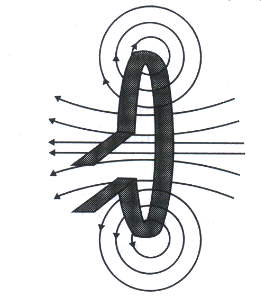
In case of a circular current carrying conductor, the magnetic field lines would be in the form of concentric circles around every part of the periphery of the conductor. Since, magnetic field lines tend to remain closer when near the conductor, so the magnetic field would be stronger near the periphery of the loop. On the other hand, the magnetic field lines would be distant from each other when we move towards the centre of the current carrying loop. Finally, at the centre, the arcs of big circles would appear as a straight lines.
Magnetic field and number of turns of coil: Magnitude of magnetic field gets summed up with increase in the number of turns of coil. If there are 'n' turns of coil, magnitude of magnetic field will be 'n' times of magnetic field in case of a single turn of coil.
31.
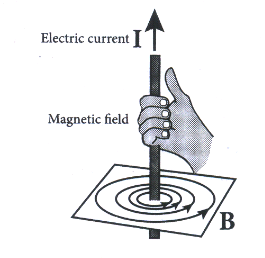
The following diagram depicts the pattern and direction of magnetic field lines around a straight current-carrying conductor.
Right Hand Thumb Rule: If a current carrying conductor is held by right hand, keeping the thumb straight and if the direction of electric current is in the direction of thumb, then the direction of wrapping of other fingers will show the direction of magnetic field.

10th Standard CBSE Syllabus & Materials
10th Standard CBSE
CBSE 10th Social Science PS - Federalism - New Model Questions Papers Study Material - QB365 Set A
NEW10th Standard CBSE
CBSE 10th Social Science PS - Power Sharing - New Model Questions Papers Study Material - QB365 Set A
NEW10th Standard CBSE
CBSE 10th Social Science GEO - Manufacturing Industries - New Model Questions Papers Study Material - QB365 Set A
NEW10th Standard CBSE
CBSE 10th Social Science GEO - Minerals and Energy Resources - New Model Questions Papers Study Material - QB365 Set A



CBSE 10th Standard CBSE Subjects
CBSE Standards





