
 100% FREE ACCESS
10th Standard CBSE Syllabus & Materials
10th Standard CBSE
CBSE 10th Social Science ECO - Globalisation and the Indian Economy - New Model Questions Papers Study Material - QB365 Set A
NEW10th Standard CBSE
CBSE 10th Social Science ECO - Money and Credit - New Model Questions Papers Study Material - QB365 Set A
NEW10th Standard CBSE
CBSE 10th Social Science ECO - Sectors of the Indian Economy - New Model Questions Papers Study Material - QB365 Set A
NEW10th Standard CBSE
CBSE 10th Social Science ECO - Development - New Model Questions Papers Study Material - QB365 Set A
NEW10th Standard CBSE
CBSE 10th Social Science PS - Outcomes of Democracy - New Model Questions Papers Study Material - QB365 Set A
NEW10th Standard CBSE
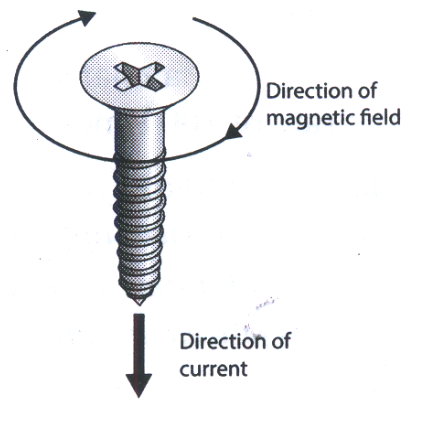
CBSE 10th Social Science PS - Gender, Religion and Caste - New Model Questions Papers Study Material - QB365 Set A

Published on: 05/08/2019
Magnetic Effects of Electric Current
Download CBSE Class 10th Standard CBSE Science question papers, sample papers, important questions, and previous year solved papers in PDF format. Get free study materials, NCERT solutions, and exam preparation resources for Class 10th Standard CBSE Science
Questions + Answers key
Take MCQ Science Test
1.
The strength of magnetic field inside a long current carrying straight solenoid is
More at the ends than at the centre
Minimum in the middle
Same at all points
Found to increase from one end to the other.
2.
Choose the incorrect statement
Fleming's right-hand rule is a simple rule to know the direction of induced current.
The right-hand thumb rule is used to find the direction of magnetic fields due to current carrying conductors.
The difference between the direct and alternating currents is that the direct current always flows in one direction, whereas the alternating current reverses its direction periodically.
In India, the AC changes direction after every 1/50 second.
3.
Choose the incorrect statement from the following regarding magnetic lines of field.
The direction of magnetic field at a point is taken to be the direction in which the north pole of a magnetic compass needle points.
Magnetic field lines are closed curves
if magnetic field lines are parallel and equidistant, they represent zero field strength
Relative strength of magnetic field is shown by the degree of closeness of the field lines.
4.
The phenomenon of electromagnetic induction is
the process of charging a body.
the process of generating magnetic field due to a current passing through a coil.
producing induced current in a coil due to relative motion between a magnet and the coil.
the process of rotating a coil of an electric motor.
5.
Which of the following correctly describes the magnetic field near a long straight wire ?
The field consists of straight lines perpendicular to the wire.
The field consists of straight lines Parallel to the wire.
The field consists of radial lines originating from the wire.
The field consists of concentric circles centred on the wire.
6.
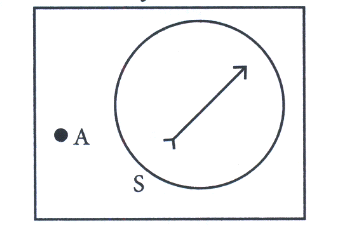
A magnetic compass needle is placed in the plane of paper near point A as shown in Figure. In which plane should a straight current carrying conductor be placed so that it passes through A and there is no change in the deflection of the compass? Under what condition is the deflection maximum and why?
7.
What will be the frequency of an alternating current, if its direction changes after every 0.05 s?
8.
Different between electric motor and generator.
9.
Name the factors on which force produced due to magnetic field depends.
10.
Name the device that converts electric energy into mechanical energy.
11.
Distinguish between DC and AC.
12.
What is meant by overloading.
13.
Under what conditions permanent electromagnet is obtained if a current carrying solenoid is used? Support your answer with the help of a labelled circuit diagram.
14.
(a) What is an electromagnet? What does it consist of?
(b) Name one material in each case which is used to make a
(i) Permanent magnet
(ii) Temporary magnet
(c) Describe an activity to show how you can make an electromagnet in your school laboratory.
15.
Distinguish between permanent magnet and electromagnet.
1.
(c)
Same at all points
2.
(d)
In India, the AC changes direction after every 1/50 second.
3.
(c)
if magnetic field lines are parallel and equidistant, they represent zero field strength
4.
(c)
producing induced current in a coil due to relative motion between a magnet and the coil.
5.
(d)
The field consists of concentric circles centred on the wire.
6.
When the magnetic field and the direction of current are perpendicular to each other, the deflection is maximum. But when they are in the same plane, no deflection takes place. So, the current carrying conductor needs to be placed in the same plane as the magnetic compass to attain no deflection.
7.
The time period (T) of one cycle would be =
2 X (0.05 s) = 0.1 s.
Frequency, f = 1/t.
Hence, f= (1/0.1) = 10 Hz.
8.
| Electric motor | Electric generator |
| 1. It works on the principle of Fleming's left hand rule. | It works on the principle of Fleming's right hand rule. |
| 2. It uses current and magnetic field to produce motion. | It uses motion and magnetic field to induce current. |
9.
The factors on which force produced due to magnetic field depends are:
(i) length of the conductor.
(ii) the amount of current flowing.
(iii) The strength of magnetic field.
(iv) direction of current and magnetic field.
If are at right angles, then maximum amount of force will be produced.
10.
An electric motor.
11.
| DC | AC |
| 1. Unidirectional flow of current. | Current changes its direction in a cycle. |
| 2. Cells and batteries produce DC. | Dynamo produces AC. |
12.
When the total current drawn by all the appliances at a particular time exceeds the bearing capacity of that wire, the wires of the domestic wiring gets heated. This is called overloading.
13.
We know that for making an electromagnet we need to place a soft iron core inside a solenoid. Soft iron is a ferro-magnetic material and hence it augments the magnetic property of solenoid by thousands of times. Thus, for making a permanent electromagnet, we need to place a soft iron core inside a solenoid.
14.
(a) When we magnetise a piece of magnetic material such as soft iron by keeping it inside a coil and then passing current through it, the magnet so formed is called electromagnet.
(b) (i) Steel is used to make permanent magnet.
(ii) Soft iron is used to make temporary magnets.
(c) Take a coil of wire having N number of turns and then wound it around a soft iron core. Connect the end of the wire with a battery and plug key and then let current pass through the coil. While current is passing through the coil, bring a compass near the coil. It will be observed that compass needle shows deflection. This shows that the coil will have a magnetic field of its own. The magnet so formed is called an electromagnet.
15.
| Electromagnet | Permanent Magnet |
| 1. It is temporary magnet and can be demagnetized | 1. It is a permanent magnet and cannot be demagnetized |
| 2. Magnetic strength can be changed. | 2. its strength is fixed. |
| 3. Its polarity can also be changed. | 3. Its polarity is fixed. |
| 4. It is prepared from soft iron. | 4. It is prepared from hard steel. |

10th Standard CBSE Syllabus & Materials
10th Standard CBSE
CBSE 10th Social Science PS - Federalism - New Model Questions Papers Study Material - QB365 Set A
NEW10th Standard CBSE
CBSE 10th Social Science PS - Power Sharing - New Model Questions Papers Study Material - QB365 Set A
NEW10th Standard CBSE
CBSE 10th Social Science GEO - Manufacturing Industries - New Model Questions Papers Study Material - QB365 Set A
NEW10th Standard CBSE
CBSE 10th Social Science GEO - Minerals and Energy Resources - New Model Questions Papers Study Material - QB365 Set A



CBSE 10th Standard CBSE Subjects
CBSE Standards





